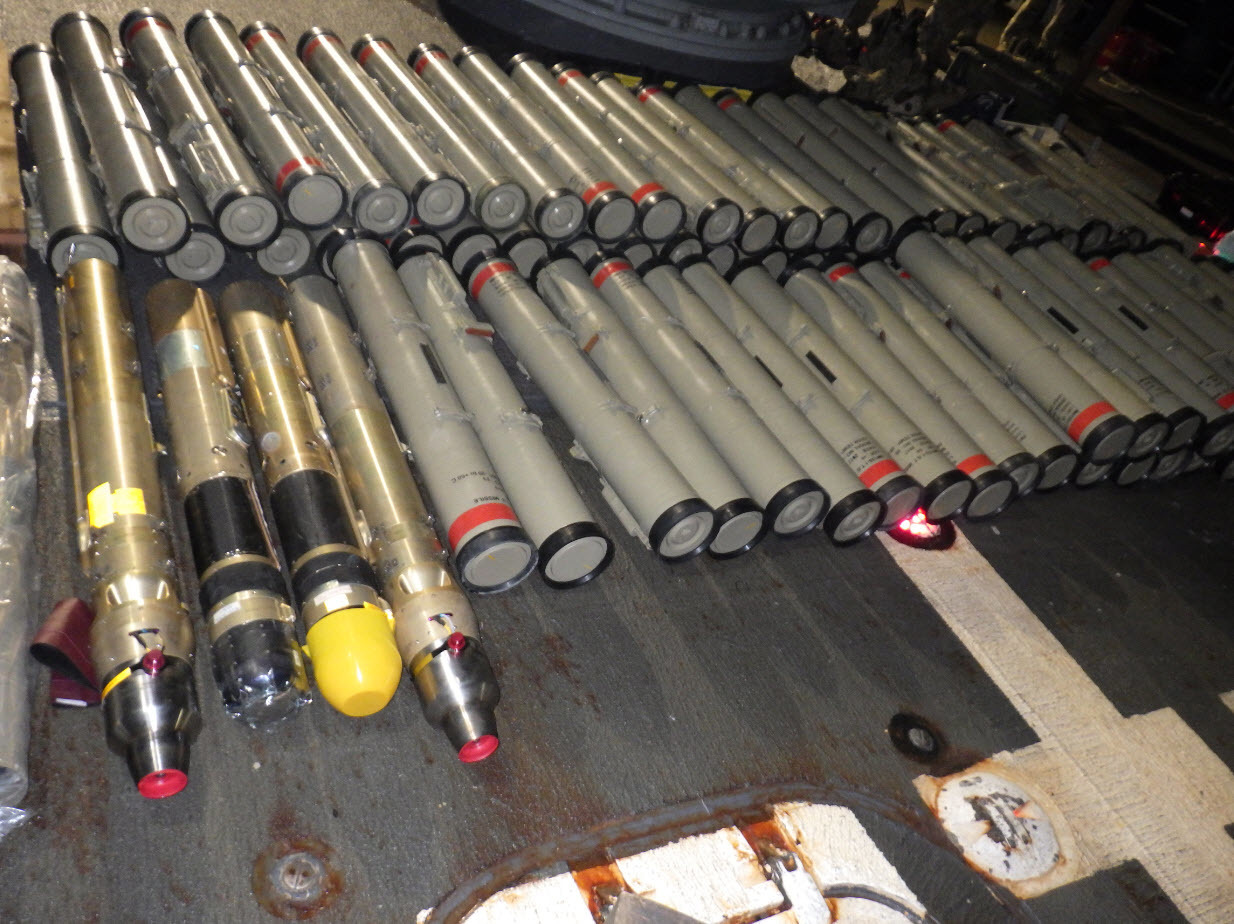
US Navy Seizes Iran Ship with SAMs on Board

Our turn eh? Hummm, the same say that the Senate votes to limit the President’s war power measures on declaring war with Iran, this event from last week hits the headlines. By the way, President Trump has never indicated he would go to war with Iran with or without Congressional approval so that whold bi-partisan measure in the Senate was just a formality…gesture.

The Senate passed a war powers resolution Thursday that constrains President Donald Trump’s ability to authorize military strikes against Iran.

The resolution from Democratic Sen. Tim Kaine received bipartisan support. It passed 55–45 with eight Republicans voting with Democrats in favor. However, Trump has signaled he will veto the resolution, and there are not enough votes in Congress to override the veto.

Kaine introduced the resolution in early January after escalating tensions with Iran culminated in an American strike killing Iranian general Qassem Soleimani and Iran responding by firing missiles at two American bases in Iraq. The administration gave Congress a briefing to justify the strike after the fact, which didn’t satisfy Democrats and infuriated two administration allies, Republican Reps. Mike Lee and Rand Paul.

“The nation should not be at war without a vote of Congress,” said Kaine Wednesday. “Even if he chooses to veto it and we can’t override, the will of both bodies and the public they represent, that could be a factor in his decision making.” h/t

Anyway, back to the SAMs…surface to air missiles…

U.S. Warship in Arabian Sea Seizes Suspected Iranian Weapons

***

Ticonderoga-class guided-missile cruiser USS Normandy (CG-60) seized a cache of Iranian-made anti-tank missiles and other munitions aboard a dhow in the Arabian Sea over the weekend.

Normandy stopped the dhow while conducting maritime security operations over the weekend, in accordance with international law, according to a statement released Thursday by U.S. Central Command.

The seized weapons include:

  • 150 Dehlavieh anti-tank missiles, which are Iranian-made version of the Russian Kornet anti-tank missiles
  • Three Iranian-made surface-to-air missiles
  • Thermal imaging weapon scopes
  • Components for manned and unmanned aerial and surface vessels

The CENTCOM statement noted that many of the munitions seized over the weekend by Normandy are similar to weapons and components seized in November by the crew of Arleigh Burke-class guided-missile destroyer USS Forrest Sherman (DDG-98).

The weapons included 358 surface-to-air missile components and ‘Dehlavieh’ anti-tank guided missiles (ATGM), intended for the Houthis in Yemen, aboard a stateless dhow during a maritime interdiction operation in the U.S. Fifth Fleet area of operations on Feb. 9, 2020. US Navy Photo

The weapons seized by Forrest Sherman were determined to be destined for Houthi rebels fighting in Yemen, according to CENTCOM. Houthi rebels have been fighting Saudi Arabian forces in Yemen for five years. The force has used unmanned aerial and surface vessels to attack Saudi Arabian forces in the past, using equipment that U.S. military experts say comes from Iran.

The shipment of weapons seized over the weekend would violate a United Nations Security Council resolution prohibiting the “direct or indirect supply, sale, or transfer of weapons to the Houthis,” the CENTCOM statement notes.

Chinese Spy Leading California Public Pension Fund?

This may add some very new and different questions when it comes to the Biden foreign operations….read on….

Rep. Jim Banks, R-Ind., joined “Mornings with Maria” to explain why he wrote a letter to California Gov. Gavin Newsom highlighting his concerns about the state public pension fund’s chief investment officer having ties to China.

The fund has invested $3.1 billion in Chinese companies, some of which have been blacklisted by the U.S. government, Banks told FOX Business’ Maria Bartiromo.

“If this were up to me, I would fire [Chief Investment Officer Yu Ben Meng] immediately because of these suspicious ties,” he said. “We learned that Mr. Meng, who is the chief investment officer of CalPERS, was actually recruited to this position by the [Chinese Communist Party] through something called the Thousand Talents Program. Now he’s denied it.”

CalPERS stands for the California Public Employees’ Retirement System, the largest public pension fund in the nation.

“What is unusual is that many of these companies are companies that we’ve blacklisted, that make Chinese military equipment or are responsible for technologies like Hikvision, which is the equipment that’s used by the Chinese for surveillance on the Uighur Muslim population that they’ve been abusing in their own country,” Banks said.

The Commerce Department blacklisted Hikvision in October “for engaging in or enabling activities contrary to the foreign policy interests of the United States.”

CalPERS defended Meng.

“This is a reprehensible attack on a U.S. citizen. We fully stand behind our Chief Investment Officer who came to CalPERS with a stellar international reputation,” a CalPERS spokeswoman told Reuters.

China's Social Credit System – It's Coming To The United ...

Hold on, it is actually worse… going back 4 months ago….

(Reuters) – Some of the biggest public pensions funds in the United States have invested in one of the world’s largest purveyors of video surveillance systems that the U.S. government claims are used in wide-scale repression of the Muslim population of western China.

The Trump administration’s decision to put the company, Hangzhou Hikvision Digital Technology Co (002415.SZ), on a blacklist last week has prompted at least two of the pension plans to say they are reviewing or monitoring that development.

The blacklist applies to Hikvision and seven other companies because they allegedly enabled the crackdown that has led to mass arbitrary detentions in the Xinjiang region.

“We are tracking the situation given this new development with the Department of Commerce’s announcement,” a spokeswoman for the California State Teachers’ Retirement System (CalSTRS) said in an email.

CalSTRS owned 4.35 million Hikvision shares at the end of June 30, 2018, the last data available. The holding, owned directly and through emerging market exchange-traded funds, would be worth $24 million at that share count.

The New York State Teachers Retirement System also owned Hikvision, reporting 81,802 shares at the end of June, up from 26,402 shares at the end of 2018, fund disclosures show.

“Our holdings are primarily held according to their weights in passive portfolios matching the MSCI ACWI ex-U.S. index, our policy benchmark. We are monitoring the situation,” said a spokesman for the teachers’ fund. The ex-U.S. All Country World Index includes stocks from 22 developed and emerging markets.

The blacklisting means Hikvision and the other companies will not be able to buy U.S. technology, such as software and microchips, without specific U.S. government approval. It does not prevent U.S. investors from buying the companies’ shares. In August, Hikvision had been banned from selling to U.S. federal agencies because the government said its products could allow access to sensitive systems.

Hikvision’s General Manager Hu Yangzhong told Reuters on Wednesday it has been talking to the U.S. government about Xinjiang and has hired human rights lawyers to defend itself against the blacklisting.

A spokeswoman for law firm Sidley Austin LLP, which has lobbied for Hikvision this year, declined to comment.

Another major fund investing in Hikvision shares is the Florida Retirement System (FRS), with 1.8 million shares at the end of June.

A spokesman for the fund said it was working closely with external money managers “related to the issue in order to meet all regulatory and fiduciary requirements.”

POSTER CHILD

Risk consultants say the ease with which money used for the retirements of tens of millions of Americans is being invested in such companies should concern U.S. authorities at every level, as well as Americans generally.

“Hikvision has emerged as the corporate poster child for enabling Chinese human rights abuses, with its surveillance cameras visible atop the walls of detention camps incarcerating some one million or more Uighurs in Xinjiang,” said Roger Robinson, president and CEO of Washington DC-based risk consultancy RWR Advisory Group.

Beijing denies any mistreatment of people at the camps, which it says provide vocational training to help stamp out religious extremism and teach new work skills.

Robinson said that many Americans are unwittingly owning shares in such companies because they are in index funds. “They are picked up by the index providers in sizable numbers and sluiced into U.S. investor portfolios with seemingly very little, if any, due diligence or disclosure in the categories of national security and human rights.”

MSCI Inc (MSCI.N), whose products are designed for global investors, added Hikvision to its benchmark emerging markets index last year. MSCI declined to comment.

One other company among the blacklisted eight that is owned by some of the big pension funds is iFlytek Co Ltd (002230.SZ), a speech-recognition firm. Its shares were owned by funds in Florida, New York State as well as CalSTRS and the California Public Employees Retirement System (CalPERS) indirectly through the iShares MSCI Emerging Markets ETF at their last disclosure dates. IShares, a top ETF provider owned by BlackRock Inc (BLK.N), declined to comment.

CUTTING TIES

Not all the funds have stuck with Hikvision.

The New York State Common Fund, one of the country’s biggest pension funds, liquidated its position months ago. It had owned 2.7 million shares worth $14.2 million at the end of March through an external fund manager, but sold them in May, a spokesman said, declining to say why.

U.S. mutual funds have also cut or eliminated positions in Hikvision amid the negative publicity, which included it being named in a Human Rights Watch report on mass surveillance in Xinjiang in May.

Just 9% of global emerging markets funds now own Hikvision, down from 20% in 2018, according to Copley Fund Research. One fund to pull out is the $2.7 billion Artisan Developing World Fund (APDYX.O), which had a $66 million position in Hikvision at the end of March but reported holding no shares three months later, fund disclosures show. Artisan did not respond to a request for comment.

At least one U.S. pension fund had worried this summer about whether to invest in the Chinese surveillance company.

The $33 billion Alaska Permanent Fund had considered an investment in a China fund featuring Hikvision as a top holding, according to minutes of a June meeting of its trustees and staff. The minutes were published last month.

Schroders Global Asset Management, a finalist for the fund’s mainland China investment mandate, touted Hikvision as a top performer.

Some Alaska trustees, however, worried about “headline risks” of investing in companies that aid the Chinese government’s surveillance activities, according to the minutes.

Jack Lee, portfolio manager of the China fund, assured Alaska pension officials he had spoken with Hikvision executives. Hikvision will “try to avoid that kind of business,” the trustees were told, but “they don’t necessarily know how their equipment is used,” Lee told the trustees, according to the minutes.

Reuters could not determine whether Alaska made an investment in the Schroders fund that included Hikvision stock.

A spokeswoman for the Alaska Retirement Management Board, which oversees the pension, said it does not have any additional information to share regarding Schroders’ efforts. A Schroders spokesman declined to comment.


Huawei Snooping via Backdoor on US Telecom Network

For ten years…..

U.S. officials say Huawei Technologies Co. can covertly access mobile-phone networks around the world through “back doors” designed for use by law enforcement, as Washington tries to persuade allies to exclude the Chinese company from their networks.

Chinese tech giant Huawei can reportedly access the networks it helped build that are being used by mobile phones around the world. It’s been using backdoors intended for law enforcement for over a decade, The Wall Street Journal reported Tuesday, citing US officials. The details were disclosed to the UK and Germany at the end of 2019 after the US had noticed access since 2009 across 4G equipment, according to the report.

The backdoors were inserted for law enforcement use into carrier equipment like base stations, antennas and switching gear, the Journal said, with US officials reportedly alleging they were designed to be accessible by Huawei.

“We have evidence that Huawei has the capability secretly to access sensitive and personal information in systems it maintains and sells around the world,” Robert O’Brien, national security adviser, reportedly said.

The White House and Huawei didn’t immediately respond to a request for comment, but the tech giant rejected the claims according to the Journal.

UK Prime Minister Boris Johnson approved Huawei for 5G last month with some conditions: The British restrictions are to exclude Huawei from building core parts of the UK’s 5G networks, have Huawei’s market share capped at 35% and exclude Huawei from sensitive geographic locations. The European Union allowed higher-risk vendors for 5G with similar restrictions at the end of January.

Huawei’s 5G approval there came despite the US urging the UK to ban the Chinese telecommunications giant.

Huawei was blacklisted in May when it was added to the United States’ “entity list” (PDF). In addition, US President Donald Trump at the same time signed an executive order essentially banning the company in light of national security concerns that Huawei had close ties with the Chinese government. Huawei has repeatedly denied that charge.

*** Huawei faces further investigation into Chinese 'spying ... source

Huawei disputed the latest allegations, as it has done in the past, saying it “has never and will never do anything that would compromise or endanger the security of networks and data of its clients.” Huawei also said that the United States made its latest accusations “without providing any kind of concrete evidence.”

“No Huawei employee is allowed to access the network without an explicit approval from the network operator,” a Huawei official said, according to the Journal.

The US government has been moving to reduce the amount of Huawei and ZTE equipment in telecom networks. The Federal Communications Commission voted unanimously in November to ban Huawei and ZTE gear in projects paid for by the FCC’s Universal Service Fund (USF). FCC Chairman Ajit Pai said at the time that Huawei and ZTE “have close ties to China’s Communist government and military apparatus” and “are subject to Chinese laws broadly obligating them to cooperate with any request from the country’s intelligence services and to keep those requests secret.”

The ban is expected to hit small carriers the hardest, as Huawei has appealed to small network operators by selling low-cost gear. By contrast, big telcos like AT&T “have long steered clear of Huawei,” a March 2018 Wall Street Journal report said.


4 Members of the Chinese Military Hacked Equifax

(AP) — Four members of the Chinese military have been charged with breaking into the networks of the Equifax credit reporting agency and stealing the personal information of tens of millions of Americans, the Justice Department said Monday, blaming Beijing for one of the largest hacks in history to target consumer data.

The 2017 breach affected more than 145 million people, with the hackers successfully stealing names, addresses, Social Security and driver’s license numbers and other personal information stored in the company’s databases.

4 Chinese military members charged in Equifax case

The four — members of the People’s Liberation Army, an arm of the Chinese military — are also accused of stealing the company’s trade secrets, including database designs, law enforcement officials said.

The accused hackers exploited a software vulnerability to gain access to Equifax’s computers, obtaining log-in credentials that they used to navigate databases and review records. The indictment also details efforts the hackers took to cover their tracks, including wiping log files on a daily basis and routing traffic through dozens of servers in nearly 20 countries.

  Source

“The scale of the theft was staggering,” Attorney General William Barr said Monday. “This theft not only caused significant financial damage to Equifax, but invaded the privacy of many millions of Americans, and imposed substantial costs and burdens on them as they have had to take measures to protect against identity theft.”

Equifax, headquartered in Atlanta, maintains a massive repository of consumer information that it sells to businesses looking to verify identities or assess creditworthiness. All told, the indictment says, the company holds information on hundreds of millions of Americans in the U.S. and abroad.

The case is the latest Justice Department accusation against Chinese hackers suspected of breaching networks of American corporations. It comes as the Trump administration has warned against what it sees as the growing political and economic influence of China, and efforts by Beijing to collect data on Americans and steal scientific research and innovation.

The administration has also been pressing allies not to allow Chinese tech giant Huawei to be part of their 5G wireless networks due to concerns that the equipment could be used to collect data and for surveillance.

The accused hackers are based in China and none is in custody. But U.S. officials nonetheless view criminal charges like the ones brought in this case as a powerful deterrent to foreign hackers and a warning to other countries that American law enforcement has the capability to pinpoint individual culprits behind hacks.

A spokesperson for the Chinese embassy did not immediately return an email seeking comment Monday.

The case resembles a 2014 indictment from the Obama administration Justice Department that accused five members of the PLA of hacking into major American corporations to steal their trade secrets. U.S. authorities also suspect China in the massive 2015 breach of the Office of Personnel Management and of intrusions into the Marriott hotel chain and Anthem health insurance company.

“This kind of attack on American industry is of a piece with other Chinese illegal acquisitions of sensitive personal data,” Barr said of Monday’s announcement, adding that “for years we have witnessed China’s voracious appetite for the personal data of Americans.”

The criminal charges — which include conspiracy to commit computer fraud and conspiracy to commit economic espionage — were filed in federal court in Atlanta.

Equifax last year reached a $700 million settlement over the data breach, with the bulk of the funds intended for consumers affected by it.

Equifax didn’t notice the intruders targeting its databases for more than six weeks. Hackers exploited a known security vulnerability that Equifax hadn’t fixed.

Once inside the network, officials said, the hackers spent weeks conducting reconnaissance. They stole login credentials and ultimately downloaded and extractedate data from Equifax to computers outside the United States.

The indictment says the hackers obtained names, birth dates, and Social Security numbers for about 145 million American victims, along with credit card numbers and other personal information for about 200,000.

According to the Government Accountability Office, the investigative arm of Congress, a server hosting Equifax’s online dispute portal was running software with a known weak spot. The hackers jumped through the opening to reach databases containing consumers’ personal information.

Equifax officials told GAO the company made many mistakes, including having an outdated list of computer systems administrators. When the company circulated a notice to install a patch for the software vulnerability, the employees responsible for installing the patch never got it.

Equifax’s $700 million settlement with the U.S. government gives affected consumers free credit-monitoring and identity-restoration services, plus money for their time or reimbursement for certain services. However, because so many people made claims, officials said some consumers would get far less than the eligible amounts because of caps in the settlement pool.

The Detailed Iran Coverup of Ukraine Plane Struck by a Missile

(AP) — A leaked recording of an exchange between an Iranian air-traffic controller and an Iranian pilot purports to show that authorities immediately knew a missile had downed a Ukrainian jetliner after takeoff from Tehran, killing all 176 people aboard, despite days of denials by the Islamic Republic.

Ukraine’s President Volodymyr Zelenskiy acknowledged the recording’s authenticity in a report aired by a Ukrainian television channel on Sunday night.

In Tehran on Monday, the head of the Iranian investigation team, Hassan Rezaeifar, acknowledged the recording was legitimate and said that it was handed over to Ukrainian officials. A transcript of the recording, published by Ukrainian 1+1 TV channel, contains a conversation in Farsi between an air-traffic controller and a pilot reportedly flying a Fokker 100 jet for Iran’s Aseman Airlines from Iran’s southern city of Shiraz to Tehran.

“A series of lights like … yes, it is a missile, is there something?” the pilot calls out to the controller.

“No, how many miles? Where?” the controller asks.

The pilot responds that he saw the light by the Payam airport, near where the Guard’s Tor M-1 anti-aircraft missile was launched from. The controller says nothing has been reported to them, but the pilot remains insistent.

“It is the light of a missile,” the pilot says.

“Don’t you see anything anymore?” the controller asks.

“Dear engineer, it was an explosion. We saw a very big light there, I don’t really know what it was,” the pilot responds.

The controller then tries to contract the Ukrainian jetliner, but unsuccessfully.

Publicly accessible flight-tracking radar information suggests the Aseman Airlines aircraft, flight No. 3768, was close enough to Tehran to see the blast.
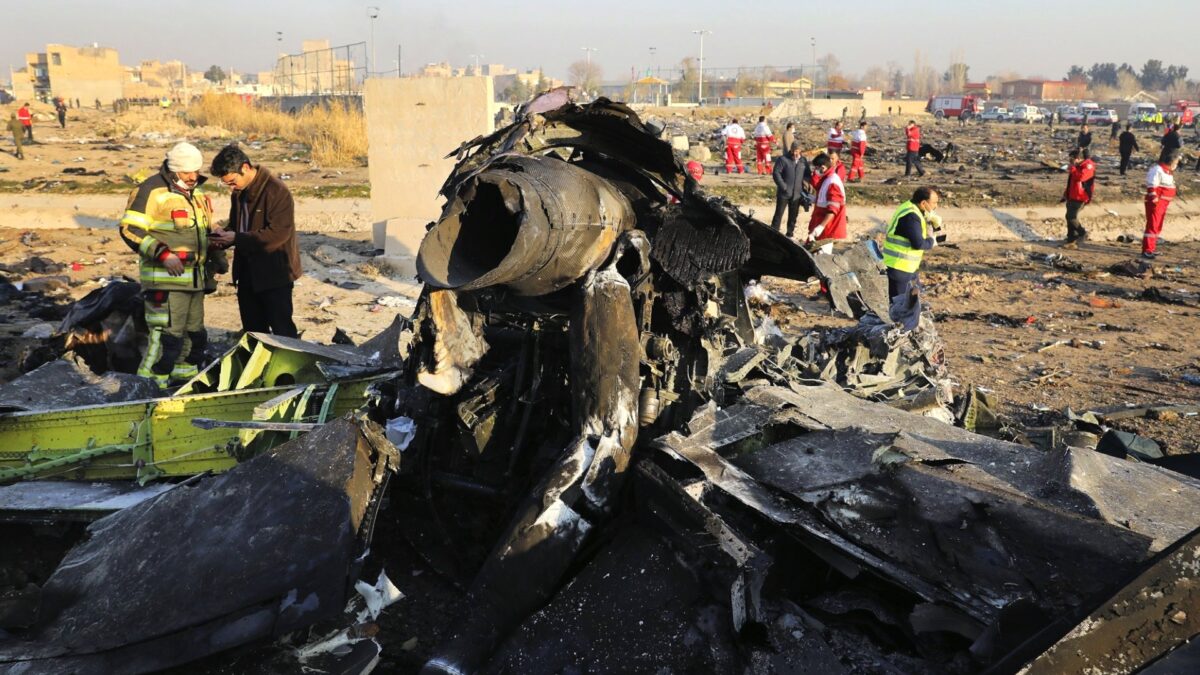
Iran’s Guard Accepts Responsibility for Plane Shootdown

In part from the NYT’s: Around midnight on Jan. 7, as Iran was preparing to launch a ballistic-missile attack on American military posts in Iraq, senior members of the Islamic Revolutionary Guards Corps deployed mobile antiaircraft defense units around a sensitive military area near Tehran’s Imam Khomeini Airport.

Iran was about to retaliate for the American drone strike that had killed Iran’s top military commander, Gen. Qassim Suleimani, in Baghdad five days earlier, and the military was bracing for an American counterstrike. The armed forces were on “at war” status, the highest alert level.

But in a tragic miscalculation, the government continued to allow civilian commercial flights to land and take off from the Tehran airport.Gen. Amir Ali Hajizadeh, commander of the Guards’ Aerospace Force, said later that his units had asked officials in Tehran to close Iran’s airspace and ground all flights, to no avail.

Iranian officials feared that shutting down the airport would create mass panic that war with the United States was imminent, members of the Guards and other officials told The Times. They also hoped that the presence of passenger jets could act as a deterrent against an American attack on the airport or the nearby military base, effectively turning planeloads of unsuspecting travelers into human shields.
After Iran’s missile attack began, the central air defense command issued an alert that American warplanes had taken off from the United Arab Emirates and that cruise missiles were headed toward Iran.

The officer on the missile launcher near the airport heard the warnings but did not hear a later message that the cruise missile alert was a false alarm.

The warning about American warplanes may have also been wrong. United States military officials have said that no American planes were in or near Iranian airspace that night.

When the officer spotted the Ukrainian jet, he sought permission to fire. But he was unable to communicate with his commanders because the network had been disrupted or jammed, General Hajizadeh said later.The officer, who has not been publicly identified, fired two missiles, less than 30 seconds apart.

General Hajizadeh, who was in western Iran supervising the attack on the Americans, received a phone call with the news.

“I called the officials and told them this has happened and it’s highly possible we hit our own plane,” he said later in a televised statement.General Hajizadeh advised the generals not to tell the rank-and-file air defense units for fear that it could hamper their ability to react quickly if the United States did attack.

“It was for the benefit of our national security because then our air defense system would be compromised,” Mr. Hajizadeh said in an interview with Iranian news media this week. “The ranks would be suspicious of everything.”The military leaders created a secret investigative committee drawn from the Guards’ aerospace forces, from the army’s air defense, and from intelligence and cyberexperts. The committee and the officers involved in the shooting were sequestered and ordered not to speak to anyone.

The committee examined data from the airport, the flight path, radar networks, and alerts and messages from the missile operator and central command. Witnesses — the officer who had pulled the trigger, his supervisors and everyone involved — were interrogated for hours.

The group also investigated the possibility that the United States or Israel may have hacked Iran’s defense system or jammed the airwaves.Senior commanders discussed keeping the shooting secret until the plane’s black boxes — the flight data and cockpit voice recorders — were examined and formal aviation investigations completed, according to members of the Guards, diplomats and officials with knowledge of the deliberations. That process could take months, they argued, and it would buy time to manage the domestic and international fallout that would ensue when the truth came out.

The government had violently crushed an anti-government uprising in November. But the American killing of General Suleimani, followed by the strikes against the United States, had turned public opinion around. Iranians were galvanized in a moment of national unity.

The authorities feared that admitting to shooting down the passenger plane would undercut that momentum and prompt a new wave of anti-government protests.

“They advocated covering it up because they thought the country couldn’t handle more crisis,” said a ranking member of the Guards who, like others interviewed for this article, spoke on condition of anonymity to discuss internal deliberations. “At the end, safeguarding the Islamic Republic is our ultimate goal, at any cost.”

That evening, the spokesman for the Joint Armed Forces, Brig. Gen. Abolfazl Shekarchi, told Iranian news media that suggestions that missiles struck the plane were “an absolute lie.”

Why did Iran lie about shooting down the Ukrainian plane ...  source, Aljizeera
On Thursday, as Ukrainian investigators began to arrive in Tehran, Western officials were saying publicly that they had evidence that Iran had accidentally shot down the plane.A chorus of senior Iranian officials — from the director of civil aviation to the chief government spokesman — issued statement after statement rejecting the allegations, their claims amplified on state media.

The suggestion that Iran would shoot down a passenger plane was a “Western plot,” they said, “psychological warfare” aimed at weakening Iran just as it had exercised its military muscle against the United States.

But in private, government officials were alarmed and questioning whether there was any truth to the Western claims. Mr. Rouhani, a seasoned military strategist himself, and his foreign minister, Javad Zarif, deflected phone calls from world leaders and foreign ministers seeking answers. Ignorant of what their own military had done, they had none to give.

Domestically, public pressure was building for the government to address the allegations.

Among the plane’s passengers were some of Iran’s best and brightest. They included prominent scientists and physicians, dozens of Iran’s top young scholars and graduates of elite universities, and six gold and silver medal winners of international physics and math Olympiads.

There were two newlywed couples who had traveled from Canada to Tehran for their weddings just days earlier. There were families and young children.

Their relatives demanded answers. Iranian social media began to explode with emotional commentary, some accusing Iran of murdering its own citizens and others calling such allegations treason.

Persian-language satellite channels operating from abroad, the main source of news for most Iranians, broadcast blanket coverage of the crash, including reports from Western governments that Iran had shot down the plane.

Mr. Rouhani tried several times to call military commanders, officials said, but they did not return his calls. Members of his government called their contacts in the military and were told the allegations were false. Iran’s civil aviation agency called military officials with similar results.

“Thursday was frantic,” Ali Rabiei, the government spokesman, said later in a news conference. “The government made back-to-back phone calls and contacted the armed forces asking what happened, and the answer to all the questions was that no missile had been fired.”
On Friday morning, Mr. Rabiei issued a statement saying the allegation that Iran had shot down the plane was “a big lie.”

Several hours later, the nation’s top military commanders called a private meeting and told Mr. Rouhani the truth.

Mr. Rouhani was livid, according to officials close to him. He demanded that Iran immediately announce that it had made a tragic mistake and accept the consequences.

The military officials pushed back, arguing that the fallout could destabilize the country.

Mr. Rouhani threatened to resign.

Canada, which had the most foreign citizens on board the plane, and the United States, which as Boeing’s home country was invited to investigate the crash, would eventually reveal their evidence, Mr. Rouhani said. The damage to Iran’s reputation and the public trust in the government would create an enormous crisis at a time when Iran could not bear more pressure.

As the standoff escalated, a member of Ayatollah Khamenei’s inner circle who was in the meeting informed the supreme leader. The ayatollah sent a message back to the group, ordering the government to prepare a public statement acknowledging what had happened.

Mr. Rouhani briefed a few senior members of his government. They were rattled.Mr. Abdi said the government’s actions had gone “far beyond” just a lie.

“There was a systematic cover-up at the highest levels that makes it impossible to get out of this crisis,” he said.

Iran’s National Security Council held an emergency meeting and drafted two statements, the first to be issued by the Joint Armed Forces followed by a second one from Mr. Rouhani.

As they debated the wording, some suggested claiming that the United States or Israel may have contributed to the accident by jamming Iran’s radars or hacking its communications networks.

But the military commanders opposed it. General Hajizadeh said the shame of human error paled compared with admitting his air defense system was vulnerable to hacking by the enemy.

Iran’s Civil Aviation Agency later said that it had found no evidence of jamming or hacking.