An affordable price is probably the major benefit persuading people to buy drugs at www.americanbestpills.com. The cost of medications in Canadian drugstores is considerably lower than anywhere else simply because the medications here are oriented on international customers. In many cases, you will be able to cut your costs to a great extent and probably even save up a big fortune on your prescription drugs. What's more, pharmacies of Canada offer free-of-charge shipping, which is a convenient addition to all other benefits on offer. Cheap price is especially appealing to those users who are tight on a budget
Service Quality and Reputation
Although some believe that buying online is buying a pig in the poke, it is not. Canadian online pharmacies are excellent sources of information and are open for discussions. There one can read tons of users' feedback, where they share their experience of using a particular pharmacy, say what they like or do not like about the drugs and/or service. Reputable online pharmacy canadianrxon.com take this feedback into consideration and rely on it as a kind of expert advice, which helps them constantly improve they service and ensure that their clients buy safe and effective drugs. Last, but not least is their striving to attract professional doctors. As a result, users can directly contact a qualified doctor and ask whatever questions they have about a particular drug. Most likely, a doctor will ask several questions about the condition, for which the drug is going to be used. Based on this information, he or she will advise to use or not to use this medication.
Dark Money refers to political spending meant to influence the decision of a voter, where the donor is not disclosed and the source of the money is unknown. Depending upon the circumstances, Dark Money can refer to funds spent by a political nonprofit or a super PAC. Here’s how:
Political nonprofits are under no legal obligation to disclose their donors. When they choose not to, they are considered Dark Money groups.
Super PACs can also be considered Dark Money groups in certain situations. While these organizations are legally required to disclose their donors, they can accept unlimited contributions from political non-profits and “shell” corporations who may not have disclosed their donors, in these cases they are considered Dark Money groups. More here.
Boston law firm accused of massive straw-donor scheme
Last Updated Nov 2, 2016 12:04 PM EDT
CBS: Hillary Clinton’s campaign is returning thousands of dollars in donations linked to what may be one of the largest straw-donor schemes ever uncovered.
A small law firm that has given money to Sen. Elizabeth Warren, Sen. Harry Reid, President Obama and many others is accused of improperly funneling millions of dollars into Democratic Party coffers. The program was exposed by the Center for Responsive Politics and the same team of Boston Globe investigative reporters featured in the movie “Spotlight.”
The Thornton Law Firm has just 10 partners, but dollar for dollar, it’s one of the nation’s biggest political donors, reports CBS News correspondent Tony Dokoupil.
But according to the firm’s own documents – leaked by a whistleblower — days or even hours after making these donations, partners received bonuses matching the amount they gave.
“Once the law firm knew that we had these records, they didn’t deny that this was the case,” said Scott Allen, Boston Globe’s Spotlight editor.
“If you give a donation and then somebody else reimburses you for that contribution, that is a clear violation of the spirit and the letter of the law at the state and federal levels,” Allen added.
Federal law limits partnerships, like the Thornton Law Firm, to a maximum donation of $2,700 per candidate. But campaign finance watchdogs say the firm used its individual partners as straw donors, allowing it to funnel money to campaigns well above that legal limit.
“Straw donor reimbursement systems are something both the FEC and the Department of Justice take very seriously, and people have gone to jail for this,” Center for Responsive Politics editorial director Viveca Novak said.
The Spotlight team and the Center for Responsive Politics looked at donations from three of the firm’s partners from 2010 to 2014. The trio and one of their wives gave $1.6 million, mostly to Democrats. Over the same period, they received $1.4 million back in bonuses.
A Thornton spokesman said the bonuses are legal because they came out of each partner’s ownership stake in the firm. In other words, they were paid with their own money.
In a statement, the firm said:
“We would like to make it clear that the Thornton law firm has complied with all applicable laws and regulations regarding campaign contributions. Ten years ago, it hired an outside law firm to review how it wanted to handle donations to politicians. It was given a legal opinion on how it should structure its program and then it hired an outside accountant to review and implement the program. It was a voluntary program which only involved equity partners and their own personal after-tax money to make donations.”
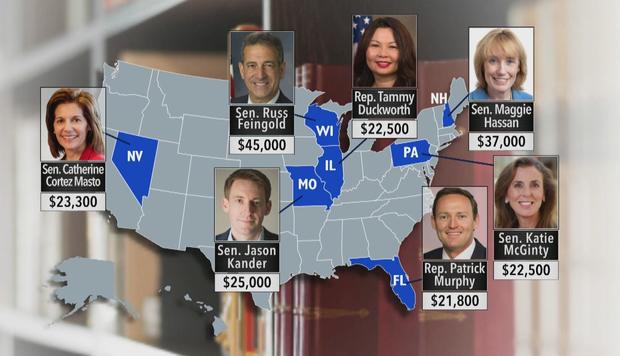
Through its employees, the firm gave to Democrats running in some of this year’s most hotly contested races — ones that could determine control of the U.S. Senate.
Thornton Law Firm donated to Democrats running in some of this year’s most hotly contested races — ones that could determine control of the U.S. Senate
CBS News
Massachusetts Republicans are calling for an investigation.
“In the end, it’s about restoring integrity to a process that folks are already extremely wary of,” Massachusetts Republican Party chair Kirsten Hughes said.
Allen said he’s not “confident at all” that this is an isolated program at Thornton.
“We’ve had a number of parties coming forward to us saying, ‘Hey, they do this at our place too.’ So the issue is always, can you prove it?” Allen said.
CBS News has learned the non-partisan Campaign Legal Center will file a complaint with the Federal Elections Commission Wednesday.
Sen. Elizabeth Warren, who has received nearly $130,000 from the firm since 2007, told the Boston Globe she will not return any money unless investigators find the donations were illegal.
NEW DIRECTION: John Brennan at a Senate Intelligence Committee hearing on his nomination to be the director of the CIA in 2013. Brennan has restructured the agency to REUTERS/Jason Reed
The CIA director has put the U.S. spy agency through a historic restructuring to cope with the era of digital warfare. Many in the agency are unhappy with the shake-up. In a series of interviews, Brennan outlines his strategy. “I think CIA really needs to up its game.”
ReutersInvestigates:WASHINGTON – When America goes to the polls on Nov. 8, according to current and former U.S. intelligence officials, it will likely experience the culmination of a new form of information war.
A months-long campaign backed by the Russian government to undermine the credibility of the U.S. presidential election – through hacking, cyber attacks and disinformation campaigns – is likely to peak on voting day, the officials said.
Russian officials deny any such effort. But current and former U.S. officials warn that hackers could post fictional evidence online of widespread voter fraud, slow the Internet to a crawl through cyber attacks and release a final tranche of hacked emails, including some that could be doctored.
“Don’t underestimate what they can do or will do. We have to be prepared,” said Leon Panetta, who served as CIA director and defense secretary in President Barack Obama’s first term. “In some ways, they are succeeding at disrupting our process. Until they pay a price, they will keep doing it.”
John Brennan, the current CIA director, declined to comment on the Russian efforts. But he said Russian intelligence operatives have a long history of marrying traditional espionage with advances in technology. More broadly, Brennan said, the digital age creates enormous opportunities for espionage. But it also creates vulnerabilities.
Citing an array of new cyber, conventional and terrorist threats, Brennan announced the most sweeping reforms of the CIA in its 69-year history 18 months ago.
Weakening the role of the Directorate of Operations, the agency’s long-dominant arm responsible for gathering intelligence and conducting covert operations, Brennan created 10 new “mission centers” where CIA spies, analysts and hackers work together in teams focused on specific regions and issues. He also created a new Directorate for Digital Innovation to maximize the agency’s use of technology, data analytics and online spying.
The information age “has totally transformed the way we are able to operate and need to operate,” Brennan told Reuters in a series of interviews. “Most human interactions take place in that digital domain. So the intelligence profession needs to flourish in that domain. It cannot avoid it.”
When a new American diplomat arrives for duty at the U.S. embassy in Moscow or Beijing, CIA official say, Russian and Chinese intelligence operatives run data analytics programs that check the “digital dust” associated with his or her name. If the newcomer’s footprint in that dust – social media posts, cell phone calls, debit card payments – is too small, the “diplomat” is flagged as an undercover CIA officer.
The Russian-backed campaign to discredit the U.S. election is not isolated. Hackers believed to have links to Chinese intelligence began stealing the personal information of 22 million federal employees and job applicants in 2014, the worst known data breach in U.S. government history. Islamic State’s online propagandists continue to inspire lone wolf attacks in the United States even as the group loses territory.
A senior official from the Directorate of Operations, who backs the shake-up, said the agency is experiencing its greatest test in decades.
“The amount of threats and challenges that are facing this organization and this nation are greater than at any time in the last 30 years,” said the official, who declined to be named. “The days of a black passport, a fistful of dollars and a Browning pistol are over.”
INNER CIRCLE: President Barack Obama with Brennan and Chief of Staff Denis McDonough at the White House in 2013. The president and the CIA chief are criticized by some former agents for being overly cautious in Syria, Russia and elsewhere. Courtesy Pete Souza/The White House/Handout via REUTERS
“Most human interactions take place in that digital domain. So the intelligence profession needs to flourish in that domain. It cannot avoid it.”
James Clapper, the Director of National Intelligence, praised Brennan and his efforts to retool the CIA for a new era in an interview. So did Lisa Monaco, Brennan’s successor as the President Obama’s Homeland Security and Counterterrorism adviser.
But some current and former officials question Brennan’s strategy, arguing his reforms are too digitally focused and will create a more cautious, top-heavy spy agency. At a time when the agency needs to refocus its efforts on human espionage, they say, the concentration of power in the new mission centers weakens the ability of the Directorate of Operations to produce a new generation of elite American spies.
The reforms have hurt morale, created confusion and consumed time and attention at a time of myriad threats, according to interviews with ten former officials.
Glenn Carle, a former CIA covert officer, supports Brennan and his reforms but said they have sparked a mixed reaction among directorate of operations officials who believe human intelligence is getting short shrift.
“The value the CIA can fundamentally add is to steal secrets, and the ultimate secret is intention,” the often inscrutable aims of foreign leaders, Carle said. “Obtaining that is a human endeavor.”
At the same time, Brennan has stirred a different sort of criticism – that he has defied Congressional oversight. Liberal Democrats and libertarian Republicans in Congress say the Brennan-Obama tenure has been tarnished by a lack of transparency with congressional oversight committees and the public regarding surveillance, drone strikes and the agency’s use of torture against terrorism suspects during the administration of George W. Bush.
“While I think John’s overall legacy will be as a reformer, that legacy will suffer from his refusal to come to grips with the CIA’s troubled torture program,” said Senator Dianne Feinstein, D-Calif, vice chair of the Senate’s intelligence committee. “I think the new president’s CIA director must prioritize a high level of trust between the CIA and Congress to insure proper oversight is conducted.”
It’s unclear how closely the country’s next president will hew to Brennan’s strategy.
The front-runner, Democrat Hillary Clinton, has an incentive to beef up American cyber-espionage: U.S. intelligence officials blame the continuing leak of emails from her campaign on Russian-backed hacking. Clinton also expressed support for covert action in a transcript of a 2013 speech she gave to Goldman Sachs that was recently released by Wikileaks.
Republican Donald Trump, meanwhile, pledged to make cybersecurity a top priority in his administration in an October 3 speech. “For non-state terror actors, the United States must develop the ability – no matter how difficult – to track down and incapacitate those responsible and do it rapidly,” Trump said. “We should turn cyber warfare into one of our greatest weapons against the terrorists.”
In interviews at agency headquarters in Langley, Virginia, Brennan declined to comment on either candidate or discuss operational details of the CIA. But he and eight other senior CIA officials gave the most detailed description yet of their rationale for the most radical revamp of the agency since its founding in 1947.
“I look out at the next 10, 20, 30 years, and I look at technology, I look at complexity, I look at the global environment,” Brennan said. “I think CIA really needs to up its game.”
JUST-WAR THEORIST
Brennan, a 61-year-old native of north New Jersey, looks like a linebacker but talks like a technocrat. He speaks excitedly about how the CIA and other government bureaucracies can be configured in “a way to ensure optimal outcomes.”
The son of devout-Catholic Irish immigrants, Brennan speaks reverently of CIA officers as public servants who risk their lives without public accolades. He joined the agency in 1980, at the age of 24, after receiving a Master’s Degree in government with a concentration in Middle Eastern studies from the University of Texas.
“The value the CIA can fundamentally add is to steal secrets, and the ultimate secret is intention. Obtaining that is a human endeavor.”
Educated in various Catholic schools, including Fordham University, Brennan says he is an adherent of just war theory – a centuries-old Christian theological argument that war is justified when it is waged in self defense, as a last resort and minimizes civilian casualties. Those beliefs, he says, have guided him in one of the most controversial aspects of his tenure in the Obama administration.
As Obama’s White House counter-terrorism adviser and CIA director, Brennan played a central role in carrying out 473 U.S. airstrikes outside conventional war zones between 2009 and 2015, primarily by drone. U.S. officials estimate the attacks have killed 2,372 to 2,581 people, including 64 to 116 civilians. Human rights groups say the totals are vastly higher. Last year, for instance, a U.S. drone strike in Pakistan accidentally killed American aid worker Warren Weinstein and Italian aid worker Giovanni Lo Porto, who were both being held captive by al Qaeda.
Brennan declined to comment on specific strikes, but said, “I still can look myself in the mirror everyday and believe that I have tried to do what is morally right, what is necessary, and what is important to keep this country safe.” He also acknowledged mistakes.
“You question yourself. You beat yourself up. You try to learn from it,” Brennan said, in a rare display of emotions. “But you also recognize that if you’re not prepared to make the tough decisions in the jobs that have been entrusted to you, you shouldn’t be in those jobs.”
Today, Brennan says the United States faces the most complex array of threats he has seen since joining the agency 36 years ago. As a CIA analyst, operative and executive, he has lived through the Cold War espionage duels of the 1980s; the disintegration of nation-states after the 1989 fall of the Berlin Wall; the rise of non-state terrorist groups since 2001; and the current digital disruption. Now, he says, all four dynamics are converging at once.
BOLD AND INNOVATIVE RIVALS
CIA officials say their greatest state competitors are the Russian and Chinese intelligence services. While smaller countries or terrorist groups may want to strike at the United States, Russia and China are the only two adversaries with the combination of skills, resources and motivation needed to challenge Washington.
In recent years, Moscow’s Federal Security Service, or FSB, has become adept at waging “gray zone” conflicts in Ukraine, Crimea and Syria, the officials said. In all three countries, Russian intelligence operatives have deftly shrouded protagonists, objectives and war crimes in ambiguity.
GREAT RIVALS: U.S. President Barack Obama with his Chinese and Russian counterparts, Xi Jinping and Vladimir Putin, in Beijing in 2014. Washington has faced barrages of digital threats from Beijing and Moscow; CIA insiders say the two nations remain the biggest challenge for the United States. REUTERS/Pablo Martinez Monsivais
“You beat yourself up…. But you also recognize that if you’re not prepared to make the tough decisions in the jobs that have been entrusted to you, you shouldn’t be in those jobs.”
One target is America’s increasingly politically polarized democracy. As Russian-backed hacking unfolded this summer, the Obama White House’s response fueled frustration among law enforcement and intelligence officials, according to current and former officials. The administration, they said, seemed to have no clear policy for how to respond to a new form of information warfare with no rules, norms or, it seemed, limits.
White House officials said the administration is still considering various methods of responding, but the responses won’t necessarily be made public.
China presents another challenge. Chinese businessmen and students continue trying to scoop up American state and economic secrets. In one bright spot, Beijing appears to be abiding by a 2015 pact signed by Obama and Chinese leader Xi Jinping that the two governments would not conduct economic espionage against one another. Chinese hacking appears to have slowed from the voracious rate of the past, which included hacking into the computers of the 2008 presidential campaigns of John McCain and Barack Obama but not releasing what was found.
“The question is whether or not it is due to greater care in terms of covering one’s tracks,” Brennan said of the apparent change. “Or whether or not they realize that they’re brand is being tarnished by this very rapacious appetite for vacuuming up things.”
Regional powers are also increasing their digital espionage efforts.
In 2014, the Obama administration blamed North Korea for the hacking of Sony Pictures’ computer system. This spring, U.S. prosecutors indicted seven Iranian hackers for allegedly trying to shut down a New York dam and conducting a cyber attack on dozens of U.S. banks. They also indicted three Syrian members of the “Syrian Electronic Army,” a pro-Syrian government group, who hacked into the websites of U.S. government agencies, corporations and news organizations.
In a 2015 case that U.S. officials said marks a worrying new trend, federal prosecutors indicted a 20-year-old hacker from Kosovo. With the help of a criminal hacker, Ardit Ferizi stole the home addresses of 1,300 members of the U.S. military, providing the information to Islamic State and posting it online, and calling for attacks on the individuals. Ferizi was arrested in Malaysia, where he was studying computer science. In September, he pleaded guilty in a U.S. federal court and was sentenced to 20 years in prison.
“This blend of the criminal actor, the nation-state actor and the terrorist actor, that’s going to be the trend over the next five years,” said John Carlin, who recently stepped down as head of the Justice Department division that monitors foreign espionage in the United States.
But some active clandestine officers argue that the intelligence community has grown too reliant on technology, a trend they trace back four decades to the directorship of Stansfield Turner. Satellite photography, remote sensors and communications intercepts have become more sophisticated, but so have encryption techniques and anti-satellite weapons.
More important, they argue, is that technology is no substitute for “penetrations” – planting or recruiting human spies in foreign halls of power. The CIA missed India’s 1998 nuclear tests and misjudged Saddam Hussein’s arsenal in 2003 because it lacked spies in the right places.
Today, these current and former CIA officials contend, American policymakers have little insight into the thinking of Vladimir Putin’s inner circle. Presidents, kings and dictators often don’t share their true intentions electronically, putting this valuable information largely beyond the scope of digital spying. The best sources are still people, and these officials believe the agency is not mounting the kind of bold human spying operations it did in the past.
Brennan and other CIA officials flatly denied downplaying human intelligence. They said aggressive, high-risk human spying is under way but they cannot go into operational detail.
One of Brennan’s predecessors, Michael Hayden, former CIA chief under President George W. Bush, says the agency strayed from its core mission during the Bush years. After the Al Qaeda attacks of Sept. 11, 2001, Hayden said, the CIA had to shift to become a paramilitary organization that devoted its most talented officers to tracking and killing terrorists. It now needs to reverse that trend by focusing on espionage against rival nations, he said.
“The constant combat of the last 15 years has pushed the expertise of the case officer in the direction of the battlefield and in the direction of collecting intelligence to create physical effects,” said Hayden, using an intelligence euphemism for killing. “At the expense of what the old guys called long-range, country-on-country intelligence gathering.”
‘OPTIMIZING CAPABILITIES’
Brennan and the eight other senior CIA officials made the case that their modernization effort will address the needs and threats described by Hayden and others. Technological advances, they said, have leveled the intelligence playing field. The web’s low cost of entry, creativity and speed benefits governments, hackers and terrorists alike.
A veteran covert operative who runs a new CIA mission center compared Brennan’s reforms to the Goldwater-Nichols Act. The landmark 1986 legislation reorganized the U.S. military into a half dozen regional commands where the Army, Navy, Air Force and Marines work together. It was a response to inter-service rivalries that bedeviled the American military in Vietnam.
The CIA equivalent involves having the agency’s five main directorates – Operations (covert spies), Analysis (trends and prediction), Science and Technology (listening devices and other gadgetry) and Digital Innovation (online sleuthing) and Support (logistics) – provide the personnel needed by each regional mission center.
CORE MISSION: Former CIA Director Michael Hayden says the agency went deeply into anti-terrorist operations during the Bush years and needs to return to its traditional mission of spying. REUTERS/Brendan McDermid
Andrew Hallman, director of the new Directorate for Digital Innovation, said the CIA has embraced cloud computing as a way to better share intelligence. In a move that shocked insiders and outsiders, the CIA awarded an $600 million contract to Amazon in 2013 to build a secure cloud computing system where multiple CIA databases can be quickly accessed.
For decades, different directorates maintained their own separate databases as a security measure, said Hallman. Some of the applications the agency used were so old – up to 30 years – that the manufacturer was no longer in business.
Turning to Amazon was designed to immediately put private-sector computing advances at the fingertips of CIA operatives. It was also an admission that it was easier for the agency to buy innovation from the private sector than try to create it internally.
Several former CIA officials criticized the new team-focused system, saying it dilutes the cultures that made each agency directorate strong. The best analysts are deeply skeptical and need to be separated from covert operatives to avoid group-think, they said. And the best covert operatives are famously arrogant, a trait needed to carry out the extraordinarily difficult task of convincing foreigners to spy for America.
Richard Blee, a former CIA clandestine officer, said the agency needed reform but highlighted a separate problem created by technological change. Instant secure communications between CIA headquarters and officers in the field has centralized decision-making in Washington, Blee said. And regardless of administration, senior officials in Washington are less willing to take a risk than field officers – virtually all of whom complain about headquarters’ excessive caution.
“The mentality across the board in Washington is to take the lowest common denominator, the easiest option, the risk-free option,” Blee said. “The Chinese are taking tough decisions, the Russians are taking tough decisions and we are taking risk-averse decisions. And we are going to pay a price for that down the road.”
Brennan says his reforms will empower CIA officers: The integrated teams in each new mission center will improve speed, adaptability and effectiveness.
“To me, that’s going to be the secret of success in the future, not just for CIA but for other organizational structures,” Brennan said. “Taking full advantage of the tools, capabilities, people and expertise that you have.”
The old ways of spycraft, Brennan argues, are no longer tenable. Asked what worries him most, he gave a technocratic answer: Twentieth century American government management practices are being rendered obsolete in the digital age.
“U.S. decision making processes need to be streamlined and accelerated,” he said. “Because the problems are not going to wait for traditional discussions.”
THE LONG VIEW: CIA headquarters in Langley, Virginia. “I look out at the next 10, 20, 30 years, and I look at technology, I look at complexity, I look at the global environment,” Brennan says. “I think CIA really needs to up its game.” REUTERS/Jason Reed
SEPARATION OF POWERS: Brennan at his Senate Intelligence Committee confirmation hearing with Senator Dianne Feinstein (D-CA). The two later crossed swords over the Senate’s probe into the Bush era CIA’s use of torture. REUTERS/Gary Cameron
Supporters hail CIA director John Brennan as a devoted public servant with a strong moral core and a tenacious work ethic. He has increased the recruitment of minority intelligence officers and promoted women to senior posts. He wears a lanyard around his neck every day that celebrates LGBT diversity at the CIA.
But some former covert operatives say Brennan is too cautious and political. Liberals accuse Brennan of protecting the CIA instead of forcing it to become more accountable to Congress. In particular, they blame Brennan for convincing President Barack Obama to oppose the release of the full 6,000-page U.S. Senate report detailing torture by the CIA during the presidency of George W. Bush. In private hearings, they said, Brennan bristled at questions from senators regarding the report.
After CIA officials searched the computer of a Senate staffer investigating torture, an outraged Sen. Dianne Feinstein accused Brennan’s CIA of provoking a “constitutional crisis” by thwarting Congress’ ability to perform its mandated right to oversee the executive-branch agency. Two other Democratic Senators called for Brennan’s resignation. Obama and White House Chief of Staff Denis McDonough aggressively defended Brennan, who eventually apologized to Feinstein.
“The exhaustive 6,000-page Senate Intelligence Committee report fully documented the program,” Feinstein told Reuters, “but the CIA under John’s leadership has had difficulty confronting this dark chapter and learning from its mistakes.”
Leon Panetta, who served as President Obama’s first CIA director, said he understood Brennan’s desire to protect CIA officers who carried out interrogation methods deemed legal at the time by the Bush administration. But he said it was important to also be open with Congress and the public.
“I think you can do both,” Panetta said. “You can protect people there [at the CIA]. And be honest with the American people.”
Brennan and his aides vehemently defend his reforms, his transparency and his response to the Senate torture investigation, which they say exaggerated the scale of CIA abuse. They say Brennan, who opposes waterboarding, successfully struck a middle course – ending torture while protecting the identities of CIA operatives.
“He did more to stand up for human rights than any other official in the administration,” said Harold Hongju Koh, a Yale Law School professor who served as Hillary Clinton’s top legal adviser in the State Department.
In the interview, Brennan said the actions of CIA officials who exceeded the Bush-era interrogation guidelines were “reprehensible.” But he said the Senate report exaggerated the scale of abuse. Brennan contended that the vast majority of CIA officers followed the Bush-era guidelines and were being unfairly “maligned by individuals who have political agendas.”
“When we do things that are within our authorized mandate, things that we are directed to do by our presidents, things that are deemed lawful by our Department of Justice,” Brennan said, “for us to be dragged through the coals on that, I find that reprehensible as well.”
Friends say Brennan say he has privately expressed frustration with the White House’s cautious response to the war in Syria and growing Russian assertiveness. But, they add, he is in many ways similar to Obama himself, questioning America’s ability to unilaterally change the world.
Brennan declined to comment on his own policy views. But he said, “I really feel as though my moral compass is pretty similar” to Obama’s. And he echoed a central tenet of Obama’s worldview.
The U.S. should act as the “world’s organizer of support to countries that are in desperate need,” Brennan said, but “recognize that our influence and power over the course of events is limited.”
—————
Digitizing the CIA
By David Rohde
Additional reporting by John Walcott and Jonathan Landay
Irma Maldonado in her dorm room at Grand Canyon University in Phoenix.
All photographs by Caitlin O’Hara
PHOENIX — In an office suite not far from the airport, Irma Maldonado, 18, expertly role-played what she’d be doing on the city’s streets in half an hour: knocking on the doors of residents and exhorting them to vote. But not everything was a game. Before a group of young canvassers headed out for the day, a team leader at the community organizing group LUCHA mentioned that someone had earlier pulled a gun on two members of the team.
“Everything was OK,” the organizer said, but Maldonado and the 15 or so other teens and 20-somethings were given safety whistles before hitting the streets.
Maldonado has a personal stake in America’s immigration debate, which has been making headlines throughout the election, particularly because of Donald Trump’s description of Mexicans as rapists and his desire to have Mexico pay for a border wall.
“Before going into high school — it was the summer of 2012 — my mother decided to self-deport to Mexico” with her two youngest children, Maldonado said. Maldonado, who was born and grew up in New Mexico, had a hard time adjusting to life in Nayarit, Mexico, a small state on the Pacific coast north of Puerto Vallarta, especially given that she hadn’t known her family’s status. “I think it was right when we had to move when I actually realized that my mom wasn’t actually legal here in the United States, when I was 14 years old,” she said. Her father, who has a green card, continues to work in New Mexico; Maldonado now is a first-year nursing student and lives with her 23-year-old sister in Arizona. Her mother and brother remain in Mexico.
Mexican-Americans such as Maldonado may help determine the political future of Arizona — and the nation — in a landmark election year. In an August survey, respondents were asked if Trump and Clinton made their respective parties more welcoming or more hostile to Latinos. Nine percent of Mexican-Americans said Trump made the GOP more welcoming; 74 percent said he made it more hostile. By contrast, 59 percent said Clinton made the Democratic party more welcoming; 9 percent said more hostile. An October poll by Latino Decisions found that 17 percent of Latino voters nationwide said they support Trump or are leaning toward him; 70 percent supported Clinton.
In Arizona, a state long dominated by Republicans, Clinton and Trump are in a virtual tie, according to a Monmouth University Poll released last week. Latino voters, who make up a fifth of the state’s electorate, are supporting Clinton over Trump by 35 percentage points. And critical to the electoral vote, only 9 percent of Latino voters who support Trump are in battleground states. Overall, 13 percent of the eligible voters in battleground states are Latino.
Arizona “was this strong, powerful red,” said Pita Juarez, 29, the communications director for the One Arizona coalition, an umbrella group of 14 advocacy groups, including LUCHA, that is working to boost Latino voter turnout. “Just today, we saw on FiveThirtyEight … it’s a light blue. And that’s something that I thought, really, I would never see.” (Arizona has gone back and forth between light blue and light red in FiveThirtyEight’s forecast over the last few weeks. Currently, Trump has a slight edge in the state’s forecast.)
Gabriel Sanchez, a professor of political science at the University of New Mexico and a principal at the opinion research firm Latino Decisions, said Latinos are more enthusiastic about voting this year than in 2012, having been mobilized by Trump’s comments targeting Mexicans. He added that the Republican Party will have a hard time winning over Mexican-Americans in subsequent elections unless it supports comprehensive immigration reform.
Like black millennials, younger Latinos show much weaker enthusiasm for Clinton than their elders. According to the October GenForward survey, conducted over the first half of the month, 44 percent of Latinos ages 18-30 plan to vote for Clinton and 8 percent will vote for Trump, with 10 percent going to third-party candidates. Nineteen percent said they didn’t plan to vote, and 12 percent were undecided.1GenForward, a survey by the Black Youth Project at the University of Chicago and The Associated Press-NORC Center for Public Affairs Research, queries 18- to 30-year-olds and oversamples for Latino and nonwhite respondents, in this case with a total cohort of 1,832 respondents.
Irma Maldonado in math class and walking to her dorm room at Grand Canyon University.
Mark Hugo Lopez, director of Hispanic research at the Pew Research Center, said that much of the growth in the Latino electorate in coming years will be from U.S.-born Latinos entering adulthood. Like other cohorts of younger voters they tend to be more supportive of bigger government, in contrast to older Mexican-Americans, who are more likely to hold conservative views. “Mexican-Americans are more likely to be Catholic than other groups of Latinos,” he said. “They are also more likely to be third or higher generation than other U.S. Latino groups and as a result to have served in the military. Both of these characteristics correlate with conservative views on many issues.” He noted that George W. Bush won at least 40 percent of the Latino vote in 2004.
Nationwide, 11 percent of eligible voters are Latino, but in Arizona, 22 percent of eligible voters are. The state is currently going through a fierce local battle involving Sheriff Joe Arpaio that is arguably fanning the fires of Latino voter turnout as much as the national election.
Arpaio is an outsize figure who has served as Maricopa County sheriff for 23 years; run jails where the men must wear pink underwear and striped uniforms; and organized citizen border patrols with actor Steven Seagal. Arpaio also has a December court date on a contempt charge for violating a 2011 injunction against stopping people on the suspicion that they were not in the country legally. (He alleges the prosecution is politically motivated because of his support for Trump.) And just one week from now, Arpaio faces perhaps an even bigger challenge: a re-election bid with polls showing him trailing his challenger by 15 points.
LUCHA’s canvassers are campaigning against Arpaio, and there are indications that his presence on the ballot is motivating new voters. In Maricopa County, Democratic voter rolls rose by 13 percent since 2012, according to figures released in August, compared to a 7.6 percent increase for Republicans. And many Latinos register as independents but lean Democratic.
Some of the young activists who are canvassing for LUCHA are undocumented, according to One Arizona’s Juarez, and in other areas around the country with significant Latino populations, immigrants who are not yet on a path to citizenship are playing a role in the political process. One of them is Yessica Vasquez Moctezuma, 25, a bank teller, who will graduate this fall with a bachelor’s degree in political science from the University of Texas at San Antonio. She has been in the United States for 19 years, which means she was undocumented until 2012, at which point an executive order qualified her for temporary but renewable DACA (Deferred Action for Childhood Arrivals) status.
Vasquez Moctezuma is frank in her assessment of her family’s legal status, since her parents are not eligible for DACA and continue to work without documentation.
“We are breaking some laws just by being here illegally, but we bind to the laws here,” she said. “We pay our taxes every year, like any other citizen would.” She worries that her parents, who have paid into the Social Security system — which receives an estimated $12 billion a year from undocumented immigrants and their employers — will never receive benefits and will never be able to truly retire. Still, she said, “This is why I studied political science, because I love the government here. I feel like in so many ways it’s so great.”
For her part, Irma Maldonado said she is excited about voting in her first presidential election. After remaining undecided until early October, she decided to vote for Clinton. But she added, “Honestly, this election, a lot of people are not that pumped to vote. It’s really kind of sad.” The number of Mexican-American and Latino voters who show up on Nov. 8 could determine the outcome in her state, and possibly in the nation.
Hundreds of Migrants Pitch Tents on Paris Streets as Calais Camp Shuts
(REUTERS) – The number of migrants sleeping rough on the streets of Paris has risen by at least a third since the start of the week when the “Jungle” shanty town in Calais was evacuated, officials said on Friday.
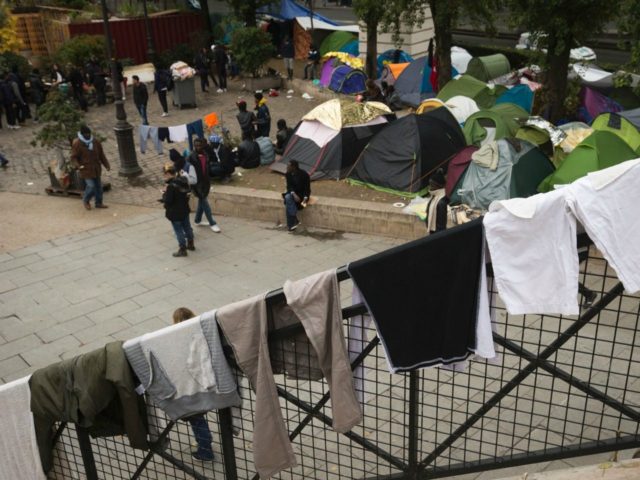
Along the bustling boulevards and a canal in a northeastern corner of Paris, hundreds of tents have been pitched by migrants – mostly Africans who say they are from Sudan – with cardboard on the ground to try and insulate them from the autumn chill.
While the presence of migrants there is not new, it has grown substantially this week, Colombe Brossel, Paris deputy mayor in charge of security issues, told Reuters.
“We have seen a big increase since the start of the week. Last night, our teams counted 40 to 50 new tents there in two days,” Brossel said, adding there was now a total of 700 to 750.
This means there are some 2,000-2,500 sleeping in the area, up from around 1,500 a few days before, she said.
“It’s not a huge explosion in numbers but there is a clear increase,” she said. “Some of them come from Calais, others from other places.”
JOEL SAGET/AFP/Getty
After years as serving as an illegal base camp for migrants trying to get to Britain, the “Jungle” at Calais was finally bulldozed this week and the more than 6,000 residents of the ramshackle camp near the English channel were relocated to shelters around France. More here.
Sessions: ‘Critical alert,’ 817,740 illegals crossed last year
In a bid to put the issue of illegal immigration back into the presidential debate, outspoken critic Sen. Jeff Sessions on Monday issued a “Critical Alert” warning of a potentially historic surge of over the border.
“We are simply overwhelmed,” his statement said. In it he estimated the Fiscal Year 2016 illegal crossings at 817,740.
“There is a crisis at our southwest border — one that in many ways exceeds the crisis we saw just two years ago, one that further undermines the integrity of our immigration system, but one that the most of the media has elected to ignore,” said Sessions, an advisor to Republican presidential nominee Donald Trump.
U.S. Immigration and Customs Enforcement is currently detaining more than 40,000 aliens, with internal predictions indicating that the number could reach 47,000 in the coming months.
In fiscal 2016, the U.S. Border Patrol apprehended 408,870 illegal aliens at the southern border; a number 23 percent higher than in fiscal 2015.
Brandon Judd, president of the National Border Patrol Council, was quoted as saying just half of illegals are caught crossing the border.
Calculating illegal entries based on that formula, 408,870 illegal aliens evaded detection in fiscal 2016, for a total of approximately 817,740 illegal entries into the United States last year.
Sessions said the border crisis demands a new president and approach to reforming immigration starting with a closed border.
*****
In part from Breitbart: Border Patrol Agent and NBPC President Brandon Judd spoke exclusively with Breitbart Texas and condemned the leadership of the Border Patrol’s parent agency, Customs and Border Protection (CBP), for allegedly “keeping this information secret” ahead of the 2016 U.S. presidential election.
“We are at breaking point. We have the highest number of illegal aliens in custody in history in Border Patrol’s RGV Sector and this information has been kept from the American public,” said Agent Judd. “The talk of amnesty has once again created pull factors and encouraged people from all over the world to cross Mexico and then cross our porous southern border to illegally enter the U.S. We are simply overwhelmed.” (See CBP’s response below.)
Agent Judd told Breitbart Texas that Americans should vote their conscience, but they should do so with all of the information available. “This is an issue of the federal government restricting crucial information from the public ahead of a presidential election and it is unacceptable. Americans deserve to know the truth. Our Border Patrol agents deserve for Americans to know what they are really facing. Too many Border Patrol agents have given their lives and left loved ones to grieve for CBP leadership to play these types of political games ahead of such an impactful election.”
Agent Cabrera said CBP were in fact concealing the gravity of the current border crisis. “One side in this coming election is downplaying illegal immigration and concealing this information only serves to help that agenda,” said Agent Cabrera.
Breitbart Texas reached out to the RGV Sector PIO for the Border Patrol and did not receive a response, though not much time was given to the agency. (See update below. A strong denial of the agents’ claims was issued by CBP to Breitbart Texas after publication.)
CBP has released numbers indicating near-record apprehensions; however, the assertions from the agents in the NBPC pertain to people who illegally entered the U.S. and are currently in custody in Border Patrol facilities. Agent Judd stated, “There is a significant difference between apprehension numbers and numbers in custody in our facilities. These record numbers in custody indicate that these are people who are not voluntarily returning. This indicates that these people will, under current policy, be released into our communities and given amnesty. This record number of people currently in detention is significant because the RGV Sector is dealing with the Gulf and Los Zetas cartels. This means our agents are busy babysitting record numbers in facilities instead of patrolling the border and stopping these murderers, kidnappers, and drug smugglers.” More here.
*****
Judge rebukes administration over few admissions for Syrian Christian refugees
FNC: A federal judge has rebuked the Obama administration over the lack of Syrian Christians being admitted from the war-zone, calling it a “perplexing discrepancy” that only 56 of 11,000 Syrian refugees to the U.S. in fiscal 2016 were Christian.
The rebuke came in a Seventh Circuit Court of Appeals opinion on a Freedom of Information Act lawsuit filed by The Heartland Alliance’s National Immigrant Justice Center – a liberal human rights group that advocates for immigrants and asylum-seekers — seeking information on certain terror groups.
As first reported by attorney and former FEC member Hans von Spakovsky for The Daily Signal, while the court found in favor of the government, Judge Daniel Manion addressed the refugee issue and took aim at the Obama administration over how few Christians had been admitted to the U.S.
“It is well‐documented that refugees to the United States are not representative of that war‐torn area of the world. Perhaps 10 percent of the population of Syria is Christian, and yet less than one‐half of one percent of Syrian refugees admitted to the United States this year are Christian,” he wrote.
According to government figures, of the almost 11,000 Syrian refugees admitted to the United States in fiscal 2016, only 56 were Christian.
“To date, there has not been a good explanation for this perplexing discrepancy,” Manion noted.
The numbers are disproportionate to the Christian population in Syria, estimated last year by the U.S. government to make up roughly 10 percent of the population. Since the outbreak of civil war in 2011, it is estimated that between 500,000 and 1 million Christians have fled the country, while many have been targeted and slaughtered by the Islamic State.
Manion qualified his remarks by saying that his point “is not to suggest that any refugee group is more or less welcome: quite the contrary” but warned the Obama administration against failing to provide states with enough data on the people coming in.
In the case, the NIJC was requesting the identities of Tier III terrorist organizations, which are not publicly available. The administration argued that Tier III terrorist organizations “tend to be groups about which the U.S. government does not have good intelligence, making it essential that [DHS] be able to obtain information about them during screening interviews that are as focused and complete as possible.”
Manion noted that potential ties to a Tier III organization like a Christian militia may be why the government is not letting in as many Christians, but that it was impossible to tell since the information is not publicly available.
“It is at least possible that incidental affiliation with some Christian militia could lead an immigration officer to deny entry to Syrians on this basis. That would be a dubious consequence,” he wrote.
A State Department spokesperson told FoxNews.com in September that religion was only one of many factors used in determining a refugee’s eligibility to enter the United States.
Tablet: Late last week, the Southern Poverty Law Center, which became deservedly famous in the 1980s for combating violent white-power hate groups like the Ku Klux Klan and neo-Nazis, published a list of 15 individuals it labels as particularly threatening anti-Muslim extremists. It is sad but telling that the SPLC’s so-called field guide to Muslim-haters is not a list of violent extremists—who certainly do exist—but is instead a blacklist of prominent writers whose opinions on a range of cultural and political issues are offensive to the SPLC. The SPLC blacklist list contains practicing Muslims like Maajid Nawaz, ex-Muslims like Ayaan Hirsi Ali, foreign-policy think-tankers like Frank Gaffney and Daniel Pipes, and right-wing firebrands like David Horowitz—none of whom could be reasonably described as anti-Muslim bigots.
I spoke to Nawaz on the phone in London to ask for his reaction. “A bunch of first-world, comfortable liberal Americans who are not Muslims have decided from their comfortable perch to label me, an activist who is working within his Muslim community to push back against extremism, an anti-Muslim extremist.”
On the face of it, it’s difficult to understand why Nawaz was listed as such. As he told me, he’s a proud Muslim. “I learned Arabic in order to read my holy book,” he said. “In an Intelligence Squared debate, I defended the proposition that Islam was a religion of peace. This was the same week that the man who attempted to bomb Times Square was sentenced so it wasn’t the friendliest New York audience. I hosted Morgan Freeman in a mosque for his documentary The Story of God.”
Nawaz takes the SPLC blacklist seriously, he told me, because he believes that it has put his life in danger. “They’ve put a target on my head,” he said. “This is what putting people on lists does. When Theo Van Gogh was killed in the Netherlands, a list was stuck to his body that included Ayaan Hirsi Ali’s name. It was a hit list. When Bangladeshi reformers were hacked to death by jihadist terrorists, they were working off lists. Only fascists produce lists.”
It’s not easy to understand how the SPLC got here. The organization started in 1971 as a civil-rights law firm designed to combat white-supremacist groups. In 1981 it won a civil suit against the Klan for $7 million that bankrupted the United Klans of America. In 1991, it used the same tactics to win a $12 million judgment against the White Aryan Resistance. It won a $6.5 million case against the Aryan Nations in 2001. Co-founder Morris Dees’ career was dramatized in a TV movie, Line of Fire.
For SPLC’s efforts against violent white supremacists, its members were frequently targeted for reprisal. Yet now, the SPLC is putting bounties on the heads of Muslims like Maajid Nawaz, who are opposed to Muslim extremism. Where the SPLC was once able to win legal battles through careful, often dangerous research that could stand up in court, the organization now identifies the Center for Security Policy, a hawkish right-wing think tank, as a hate group, right alongside the Ku Klux Klan. Where the organization once pushed for freedom for all regardless of race or creed, now it aims to silence those whose opinions it finds objectionable. In doing so, it makes it hard for any impartial observer to place much confidence in future claims about groups and individuals that may actually be dangerous.
Perhaps in spite of the number of white supremacists who have moved into the light with the nomination of Donald Trump, the SPLC no longer has the resources to tackle those who threaten violence and act on it. Instead, it’s spending its time on Google and Twitter—and hoping to raise money by going after writers and intellectuals who get its goat.
What’s more troubling are the suggestions contained in the report that the SPLC no longer thinks that political violence and hate are a bad thing, or even real—as long as the people committing such acts are Muslims. Complaints against radical Islamist violence, the report bizarrely suggests, are
propaganda, the vast majority of it completely baseless, produced and popularized by a network of anti-Muslim extremists and their enablers. These men and women have shamelessly exploited terrorist attacks and the Syrian refugee crisis, among other things, to demonize the entire Islamic faith.
Sadly, a shocking number of these extremists are seen regularly on television news programs and quoted in the pages of our leading newspapers. There, they routinely espouse a wide range of utter falsehoods, all designed to make Muslims appear as bloodthirsty terrorists or people intent on undermining American constitutional freedoms. More often than not, these claims go uncontested.
Interestingly, the document fails to list the man who, according to this description, is the world’s most influential anti-Muslim extremist—President Barack Obama, who told the Atlantic that young people in the Middle East are only thinking about how to kill Americans.
Obama isn’t a violent anti-Muslim extremist any more than the 15 people named here. Ayaan Hirsi Ali is an outspoken critic of Islam and has a compelling personal narrative that reflects the story of millions of women and men who have suffered in the name of Islam. David Horowitz is a pugnacious right-wing intellectual who often engages in sharp propaganda. Daniel Pipes is a fierce adversary of Islamic extremism and a knowledgeable scholar of the Middle East. There is much to disagree with in what they and others identified in the SPLC write or argue. I find the work of a small number of the people listed in the report to be puerile. But neither they, nor anyone on this list, deserve to be listed alongside white supremacists who threaten or actually employ violence.
In reality, the SPLC’s field guide has little to do with real anti-Muslim extremism, the red-hot center of which these days is not America but Syria—where so-called secular dictator Bashar al-Assad has teamed up with Iran and Russia to slaughter nearly half a million Sunni Arabs. The SPLC document is simply an enemies’ list, of the kind that fascists, Stalinists, and other totalitarian thinkers can’t help producing. So it’s hardly surprising that the ghost of Stalin makes an appearance. In a paper nominally highlighting anti-Muslim sentiment, David Horowitz is chided for questioning why one professor identifies Paul Robeson as a “model of [American] patriotism.”
That the SPLC document seeks to re-litigate the case of Paul Robeson, who openly admired Stalin, is evidence that the field guide is simply a blunt instrument used to attack the enemies, personal and institutional, of the paper’s four contributing institutions—Southern Poverty Law Center, Media Matters for America, the Center for New Community, and ReThink Media. (Regarding the Robeson issue, perhaps it’s the pet project of SPLC Senior Fellow Mark Potok who has contributed to the People’s World, a publication affiliated with the Communist Party of the United States of America.)
Nor does the SPLC hide the fact that the purpose of its publication is to blacklist and silence its enemies. The field guide recommends to its consumers in the media that they, “research the background of extremist spokespeople and consider other sources, and if they do use anti-Muslim spokespeople, point out their extremism.”
Why is a liberal organization like the SPLC now using fascist tactics to blacklist enemies? Maajid Nawaz believes the organization has targeted him for a very specific reason. “The left is no longer about advancing progressive values,” he said. “For them, it’s now about tribal identities, and any internal critique is seen as treachery.” Nawaz also believes there may be another reason—the activists at the SPLC, he suggested, “may be influenced by Islamists themselves.” And there is evidence in the paper to suggest that Nawaz’s contention may have some truth to it.
The field guide attempts to rewrite history of the Muslim Student Association, for one. In its dossier on Horowitz, the SPLC complains that he
placed an ad in an April 2008 issue of a campus newspaper, The Daily Nexus, claiming that the Muslim Student Association was “founded by members of the Muslim Brotherhood, the godfather of Al Qaeda and Hamas, to bring jihad into the heart of American higher education.” In fact, it had worked with Jewish campus groups, according to faculty members.
Whether or not some chapters of the MSA worked with Jewish campus groups (while the University of California at Irvine chapter shouted down guest speaker Israeli ambassador Michael Oren in 2011), it’s established that Brotherhood members played a role in founding the MSA.
Even more telling is the rationale for blacklisting Nawaz. Among others, he “tweeted out a cartoon of Jesus and Muhammad—despite the fact that many Muslims see it as blasphemous to draw Muhammad. He said that he wanted ‘to carve out a space to be heard without constantly fearing the blasphemy charge.’ ”
That Nawaz tweeted out a cartoon of the prophet Muhammad in an effort to change the minds of Muslims who might automatically declare such an action to be blasphemy is the act not of an anti-Muslim extremist but a Muslim reformer. That the SPLC itself accuses him of blasphemy belongs not to the tradition of an American Civil Rights organization, but rather to the ideology of a religious fundamentalist organization, of the type that inspired the ISIS cadre that executed the staff of Charlie Hebdo.
The fact is that more than 40 years after its founding, the Southern Poverty Law Center is now aggressively defending the kind of violent supremacists it had once sought to prosecute, and attacking types like Nawaz it had once defended against violence. The suggestion that the organization has in fact switched sides will likely cause violent extremists of all shades and types to breathe a sigh of relief. It is also sign that there is something deeply wrong with our political culture.
****
In 2015:
(CNSNews.com) – John Carlin, the assistant attorney general for national security, announced Wednesday that the Justice Department is creating the new position of domestic terrorism counsel to combat the “real and present threat” of domestic extremism.
Carlin praised groups such as the Southern Poverty Law Center “that dedicate themselves to examining what the threat is, observing it, and reporting on it,” adding that the work of the SPLC was “very important.”
The SPLC says it places groups — including conservative, Christian groups — on its “Hate List” based on their beliefs, not their propensity for violence.
“Homegrown violent extremists can be motivated by any viewpoint on the full spectrum of hate — anti-government views, racism, bigotry, anarchy and other despicable beliefs,” Carlin told a gathering at George Washington University. The discussion was co-hosted by SPLC. “When it comes to hate and intolerance, no single ideology governs.”
Carlin was asked about the value of SPLC’s work in helping DOJ deal with the threat of domestic terrorist extremism.
“I can say, based on our briefings, that as I said in my opening remarks, we very much think that the domestic terrorism threat is a real and present threat that demands to be addressed in new, creative ways,” he replied emphasizing that “Southern Poverty Law Center and other groups in this space are very important.”
The SPLC’s website features a “hate map” that lists the conservative. Christian Family Research Council (FRC) as a “hate group” because of its defense of traditional marriage. The “hate map” was cited by convicted domestic terrorist Floyd Lee Corkins in his decision to attack the FRC in 2012 when he shot and wounded a security guard before being subdued. More here from CNS



 JOEL SAGET/AFP/Getty