
Primer:
Stuart Madnick, who’s been professor of information technology at the Massachusetts Institute of Technology since 1972, tells Inverse that the FCC and ISPs are casting a double-edged sword in their rush to implement 5G.
“It’s like going from fireworks to dynamite sticks,” Madnick says. “5G encourages further evolution and expansion of Internet of Things related networks. All of the good news and bad news that comes along with this technology gets magnified.”
He’s especially concerned about the risk of denial of service attacks — or DDoS for short — becoming more powerful than ever before. One of the advertised benefits of 5G is that it will allow even more IoT devices, like refrigerators or light bulbs, to come online. This would allow users to remotely check the contents of their fridge or dim their bedroom lights using their phones, but these devices can also be harnessed for nefarious purposes.
One of the most notorious DDoS incidents in history — the 2016 Dyn cyberattack — was facilitated by unsecured IoT devices, like security cameras, printers, and baby monitors. Hacker groups Anonymous and New World Hackers allegedly took control of thousand of electronics that still had their default passwords to amass an army of zombie devices, known as a botnet.
This network was used to overwhelm the servers of internet performance management company, Dyn. Websites like Twitter, SoundCloud, Spotify, and Shopify were inaccessible for a day. Madnick believes this could happen again, to a degree that hasn’t even been imagined yet. Perhaps the biggest sites on the web will go down for days, including online blanks, or worse, the internet that controls a public utility like electricity. Perhaps the biggest sites on the web will go down for days, including online blanks, or worse, the internet that controls a public utility like electricity.
*** Related reading: Lessons Learned from WannaCry attack
Ex-security minister Admiral Lord West calls for urgent government action after Chinese firms are banned in Australia and the US.
Security threats from Chinese companies building 5G networks could end up “putting all of us at risk” if they are not tackled quickly, according to a former security minister.
Speaking to Sky News, Admiral Lord West, a former First Sea Lord who served under Gordon Brown as a security minister, urged the government to set up a unit reporting directly to the prime minister to monitor the risk posed by Chinese equipment in 5G.
5G has been hailed as the next great leap for mobile communications, enabling everything from smart cities to hologram calls.
However, the best 5G technology comes from Chinese companies, raising the fear that China’s government could have ground-level access to – even control of – the UK’s critical data infrastructure.
“We’ve got to see there’s a risk,” Lord West said. “Yes, we want 5G, but for goodness sake we need to do all of these things to make sure it’s not putting all of us at risk.”
In April, the United States banned Chinese multinationals Huawei and ZTE – both specialists in 5G – from selling equipment to the federal government.
In August, the Australian government banned the same two firms from supplying technology for its 5G network, a decision foreign minister Marise Payne described as necessary for “the protection of Australia’s national security”.
In a statement, Huawei called the decision “politically motivated, not the result of a fact-based, transparent, or equitable decision-making process,” adding that “there is no fundamental difference between 5G and 4G network architecture… 5G has stronger guarantees around privacy and security protection than 3G and 4G”.
Robert Hannigan, former director of GCHQ, told Sky News an outright ban in the UK would not make 5G safe.
“The best companies in 5G are probably the Chinese ones and there aren’t many alternatives,” he said, before warning that new measures were needed to test the security of the network.
“We do need to find a way of scrutinising what is being installed in our network, and how it is being overseen and how it is being controlled and how it’s being upgraded in the future. And we have to find a more effective way of doing that at scale.”
In April, GCHQ’s National Cyber Security Centre warned ZTE could pose a national security risk to the UK.
Two months later, the UK’s Huawei Cyber Security Evaluation Centre, a group set up by the government to monitor the Chinese firm, announced that it had “only limited assurance” that Huawei posed no threat to national security
“It was a bit of a warning to Huawei,” said Mr Hannigan. “They needed to get better at cooperating and take this more seriously.”
The difficulty for the Huawei Cyber Security Evaluation Centre is knowing for certain that the code it vets and approves is the same code that is going into networks.
“That’s been a persistent problem,” said Mr Hannigan. “That needs more work.”
The government has put £200m into the development of 5G. Last month, the first 5G pilot centre launched in the West Midlands, testing the technology before a national roll-out.
BT, which uses Huawei to supply parts for its network, told Sky News that it would “apply the same stringent security measures and controls to 5G when we start to roll it out, in line with continued guidance from government”.
Category Archives: Legislation


The Soros Working Group Spreadsheet
Soros working group spread sheet.
This is quite the research product and will demonstrate just how pervasive chaos and activism really is. Asra Nomani of the Wall Street Journal performed intensive investigations and her work was published by the WSJ with the title ‘George Soros’s March on Washington. Now the question becomes, does this information get some cultivation by the FBI, the IRS or the Justice Department to see what laws were broken or consequence should apply? No answer at this point.
But let’s check out just one of the Soros organizations shall we? Not only is money spread around in grant form but people are too….sheesh
Anti government, anti Trump activism is here to stay. It is political insurgency…maybe even terrorism. At least those like Senator Paul and Congresman Scalise are victims of physical harm. Hillary, what about that civility thing again?
How about Ultra Violet?

Kat Barr
Chief Operating Officer
Kat is the Chief Operating Officer at UltraViolet, overseeing the organization’s internal strategy and operations. Prior to UltraViolet, Kat worked as a Campaign Director at MoveOn.org, running efforts around health care reform, women’s rights, civil liberties, and LGBTQ equality. In addition, she helped launch MoveOn’s first text message organizing program and played a role in recruiting progressives interested in running for office. Before MoveOn, Kat was the Communications Director and then the Director of Political Outreach at Rock the Vote, where she helped increase young voter turnout to record levels in 2006 and 2008. After nine years in DC, Kat relocated to Colorado, where she lives with her husband and two dogs in a beautiful small town in the Rocky Mountains. Aside from work, most of her time is spent mountain biking, doing yoga, volunteering with a local dog rescue, and taking hundreds of photographs of the amazing local wilderness.
Emma Boorboor
Deputy Organizing Director
Emma Boorboor is the Deputy Organizing Director at UltraViolet. She works closely with the Chief Campaigns Officer to manage the day to day operations of UV’s campaigns team. Emma also leads UltraViolet’s campaigns related to ending violence against women.
Prior to joining the team, Emma ran national and state level campaigns for voting rights and campaign finance reform with U.S. PIRG. She has been hooked on organizing since her first job as a field organizer with Green Corps, the Field School for Environmental Organizing. She currently lives in Philadelphia where she enjoys lots of live music and biking around the city.
Lindsay Budzynski
Executive Administrator
Lindsay is the Executive Administrator at UltraViolet. She is a long-time clinic escort and serves on the board of directors of Chicago Abortion Fund. Prior to joining the UV team she spent over eight years in fund administration. In her free time Lindsay can be found working in her art studio, hassling her cats, and poking around flea markets.
Nita Chaudhary
Co-Founder
Nita Chaudhary is a co-founder of UltraViolet. Before founding UltraViolet, Nita was the National Campaigns and Organizing Director at MoveOn.org Political Action. As a part of that role she oversaw and managed MoveOn’s national campaigns department, including the organization’s work on health care reform, the economy and Social Security, and she supervised MoveOn’s team of Campaign Directors. During her tenure at MoveOn, Nita oversaw the fundraising program for the 2008 election, and led some of the organization’s largest campaigns including MoveOn’s work to end the Iraq war, protect constitutional liberties, and address climate change. Prior to that she was the Democratic National Committee’s first Director of Online during the 2004 cycle. She started her career at People for the American Way where she held several positions, including Media Research Analyst, Web Editor, and Online Organizer. Nita’s a native New Yorker who loves the Yankees, the Knicks and cooking Indian food.
Anathea Chino
Advancement Director
Anathea Chino is the Advancement Director at UltraViolet and leads the development team for the organization. Anathea has more than 13 years of experience in politics and fundraising at the state and national level. In Washington, D.C., she served as an Investment Advisor at Democracy Alliance and prior to that, she was the Development Director at NARAL New Mexico and a Regional Field Director for the Democratic National Committee and Democratic Party of New Mexico. Anathea currently serves on the Board of Directors and Advisory Boards of Inclusv, Americans for Indian Opportunity, and PowerPac+. She is also a co-founder of Indigenous Women Rise and a senior advisor to a Women Donors Network-funded reflective democracy project called Advance Native Political Leaders. She was also a founding board member and President of Emerge New Mexico. Anathea is an enrolled tribal member of Acoma Pueblo, NM and divides her time between Texas and New Mexico.
Pam Bradshaw Fujii
Senior Grant Writer
Pam is the Senior Grant Writer at UltraViolet. Prior to joining the team at UV, she was the Grant Writer at the Center for Constitutional Rights. Pam has a decade of experience working in human rights and social justice, where she’s done everything from fundraising to video advocacy to media relations. Pam holds a MA in Media Studies from The New School and a BA in English Literature and Film Studies from Mount Holyoke College. If Pam could be anywhere, you’d find her by the ocean with her partner, their spirited toddler and teenage dachshund.
Natalie Green
Communications Manager and Spokesperson
Natalie Green is the Communications Manager and Spokesperson at UltraViolet. Prior to joining UltraViolet, Natalie was a campaigner at Change.org where she worked with petition starters to develop national campaigns around police accountability, human rights, and political prisoners. Natalie previously worked on digital rights and technology policy issues at Public Knowledge and the Open Technology Institute.
Natalie is a New Jersey native and currently lives in Washington DC.
Susan Hildebrand
National Field Director
Susan Hildebrand is the National Field Director at UltraViolet. Prior to joining the team they acted as a consultant to Thoughtwork Inc. where they worked with developers and organizers to build tech for campaigns. Susan cut their teeth in online to offline organizing as a National Field Organizer at MoveOn.org where they built teams of activists across the Midwest to take action on issues from the election to fair taxes to stopping the foreclosure crisis. They have a B.A. in Political Science from Grinnell College and are a graduate of Green Corps: The Field School for Environmental Organizing. Outside of work, Susan enjoys rock climbing and circus arts. They are based in Chicago.
Pilar Martinez
Director of Finance
Pilar Martinez is the Director of Finance at UltraViolet, managing daily accounting functions and staff. Pilar has more than 23 years of progressive experience in finance and management, including 20 years in the non-profit sector. She has been with Media Matters for America since 2008 and is the Chief Financial Officer. Prior to Media Matters for America, Pilar worked as the Finance and Administrative Director at the Center for Clean Air Policy (CCAP), served as the Controller at the National Park Foundation, and worked as the Revenue Accountant at the U.S. Holocaust Memorial Museum. Her accounting educational background includes M.A. from George Washington University, B.A. from Strayer University, and A.A.S from Northern Virginia Community College.
Kathy Plate
Senior Online Communications Director
Kathy is the Senior Online Communications Director at Ultraviolet. Prior to joining the team, she was Digital Strategies Director at the National Gay and Lesbian Task Force. While at the Task Force, Kathy grew and strengthened the organization’s online presence around issues including marriage equality, workplace discrimination, and access to healthcare. Kathy helped revolutionize online participation with the organization’s largest annual event, the National Conference on LGBT Equality: Creating Change by introducing livestreaming, developing a conference mobile app and facilitating more robust conversations on social media. Kathy previously managed online communications for Alliance for Justice, where she worked to engage progressives in the fight for a fair judiciary. She currently lives in Southern California where she loves to take advantage of the mountain biking, rock climbing, and hiking opportunities.
Ryan Rastegar
Associate Field Director
Ryan is the Associate Field Director at UltraViolet. He engages, trains, and mobilizes UltraViolet members to take offline action on our most pressing campaigns. Throughout his career, Ryan has worked on many different progressive issues – climate change, ecological restoration, eliminating nuclear weapons, LGBTQ rights, and more – always with a concentration on grassroots organizing and mobilization. He has dedicated his professional life to helping individuals to realize their political might and training them to take collective action in ways that shifts the balance of power from the very few to many. He also sits on the advisory board of UnKoch My Campus, a national campaign to end the Koch Brothers’ unethical corporate influence within academia, where he provides mentorship and strategic digital organizing guidance. He got his start as a field organizer in Green Corps in 2008 and has been organizing ever since.
Karin Roland
Chief Campaigns Officer
Karin Roland is the Chief Campaigns Officer at UltraViolet, a powerful and rapidly growing community of people who work to expand women’s rights. She oversees campaigns and programs on issues including economic security, preventing violence against women, and women’s reproductive rights and access to health care.
Previously, Karin spent a decade working in progressive politics and campaigns. She helped fight the Iraq war and advocate for the Affordable Care Act at MoveOn.org, campaigned for marriage equality in Maine, and used online tools to help Representative Chellie Pingree (D-Maine) make her Congressional office transparent and responsive, among other endeavors. Throughout her career, she has focused on using digital media and tools to advance progressive causes.
Audine Tayag
Campaign Director
Audine is a Campaign Director at UltraViolet. Audine leads campaigns related to economic security and immigration.
Prior to joining the team, she worked for the Alliance for Citizenship in its 2013 and 2014 Comprehensive Immigration Reform campaign. As a Communications Organizer for the Alliance, she helped organizers build a year’s worth of online and offline actions and worked on high-profile campaign, “Fast for Families: A Call for Immigration Reform and Citizenship.” Audine currently lives in Los Angeles where she also spends her time organizing for Filipino migrant rights.
Shaunna Thomas
Co-Founder & Executive Director
Shaunna Thomas is co-founder and Executive Director of UltraViolet. Shaunna has had a fifteen year career in progressive organizing, building progressive infrastructure projects and winning critical policy fights at the national level. Shaunna has appeared numerous times on network and cable TV including NBC, MSNBC, CNN, and CNBC as a political commentator. Before founding UltraViolet, Shaunna was the Executive Director of the P Street Project, a 501c4 nonprofit dedicated to organizing progressive members of Congress and connecting federal legislative strategy with online grassroots mobilization efforts. Prior to that, Shaunna was the COO of Progressive Congress, a nonprofit supporting the policy and organizing work of the Congressional Progressive Caucus. Shaunna was introduced to organizing and advocacy through the 2004 presidential election, which inspired the next five years of her work at Young People For, a Project of People For the American Way Foundation dedicated to identifying, engaging and empowering the next generation of progressive leaders. Shaunna–originally from Los Angeles–is a resident of Washington, D.C.
Melody Varjavand
Senior Accountant
Melody has over 13 years of progressive experience in finance and accounting, including over 6 years in the non-profit sector. She has worked as an auditor in public accounting, and has worked on the accounting teams of Planned Parenthood of Illinois and the Adler Planetarium in Chicago. She has successfully led initiatives to develop financial processes and improve financial reporting to end users. Melody is a graduate of the University of Illinois at Urbana–Champaign and is a CPA. In her free time, she enjoys seeking out great restaurants, biking, crafting, and travel, with a goal of visiting all the national parks someday.
Holly Witherington
Director of Human Resources & Organizational Development
Holly oversees organizational operations at UltraViolet, with a primary focus on human resources, organizational culture, and staff training and development.
Prior to working at UltraViolet, Holly worked at MoveOn.org as a lead organizer on the field team. She managed staff and created programs that trained MoveOn members across the country as organizers and helped them build council structures to carry out various strategies in the field. Before MoveOn, Holly was an internal organizer with the Service Employees International Union in San Francisco, CA and Portland, OR. Holly began her organizing career in New Orleans, after Hurricane Katrina, working with communities living on the fence line of oil refineries and chemical plants.
Google Doc Notes Tech Media Censorship
The Good Censor – GOOGLE LEAK by on Scribd
The other cyber war…censorship.
Primer:
Google should refuse to develop a censored search engine for China, Vice President Mike Pence said Thursday while criticizing the Communist regime.
“Google should immediately end development of the ‘Dragonfly’ app that will strengthen Communist Party censorship and compromise the privacy of Chinese customers,” Pence said at the Hudson Institute in Washington, D.C.
Pence’s recommendation came amid a broad criticism of China’s domestic repression and international aggression. But his turn towards Google attests to how U.S. leaders also see Beijing’s relationship with American institutions as a source of unwarranted strength for Chinese leaders, even as President Trump takes a more confrontational posture towards the rising Asian power. More here.
Summary background on the 85 page document authored by Google and published by Breitbart:
Leaked Google documents suggest the tech giant wants increased censorship of the internet and believes other internet firms should police debate online.
The 85-page paper, leaked by a Google employee, claims that cyber harassment, racism and people venting their frustrations are ‘eroding’ free speech online.
It says that the ability to post anonymously has ’empowered’ online commenters to express their views ‘recklessly’ and ‘with abandon’.
Censoring the internet could make comment sections safer and more civil for everyone, the report concludes.
The report reads: ‘When they’re angry, people vent their frustrations.
‘But whereas people used to tell friends and family about bad experiences, the internet now provides a limitless audience for our gripes.’
Anonymity of users is also earmarked as a potential danger online, claiming that people were more likely to share abhorrent or radical views due to the lack of accountability.
Racism, hate speech, trolling and harassment are also mentioned in the extensive report, which was leaked to Breitbart.
It adds: ‘Although people have long been racist, sexist and hateful in many other ways, they weren’t empowered by the internet to recklessly express their views with abandon.’
Groups which were once minority have been emboldened to discuss their radical views online as the internet provides them with a safe space to communicate, the report suggests.
In response to the leak, Google insisted the document was not company policy, though it admitted the research was something being considered by top bosses.
Internet rights advocates said that censoring online debate risks hampering free speech and creating an environment in which the views of some groups are not tolerated by big technology firms.
Of harassment, Google says: ‘From petty name-calling to more threatening behaviour, harassment is an unwelcome component of life online for all too many users.’
It goes on to suggest that Google should monitor the tone of what is said as opposed to the content, and that the firm should not adopt a political standpoint in arguments.
‘Shifting with the times’, depending on the mood around censorship, is also not ruled out.
***
United States Withdraws from the Treaty of Amity/Iran
The International Court of Justice at the United Nations has issued an “order” Tuesday demanding that the United States lift sanctions against Iran re-imposed after the Trump administration decided to pull out of a nuclear proliferation treaty inked with Iran during the Obama years.
Iran apparently requested that the ICJ force the United States to rescind measures banning the sale and transport of certain “humanitarian goods” to the region, including medical supplies, emergency food, and mechanical and airplane parts.
The Hauge, agreeing with the Iranians, issued the “blow” to the Trump White House Tuesday.
“The court finds unanimously that … the United States of America … shall remove by means of its choosing any impediments arising from the measures announced on 8 May to the free exportation to Iran of medicines and medical devices, food and agricultural commodities” chief judge Abdulqawi Ahmed Yusuf said, according to the Times of India.
Yusuf added that if the United States does not lift the ban on airplane parts, there is a “potential to endanger civil aviation safety in Iran and the lives of its users.”
Why else would Iran need mechanical items?
The ICJ based its ruling on a 1955 agreement between Iran and the United States to provide certain necessary items as part of an international aid deal. Neither country recognizes the Eisenhower-era treaty; the two countries dropped diplomatic ties in the Carter administration, when Iran took a number of American diplomats hostage.
 AP
AP
*** The United States response to this order?
WASHINGTON (AP) — In response to a U.N. court order that the U.S. lift sanctions on Iran, the Trump administration said Wednesday it was terminating a decades-old treaty affirming friendly relations between the two countries. The largely symbolic gesture highlights deteriorating relations between Washington and Tehran.
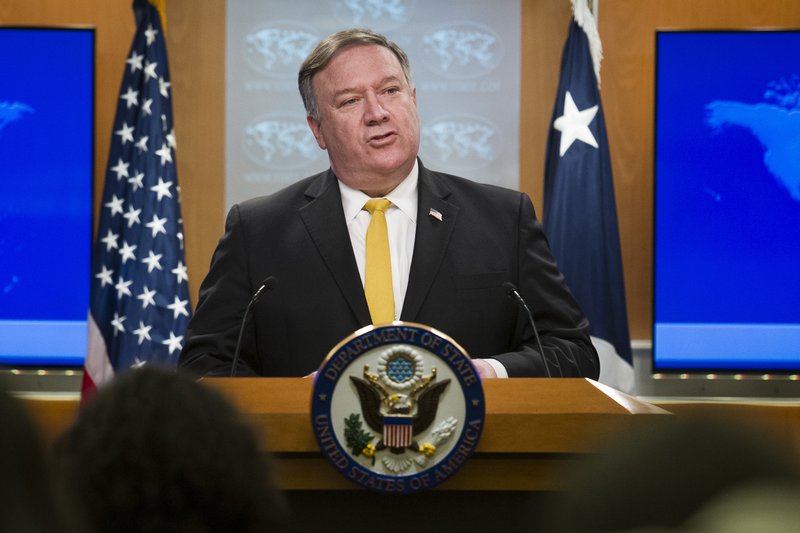
Secretary of State Mike Pompeo said withdrawing from the 1955 Treaty of Amity was long overdue and followed Iran “groundlessly” bringing a complaint with the International Court of Justice challenging U.S. sanctions on the basis that they were a violation of the pact.
Meanwhile, national security adviser John Bolton said the administration also was pulling out of an amendment to the Vienna Convention on Diplomatic Relations that Iran or others, notably the Palestinians, could use to sue the U.S. at The Hague-based tribunal. Bolton told reporters at the White House that the provision violates U.S. sovereignty.
“The United States will not sit idly by as baseless politicized claims are brought against us,” Bolton said. He cited a case brought to the court by the “so-called state of Palestine” challenging the move of the U.S. Embassy in Israel from Tel Aviv to Jerusalem as the main reason for withdrawing.
Bolton, who last month unleashed a torrent of criticism against the International Criminal Court, noted that previous Republican administrations had pulled out of various international agreements and bodies over “politicized cases.” He said the administration would review all accords that might subject the U.S. to prosecution by international courts or panels.
Earlier, Pompeo denounced the Iranian case before the U.N. court as “meritless” and said the Treaty of Amity was meaningless and absurd.
“The Iranians have been ignoring it for an awfully long time, we ought to have pulled out of it decades ago,” he told reporters at the State Department.
The little-known treaty with Iran was among numerous such ones signed in the wake of World War II as the Truman and Eisenhower administrations tried to assemble a coalition of nations to counter the Soviet Union. Like many of the treaties, this one was aimed at encouraging closer economic relations and regulating diplomatic and consular ties.
Its first article reads: “There shall be firm and enduring peace and sincere friendship between the United States of America and Iran.”
The treaty survived the 1979 overthrow of the Shah in Iran’s Islamic revolution and the subsequent hostage crisis that crippled American-Iranian relations for decades.
But amid a broader push to assert U.S. sovereignty in the international arena and after pulling out of the Iran nuclear deal this year, the administration determined that the court case made the treaty irrelevant.
Pompeo said the ruling was a “useful point for us to demonstrate the absolute absurdity” of the treaty.
The court case is legally binding, but Pompeo said the administration would proceed with sanctions enforcement with existing exceptions for humanitarian and flight safety transactions.
“The United States has been actively engaged on these issues without regard to any proceeding before the ICJ,” he said.
At the same time, he criticized the ruling.
“We’re disappointed that the court failed to recognize that it has no jurisdiction to issue any order relating to these sanctions measures with the United States.”
The ruling said Washington must “remove, by means of its choosing, any impediments arising from” the re-imposition of sanctions to the export to Iran of medicine and medical devices, food and agricultural commodities and spare parts and equipment necessary to ensure the safety of civil aviation.
It said the exceptions mentioned by Pompeo “are not adequate to address fully the humanitarian and safety concerns” raised by Iran.
The first set of sanctions that had been eased under the terms of the nuclear deal negotiated by the Obama administration was reimposed in August. A second, more sweeping set of sanctions, is set to be reimposed in early November.
Iran’s foreign minister, Mohammad Javad Zarif, praised the court ruling, saying on Twitter that it was “another failure for sanctions-addicted” U.S. and a “victory for rule of law.” He said it was imperative for other countries ’to collectively counter malign US unilateralism” and he accused the U.S. of being an “outlaw regime.”
The court said the case will continue and the U.S. can still challenge its jurisdiction but no date has been set for further hearings.
Trump Admin Trying to Get a Cyber Doctrine
October is national cyber awareness month, frankly every month and every day should be an awareness day.

So, back in late 2017, the House passed by a voice vote H.R. 3559 – Cybersecurity and Infrastructure Security Agency Act of 2017. As you may guess, it is stalled in the Senate.
Meanwhile, in an effort to mobilize and consolidate cyber operations for the United States, there is no consensus within Congress. Should every government agency has a cyber division? Should the United States be able to perform counter cyber attacks? What kind of a cyber attack on the United States constitutes an act of war?
Just last month, Politico published a piece stating in part:
Recent reports that Russia has been attempting to install malware in our electrical grid and that its hackers have infiltrated utility-control rooms across America should constitute a significant wakeup call. Our most critical infrastructure systems are vulnerable to malicious foreign cyberactivity and, despite considerable effort, the collective response has been inadequate. As Director of National Intelligence Dan Coats ominously warned, “The warning lights are blinking red.”
A successful attack on our critical infrastructure — power grids, water supplies, communications systems, transportation and financial networks — could be devastating. Each of these is vital to our economy, health and security. One recent study found that a single coordinated attack on the East Coast power grid could leave parts of the region without power for months, cause thousands of deaths due to the failure of health and safety systems, and cost the U.S. economy almost $250 billion. Cyberattacks could also undermine our elections, either by altering our voter registration rolls or by tampering with the voting systems or results themselves.
The op-ed was written by retired General and former CIA Director David Petraeus who is arguing: “Our grab-bag approach isn’t working. Gen. David Petraeus says it’s time to go big.”
Actually, I agree with General Petraeus on his position. Last month also, John Bolton on the White House National Security Council declared that the U.S. is going on the offensive. Yet in an interesting article, Forbes offers a point and counter-point to that argument.
Last week, President Trump spoke to world leaders about how China is interfering in U.S. elections via the cyber realm. While no evidence has been offered, that is not to say there is no evidence, it is a common tactic of China. Additionally, the United States is offering robust assistance to NATO allies.
Acting to counter Russia’s aggressive use of cyberattacks across Europe and around the world, the U.S. is expected to announce that, if asked, it will use its formidable cyberwarfare capabilities on NATO’s behalf, according to a senior U.S. official.
The announcement is expected in the coming days as U.S. Defense Secretary Jim Mattis attends a meeting of NATO defense ministers on Wednesday and Thursday.
Katie Wheelbarger, the principal deputy assistant defense secretary for international security affairs, said the U.S. is committing to use offensive and defensive cyber operations for NATO allies, but America will maintain control over its own personnel and capabilities.
The decision comes on the heels of the NATO summit in July, when members agreed to allow the alliance to use cyber capabilities that are provided voluntarily by allies to protect networks and respond to cyberattacks. It reflects growing concerns by the U.S. and its allies over Moscow’s use of cyber operations to influence elections in America and elsewhere.
“Russia is constantly pushing its cyber and information operations,” said Wheelbarger, adding that this is a way for the U.S. to show its continued commitment to NATO.
Wheelbarger told reporters traveling to NATO with Mattis that the move is a signal to other nations that NATO is prepared to counter cyberattacks waged against the alliance or its members.
Much like America’s nuclear capabilities, the formal declaration of cyber support can help serve as a military deterrent to other nations and adversaries.
The U.S. has, for some time, considered cyber as a warfighting domain, much like air, sea, space and ground operations. In recent weeks the Pentagon released a new cybersecurity strategy that maps out a more aggressive use of military cyber capabilities. And it specifically calls out Russia and China for their use of cyberattacks.
China, it said, has been “persistently” stealing data from the public and private sector to gain an economic advantage. And it said Russia has use cyber information operations to “influence our population and challenge our diplomatic processes.” U.S. officials have repeatedly accused Moscow of interfering in the 2016 elections, including through online social media.
“We will conduct cyberspace operations to collect intelligence and prepare military cyber capabilities to be used in the event of a crisis or conflict,” the new strategy states, adding that the U.S. is prepared to use cyberwarfare along with other military weapons against its enemies when needed, including to counter malicious cyber activities targeting the country. Read more here.
Not to be left out is North Korea.
The Department of Homeland Security, the Department of the Treasury, and the Federal Bureau of Investigation have identified malware and other indicators of compromise used by the North Korean government in an ATM cash-out scheme—referred to by the U.S. Government as “FASTCash.” The U.S. Government refers to malicious cyber activity by the North Korean government as HIDDEN COBRA.
For more information, see:
Yup, in closing…..we agree with General Petraeus….it is long overdue to go big and go NOW.