Pope Francis is Breaking the Catholic Doctrine, Revolt at Vatican

On the very same day that the Kentucky clerk, Kim Davis is ordered released from jail by a local judge for adhering to her inalienable rights to her belief system, a religious debate is underway throughout America.

Anyone remember the Obama administration suing the Little Sisters of the Poor due to Obamacare and birth-control?

Inalienable rights, cannot be surrendered, sold, suspended or transferred at the behest of any government and Kim Davis stood stern.

Meanwhile, while so many issues challenge America, one place to normally seek stability, sense or morality is church, but such is not the case with the Catholic Church or the Vatican.

Due to Pope Francis and what most of the media is not saying, the Papacy and the Vatican is in crisis, in Rome and honestly across the globe.

The edge of a movement is underway at home and worldwide, the rise of the moral and religious compass.

A Conservative revolt is brewing in the Vatican as Pope Francis introduces more inclusive measures

VATICAN CITY — On a sunny morning earlier this year, a camera crew entered a well-appointed apartment just outside the 9th-century gates of Vatican City. Pristinely dressed in the black robes and scarlet sash of the princes of the Roman Catholic Church, the Wisconsin-born Cardinal Raymond Burke sat in his elaborately upholstered armchair and appeared to issue a warning to Pope Francis.

A staunch conservative and Vatican bureaucrat, Burke had been demoted by the pope a few months earlier, but it did not take the fight out of him. Francis had been backing a more inclusive era, giving space to progressive voices on divorced Catholics as well as gays and lesbians. In front of the camera, Burke said he would “resist” liberal changes — and seemed to caution Francis about the limits of his authority. “One must be very attentive regarding the power of the pope,” Burke told the French news crew.

Papal power, Burke warned, “is not absolute.” He added, “The pope does not have the power to change teaching (or) doctrine.”

Burke’s words belied a growing sense of alarm among strict conservatives, exposing what is fast emerging as a culture war over Francis’s papacy and the powerful hierarchy that governs the Roman Catholic Church.

This month, Francis makes his first trip to the United States at a time when his progressive allies are heralding him as a revolutionary, a man who only last week broadened the power of priests to forgive women who commit what Catholic teachings call the “mortal sin” of abortion during his newly declared “year of mercy” starting in December. On Sunday, he called for “every” Catholic parish in Europe to offer shelter to one refugee family from the thousands of asylum-seekers risking all to escape war-torn Syria and other pockets of conflict and poverty.

Yet as he upends church convention, Francis also is grappling with a conservative backlash to the liberal momentum building inside the church. In more than a dozen interviews, including with seven senior church officials, insiders say the change has left the hierarchy more polarized over the direction of the church than at any point since the great papal reformers of the 1960s.

The conservative rebellion is taking on many guises, in public comments, yes, but also in the rising popularity of conservative Catholic websites promoting Francis dissenters; books and promotional materials backed by conservative clerics seeking to counter the liberal trend; and leaks to the news media, aimed at Vatican reformers.

In his recent comments, Burke was also merely stating fact. Despite the vast powers of the pope, church doctrine serves as a kind of constitution. And for liberal reformers, the bruising theological pushback by conservatives is complicating efforts to translate the pope’s transformative style into tangible changes.

“At least we aren’t poisoning each other’s chalices anymore,” said the Rev. Timothy Radcliffe, a liberal British priest and Francis ally appointed to an influential Vatican post in May. Radcliffe said he welcomed open debate, even critical dissent within the church. But he professed himself as being “afraid” of “some of what we’re seeing”

Rather than stake out clear stances, the pope is more subtly, often implicitly, backing liberal church leaders who are pressing for radical change, while dramatically opening the parameters of the debate over how far reforms can go. For instance, during the opening of a meeting of senior bishops last year, Francis told those gathered, “Let no one say, ‘This you cannot say.’ ”

We have a serious issue right now, a very alarming situation where Catholic priests and bishops are saying and doing things that are against what the church teaches

Since then, liberals have tested the boundaries of their new freedom, with one Belgian bishop going as far as calling for the Catholic Church to formally recognize same-sex couples.

Conservatives counter that in the climate of rising liberal thought, they have been thrust unfairly into a position in which “defending the real teachings of the church makes you look like an enemy of the pope,” a senior Vatican official said on the condition of anonymity in order to speak freely.

“We have a serious issue right now, a very alarming situation where Catholic priests and bishops are saying and doing things that are against what the church teaches, talking about same-sex unions, about Communion for those who are living in adultery,” the official said. “And yet the pope does nothing to silence them. So the inference is that this is what the pope wants.”

A measure of the church’s long history of intrigue has spilled into the Francis papacy, particularly as the pope has ordered radical overhauls of murky Vatican finances. Under Francis, the top leadership of the Vatican Bank was ousted, as was the all-Italian board of its financial watchdog agency.

One method of pushback has been to give damaging leaks to the Italian news media. Vatican officials are now convinced that the biggest leak to date — of the papal encyclical on the environment in June — was driven by greed (it was sold to the media) rather than vengeance. But other disclosures have targeted key figures in the papal cleanup — including the conservative chosen to lead the pope’s financial reforms, the Australian Cardinal George Pell, who in March was the subject of a leak about his allegedly lavish personal tastes.

More often, dissent unfolds on ideological grounds. Criticism of a sitting pope is hardly unusual — liberal bishops on occasion challenged Benedict. But in an institution cloaked in traditional fealty to the pope, what shocks many is just how public the criticism of Francis has become.

In an open letter to his diocese, Bishop Thomas Tobin of Providence, Rhode Island, wrote: “In trying to accommodate the needs of the age, as Pope Francis suggests, the Church risks the danger of losing its courageous, countercultural, prophetic voice, one that the world needs to hear.” For his part, Burke, the cardinal from Wisconsin, has called the church under Francis “a ship without a rudder.”

Even Pell appeared to undermine him on theological grounds. Commenting on the pope’s call for dramatic action on climate change, Pell told the Financial Times in July, “The church has got no mandate from the Lord to pronounce on scientific matters.”

In conservative circles, the word “confusion” also has become a euphemism for censuring the papacy without mentioning the pope. In one instance, 500 Catholic priests in Britain drafted an open letter this year that cited “much confusion” in “Catholic moral teaching” following the bishops’ conference on the family last year in which Francis threw open the floodgates of debate, resulting in proposed language offering an embraceable, new stance for divorced or gay Catholics.

That language ultimately was watered down in a vote that showed the still-ample power of conservatives. It set up another showdown for next month, when senior church leaders will meet in a follow-up conference that observers predict will turn into another theological slugfest. The pope himself will have the final word on any changes next year.

Conservatives have launched a campaign against a possible policy change that would grant divorced and remarried Catholics the right to take Communion at Mass. Last year, five senior leaders including Burke and the conservative Cardinal Carlo Caffarra of Bologna, Italy, drafted what has become known as “the manifesto” against such a change. In July, a DVD distributed to hundreds of dioceses in Europe and Australia, and backed by conservative Catholic clergy members, made the same point. In it, Burke, who has made similar arguments at Catholic conferences, issued dire warnings of a world in which traditional teachings are ignored.

The pope does not have the power to change teaching (or) doctrine

But this is still the Catholic Church, where hierarchical respect is as much tradition as anything else. Rather than targeting the pope, conservative bishops and cardinals more often take aim at their liberal peers. They include the German Cardinal Walter Kasper, who has suggested that he has become a proxy for clergy members who are not brave enough to criticize the pope directly.

Yet conservatives counter that liberals are overstepping their bounds, putting their own spin on the pronouncements of a pope who has been more ambiguous than Kasper and his allies are willing to admit.

“I was born a papist, I have lived as a papist, and I will die a papist,” Caffarra said. “The pope has never said that divorced and remarried Catholics should be able to take Holy Communion, and yet, his words are being twisted to give them false meaning.”

Some of the pope’s allies insist that debate is precisely what Francis wants.

“I think that people are speaking their mind because they feel very strongly and passionately in their position, and I don’t think the Holy Father sees it as a personal attack on him,” said Chicago Archbishop Blase Cupich, considered a close ally of the pope. “The Holy Father has opened the possibility for these matters to be discussed openly; he has not predetermined where this is going.”

Stefano Pitrelli contributed to this report.
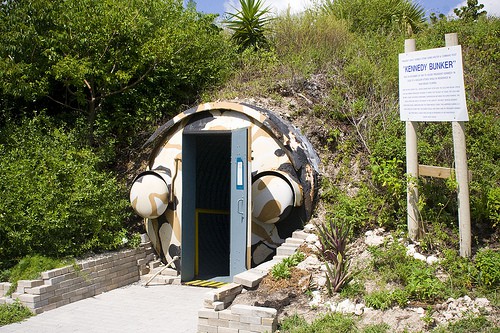
Peanut Island and JFK, a Hidden Treasure Bunker

A little piece of history, but few tourists and historians know during the Cuban Missile Crisis.

Secret Kennedy Bunker on Peanut Island: Hidden treasure, historic site

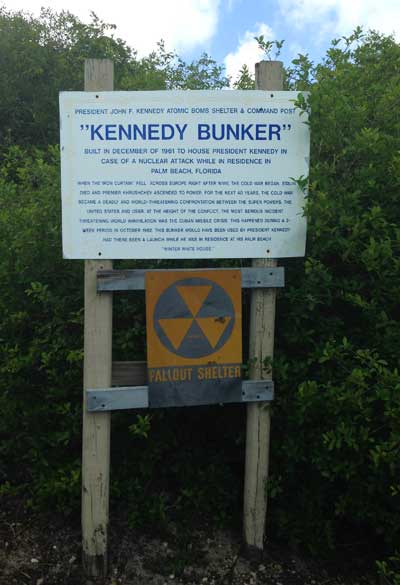
~Hidden on an island best known for boats and bikinis is a  fascinating relic of another era in South Florida —  the Kennedy Bunker,  the underground fallout shelter built in December 1961 as a safe haven for President John F. Kennedy, whose family’s Palm Beach compound is minutes away across the water.

John F. Kennedy bunker in Peanut Island, Palm Beach, Florida


The bunker was constructed quickly and secretly during the run up to the Cuban Missile Crisis. Hidden in the woods and underground, it fell into disrepair until restored by the museum in 1999.

At the entrance to the bunker is a the fallout shelter sign, which will be familiar to Baby Boomers.

Inside the Kennedy Bunker, the president's desk would be equipped with the red phone, a hotline to Moscow.

The historic Coast Guard Station on Peanut Island is part of the tour of the Kennedy Bunker.

Peanut Island, with a view of the Palm Beach Inlet.

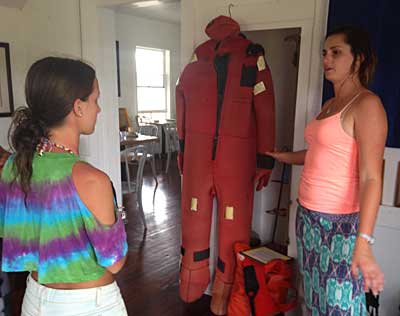
At the Palm Beach Maritime Museum on Peanut Island, you can tour the historic Coast Guard station, where the guide explains how this survival suit worked.

The bunker is located on Peanut Island, a Palm Beach County park accessible only by boat, that is usually surrounded by partiers on boats.

The bunker is operated by the Palm Beach Maritime Museum, which also runs the adjacent Historic Former Coast Guard Station museum.

The bunker is the real deal. The museums site says:

“With the exception of a presidential seal, added as a modern enhancement, the declassified, decommissioned bunker is very close to the original. The structure is covered with earth and many layers of concrete and rebar. Entry is via a blast-hardened tunnel, with a 90 degree angle to minimize shock effects from a nuclear explosion. Entry is through a secure decontamination area, which was, however, and interestingly, made of plywood.”

While a few folks around Palm Beach County know about the Kennedy Bunker and Peanut Island, it still ranks as one of Florida’s hidden treasures. It’s likely to stay that way, however: Since it is located on an island, visiting it will always require taking a water taxi, private boat or a kayak — which is part of why we love it in the first place.

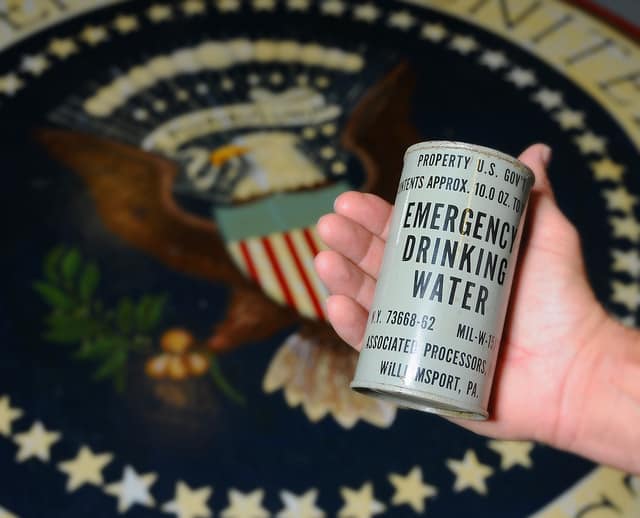
The bunker itself is quite small. Shelves are stocked with containers of drinking water, Army K-rations and gas masks. There’s a rocking chair — the seat of choice for a president with a bad back, and a ham radio reminds us of life before cell phones.

It’s a spooky space. You know that if this bunker were ever actually used, it would be something close to the end of the world.

More practical matters, however, are also discussed. There is no bathroom. How would that work?

The answer: You used a bucket, filled it and sealed it.

Before touring the bunker, visitors are taken through the historic Coast Guard Station. The tour is short and modest, but you see some interesting items.

Kennedy Bunker on Peanut Island: Emergency supplies. (VISIT FLORIDA photo by Pete Cross)


An interesting piece in the New York Times tells how JFK had a similar shelter built on another vacation destination, Nantucket Island. That shelter has never been open to the public.

More from Reuters on Peanut Island:

ESCAPE HATCH, HELIPAD

Getting to the fallout shelter’s main living quarters required passing through a series of narrow passages that held a generator, air pumps and filters, a radiation detector and a sterilization chamber.

At the back of the largest room was an emergency escape hatch that led to a helipad in case the shelter itself came under attack. The U.S. government did not acknowledge its existence until 1974.

The island where it sits was dredged up from the Palm Beach inlet in 1918 to serve as a port for peanut oil shipping.

Although that business failed, the name of Peanut Island remained. It was closed to the public from the time the Coast Guard took it over in 1936 in preparation for World War Two until 1995, when the museum secured a 45-year lease on the property.

At the time, the shelter was partially flooded and in disrepair, Miller said. Nearly all of its contents had been removed or destroyed.

The museum opened to the public in 1999, and efforts continue to restore the bunker to its original condition.

The steel hatch that leads to a dark, downward sloping steel tube was once hidden from sight by a thicket of trees. Miller said he planned to replant the trees, which for visitors will recreate the dramatic effect of stumbling upon the entrance in a small hill.

Despite the long-lasting interest in the Kennedys and their fairy-tale image, maintaining the shelter remains a challenge. It sees about 12,000 visitors annually and relies on volunteer efforts to help with maintenance.

It receives no financial contributions from the federal government or the Kennedy family, even though Ethel Kennedy, the widow of slain former Attorney General Robert F. Kennedy, visits the bunker almost every year with her grandchildren.


The Global Refugee Crisis Snapshot

  1. Refugees travel light, for their trek is as dangerous as it is arduous. They are detained, shot at, hungry. Smugglers routinely exploit them, promising safety for a price, only to squeeze them like sardines into tiny boats. Most have no option but to shed whatever meager belongings they may have salvaged from their journeys. Those allowed to bring extra baggage aboard often toss it overboard, frantically dumping extra weight as the leaky boats take on water.

    Few arrive at their destinations with anything but the necessities of life. The International Rescue Committee asked a mother, a child, a teenager, a pharmacist, an artist, and a family of 31 to share the contents of their bags and show us what they managed to hold on to from their homes. Their possessions tell stories about their past and their hopes for the future. Much more here from Medium.

  2. No one is vetting these jihadists. And worse still, Pope Francis called on Sunday on every European parish and religious community to take in one migrant family each in a gesture of solidarity he said would start in the tiny Vatican state where he lives.

    The Westgate Mall massacre was gruesome even by Islamic standards. Muslims were released, while non-Muslims had their eyes gouged out and were murdered in cold blood. More here from PamelaGeller.

  3. Five of the wealthiest Muslim countries have taken no Syrian refugees in at all, arguing that doing so would open them up to the risk of terrorism. Although the oil rich countries have handed over aid money, Britain has donated more than Saudi Arabia, the United Arab Emirates and Qatar combined.

    Between 10 and 12 million Syrians have been displaced by the bloody civil war raging in their country. Most still remain within Syria’s borders, but around four million have fled over the borders into neighboring countries, mostly Turkey, Jordan and Lebanon and beyond. More here from Breitbart.

  4. Greek police are still searching for 10 illegal immigrants who escaped from a holding centre in Athens after a riot late on Saturday night. A protest over the extension of their detention turned violent as inmates clashed with police and security guards. The detainees hurled water bottles and set fire to rubbish bags and mattresses.

    Greece, struggling to exit its worst financial crisis in decades, has become a frontier for immigrants mainly from Asia and Africa, who seek a better life in Europe but often end up living in cramped detention centres.

  5. The Syrian operative claimed more than 4,000 covert ISIS gunmen had been smuggled into western nations – hidden amongst innocent refugees. The ISIS smuggler, who is in his 30s with a trimmed jet-black beard, revealed the ongoing clandestine operation is a complete success. “Just wait,” he smiled.

    The Islamic State operative spoke exclusively to BuzzFeed on the condition of anonymity and is believed to be the first to confirm plans to infiltrate western countries. Islamic State, also referred to as IS and ISIS, is believed to be actively smuggling deadly gunmen across the sparsely-guarded 565-mile Turkish border and on to richer European nations, he revealed.

  6. WASHINGTON, D.C. – Chairman Michael McCaul, of the House Homeland Security Committee, wrote a letter to President Obama last Thursday expressing concerns over the Administration’s announced plans to resettle some 2,000 Syrian refugees in the United States this year. Terrorists have made known their plans to attempt to exploit refugee programs to sneak terrorists into the West and the U.S. homeland. Chairman McCaul’s letter points out the potential national security threat this poses to the United States.

    Chairman McCaul: “Despite all evidence towards our homeland’s vulnerability to foreign fighters, the Administration still plans to resettle Syrian refugees into the United States. The Director of the National Counterterrorism Center and the Deputy Director of the FBI both sat before my Committee this Congress and expressed their concern with admitting refugees we can’t properly vet from the global epicenter of terrorism and extremism in Syria. America has a proud tradition of welcoming refugees from around the world, but in this special situation the Obama Administration’s Syrian refugee plan is very dangerous.”

    Read Chairman McCaul’s letter HERE.

    The Subcommittee on Counterterrorism and Intelligence will hold a hearing on June 24th to examine the refugee resettlement program and discuss vulnerabilities to our security exposed by the Administration’s plan.

The conditions in Europe will soon come to the United States.


Here’s a summary of the latest developments:

France and Germany are are to take an extra 55,000 refugees over the next two years. The plan, part of an initiative to taken an extra 120,000 across Europe, will be set out on Wednesday by EU commission president, Jean-Claude Juncker.
France is considering launching airstrikes against Islamic State militants in Syria president François Hollande announced as he confirmed plans to take an extra 24,000 refugees. “We have proof that attacks have been planned from Syria against several countries, notably France,” Hollande told a news conference.
Angela Merkel called on other European countries to pull their weight to help tackle the crisis. She described the number of people coming to Germany over the weekend as “breathtaking” and said Germany should be proud of its response.
Tensions between the authorities and migrants and asylum seekers have remained tense at a number of flash points across Europe. On Greek island of Lesbos the sight of thousands of frustrated refugees and migrants marching on Mytilini, the capital, prompted Greece’s migration minister to announce that transit of the newcomers would be speeded up immediately. Scuffles broke out earlier on between police and thousands of people attempting to enter Macedonia from with Greece. The Hungarian security forces struggled to contain migrants trying to break out of the Röszke camp on the Serbia border.
The Bavarian authorities have warned they are at “breaking point” after accepting two thirds of the 18,000 refugees who arrived in Munich via Austria over the weekend. “We’re right at our limit,” said Christoph Hillenbrand, meeting reporters at Munich train station.
David Cameron is to set out details of the government’s plans to resettle thousands of refugees fleeing the civil war in Syria. He will also announced further details of a counter terrorism strategy on Syria.
Hundreds of millions of pounds from Britain’s aid budget will be used to tackle the crisis, Chancellor George Osborne confirmed that every penny in the “uplift” in the aid budget – the automatic rises as the economy grows – would be spent on global challenges with a direct effect on Britain.
The ruling coalition in Germany has set out plans to spend an extra €6bn to cope with migration. After a meeting in Berlin lasting more than five hours, leaders from chancellor Merkel’s coalition also agreed to speed up asylum procedures and facilitating the construction of asylum shelters.
Hungary’s hardline PM, Viktor Orban, said people coming into the EU are “immigrants not refugees”. He also said that it was the EU primary interest that Hungary protects its borders.
The United Nations warned that its humanitarian agencies were on the verge of bankruptcy and unable to meet the basic needs of millions of people because of the size of the refugee crisis. “We are broke,” the UN high commissioner for refugees, António Guterres, told the Guardian.

Snapshots:


Meanwhile, the BRICS’ have $100 Billion, Operational

Back to Irregular Warfare, as previously posted on this site:

$100bn BRICS monetary fund now operational

The five leaders of BRICS met in Ufa, Russia on 9 July 2015  [Xinhua]

The $100 billion BRICS Contingent Reserve Arrangement (CRA) has become fully operational following the inaugural meetings of the BRICS CRA Board of Governors and the Standing Committee in the Turkish capital of Ankara.

“The first meetings of the governing bodies mark the start of a full-scale operation of the BRICS Contingent Reserve Arrangement as an international institution with activities set to enhance and strengthen cooperation,” said a Russian Central Bank statement on Friday.

BRICS leaders Xi Jinping, Vladimir Putin, Jacob Zuma, Narendra Modi and Dilma Rousseff witnessed the signing of the agreement on the CRA in the Brazilian city of Fortaleza in July 2014.

The agreement entered into force on July 30, 2015.

China will provide the bulk of the funding with $41 billion, Brazil, Russia and India with $18 billion each, and South Africa with $5 billion.

The CRA is meant to provide an alternative to International Monetary Fund’s emergency lending. In the CRA, emergency loans of up to 30 per cent of a member nation’s contribution will be decided by a simple majority. Bigger loans will require the consent of all CRA members.

Meanwhile, Finance Ministers from the five BRICS countries have met in Ankara on the sidelines of the G20 meeting of global finance ministers and central bankers, amid growing worries about the state of the global economy.

With a looming US federal Reserve rate hike and Chinese market turbulence sending shock waves through emerging markets, the IMF has lowered its global growth forecast.

A G20 communique after their two-day meeting in the Turkish capital Ankara noted that global growth was falling short of expectations.

“Global growth falls short of our expectations. We have pledged to take decisive action to keep the economic recovery on track and we are confident the global economic recovery will gain speed,” the statement said.

The G20 vowed to “carefully calibrate and clearly communicate our actions … to minimise negative spillovers, mitigate uncertainty and promote transparency”.

As the BRICS countries launched new financial institutions like the $100 billion BRICS Bank, the China-led Asia Infrastructure Investment Bank, and a $100 billion BRICS currency reserve fund, the IMF has once again delayed voting reforms to give emerging countries greater say.

***

Meanwhile, Putin is rejoicing in the European refugee crisis, this too is part of Irregular Warfare.

***

Refugee Crisis: EU bearing burden of US foreign policy, says Putin

Refugees are prevented by police from entering the Keleti railway station in Budapest, Hungary on September 1, 2015 [Xinhua]

Russian President Vladimir Putin on Friday said Syrian President Bashar al-Assad is willing to hold snap parliamentary elections and share power with a “healthy opposition”.

Russia and Iran, have backed Assad since Syria’s civil war broke out in 2011.

Russia, along with other members of the BRICS bloc, have insisted on  international efforts being geared to bring about a ‘political solution’ to the crisis rather than a military one.

Syria’s conflict began with anti-government demonstrations in March 2011, which soon spiraled into a multi-front civil war that has left more than 230,000 people dead, according to UN estimates.

“Overall there is an understanding that the unification of forces in the fight against terrorism should proceed in parallel with some sort of political process within Syria. The Syrian president agrees with that, all the way down to holding early parliamentary elections, establishing contacts with the so-called healthy opposition, and bringing them into the governing,” Putin said on the sidelines of the Eastern Economic Forum in Vladivostok on Friday.

“But this is, first of all, an issue of internal Syrian development; we are not imposing anything, but are ready to facilitate this internal Syrian dialogue,” he added.

A 2013 accord, brokered by Russia, took Assad’s declared chemicals out of Syria in an 11th-hour move to avert US bombing.

The Syrian government is fighting a number of rebel groups as well as radical militant organizations, including militants from ISIL and the Nusra Front.

“By the way, the people aren’t fleeing from the regime of Bashar Assad. They are fleeing from ISIL, which has seized their territories, including considerable parts of Syria, Iraq,” Putin said referring to the refugee crisis in Europe.

Russia has stressed in the past that Washington’s refusal to coordinate its airstrikes against purported ISIL positions in Syria with Damascus is a “mistake.” Western and Arab leaders have shied away from cooperating with Assad in the fight against the Islamic State to avoid being seen as legitimising his rule.

More than 300,000 people have crossed to Europe by sea so far this year and more than 2,600 have died during these desperate journeys.

“I think the crisis was absolutely expected. We in Russia, and me personally several times said it straight that pervasive problems would emerge, if our so-called Western partners continued to maintain their flawed, as I always stressed it, foreign policy, which they pursue to date, especially in regions of the Muslim world [such as] Middle East, North Africa,” Putin said on Friday.

“And it is, first of all, the policy of our American partners. Europe is blindly following this policy within the framework of the so-called allied liabilities, and in the end shoulders the entire burden. I am now quite surprised that some of the American mass media are criticizing Europe for what they consider to be excessive cruelty towards migrants,” the Russian President added.

As refugees land on European shores, “the ‘United States of Europe’ appeared singularly dis-united”, writes journalist and Faculty of Media at London College of Communication, Russell Merryman.

“While the EU itself resorted to lofty rhetoric about working together to deal with the crisis and developing equitable ways of distributing refugees among the member states, some of Merkel’s European partners began to retreat into petty nationalism,” writes Merryman.

“The worst display was from Hungary which built a 180km fence, while their pugnacious prime minister, Viktor Orban, said it was Germany’s problem and that the refugees threatened to undermine Europe’s Christian roots,” he adds.


How Obama Won Iran Deal and the Money Flows

Obama has officially won on the Iran deal. How?

In part from the Hill:

The White House —which has a reputation for keeping an arms-length relationship with Capitol Hill —mounted an all hands on deck effort in the three weeks after the deal was signed and before lawmakers left town for the August recess.

Secretary of State John Kerry, Energy Secretary Ernest Moniz and other top officials became fixtures on Capitol Hill and sought to answer every lawmaker’s questions in person before they fanned out across the country.

Moniz was the ringer, offering a detailed yet affable performance that contrasted with Kerry’s more pedantic style, and earned him the affection of even the deal’s most bitter critics.

The president, too, got personally involved, and refused to relent once Congress left town.

Obama spoke to more than 100 lawmakers in individual or small-group settings, according to a White House official, including 30 calls during his two-week August vacation in Martha’s Vineyard, Mass.

Cabinet secretaries and senior administration officials made the case directly to over 200 House members and senators after the deal was reached.

Supporters were up against heavy artillery. At home, lawmakers were bombarded with tens of millions of dollars’ worth of TV ads from opponents of the agreement such as the American Israel Public Affairs Committee (AIPAC).

To counteract that firepower, organizations such as J Street spent millions of their own to run advertisements in key markets.

Obama also made an open plea for liberal groups to lend him a hand.

“As big of a bully pulpit as I have, it’s not enough,” Obama told thousands of activists in July. “I can’t carry it by myself.”

But what do the Republicans know that the Democrats also know but are ignoring because of the covert Iran money deals to the Democrats?

Iran spending billions on terrorists’ salaries: report

 Iran has been sending billions of dollars to fill the pockets of terrorist fighters across the Middle East, including in Yemen, Syria, Lebanon and the Gaza Strip, according to a private U.S. government report ordered by Sen. Mark Kirk.

Iran’s defense budget ranges anywhere between $14 billion to $30 billion a year and much of that money goes to fund terrorist groups and rebel fighters throughout the region, according to the Congressional Research Service report conducted at the request of Mr. Kirk, an Illinois Republican.
The report, first viewed by The Washington Free Beacon, discloses that funding for these terrorist groups could be much higher than originally estimated, as Iran often hides public records about its defense spending.

“Some regional experts claim that Iran’s defense budget excludes much of its spending on intelligence activities and support of foreign non-state actors,” the report states, stressing that actual military spending could far exceed the $30 billion that Iran discloses annually, The Free Beacon reported.

“Similarly, another study claims that actual funding for the [Iranian Revolutionary Guard Force’s Al Quds Force] is ‘much greater’ ” than the amount allocated in the state budget, as the group’s funds are supplemented by its own economic activities,” the report said.

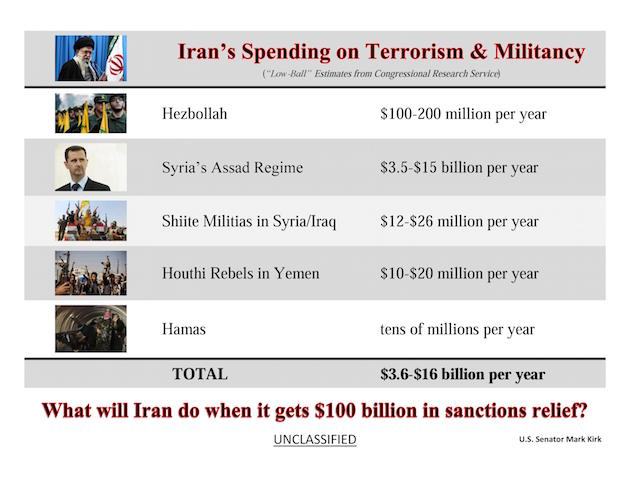
The report gives “low-ball” estimates for each of the groups supported by Iranian funding. Researchers estimate Iran spends between $100 million and $200 million per year on Hezbollah, $3.5 billion to $15 billion per year in support of Syria’s Asad Regime, $12 million to $26 million per year on Shiite militias in Syria and Iraq, $10 million to $20 million per year to support Houthi rebels in Yemen and tens of millions per year to support Hamas terrorists in Israel.

In Syria, for example, Iranian-backed fighters are paid between $500 to $1,000 a month to fight in support of Bashar Assad’s regime, according to the report.

Afghan fighters in Syria have disclosed that they “had recently returned from training in Iran and planned to fight in Syria,” the report notes. These militants “expected to receive salaries from Iran ranging from $500 to $1000 a month.”

The report comes as the Obama administration gained the final critical vote needed to suppress a resolution to disapprove a nuclear deal with Iran. Under the deal, the U.S. and other world powers will gradually lift economic sanctions on the Islamic Republic in exchange for dismantling its nuclear weapons program.

Similar reports from watchdog groups have revealed that releasing Iranian assets sanctions could allow Tehran to spend more money on its terrorist-link Quds force, as well as beef up its own military in general.

“The administration is celebrating support from a partisan minority of senators for a nuclear deal that threatens the security of the United States and our allies,” Mr. Kirk said, The Free Beacon reported. “This deeply flawed agreement will transfer over $100 billion to a regime that U.S. Director of National Intelligence James Clapper calls the ‘foremost state sponsor of terrorism,’ and pave Iran’s path to nuclear weapons.

“Like North Korea before it, Iran will cheat on this flawed deal in order to get nuclear weapons. Congress must hold accountable the Iranian regime and ensure that our children never wake up to a nuclear-armed Iran in the Middle East.”

20150800-INFOGRAPHIC-Kirk-CRS Estimates of Iranian Financial Support to Terrorists Militants

The report is located here and everyone in Congress has access.

CSMonitor: One of the beneficiaries will be Iran’s primary tool for projecting power – the Islamic Revolutionary Guard Corps (IRGC), and especially its elite Qods Force, which handles operations abroad.

But are Iran’s wizened generals, who mostly cut their military teeth in the 1980s as teenage volunteers during the brutal Iran-Iraq War, already in danger of overreach?

For decades, American military planners aimed to be capable of simultaneously fighting – and winning – two full-blown wars in different regions. It was a challenge, even for a superpower. Today, on a much smaller scale and with a sliver of the military means, Iran is attempting the same thing in the Middle East: It is deeply engaged in Syria and Iraq; waving the flag in Yemen; and very influential in Lebanon.

Never before has the Revolutionary Guard, whose 120,000-strong force is much smaller than Iran’s regular 425,000-strong armed forces, been engaged so deeply and widely abroad – yet with increasingly mixed and entangling results.

There is no shortage of commitment: at least seven IRGC generals have died on the frontlines, primarily in Syria but also in Iraq, taken down by snipers’ bullets, bombs, and even an Israeli airstrike. The Guards are relatively top heavy with generals due to their origins as an ideological militia. Still, such high-ranking losses are highly uncommon in modern warfare.

In Syria, the IRGC and its Lebanese Shiite ally Hezbollah are bolstering the regime of President Bashar al-Assad against an array of rebels and jihadists. In Iraq, Iran has mobilized Shiite militias to take on the self-described Islamic State, but at a cost of stoking more sectarian strife. While in Yemen, Iran has played a much lesser role in aiding Houthi militiamen against Saudi-backed forces.

Each conflict has now devolved largely along sectarian lines that pit Shiite Iran against its regional Sunni rivals, Saudi Arabia and Persian Gulf states allied with the US and Israel.

The IRGC “exceeded their reach long ago.… They are at the end of their tricks [in Syria], and Hezbollah lost a lot,” says Walter Posch, a specialist on Iranian military forces at the Austrian National Defense Academy in Vienna.

“It worked well when it was low cost, but now it is high cost.… There is no Saddam Hussein who insulted the Iranian nation as a whole” as a national motivating factor, as in the 1980s, says Mr. Posch. “This is a war of their own liking, for the purpose of power projection. But they’ve been too ignorant of the fear of the small Gulf countries; too ignorant about the fears of the Saudis.”


Ideological origins

The IRGC was formed after Iran’s 1979 Islamic revolution by Ayatollah Ruhollah Khomeini, who wanted a more trusted and ideologically pure force than the regular Army. The grim years of the Iran-Iraq war consolidated its role – and its anything-is-possible reputation.

Embracing the religious Shiite aspects of resistance in the image of Imam Hossein, the 7th-century Shiite saint venerated as “lord of the martyrs,” the IRGC has since become an economic and political powerhouse. It runs a multi-billion dollar business empire that handles everything from oil and infrastructure projects to weapons production. In politics, active-duty guardsman play no formal role, but its generals are close to Iran’s supreme leader Ayatollah Ali Khamenei, and veterans have held cabinet and other government posts.

“I don’t see signs of overreach; I think they’ve got leadership in depth,” says Richard Dalton, a former British ambassador to Tehran now at the Chatham House think tank in London. “They are tested in difficult situations. They’ve been involved, whether in Lebanon, Iraq, or Afghanistan, for a very long period.”

“It comes back to, ‘Who wins wars?’ People who win wars and are the most effective are the ones with the greatest conviction, and the Iranians have got it,” says Amb. Dalton.

That certainly applies to Qods Force commander Qassem Soleimani, who has often been photographed along frontlines in Iraq and elsewhere. He claimed this week that Iran’s efforts prompted the “collapse of American power in the region,” according to details of a high-level briefing published in Iran’s conservative media.


‘Gobbling’ or choking?

Some argue that Iran’s regional expansion is unprecedented. Addressing Congress in March, Israel’s Prime Minister Benjamin Netanyahu said Iran was “gobbling up” Mideast capitals. Yet the tide now isn’t all going Iran’s way.

In Syria, for example, Iran has been fighting to defend Mr. Assad’s regime for more than 4-½ years, spending an estimated $6 billion to $15 billion a year in a war that has claimed more than 240,000 lives. But pro-Assad forces have lost ground in recent months to rebels backed by the US, Turkey, Qatar, and Saudi Arabia, as well as to the self-described Islamic State.

President Hassan Rouhani has vowed to back the Syrian government “until the end of the road.” While Assad is running short of loyalist troops, the IRGC reportedly has tried to fill the gap by finding several thousand Afghans to fight, and die, in exchange for cash, Iranian residency or passports, and sometimes for commuted jail terms, according to Germany’s Spiegel and Agence France-Presse.

In May, a special event held in Tehran commemorated Afghan martyrs killed in Syria, and 65 corpses were returned in a single exchange, according to Iranian media reports. Many are buried in Iran. Officially, Iran denies enlisting Afghans to fight in Syria.

In Iraq, Soleimani was instrumental in reviving tens of thousands of Shiite militiamen to push back IS for more than a year – in concert with American airstrikes, and ironically with a similar mission as US military advisers now in Iraq. But those militias are accused of atrocities against Sunnis, and efforts to bolster the regular Iraqi military – decisive at first – have begun to stumble.

And in Yemen, Iran has been marginally involved on the side of Houthi rebels as they advanced across the country earlier this year. In July, the critical port city of Aden was recaptured by Saudi-backed forces and troops of the United Arab Emirates. Months of Saudi-led airstrikes are imperiling the population, in a campaign explicitly aimed at rolling back Iranian influence.

“There is support for Soleimani but also high expectations,” says Posch, of the IRGC’s Qods Force chief. “He has to deliver now. I don’t know how he deals with all these crises individually. He can’t go to all these battlefields in person.”