
What Should you Know About Wilson Fish….

The Wilson-Fish (WF) program is an alternative to traditional state administered refugee resettlement programs for providing assistance (cash and medical) and social services to refugees.

  Minneapolis

  Vermont

  Twin Falls, Idaho

The full government program description is here, from the Health and Human Services website which manages the Refugee Resettlement Program.

The purposes of the WF program are to:

  • Increase refugee prospects for early employment and self-sufficiency
  • Promote coordination among voluntary resettlement agencies and service providers
  • Ensure that refugee assistance programs exist in every state where refugees are resettled

http://app.na.readspeaker.com/cgi-bin/rsent?customerid=7596&lang=en_us&readid=main&url=http%3A%2F%2Fwww.acf.hhs.gov%2Fprograms%2Forr%2Fprograms%2Fwilson-fish

I. INTRODUCTION

II. ELIGIBLITY

III. PROGRAM DESCRIPTION

IV. PROGRAM SERVICES
A. Refugee Cash Assistance
B. Refugee Medical Assistance/Refugee Medical Screening
C. Intensive Case Management
D. Employment/Employability Services
E. English Language Training
F. Translation and Interpretation Services
G. Refugee Social Services – Key Requirements

V. PROGRAM ADMINISTRATION
A. Statewide Coordination
B. RCA/RMA Administration

VI. PROCEDURES AND DEFINITIONS
A. Procurement of Services
B. Sanctioning and Fair Hearing Process
C. Definition of Terms
D. Procedure for a WF Program to Revert to a State Administered RCA or PPP Model

VII. REPORTING

VIII. Application
A. Substantial Involvement Under the Cooperative Agreement
B. Contents of the WF Application

I. INTRODUCTION

These guidelines are provided to grantees under the Wilson/Fish (WF) alternative program to assist them in their delivery of services and assistance to eligible populations. The purpose of the WF program is to establish an alternative to the traditional state administered refugee assistance program through the provision of integrated assistance (cash and medical) and services (employment, case-management, English as a Second Language (ESL) and other social services) to refugees in order to increase early employment and self-sufficiency prospects. In addition, the WF program enables refugee assistance programs to exist in every State where refugees are resettled.

The statutory authority for the WF program was granted in October, 1984, when Congress amended the Immigration and Nationality Act (INA) to provide authority for the Secretary of Health and Human Services to implement alternative projects for refugees. This provision, known as the Wilson/Fish Amendment, Pub.L. 98-473, 8 U.S.C. 1522(e)(7), provided:

“(7)(A) The Secretary shall develop and implement alternative projects for refugees who have been in the United States less than thirty-six months, under which refugees are provided interim support, medical services,1 support services, and case management, as needed, in a manner that encourages self-sufficiency, reduces welfare dependency, and fosters greater coordination among the resettlement agencies and service providers…

(B) Refugees covered under such alternative projects shall be precluded from receiving cash or medical assistance under any other paragraph of this subsection or under title XIX or part A of Title IV of the Social Security Act.

(C) “…”

(D) To the extent that the use of such funds is consistent with the purposes of such provisions, funds appropriated under section 414(a) of this Act, part A of Title IV of the Social Security Act, or Title XIX of such Act, may be used for the purpose of implementing and evaluating alternative projects under this paragraph.”

The WF Program is also referenced in the Office of  Refugee Resettlement (ORR)  regulations under the heading Alternative RCA Programs at 45 C.F.R. § 400.69:

“A state that determines that a public/private RCA program or publicly-administered program modeled after its TANF program is not the best approach for the State, may choose instead to establish an alternative approach under the Wilson/Fish program, authorized by INA section 412(e)(7).”

The ORR regulations at 45 C.F.R. §400.301 also provide authority to the ORR Director to select a replacement to respond to the needs of the state’s refugee population if a state withdraws from the refugee program:”…when a State withdraws from all or part of the refugee program, the Director may authorize a replacement designee or designees to administer the provision of assistance and services, as appropriate, to refugees in that State” (see page 14 – “Statewide Coordination”).

Neither the statute nor regulations mandate a competitive review process for determining a WF grantee.  However, the statute does require as follows:

No grant or contract may be awarded under this section unless an appropriate proposal and application (including a description of the agency’s ability to perform the services specified in the proposal) are submitted to, and approved by, the appropriate administering official. Grants and contracts under this section shall be made to those agencies which the appropriate administering official determines can best perform the services 8 U.S.C. § 1522(a)(4)(A).

ORR with the Administration for Children and Families (ACF) concurrence has concluded a competitive review process is not cost effective, not in the best interest of the government, and not a practical fit for the WF program.   ORR also, in accordance with the law cited above, will require that appropriate proposals and applications are submitted and that a determination is made that the grantees are the ones that can “best perform” the services.  Therefore funding under this program is open only to those agencies that currently administer a WF program. The WF program has the regulatory authority as cited above to expand sites in the future as necessary if a state withdraws from the refugee program or if a state proposes to switch its current RCA model to the WF model.

WF grantees which include States, voluntary resettlement agencies (local and national), and a private non-profit agency that oversees a local voluntary resettlement agency administer 12 state-wide WF programs in the following States: Alabama, Alaska, Colorado, Idaho, Kentucky, Louisiana, Massachusetts, Nevada, North Dakota, South Dakota, Tennessee and Vermont, plus one county-wide program in San Diego County, California. The WF programs in these locations are currently administered by the following agencies:

Alabama: USCCB – Catholic Social Services
Alaska: USCCB – Catholic Social Services
Colorado: Colorado Department of Human Services
Idaho: Janus Inc. (formerly Mountain States Group), Idaho Office for Refugees
Kentucky: USCCB – Catholic Charities of Louisville, Kentucky Office for Refugees
Louisiana: USCCB – Catholic Charities Diocese of Baton Rouge, Louisiana Office for Refugees
Massachusetts: Office for Refugees and Immigrants
Nevada: USCCB – Catholic Charities of Southern Nevada
North Dakota: LIRS – Lutheran Social Services of North Dakota
San Diego County, CA: USCCB – Catholic Charities Diocese of San Diego
South Dakota: LIRS – Lutheran Social Services of South Dakota
Tennessee: USCCB – Catholic Charities of Tennessee, Tennessee Office for Refugees
Vermont: USCRI – Vermont Refugee Resettlement Program

II. ELIGIBILITY

ORR Eligible Client Population

To be eligible for WF funded programs and services, grantees must ensure refugees2 meet all requirements of 45 C.F.R. 400.43, “Requirements for documentation of refugee status”. Eligibility for refugee program services and assistance also includes: Asylees3, Cuban Haitian Entrants4; Certain Amerasians5 from Vietnam; Victims of Severe Forms of Trafficking6; Special Immigrant Visa Holders7.

All eligible individuals will be referred to as “refugees” or “clients” in these guidelines, unless the context indicates otherwise. For more details on documentary proof of the above statuses and all other ORR eligible populations, including statutory and regulatory authorities, visit the ORR website.

III. PROGRAM DESCRIPTION

Under the WF program guidelines, the grantee will provide interim financial assistance, medical assistance (if applicable), employment services, case management and other social services to refugees in a manner that encourages self-sufficiency, and fosters greater coordination among voluntary agencies and other community-based service providers. An integrated system of assistance and services is an essential characteristic of a WF program. Services and assistance under this program are intended to help refugees attain self-sufficiency within the period of support defined by 45 CFR 400.211.8 This period is currently eight months from date of arrival in the U.S. (for refugees and SIVs); the date of adjustment of status if applying for Special Immigrant Status within the U.S (SIVs); the date of final grant of asylum (for asylees); the date a Cuban/Haitian becomes an entrant9; the date of certification or eligibility letter for Victims of Severe Forms of Trafficking.

WF programs provide assistance and services to refugees for the purpose of enhancing refugee self-sufficiency. Some examples include: (1) where assistance and services for refugees receiving RCA and those receiving Temporary Assistance for Needy Families  (TANF) could be provided in a better coordinated, effective, and efficient manner;  (2) where the  payment rate for RCA and TANF is well below the ORR payment rates listed in the ORR regulations at 45 C.F.R. section 400.60;  (3) where TANF-eligible refugees may not have access to timely, culturally and linguistically compatible services in the provision of employment and training programs; (4) where existing options for delivery of services and assistance to refugees do not present the most effective resettlement in that location, and where resettlement could be made more effective through the implementation of an alternative project; (5) where the continuity of services from the time of arrival until the attainment of self-sufficiency needs to be strengthened; or (6) where it is in the best interest of refugees to receive assistance and services outside the traditional TANF system.

WF programs have the flexibility to design programs tailored to the refugees’ needs, assets, and environment of the resettlement community.

There are seven main elements of WF programs that allow them to be distinguished from the traditional10 state -administered refugee resettlement programs:

a. They may serve TANF eligible clients in addition to RCA clients.
b. The provision of cash assistance, case management and employment services are integrated and administered generally under a single agency employing a “one stop shop “ model  that is culturally and linguistically equipped to work with refugees.
c. The cash assistance element may be administered and/or delivered by the state or a private entity.
d. Monthly RCA payment levels may exceed state TANF payment levels (up to the PPP levels outlined under 45 C.F.R. §400.60).
e. WF programs utilize innovative strategies for the provision of cash assistance, through incentives, bonuses and income disregards which are tied directly to the achievement of employment goals outlined in the client self-sufficiency plan.
f. Refugee Medical Assistance (RMA) may be administered by a private entity.
g. WF programs provide intensive case management to refugees who are determined to have special needs.

Funding for the WF program is made available under the Transitional Assistance and Medical Services (TAMS) and Social Services line items.  Under TAMS, WF grantees receive WF-Cash and Medical Assistance (WF-CMA) discretionary funds which are awarded through cooperative agreements to cover RCA, RMA (if privately administered), intensive case management, statewide coordination and RCA/RMA administration costs. WF-CMA discretionary grants are awarded based on a budget of estimated costs for providing up to eight months of RCA and RMA (if applicable) to eligible refugees and up to one year of intensive case management, as well as for the identifiable and reasonable administrative costs associated with providing RCA and RMA and statewide coordination. WF-CMA is a cost reimbursement grant. Any unobligated balances will be used as an offset to the following year’s award for this grant.
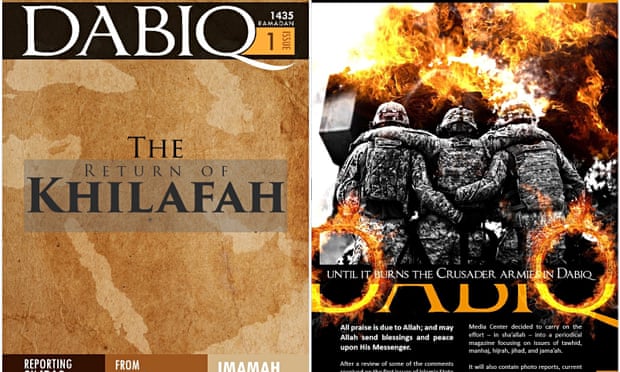
Dabiq, Syria: Cubs and Pearls

Cubs and Pearls: A generational war, there is no end.

Dabiq is the sophisticated online magazine for Islamic State. What is Dabiq?

Dabiq

TheGuardian: Dabiq is a small, rather nondescript town in northern Syria, close by the border with Turkey. It’s more of a large village really, with just a few thousand inhabitants.

And it is of limited strategic interest. Not far south, in the sprawling city of Aleppo, where battle rages, Bashar al-Assad continues to drop his untargeted barrel bombs on its Sunni population, thus rallying more and more jihadis to the black flag. Yet it is Dabiq after which Islamic State (Isis) names its glossy recruiting magazine. For this is the place where the world will come to an end.

Like Judaism and Christianity – and strongly influenced by them – Islam has a powerful eschatological strain. It anticipates the end of the world and a final historical confrontation between good and evil, after which human life is set to be miraculously transformed. And according to one reading of Islamic tradition (hadith), the place where this final malahim (apocalypse) will happen is – of all places – Dabiq. This is where the Muslim and Christian armies will finally face each other and the Crusaders will be destroyed. And this is why Dabiq is the name on the lips of Isis recruiting sergeants.

It is worth noting that Isis is extremely selective in its use of hadith. For instance, other parts of the tradition have it that Jesus, dressed in yellow robes, will return east of Damascus and will join forces with the Islamic messiah, the Mahdi, in a battle against the false messiah, the Dajjal. After the death of the Mahdi, it is the Muslim Jesus who will rule the Earth. This hadith is less useful to Isis, though its leader, Abu Bakr al-Baghdadi, looks to many observers to be trying to style himself as the Mahdi.

The Battle of Marj Dābiq (Arabic: مرج دابق‎, meaning “the meadow of Dābiq”; Turkish: Mercidabık Muharebesi) was a decisive military clash in Middle Eastern history, fought on 24 August 1516, near the town of Dabiq, 44 km north of Aleppo, Syria.[1] The battle was part of the Ottoman–Mamluk War (1516–17) between the Ottoman Empire and the Mamluk Sultanate, which ended ultimately in an Ottoman victory, the conquest of most of the Middle East by the Ottoman Empire, and the end of the Mamluk Sultanate. The Ottoman Empire’s victory in this battle gave it control of the entire region of Syria.

Abraham Ortelius - Tvrcici imperii descriptio.jpg


The Ottoman–Mamluk War of 1516–1517 was the second major conflict between the Egypt-based Mamluk Sultanate and the Ottoman Empire, which led to the fall of the Mamluk Sultanate and the incorporation of the Levant, Egypt and the Arabian Peninsula as provinces of the Ottoman Empire.[1] The war transformed the Ottoman Empire from a realm at the margins of the Islamic world, mainly located in Anatolia and the Balkans, to a huge empire encompassing the traditional lands of Islam, including the cities of Mecca, Cairo, Damascus and Aleppo. It continued to be ruled however from Constantinople

Meet the Bravery in Syria

The Pentagon and Joint Chiefs Chairman is in full opposition with the White House that Islamic State is contained.

WashingtonTimes: The nation’s top military officer on Tuesday said the U.S. has “not contained” the Islamic State, contradicting President Obama’s reassuring remarks last month just before the terrorist attacks in Paris.

“We have not contained ISIS,” Marine Gen. Joseph Dunford, chairman of the Joint Chiefs of Staff, told lawmakers at a House Armed Services Committee hearing, referring to the terror group by its acronym, The Hill reported.

Gen. Dunford said the Islamic State has been “tactically” contained in areas in Iraq and Syria since 2010, but said “strategically they have spread since 2010.”

He said the terror group poses a threat beyond Iraq and Syria, to countries such as Egypt, Nigeria, Yemen, Afghanistan, Pakistan, Lebanon and Jordan, The Hill reported.

Gen. Dunford gave his testimony alongside Defense Secretary Ashton Carter, who announced Tuesday that the U.S. will expand its special operations force in Iraq and Syria to help fight militants.

In part from HuffPo: “We crossed the border at 3 a.m.,” Saleh said in an interview with The Huffington Post last week. He remembers the time for a reason: It was the moment he attained relative safety for himself and his family. Crossing into Turkey meant they had successfully outrun the Syrian army’s airstrikes. Saleh never imagined it would one day be his job to run back toward the bombing.

But three years after he escaped from Syria, that’s exactly what this former electronics merchant is doing. Saleh left his family in Turkey and returned to Syria to become a member of the White Helmets, a group of local volunteers who carry out search-and-rescue operations amid the country’s increasing violence and mounting destruction.

The White Helmets, also known as the Syrian Civil Defence, are apolitical, refusing to align themselves with any one group or military faction. Founding members of the White Helmets were trained by the Red Cross, and the Syria Campaign, a nonprofit registered in the U.K., helps coordinate fundraising efforts for the group.

“We work with everybody to help everybody,” Saleh said. Not concerned with the allegiances of the bombers or of those bombed, their focus is saving lives — and they routinely put their own lives on the line to do it.

“When we hear the sound of an airplane, we respond quickly. We ask civilians where the bombing took place. We ask the neighbors if they know if there is still anybody under the destruction,” Saleh explained. “Sometimes we’re able to rescue lives, when we have the proper equipment. And sometimes we can’t.”

In the three years since the start of the Syrian civil war, an estimated 191,000 lives have been lost, according to a United Nations report released in August — although the report noted that the real number is likely higher.

Holocaust Documents Found in Apartment, Budapest

Holocaust Documents Trove Unearthed In Budapest Apartment

A vast and historically valuable trove of Holocaust-era documents, long thought destroyed during World War II, has been found hidden in a wall cavity by a couple renovating their Budapest apartment.

BreitbartLondon: The haul of 6,300 documents are from a 1944 census that was a precursor to the intended liquidation of the Hungarian capital’s 200,000 Jews in Nazi death camps.

Brigitte Berdefy, co-owner of the apartment overlooking Hungary’s parliament, said that in August a worker detected paper after jamming a screwdriver through a crack in the wall.

“We thought we’d ruined the neighbour’s wallpaper,” Berdefy told AFP.

But then her husband Gabor peered through the crack and saw what looked like handwriting.

Carefully removing each brick, the couple eased out some 61 kilogrammes (135 pounds) of dusty papers, many with bits of plaster caked on, but all more or less intact.

With the ink still readable — thanks to a lack of air in the cavity and nicotine from the heavy-smoking former owner — the yellowed papers were given to the Budapest City Archives.

Istvan Kenyeres, head of the archives, was amazed.

“Most wartime papers are more faded or rotten than medieval documents, on bad quality paper due to the rationing,” he told AFP.

“The content and scale of the finding is unprecedented,” he said. “It helps to fill a huge gap in the history of the Holocaust in Budapest.”

– Ironing history –

Since September, restorers at the archives have been literally ironing the papers to study them, pausing occasionally when they spot someone famous among the scrawled names.

The May 1944 Budapest census was to identify houses to serve as holding locations for Jews before moving them to a planned walled ghetto in the city’s seventh district.

Two months earlier Nazi Germany had occupied Hungary and deportations in the countryside to the gas chambers of Auschwitz began almost immediately.

The forms found in the Budapest apartment contain names of each building’s inhabitants, and whether they are Jewish or not, with total numbers of Christians and Jews marked in the corners.

“Jewish people filled in the forms honestly, they refused to believe where this might end up,” said Kenyeres.

Shortly after the census, around 200,000 Jews were moved into some 2,000 selected buildings, “Yellow Star Houses” with the Star-of-David Jewish symbol painted on the doors.

“Thanks to the Berdefys, we know that if a lot of Jews lived in a building then it likely became a Yellow Star House,” Kenyeres said.

In late 1944, they were crammed into the ghetto, where some died of starvation or were shot next to the river — a poignant memorial of abandoned iron shoes today marks the spot.

The arrival of the Russian army in January 1945 saved the rest though, and unlike the Jews from outside the city, most of Budapest’s Jewish population survived.

An estimated total of 600,000 Hungarian Jews perished in the Holocaust, most in Auschwitz.

Kenyeres said that an estimated 23,000 more documents may still be out there which would give further valuable insight into what happened in 1944 and would also be digitalised and made available to the public if they turned up.

“People should look behind their walls, you never know in Budapest what could be there.”

2011, POTUS Stopped Syrian Refugees, Security Concerns

The real humanitarian thing to do at this point is fight this war against all enemies and fight to win it. Syrians and the rest of the refugees can go home, where most do have loyalties.

The Obama Administration Stopped Processing Iraq Refugee Requests For 6 Months In 2011

Although the Obama administration currently refuses to temporarily pause its Syrian refugee resettlement program in the United States, the State Department in 2011 stopped processing Iraq refugee requests for six months after the Federal Bureau of Investigation uncovered evidence that several dozen terrorists from Iraq had infiltrated the United States via the refugee program.

After two terrorists were discovered in Bowling Green, Kentucky, in 2009, the FBI began reviewing reams of evidence taken from improvised explosive devices (IEDs) that had been used against American troops in Iraq. Federal investigators then tried to match fingerprints from those bombs to the fingerprints of individuals who had recently entered the United States as refugees:

An intelligence tip initially led the FBI to Waad Ramadan Alwan, 32, in 2009. The Iraqi had claimed to be a refugee who faced persecution back home — a story that shattered when the FBI found his fingerprints on a cordless phone base that U.S. soldiers dug up in a gravel pile south of Bayji, Iraq on Sept. 1, 2005. The phone base had been wired to unexploded bombs buried in a nearby road.

An ABC News investigation of the flawed U.S. refugee screening system, which was overhauled two years ago, showed that Alwan was mistakenly allowed into the U.S. and resettled in the leafy southern town of Bowling Green, Kentucky, a city of 60,000 which is home to Western Kentucky University and near the Army’s Fort Knox and Fort Campbell. Alwan and another Iraqi refugee, Mohanad Shareef Hammadi, 26, were resettled in Bowling Green even though both had been detained during the war by Iraqi authorities, according to federal prosecutors.

The terrorists were not taken into custody until 2011. Shortly thereafter, the U.S. State Department stopped processing refugee requests from Iraqis for six months in order to review and revamp security screening procedures:

As a result of the Kentucky case, the State Department stopped processing Iraq refugees for six months in 2011, federal officials told ABC News – even for many who had heroically helped U.S. forces as interpreters and intelligence assets. One Iraqi who had aided American troops was assassinated before his refugee application could be processed, because of the immigration delays, two U.S. officials said. In 2011, fewer than 10,000 Iraqis were resettled as refugees in the U.S., half the number from the year before, State Department statistics show.

According to a 2013 report from ABC News, at least one of the Kentucky terrorists passed background and fingerprint checks conducted by the Department of Homeland Security prior to being allowed to enter the United States. Without the fingerprint evidence taken from roadside bombs, which one federal forensic scientist referred to as “a needle in the haystack,” it is unlikely that the two terrorists would ever have been identified and apprehended.

“How did a person who we detained in Iraq — linked to an IED attack, we had his fingerprints in our government system — how did he walk into America in 2009?” asked one former Army general who previously oversaw the U.S. military’s anti-IED efforts.

President Barack Obama has thus far refused bipartisan calls to pause his administration’s Syrian refugee program, which many believe is likely to be exploited by terrorists seeking entry into the United States. The president has not explained how his administration can guarantee that no terrorists will be able to slip into the country by pretending to be refugees, as the Iraqi terrorists captured in Kentucky did in 2009. One of those terrorists, Waad Ramadan Alwan, even came into the United States by way of Syria, where his fingerprints were taken and given to U.S. military intelligence officials.

Obama has also refused to explain how his administration’s security-related pause on processing Iraq refugee requests in 2011 did not “betray our deepest values.”

*** Were we even paying attention last February when POTUS made his declaration on accepting Syrian refugees? What changed between 2011 and earlier this year? The UN? Money? Iran?

WASHINGTON — The Obama administration’s commitment to take in potentially thousands of Syrian refugees is raising national security concerns among law enforcement officials and some congressional Republicans who fear clandestine radicals could slip into the country among the displaced.
The administration has vowed to help those who fled the civil war by providing homes, furniture, English classes and job training in the United States. It says they’ll be subject to intensive screening before entering the country, and that the overwhelming majority are vulnerable women and children.
“These are people I think that if most Americans met them, their instinct would immediately be, ‘We have to help these people,'” Anne Richard, the assistant secretary of state for population, refugees and migration, said in an interview with The Associated Press.
But without reliable intelligence within Syria, some argue that it’s impossible to ensure that someone bent on violence or supporting a militant cause doesn’t come in undetected.
The issue came to the fore at a House Homeland Security Committee hearing earlier this month, when Michael Steinbach, the FBI assistant director for counterterrorism, said the information the intelligence community would normally rely on to properly vet refugees doesn’t exist in a failed country like Syria.
“You have to have information to vet, so the concern in Syria is that we don’t have systems in places on the ground to collect the information,” Steinbach testified.
More than 3.8 million Syrians are believed to have fled their country in the four years since an uprising against President Bashar Assad led to a civil war.
Most who have resettled have traveled to neighboring countries like Lebanon, Jordan and Turkey. But those avenues are strained. Lebanon announced plans last month to impose restrictions on Syrians trying to enter the country, and an international human rights group accused Jordanian authorities in the fall of deporting vulnerable refugees, including wounded men and unaccompanied children, back to Syria.
The United States last year resettled nearly 70,000 refugees from dozens of countries and accepts the majority of all referrals from U.N. refugee programs. More than 500 Syrian refugees are in the U.S., and plans call for adding a few thousand more in the next couple of years.
But aid groups say they’d like to see the U.S. move more quickly to take in more, given the humanitarian crisis in Syria.
“They need countries like the United State that have capacity to host significant numbers to really start to share that burden,” said Anna Greene, a policy and advocacy director at International Rescue Committee, a New York-based humanitarian organization.
As the Obama administration pushes to boost the numbers, three Republican members of Congress — Reps. Peter King of New York, Michael McCaul of Texas and Candice Miller of Michigan — have asked the administration to say how many Syrian refugees it plans to resettle and to provide a timeline and steps to ensure they’re not a security risk. They warned that a weak screening process could become a “backdoor for jihadists.”
When McCaul raised the issue Wednesday with Secretary of State John Kerry, Kerry assured him that the refugees would be subject to “super-vetting” and that if the FBI expressed concerns about someone, that person would not be let in. “We have amazing ways of being able to dig down and dig deep,” Kerry said at a House Foreign Affairs Committee hearing.
The security concerns echo those voiced over the past decade, when large number of Iraqis sought U.S. refuge from that country’s war.
Two Iraqi refugees who entered the United States in 2009 were charged in Kentucky two years later with plotting to send weapons and money to al-Qaida operatives in Iraq. The case raised particular alarm within the intelligence community because one of the men was able to enter the country even though his fingerprints years several earlier had been left on an unexploded bomb in Iraq. In 2011, then-FBI Director Robert Mueller said the FBI was scrutinizing Iraqi refugees already in the U.S. for possible links to al-Qaida’s affiliate in Iraq.
U.S. officials say they’ve since tightened the controls.
The FBI’s Steinbach told Congress that unlike Iraq, where Americans personnel on the ground were able to gather intelligence, there’s no comparable “footprint on the ground in Syria.”
“All of the data sets, the police, the intel services that normally you would go and seek that information, don’t exist,” he said.
State Department officials say refugees are screened more carefully than all other visitors to the United States, checked against all databases maintained by U.S. law enforcement and intelligence agencies and undergo extensive medical checks and fingerprinting. Specially trained officers from the Homeland Security Department conduct overseas, in-person interviews with those seeking refuge. Refugees are far more likely to be victims of violence than criminals themselves.
“I think if we talk about just this faceless mob of people from conflict-ridden lands, it seems very scary,” the State Department’s Richard said. “But if you meet individuals and individual families, you start to understand the very, very human nature of what it means to be a refugee.”