Federal Land Grabbed, Now the Oceans, Stroke of the Pen

Obama creates largest ocean reserve, takes heat for new federal decrees

FNC: President Obama, with the stroke of a pen, created the world’s largest ocean reserve on Friday off Hawaii, days after designating a massive federal monument in Maine – moves that have angered local lawmakers who accuse the president of disregarding the impact on residents.

A green sea turtle is seen off the coast of Oahu, Hawaii.

A green sea turtle is seen off the coast of Oahu, Hawaii. (Reuters)

Obama used a presidential proclamation to expand the Papahānaumokuākea Marine National Monument off the coast of Hawaii by over 400,000 square miles. The preserve now stretches 582,578 square miles, the world’s largest marine protected area.

“The expansion provides critical protections for more than 7,000 marine species … [and] will allow scientists to monitor and explore the impacts of climate change on these fragile ecosystems,” the White House said in a statement, citing the support of Sen. Brian Schatz and “prominent Native Hawaiian leaders.”

But the decision drew sharp criticism from the fishing industry and even fellow Democrats, as it will drastically expand the area where commercial fishing and drilling is banned.

Former Democratic Gov. George Ariyoshi said at a rally last month that it came down to the question of who actually owned the ocean.

“The ocean belongs to us,” Ariyoshi reportedly said. “We ought to be the ones who decide what kind of use to make of the ocean.”

Representatives from the fishing industry warn the move will increase prices and imports, The Honolulu Star Advertiser reported. All commercial extraction activities will be prohibited within the area, though non-commercial fishing is allowed by permit.

The regional council that manages U.S. waters in the Pacific Islands said the decision “serves a political legacy” rather than a conservation benefit.

“Closing 60 percent of Hawaii’s waters to commercial fishing, when science is telling us that it will not lead to more productive local fisheries, makes no sense,” said Edwin Ebiusi Jr., chairman of the Western Pacific Regional Fishery Management Council. “Today is a sad day in the history of Hawaii’s fisheries and a negative blow to our local food security.”

 The land grab began: On August 25, 1916, President Woodrow Wilson signed a bill that mandated the agency “to conserve the scenery and the natural and historic objects and wildlife therein, and to provide for the enjoyment of the same in such manner and by such means as will leave them unimpaired for the enjoyment of future generations.”[5] Mather became the first director of the newly formed NPS.[6] Wikipedia

*****

Celebrate National Parks’ 100th birthday by joining Obama on a (virtual) tour of Yosemite

2014: Through legislation, Congress has provided varying authorities for acquiring and disposing of

land to the federal agencies.31 With regard to acquiring land, the BLM has relatively broad

authority, the FWS has various authorities, and the FS authority is mostly limited to lands within

or contiguous to the boundaries of a national forest. DOD also has authority for acquisitions.32 By

contrast, the NPS has no general authority to acquire land to create new park units. Condemnation

for acquiring land is feasible, but rarely is used by any of the agencies and its potential use has

been controversial. The primary funding mechanism for federal land acquisition, for the four

major federal land management agencies, has been appropriations from the Land and Water

Conservation Fund (LWCF).33 For the FWS, the Migratory Bird Conservation Fund (supported

by sales of Duck Stamps and import taxes on arms and ammunition) provides a significant

additional source of mandatory spending for land acquisition. Funding for acquisitions by DOD is

provided in Department of Defense appropriations laws.

With regard to disposal, the NPS and FWS have virtually no authority to dispose of the lands they

administer, and the FS disposal authorities are restricted. The BLM has broader authority under §

203 of FLPMA. DOD lands that are excess to military needs can be disposed of under the surplus

property process administered by the General Services Administration.34 Further, it is not

uncommon for Congress to enact legislation providing for the acquisition or disposal of land

where an agency does not have standing authority to do so or providing particular procedures for

specified land transactions.

Ownership Changes, 1990-2013

Since 1990, total federal lands have generally declined. There have been many disposals of areas

of federal lands. At the same time, the federal government has acquired many new parcels of land

and there have been numerous new federal land designations, including wilderness areas, wild

and scenic rivers, and national park units. Through the numerous individual acquisitions and

disposals since 1990, the total federal land ownership has declined by 23.5 million acres, or 3.6%

of the total of the five agencies, as shown in Table 3. BLM lands declined by 24.8 million acres

(9.1%)35 while DOD lands declined by 6.1 million acres (29.8%). In contrast, the NPS, FWS, and

FS expanded their acreage during the period, with the NPS having the largest increase in both

acreage and percent growth3.5 million acres (4.6%). In some cases, a decrease in one agency’s

acreage was tied to an increase in acreage owned by another agency.36  Read more here.


Report: How Obama Took Apart Immigration Enforcement

President Obama’s Record of Dismantling Immigration Enforcement

FAIR:

The Obama administration’s strategy is to count on the fact that the public and the media will not take notice of each individual and incremental step they are taking to undermine immigration enforcement and grant de facto amnesty to as many illegal aliens as possible. This report exposes the strategy and the policy objectives behind it.

***

This report details how the Obama administration has carried out a policy of de facto amnesty for millions of illegal aliens through executive policy decisions. Since 2009, the Obama administration has systematically gutted effective immigration enforcement policies, moved aggressively against State and local governments that attempt to enforce immigration laws, and stretched the concept of “prosecutorial discretion” to a point where it has rendered many immigration laws meaningless. Remarkably, the administration has succeeded in doing all this without much protest from Congress.

Thus, despite the fact that the U.S. Constitution grants Congress plenary authority over immigration policy, the Executive Branch is now making immigration policy unconstrained by constitutional checks and balances.

This report chronologically highlights the process that has unfolded over Obama’s presidency. A review of the Obama administration’s record shows:

• The administration’s conscious effort to end policies that effectively enforce and deter illegal immigration. This includes the cessation of meaningful worksite enforcement against employers who hire illegal aliens and the removal of the illegal workers. It also includes ending effective partnership programs with state and local governments, such as the 287(g) program, that provide a structure through which state and local agencies may enforce immigration laws.

• The administration’s intimidation of State and local governments determined to enforce federal immigration laws. President Obama has turned the Department of Justice into the administration’s attack dog, filing lawsuits against states that pass their own immigration enforcement laws. When lawsuits fail, the Department’s Civil Rights division launches meritless investigations designed to harass local governments and officials who attempt to enforce the law.

The administration’s brazen efforts to grant amnesty to illegal aliens through executive fiat. First, ahead of his 2012 reelection bid, President Obama created Deferred Action for Childhood Arrivals (DACA), an amnesty program for so-called DREAMers that granted deferral from deportation and work authorization.

Then, after winning reelection, President Obama teamed up with the Gang of Eight to ram a mass amnesty guest worker bill through Congress despite the overwhelming objections from the American people. After that effort failed, President Obama claimed he had even more executive power—despite saying 22 times he did not—and expanded DACA and created the Deferred Action for Parents of Americans (DAPA), an executive amnesty program for the illegal alien parents of citizen children.

• The administration’s dependence on illegal alien advocates to make U.S. immigration policy for the Executive Branch. President Obama has placed strident amnesty advocates in key positions throughout his administration. These appointees have worked openly with advocacy groups to shape a series of policies that amount to backdoor amnesty.

• Outright deception on the part of the administration designed to convince the American public that immigration laws are being vigorously enforced. The Obama administration repeatedly engages in efforts to inflate its record of deporting illegal aliens. These deceptive practices include the release of data that is later exposed to be inaccurate. The Departments of Justice and Homeland Security carefully select data to claim that our “borders are more secure than ever,” even as violence along the southern border escalates to alarming proportions.

Continue here where the timeline begins in full summary. This 98 page report is comprehensive and is a stellar job by FAIR, The Federal for American Immigration Reform.

Explore the Videos  in this Series, by Topic
UAM BORDER SURGE
SUING THE STATES
FAILURE TO SECURE THE BORDER
DECLINE IN WORKSITE ENFORCEMENT
EXECUTIVE AMNESTY
DEPORTATION DECEPTION


AP’s Report on Access to Hillary After the Checks Cashed

Hillary’s top people are calling this comprehensive report by Associated Press cherry-picking. Given the vast list of names, organizations and timeline, it is hardly cherry-picking. Hat tip to AP.

We cant know at this point the wider implications when it comes to government money authorized and spent via the State Department and other agencies as a result of requests from donors and collusion stemming from the Clinton Foundation and policy coming out of the White House and the State Department. Another question is how much was known by the White House and approved?

Foreign governments, organizations and leaders knew and know what we have not, in order to get a meeting or a phone call, just write a check first. No wonder we are hated due to RICO and yet we fret over Davos and the Bilderbergers. Sheesh….We fret over the money that went into the Foundation(s) but not much if at all is reported about charity distributions.

WASHINGTON (AP) — More than half the people outside the government who met with Hillary Clinton while she was secretary of state gave money — either personally or through companies or groups — to the Clinton Foundation. It’s an extraordinary proportion indicating her possible ethics challenges if elected president.

At least 85 of 154 people from private interests who met or had phone conversations scheduled with Clinton while she led the State Department donated to her family charity or pledged commitments to its international programs, according to a review of State Department calendars released so far to The Associated Press. Combined, the 85 donors contributed as much as $156 million. At least 40 donated more than $100,000 each, and 20 gave more than $1 million.

Donors who were granted time with Clinton included an internationally known economist who asked for her help as the Bangladesh government pressured him to resign from a nonprofit bank he ran; a Wall Street executive who sought Clinton’s help with a visa problem; and Estee Lauder executives who were listed as meeting with Clinton while her department worked with the firm’s corporate charity to counter gender-based violence in South Africa.

The meetings between the Democratic presidential nominee and foundation donors do not appear to violate legal agreements Clinton and former president Bill Clinton signed before she joined the State Department in 2009. But the frequency of the overlaps shows the intermingling of access and donations, and fuels perceptions that giving the foundation money was a price of admission for face time with Clinton. Her calendars and emails released as recently as this week describe scores of contacts she and her top aides had with foundation donors.

The AP’s findings represent the first systematic effort to calculate the scope of the intersecting interests of Clinton Foundation donors and people who met personally with Clinton or spoke to her by phone about their needs.

The 154 did not include U.S. federal employees or foreign government representatives. Clinton met with representatives of at least 16 foreign governments that donated as much as $170 million to the Clinton charity, but they were not included in AP’s calculations because such meetings would presumably have been part of her diplomatic duties.

Clinton’s campaign said the AP analysis was flawed because it did not include in its calculations meetings with foreign diplomats or U.S. government officials, and the meetings AP examined covered only the first half of Clinton’s tenure as secretary of state.

“It is outrageous to misrepresent Secretary Clinton’s basis for meeting with these individuals,” spokesman Brian Fallon said. He called it “a distorted portrayal of how often she crossed paths with individuals connected to charitable donations to the Clinton Foundation.”

Republican presidential nominee Donald Trump fiercely criticized the links between the Clinton Foundation and the State Department, saying his general election opponent had delivered “lie after lie after lie.”

“Hillary Clinton is totally unfit to hold public office,” he said at a rally Tuesday night in Austin, Texas. “It is impossible to figure out where the Clinton Foundation ends and the State Department begins. It is now abundantly clear that the Clintons set up a business to profit from public office.”

Last week, the Clinton Foundation moved to head off ethics concerns about future donations by announcing changes planned if Clinton is elected.

On Monday, Bill Clinton said in a statement that if his wife were to win, he would step down from the foundation’s board and stop all fundraising for it. The foundation would also accept donations only from U.S. citizens and what it described as independent philanthropies, while no longer taking gifts from foreign groups, U.S. companies or corporate charities. Clinton said the foundation would no longer hold annual meetings of its international aid program, the Clinton Global Initiative, and it would spin off its foreign-based programs to other charities.

Those planned changes would not affect more than 6,000 donors who have already provided the Clinton charity with more than $2 billion in funding since its creation in 2000.

“There’s a lot of potential conflicts and a lot of potential problems,” said Douglas White, an expert on nonprofits who previously directed Columbia University’s graduate fundraising management program. “The point is, she can’t just walk away from these 6,000 donors.”

Former senior White House ethics officials said a Clinton administration would have to take careful steps to ensure that past foundation donors would not have the same access as she allowed at the State Department.

“If Secretary Clinton puts the right people in and she’s tough about it and has the right procedures in place and sends a message consistent with a strong commitment to ethics, it can be done,” said Norman L. Eisen, who was President Barack Obama’s top ethics counsel and later worked for Clinton as ambassador to the Czech Republic.

Eisen, now a governance studies fellow at the Brookings Institution, said that at a minimum, Clinton should retain the Obama administration’s current ethics commitments and oversight, which include lobbying restrictions and other rules. Richard Painter, a former ethics adviser to President George W. Bush and currently a University of Minnesota law school professor, said Bill, Hillary and Chelsea Clinton should remove themselves completely from foundation leadership roles, but he added that potential conflicts would shadow any policy decision affecting past donors.

Fallon did not respond to the AP’s questions about Clinton transition plans regarding ethics, but said in a statement the standard set by the Clinton Foundation’s ethics restrictions was “unprecedented, even if it may never satisfy some critics.”

State Department officials have said they are not aware of any agency actions influenced by the Clinton Foundation. State Department spokesman Mark Toner said Tuesday night that there are no prohibitions against agency contacts with “political campaigns, nonprofits or foundations — including the Clinton Foundation.” He added that “meeting requests, recommendations and proposals come to the department through a variety of channels, both formal and informal.”

Some of Clinton’s most influential visitors donated millions to the Clinton Foundation and to her and her husband’s political coffers. They are among scores of Clinton visitors and phone contacts in her official calendar turned over by the State Department to AP last year and in more-detailed planning schedules that so far have covered about half her four-year tenure. The AP sought Clinton’s calendar and schedules three years ago, but delays led the AP to sue the State Department last year in federal court for those materials and other records.

S. Daniel Abraham, whose name also was included in emails released by the State Department as part of another lawsuit, is a Clinton fundraising bundler who was listed in Clinton’s planners for eight meetings with her at various times. A billionaire behind the Slim-Fast diet and founder of the Center for Middle East Peace, Abraham told the AP last year his talks with Clinton concerned Mideast issues.

Big Clinton Foundation donors with no history of political giving to the Clintons also met or talked by phone with Hillary Clinton and top aides, AP’s review showed.

Muhammad Yunus, a Bangladeshi economist who won the 2006 Nobel Peace Prize for pioneering low-interest “microcredit” for poor business owners, met with Clinton three times and talked with her by phone during a period when Bangladeshi government authorities investigated his oversight of a nonprofit bank and ultimately pressured him to resign from the bank’s board. Throughout the process, he pleaded for help in messages routed to Clinton, and she ordered aides to find ways to assist him.

American affiliates of his nonprofit Grameen Bank had been working with the Clinton Foundation’s Clinton Global Initiative programs as early as 2005, pledging millions of dollars in microloans for the poor. Grameen America, the bank’s nonprofit U.S. flagship, which Yunus chairs, has given between $100,000 and $250,000 to the foundation — a figure that bank spokeswoman Becky Asch said reflects the institution’s annual fees to attend CGI meetings. Another Grameen arm chaired by Yunus, Grameen Research, has donated between $25,000 and $50,000.

As a U.S. senator from New York, Clinton, as well as then-Massachusetts Sen. John Kerry and two other senators in 2007 sponsored a bill to award a congressional gold medal to Yunus. He got one but not until 2010, a year after Obama awarded him a Presidential Medal of Freedom.

Yunus first met with Clinton in Washington in April 2009. That was followed six months later by an announcement by USAID, the State Department’s foreign aid arm, that it was partnering with the Grameen Foundation, a nonprofit charity run by Yunus, in a $162 million commitment to extend its microfinance concept abroad. USAID also began providing loans and grants to the Grameen Foundation, totaling $2.2 million over Clinton’s tenure.

By September 2009, Yunus began complaining to Clinton’s top aides about what he perceived as poor treatment by Bangladesh’s government. His bank was accused of financial mismanagement of Norwegian government aid money — a charge that Norway later dismissed as baseless. But Yunus told Melanne Verveer, a long-time Clinton aide who was an ambassador-at-large for global women’s issues, that Bangladesh officials refused to meet with him and asked the State Department for help in pressing his case.

“Please see if the issues of Grameen Bank can be raised in a friendly way,” he asked Verveer. Yunus sent “regards to H” and cited an upcoming Clinton Global Initiative event he planned to attend.

Clinton ordered an aide: “Give to EAP rep,” referring the problem to the agency’s top east Asia expert.

Yunus continued writing to Verveer as pressure mounted on his bank. In December 2010, responding to a news report that Bangladesh’s prime minister was urging an investigation of Grameen Bank, Clinton told Verveer that she wanted to discuss the matter with her East Asia expert “ASAP.”

Clinton called Yunus in March 2011 after the Bangladesh government opened an inquiry into his oversight of Grameen Bank. Yunus had told Verveer by email that “the situation does not allow me to leave the country.” By mid-May, the Bangladesh government had forced Yunus to step down from the bank’s board. Yunus sent Clinton a copy of his resignation letter. In a separate note to Verveer, Clinton wrote: “Sad indeed.”

Clinton met with Yunus a second time in Washington in August 2011 and again in the Bangladesh capital of Dhaka in May 2012. Clinton’s arrival in Bangladesh came after Bangladesh authorities moved to seize control of Grameen Bank’s effort to find new leaders. Speaking to a town hall audience, Clinton warned the Bangladesh government that “we do not want to see any action taken that would in any way undermine or interfere in the operations of the Grameen Bank.”

Grameen America’s Asch referred other questions about Yunus to his office, but he had not responded by Tuesday.

In another case, Clinton was host at a September 2009 breakfast meeting at the New York Stock Exchange that listed Blackstone Group chairman Stephen Schwarzman as one of the attendees. Schwarzman’s firm is a major Clinton Foundation donor, but he personally donates heavily to GOP candidates and causes. One day after the breakfast, according to Clinton emails, the State Department was working on a visa issue at Schwarzman’s request. In December that same year, Schwarzman’s wife, Christine, sat at Clinton’s table during the Kennedy Center Honors. Clinton also introduced Schwarzman, then chairman of the Kennedy Center, before he spoke.

Blackstone donated between $250,000 and $500,000 to the Clinton Foundation. Eight Blackstone executives also gave between $375,000 and $800,000 to the foundation. And Blackstone’s charitable arm has pledged millions of dollars in commitments to three Clinton Global aid projects ranging from the U.S. to the Mideast. Blackstone officials did not make Schwarzman available for comment.

Clinton also met in June 2011 with Nancy Mahon of the MAC AIDS, the charitable arm of MAC Cosmetics, which is owned by Estee Lauder. The meeting occurred before an announcement about a State Department partnership to raise money to finance AIDS education and prevention. The public-private partnership was formed to fight gender-based violence in South Africa, the State Department said at the time.

The MAC AIDS fund donated between $5 million and $10 million to the Clinton Foundation. In 2008, Mahon and the MAC AIDS fund made a three-year unspecified commitment to the Clinton Global Initiative. That same year, the fund partnered with two other organizations to beef up a USAID program in Malawi and Ghana. And in 2011, the fund was one of eight organizations to pledge a total of $2 million over a three-year period to help girls in southern Africa. The fund has not made a commitment to CGI since 2011.

Estee Lauder executive Fabrizio Freda also met with Clinton at the same Wall Street event attended by Schwarzman. Later that month, Freda was on a list of attendees for a meeting between Clinton and a U.S.-China trade group. Estee Lauder has given between $100,000 and $250,000 to the Clinton Foundation. The company made a commitment to CGI in 2013 with four other organizations to help survivors of sexual slavery in Cambodia.

MAC AIDS officials did not make Mahon available to AP for comment.

When Clinton appeared before the U.S. Senate in early 2009 for her confirmation hearing as secretary of state, then- Sen. Richard Lugar, a Republican from Indiana, questioned her at length about the foundation and potential conflicts of interest. His concerns were focused on foreign government donations, mostly to CGI. Lugar wanted more transparency than was ultimately agreed upon between the foundation and Obama’s transition team.

Now, Lugar hopes Hillary and Bill Clinton make a clean break from the foundation.

“The Clintons, as they approach the presidency, if they are successful, will have to work with their attorneys to make certain that rules of the road are drawn up to give confidence to them and the American public that there will not be favoritism,” Lugar said.

The Clinton’s History with Iran and Cuba and Latin America

Posted earlier on this site, Iran’s Cuba and Latin American Tours and Trouble Ahead forced a deeper examination of the Iran, Cuba and Latin America relationship. As Iran is now at least $1.7 billion dollars richer, larger questions develop on Iran’s global expansion. Being in our hemisphere and right in the backyard of America some chilling conditions emerge.

Reported in 2010, Cuba has expressed support for Iran’s nuclear program and has defended Iran’s right to peaceful nuclear technology in the face of UN sanctions. Cuban President Raul Castro also serves as the Secretary-General of the Non-Aligned Movement, which released a statement in July 2008 declaring that its member states “welcomed the continuing cooperation being extended by the Islamic Republic of Iran to the IAEA” and “reaffirmed that states’ choices and decisions, including those of the Islamic Republic of Iran, in the field of peaceful uses of nuclear technology and its fuel cycle policies must be respected.”[1]

In late November 2009, the IAEA passed a rebuke of Iran for building a second enrichment plan in secret.[2] Cuba, along with Venezuela and Malaysia, opposed the resolution.[3] The resolution by the 35-member IAEA Board of Governors calls on Iran to halt uranium enrichment and immediately freeze the construction of its Fordo nuclear facility, located near Qom.[4]  Cuba and Iran cooperate bilaterally and multilaterally through the Non-Aligned Movement. In a June 2008 memorandum of understanding, Iranian President Ahmadinejad explained that the two countries expressed their continued support for “each other on the international scene.” [17]  In September 2008, Iran began funding medical students from the Solomon Islands to study in Cuba, including airfare and computers for medical students unable to finance their own way to Havana to study.[18]  More here.

Related reading: It’s time to start worrying about what Russia’s been up to in Latin America

There is a long and nefarious history between the United States and Cuba but we don’t have to go back much further than the Clinton administration. Seems with enough money to the Clinton’s or to the Democrat National Committee, lots of things can be overlooked.

****

THREAT TO THE HOMELAND

Iran’s Extending Influence in the Western Hemisphere

Iran not only continues to expand its presence in and bilateral relationships with countries like Cuba, Ecuador, Nicaragua, and Venezuela, but it also maintains a network of intelligence agents specifically tasked with sponsoring and executing terrorist attacks in the western hemisphere. True, the unclassified annex to a recent State Department report on Iranian activity in the western hemisphere downplayed Iran’s activities in the region; this material, however, appeared in an introductory section of the annex that listed the author’s self-described “assumptions.” While one assumption noted that “Iranian interest in Latin America is of concern,” another stated that as a result of U.S. and allied efforts “Iranian influence in Latin America and the Caribbean is waning.” More here from the Washington Institute.

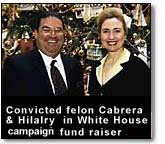
Back in 1996, seems the Clintons were doing then what they are doing today, hanging with criminals that donate.

WASHINGTON DESK – The Justice Department released on Wednesday photographs showing a convicted Miami cocaine trafficer who is seen standing next to and posing with vice president Al Gore. The two were attending a party in Florida last December.

Apparently, Cabrera was asked to make a large donation to the Clinton-Gore campaign in exchange for perks like hob-nobbing with Al Gore and the first lady, Hillary Rodham Clinton.

Jorge Cabrera’s cash contributions to the Clinton-Gore campaign were so generous, that Cabrera was also invited to the White House and gained entrance there without any FBI & Secret Service security clearance.

CNN reported Wednesday that Cabrera’s attorney, Stephen Bronis, said $20,000(given to the Clinton-Gore campaign) was not intended to buy protection for drug smuggling.

‘He had a lobster and stone crab fishery in the Keys and felt that contribution might promote that future course,’ Bronis said.

The Clinton-Gore campaign only returned the $20,000 last week after the full story had reached ABC News, and the Clinton administration had been asked for comment by the media.

Cabrera was arrested in January during a Miami drug bust of nearly three tons of cocaine. Cabrera was arrested and pleaded guilty to one drug count. He was also imprisoned in the 1980s on narcotics charges.

A report that the picture of Cabrera and Gore had been impounded by the Justice Department prompted an angry reaction from Republicans, including Bob Dole’s presidential campaign, House Speaker Newt Gingrich and Rep. Bob Livingston of Louisiana, chairman of the House Appropriations Committee.

Republicans sent letters to Attorney General Janet Reno and the directors of the FBI and the Secret Service seeking information about Cabrera and the campaign contribution.

Livingston asked the federal agencies for a complete accounting of the facts relating to the story within three days: whether Cabrera had dined at the White House, details of his relationship with Clinton and Gore and, if he did dine with them, how he passed FBI & Secret Service scrutiny to gain access to them.

The U.S. attorney’s office in Miami was contacted by reporters. Justice said it would not provide photographs of Cabrera and Gore in Florida and at the White House when reporters requested them on Monday. The Justice Department attempted to claim that Cabrera’s story is coverd by the Privacy Act law in turning down the media request for information on the arrest for cocaine possession of tons of the illegat drug and dealing.

Jant Reno put out information that the photo of Cabrera with Gore and Clinton could not be released without the consent of Cabrera. Later, the Justice Department did release the photographs after Cabrera submitted written authorization.

The delay by the Justice Department appeared to be an effort to distance itself from accusations that are mounting from the American public that the Justice Department is receiving guidance from the Clinton White House and the vice president’s office on the timing of Janet Reno’s investigation.

Justice says it is looking into the breach of National Security by Cabrera’s ready access to secured areas of the White House and its grounds when he entered as an invited quest of president Clinton for dinner and photo-ops.

Then much more recently, like February of 2016, Hillary was busy nurturing the pro-Iran lobby including a fund-raiser.

Clinton will participate in a Menlo Park fundraiser on Sunday hosted by Twitter executive Omid Kordestani and his wife Gisel Hiscock, as well as National Iranian American Council (NIAC) board member Lily Sarafan and Noosheen Hashemi, who serves on the board of the pro-Iran advocacy group Ploughshares, a major funder of pro-Iran efforts.

NIAC, an advocacy group formed by Iranian-Americans to work against the pro-Israel community, has long been accused of lobbying on Iran’s behalf against sanctions and other measures that could harm the Islamic Republic’s interest.

Ploughshares, which partners with NIAC, is joining the White House in efforts to pressure the Jewish community and others to back the recently implemented Iran nuclear agreement, the Free Beacon reported.

The organization has also spent millions to influence coverage of Iran and protect the Obama administration’s diplomatic relations with Iran.

NIAC has emerged a key pro-Iran player in the United States, working with the White House and liberal groups to spin the deal as a positive for U.S. national security.

The group is currently leading the charge to block recent counter-terrorism legislation that would require individuals who have travelled to Iran to obtain a visa before entering the United States. More from FreeBeacon.

Alright so we have established historical relationships with Cuba and Iran and the Clintons. Is there more that we should know? Yes.

  1. Cuban spies in America
  2. The DEA did it’s job but Bill Clinton remained loyal to the Castro brothers
  3. Hillary’s personal global spy, Sidney Blumenthal collaborated on Hezbollah’s new office in Cuba.
  4. In 2011, Hillary’s State Department sent their old friend Bill Richardson to Cuba to bring back an American, Alan Gross, who was an embedded spy working for USAID.
  5. In 2009, Obama and Hillary began the normalization process with Cuba.
  6. Bill Clinton’s old buddy Strobe Talbott collaborated on Cuba with Hillary’s State Department.
  7. Hillary announced that Iran would be invited to an upcoming  multinational conference on Afghanistan
  8. Documents reveal Bill Clinton’s secret contact with Iran
  9. Sid Blumenthal, Jake Sullivan and Hillary on Iran and Israel

Iran’s Cuba and Latin American Tours and Trouble Ahead

While the United States attempted to normalize relations with both Iran and Cuba, it appears the real result is a renewed friendliness between Iran and Cuba at the cost of the U.S. taxpayer, that $1.7 billion or more.

It also must be noted that Cuban refugees continue to appear on American shores but now we must question how many of them are terrorists and what are they bringing with them. Iceberg ahead.

It is also important to note that the Cuban military runs all tourism and the hospitality industry as the United States has opened those travel channels.

****

Related reading: Breaking Sanctions with Cuba?

Cuba is a state sponsor of terrorism, that is until the White House decided it was no longer.

Cuba supports Iran’s nuclear ambitions and opposed IAEA rebukes of secret Iranian enrichment sites. The two countries have banking agreements (Islamic Republic News Agency), economic cooperation and lines of credit ( FNA), and three-way energy-focused treaties with Bolivia (CSMonitor). Cuba and Iran hold regular ‘Joint Economic Commission’ meetings; the latest, in November 2009, further expanded bilateral trade and economic ties.

Related reading: The U.S. has had a Russian Problem of Espionage for Decades

One of Cuba’s largest and long-term industries is spying and selling intelligence and secrets globally.

**** Image result for javad zarif 

Iran says will open new chapter in relations with Cuba

Reuters: Kicking off a six-day tour of Latin America, Iranian Foreign Minister Mohammad Javad Zarif said on Monday in Havana his visit would open a new chapter in the Islamic Republic’s relations with Communist-ruled Cuba.

Iran, which has long been friendly with Cuba, is on a drive to improve foreign commerce after the removal in January of international sanctions against the Islamic Republic.

“We will start a new chapter in the bilateral relations with Cuba on the basis of a big (business) delegation accompanying me on this visit,” Zarif said at a meeting with his Cuban counterpart, Bruno Rodriguez.

The international community lifted sanctions on Iran as part of the deal under which Tehran curbed its nuclear program.

Rodriguez congratulated Iran on the “success of its foreign policy” while reiterating its longstanding support for “all countries to develop nuclear energy with pacific ends”.

Cuba and Iran have in common a long stand-off with the United States. They were both on the U.S. State Department’s list of terrorism sponsoring countries until Havana was removed last year as part of a detente with Washington.

“We have always been on the side of the great Cuban people in view of atrocities and unjust sanctions,” Zarif said.

“The government and Cuban people have also always shown us solidarity with regards to the atrocities committed by the empire.”

Zarif’s tour will also take him to Chile, Nicaragua, Bolivia and Venezuela.

Just last week, Cuba’s new Economy Minister Ricardo Cabrisas made a trip to Tehran where he met with President Hassan Rouhani.

German exports to Iran, mostly machines and equipment, jumped in the first half of the year following the removal of international sanctions against the Islamic Republic, official trade data showed on Monday