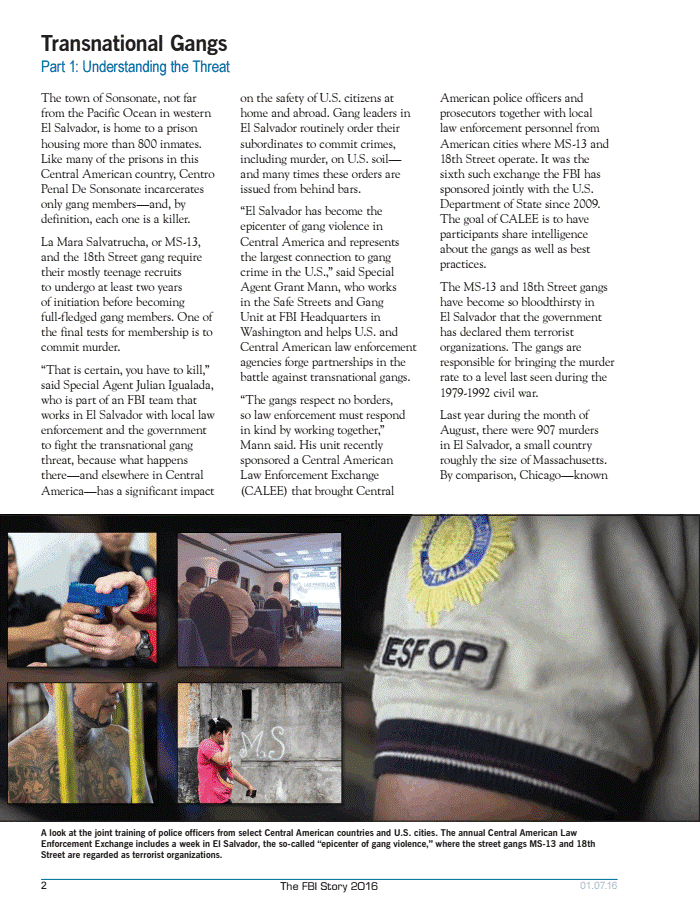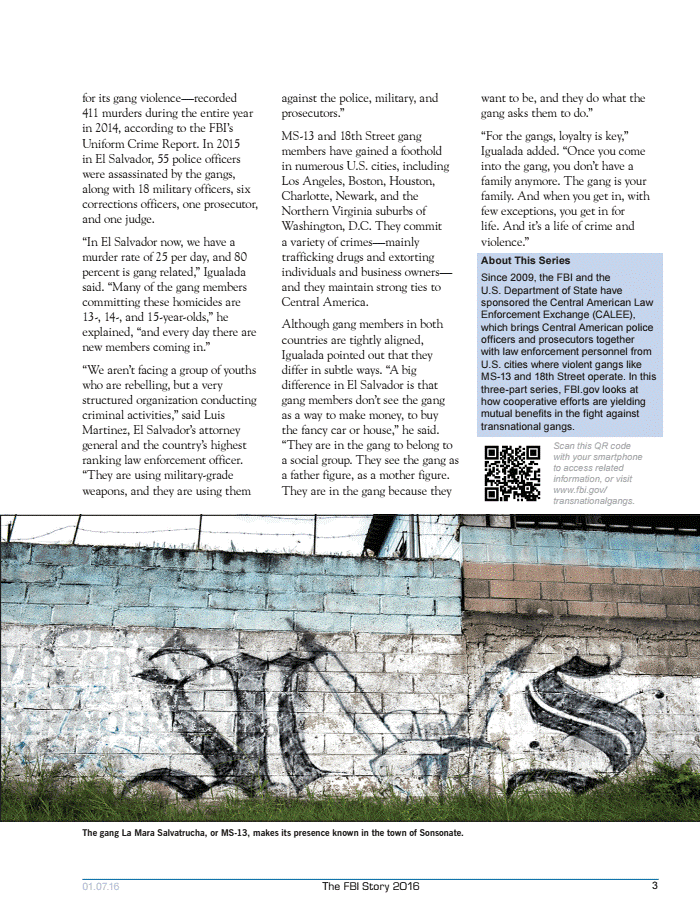
Jeff Sessions/FBI and MS-13

Four members of the violent, foreign MS-13 gang were convicted on federal racketeering charges, some of which involved murder.

Miguel Zelaya, 20-years-old, Luis Ordonez-Vega, 36-years-old, Jorge Sosa, 24-years-old and William Gavidia, 23-years-old, were all convicted on a count of conspiracy to commit racketeering, according to the Charlotte Observer:

Zelaya, who also goes by “Most Wanted” and “Ne Ne” is a member of MS-13’s “Coronados Little Cycos Salvatrucha” clique. On Dec. 18, 2013, he shot and killed Jose Orlando Ibarra, an associate of The Latin Kings, a rival gang, the release said.

Ordonez-Vega, also known as “Big Boy,” is a member of the Brentwood Locos Salvatrucha” clique, according to the news release. On June 6, 2013, Ordonez-Vega shot and killed Noel Navarro Hernandez in a strip mall parking lot in Charlotte, believing the victim was a member of a rival gang.

Sosa, who goes by “Koki” and “Loco” is a member of the “Charlotte Locotes Salvatrucha” clique. Prosecutors say he’s been involved in multiple gang-related crimes. In Feb. 2008, he flashed MS-13 gang signs at a rival gang member’s mother and pointed a gun at her while they were stopped in traffic. In June, 2013, he was involved in a gang-related shooting where he and another person followed victims in a neighborhood in Charlotte and opened fire with a high-caliber rifle, the release said.

All of the gang members are either immigrants or the children of immigrants in the U.S. and they are also facing state charges for their crimes.

“Today’s guilty verdicts underscore that even though gang membership may in some ways ‘protect’ gangsters from outsiders, it certainly won’t protect them from the vast reach of the US. Attorney’s Office and our law enforcement partners,” U.S. Attorney for the Western District of North Carolina Jill Westmoreland Rose said in a statement.

The MS-13 gang members were four of 37 who were charged with racketeering after an investigation into the criminal activity by the Organized Crime Drug Enforcement Task Force. Thirty of the other gang members charged with racketeering are either awaiting sentencing or have pleaded guilty to the charges.

According to the U.S. District Attorney, Ordonez-Vega and Zelaya were convicted on charges to murder in aid of racketeering. Those charges are connected to two separate murders. Meanwhile, Sosa was convicted for attempted murder in the aid of racketeering.

***

Image result for ms-13  InSightCrime

In 2015 the U.S. Treasury Department froze the assets of three members of the gang who were funneling funds back to higher-ups in El Salvador from prison. These actions were an attempt “disrupt” MS-13’s financial network by cutting off profits from illegal activities in the United States, the Treasury Department said. In 2012 the Obama administration designated MS-13 a transnational crime organization and implemented sanctions against six members in 2013.

While the U.S. government attempts to target MS-13’s earnings, targeting its culture is proving more difficult. The fierce loyalty among members is unique, Ron Hosko, former assistant director of the FBI’s Criminal Investigative Division, told FOX Business.

“They’re very cohesive and often directed by imprisoned bosses in El Salvador to recruit and expand in American communities. That tends to mean there’s an aggressive internal enforcement mechanism which equates to internal discipline involving physical violence and murder for disrespect or betrayal,” he said.

The FBI in El Salvador Because of MS-13:

MOAB Dropped in Astan, where Green Beret was Killed

U.S. Bombs, Destroys Khorasan Group Stronghold in Afghanistan

KABUL, Afghanistan, April 13, 2017 — At 7:32 p.m. local time today, U.S. Forces Afghanistan conducted a strike on an Islamic State of Iraq and Syria-Khorasan tunnel complex in Achin district, Nangarhar province, Afghanistan, as part of ongoing efforts to defeat ISIS-K in Afghanistan, according to a U.S. Forces Afghanistan news release

ISIS-K, also known as the Korasan group, is based in the Afghanistan-Pakistan region and is composed primarily of former members of Tehrik-e Taliban Pakistan and the Afghan Taliban.

Image result for gbu-43/b blast radius

The strike used a GBU-43/B Massive Ordnance Air Blast bomb dropped from a U.S. aircraft. The strike was designed to minimize the risk to Afghan and U.S. forces conducting clearing operations in the area while maximizing the destruction of ISIS-K fighters and facilities.

“As ISIS-K’s losses have mounted, they are using [improvised bombs], bunkers and tunnels to thicken their defense,” said Army Gen. John W. Nicholson, commander of U.S. Forces Afghanistan. “This is the right munition to reduce these obstacles and maintain the momentum of our offensive against ISIS-K.”

U.S. forces took every precaution to avoid civilian casualties with this strike and will continue offensive operations until ISIS-K is destroyed in Afghanistan.

*** President Trump did not authorize this strike as several weeks ago, he told the Pentagon he was not going to micromanage Generals in the field, meaning in theater. This was a major complaint by top flag officers and Pentagon officials of Barack Obama and Susan Rice. Rice often negated protocol and directly called military officers at forward operating bases.

***

‘Wilayat Khurasan’: Islamic State Consolidates Position in AfPak Region

Jamestown: Amid a series of government denials from Pakistan and Afghanistan regarding the presence of the Islamic State militant group in these countries and its ongoing outreach activities there, its expansion was corroborated by none other than the Islamic State’s spokesperson, Abu Muhammad al-Adnani, on January 26, 2015 (The Nation [Lahore] September 5, 2014; Dawn [Karachi], November 11, 2014; Pajhwok, February 5). Al-Adnani, who is believed to be in Iraq or Syria, formally announced the establishment of Wilayat Khurasan (literally Khurasan Province, hereafter IS Khurasan), a reference to a historical region broadly centering on Afghanistan and Pakistan. This claim was made, in an audio statement entitled “Say, ‘Die In Your Rage,’” which was released by al-Furqan media foundation, one of the Islamic State’s media arms. [1] He also endorsed a former Taliban commander, Hafiz Saeed Khan, as its governor (wali) in the same speech. Khan had previously pledged allegiance to Abu Bakr al-Baghdadi, the self-proclaimed caliph of the Islamic State, along with a network of other disgruntled Taliban commanders and foot soldiers.

Previously, on January 10, in an indication of their growing extremism, Khan and his followers had released a video pledging allegiance to IS which also featured the beheading of a captive Pakistani soldier (Dunya News TV [Lahore] January 12). This was considered to be the Islamic State’s first violent action against the Pakistani state. Since then, two senior commanders of IS Khurasan have been killed in NATO-led actions in Afghanistan. The first to be eliminated, on February 9 in the Kajaki district of Afghanistan’s Helmand Province, was Abdul Rauf Khadim, the “deputy governor” of Khorasan (Express Tribune [Karachi], February 10). Khadim had previously rejected the Afghan Taliban movement under Mullah Omar for being too moderate and had preached Salafism in Afghanistan. A few weeks later, his successor, Hafiz Wahidi, was killed by Afghan national security forces in Helmand, along with nine other fellow Islamic State militants (Khaama Press, March 16).

In response to these setbacks, IS Khurasan’s shura (leadership council), for now dominated by Pakistani Taliban members, quickly issued threats to avenge Khadim, eulogizing the slain leader. The 12-minute long homage video, released by “Khurasan Media” on March 17, featured a statement from Hafiz Saeed Khan entitled “Departure of Shaykh Khadim and Revenge is Coming.” [2] Sooner afterwards, on March 20, a deadly VBIED (vehicle borne improvised explosive device) attack on a Shi’a mosque in Karachi killed at least two people and left many injured. The attack was reportedly claimed by IS Khurasan?. [3]

Afghanistan: Islamic Emirate vs. Caliphate

These developments suggest that the Islamic State has found a conducive social and political environment in which to gain a foothold in the AfPak region, where several Taliban and al-Qaeda-linked Islamist groups, both violent and non-violent, already have similar sectarian and caliphate-centric worldviews. Underlining this, before his death in February’s drone strike, Khadim was reportedly actively engaged in recruiting Afghan fighters for the Islamic State, mostly in the country’s Helmand region (IBTimes, January 14). This recruitment drive and open campaigning for IS apparently led to direct confrontations with the followers of local Taliban warlord Abdul Rahim Akhund, a supporter of Mullah Omar’s self-declared “Islamic Emirate of Afghanistan.” At one point, as a result of these tensions, Khadim was even briefly apprehended for his pro-Islamic State activities along with his 45 followers by supporters of Mullah Omar (Afghan Zariza, February 1).

In addition, Islamic State flags have been seen hoisted in Afghanistan’s Ghazni and Nimroz provinces, following which large numbers of Taliban fighters reportedly switched allegiance from Mullah Omar to al-Baghdadi (Khaama Press, February 1). Dabiq, the official Islamic State publication, further listed a number of alleged strongholds of support, including Nuristan, Kunar, Kandahar, Khost, Paktia, Paktika, Ghazni, Wardak, Kunduz, Logar and Nangarhar. [4] Furthermore, in January, information about an Islamic State training center in Afghanistan’s Farah province raised speculation about increasing Islamic State activities there (Pajhwok, January 14). Furthermore, other armed confrontations between the Islamic State and the Taliban underscores the increasing clout of IS Khurasan, especially in Charakh in Logar province where IS Khurasan militants killed Abdul Ghani, a senior Taliban commander loyal to Mullah Omar, and wounded his three associates in February (Pajhwok, February 2).

That Islamic State influence is quickly gaining ground in Afghanistan, the current seat of famed Taliban Emirate led by Mullah Omar, is not necessarily surprising. For instance, al-Baghdadi’s public questioning of the spiritual and political credibility of the Taliban’s supreme leader, and description of him as “fool” and “illiterate warlord,” has certainly found some resonance in Afghanistan and Pakistan, where the Taliban and al-Qaeda have not been able to decisively consolidate their position after decades of struggle (Khaama Press, January 29).

Footprints in Pakistan

Before its existence was formally announced, IS Khurasan’s presence was felt across Pakistan in the form of occasional unfurling of the black flag, graffiti on the walls supporting the Caliphate and the appearance of Islamic State stickers, mostly in Karachi, Lahore and the Punjab city of Taxila in late 2014 (Dawn [Karachi], November 13, 2014; Dawn [Karachi], November 30, 2014). At around the same time, the provincial government of Balochistan uncovered massive Islamic State recruitment drives in Hangu district in Khyber Pakhtunkhwa and in the Kurram tribal agency in the Federally Administered Tribal Areas (FATA). It also reportedly discovered secret official communications between long-established Pakistani militant Salafist groups like Lashkar-e-Jhangvi (LeJ), Ahl-e-Sunnat wal Jamat (ASWJ) and the Islamic State, which showed the groups planning attacks on military installations and government buildings in Khyber Pakhtunkhwa and on the region’s Shi’a minority (Dawn [Karachi], November 8, 2014). In addition, this January, the Pakistani security services arrested Yousaf al-Salafi, a Syrian of Pakistani origin, and his local associate Hafiz Tayyab in Lahore for allegedly recruiting youths and sending them abroad for jihad. Al-Salafi was reportedly involved in an Islamic State recruitment campaign and was charging the group about $600 for every person he recruited (Express Tribune [Karachi], January 28).

In addition, leaflets and propaganda materials in support of the Islamic State have been distributed in several parts of Khyber Pakhtunkhwa and South Waziristan. There have also been verbal endorsements from pro-Taliban clerics like Maulana Abdul Aziz, chief of Islamabad’s Red Mosque (Lal Masjid), which was the epicenter of anti-government violence in July 2007. However, the most brazen support came from women students and teachers of the Jamia-e-Hafsa madrassa, which is part of the Red Mosque and led by the principal of the seminary, Umme Hassan, who is Abdul Aziz’s wife (Kashmir Observer, December 8, 2014; Express Tribune [Karachi], December 14, 2014). The students of Jamia-e-Hafsa offered an oath of fealty to al-Baghdadi in late November of last year, and invited al-Baghdadi to “avenge” the 2007 Pakistan army raid and loss of life at the then-besieged Red Mosque. However, Umme Hassan maintained that they still considered Mullah Omar of the Afghan Taliban as their supreme leader. It should be noted that the Lal Masjid has been at the forefront in supporting al-Qaeda and Taliban causes in the region for over a decade.

These developments suggest that similar oaths of allegiance from sectarian militant groups like Ansar ul-Khilafa wal Jihad (formerly, Tehrik-e-Khilafat Jihad) and Jundullah in support of the Islamic State and al-Baghdadi have made it relatively easy for the Islamic State to find traction and a foothold in Pakistan. These militant groups also remain active. For instance, in January, Ansar ul-Khilafa wal Jihad claimed responsibility for killing security personnel in Karachi, Multan and Hyderabad (ARY News, January 22). Jundullah meanwhile claimed responsibility for targeting Shi’a mosques across the country, including the deadly Shikarpur imambargah blast on January 30 (Dawn [Karachi], January 31). This indicates that it would likely be relatively easy for the Islamic State members working with these groups to begin conducting attacks of their own in Pakistan. Unsurprisingly, as with Afghanistan, Dabiq, has claimed that the Islamic State has influence in a number of places in Pakistan, including in Peshawar, Swat, Marwat, Kuki Khel, Tor Dara, Dir, Hangu, Bajaur, Orakzai, Kurram and Waziristan, although some of these claims should probably be seen as propaganda. [5]

Outlook

The Islamic State’s formation of “Wilayat Khurasan” and its endorsement by the organization’s central leadership reveals at least two changing aspects of militant Islamism in the Afghanistan-Pakistan region. Firstly, it shows militants rejecting al-Qaeda and Taliban, and secondly, for the first time in decades, it involves militants clearly rejecting Mullah Omar himself, the spiritual leader of most of the Deobandi-inspired militant groups in the region, and even openly challenging of him over his (alleged) lack of authority and lack of visible achievements in comparison to al Baghdadi and the Islamic State in the Middle East region. On the other hand, the emergence of IS Khurasan, combined with Pakistan’s ongoing anti-militant Operation Zarb-e-Azb, have encouraged fragmented Taliban units to unite once again under the Pakistani Taliban’s umbrella group, the Tehrik-e-Taliban Pakistan (TTP). This was evidenced in mid-March when the Tehrik-e-Taliban Pakistan Jamaat ul-Ahrar (TTP-JA), a powerful splinter group of TTP, and independent militant group Tehrik-e-Lashkar-e-Islam (TLeI), led by Mangal Bagh, called for a united Taliban conglomerate to fight the Pakistani state, including the army and the powerful Inter-Services Intelligence. [6] Even though such a scenario seems distant at present, these anti-state objectives, which are partly shared by both the IS Khurasan and TTP groups, suggest a potential merging point between these two powerful jihadist movements in due course.

***

Florida-based Green Beret identified as US soldier killed in Afghanistan

  WASHINGTON — Staff Sgt. Mark R. De Alencar has been identified by the Pentagon as the Green Beret killed Saturday fighting Islamic State in eastern Afghanistan.

The Florida-based soldier died in Nangarhar Province when his unit was attacked by enemy small arms fire during combat operations against ISIS, according to a Pentagon statement Monday. The 37-year-old was assigned to 1st Battalion, 7th Special Forces Group at Eglin Air Force Base. De Alencar was from Edgewood, Maryland.

American forces in Afghanistan are primarily charged with advising and assisting Afghan security forces as part of NATO’s Resolute Support mission, but the U.S. military also conducts counterterrorism combat operations against groups such as ISIS and al-Qaida under its unilateral Freedom’s Sentinel operation. Pentagon officials have said destroying the ISIS affiliate in Afghanistan is among the top goals for the United States in the country for 2017.

De Alencar recently joined Special Forces as a weapons sergeant after completing the Qualification Course in September 2016, according to Army Special Operations Command. He joined the Army in 2009 and had served previously as an infantryman, including deployments to Iraq.

His awards and decorations included the Ranger Tab, Special Forces Tab, the Purple Heart, Six Army Commendation Medals, Combat Infantryman Badge and Expert Infantryman Badge.

The soldier was a 1998 graduate of Joppatowne High School in Joppa, Maryland. He and his wife Natasha had five children, according to a Facebook page for the high school’s alumni. Several alumni on the page offered condolences to De Alencar’s family and some of them noted he had long sought to join Special Forces.

De Alencar came from a military family, according to Army Special Operations Command. He was born in a military hospital in Germany where his father was stationed. He later lived in Texas before moving to Maryland.

De Alencar was the first American killed in action in Afghanistan in 2017. Ten U.S. servicemembers were killed in hostile situations in Afghanistan in 2016, according to the website icasualties.org, which tracks those numbers. Since U.S. troops first invaded Afghanistan in 2001, 2,217 American have been killed there and some 20,000 more have been wounded in action, according to the Pentagon.

“On behalf of all of U.S. Force -Afghanistan, I offer our deepest condolences to the family and friends of our fallen comrade,” Gen. John Nicholson, the top U.S. commander in Afghanistan, said Saturday in a statement. “We will always remember our fallen comrades and commit ourselves to deliver on their sacrifice.”

The United States and Afghan special forces are battling ISIS in the small portion of Nangarhar Province that the terrorist group still controls. Pentagon officials said ISIS is confined to only a few district centers and has lost nearly half its fighters in Afghanistan in the last year.

European Union’s Attention and Dollars on Failing Africa

Image result for sahel region

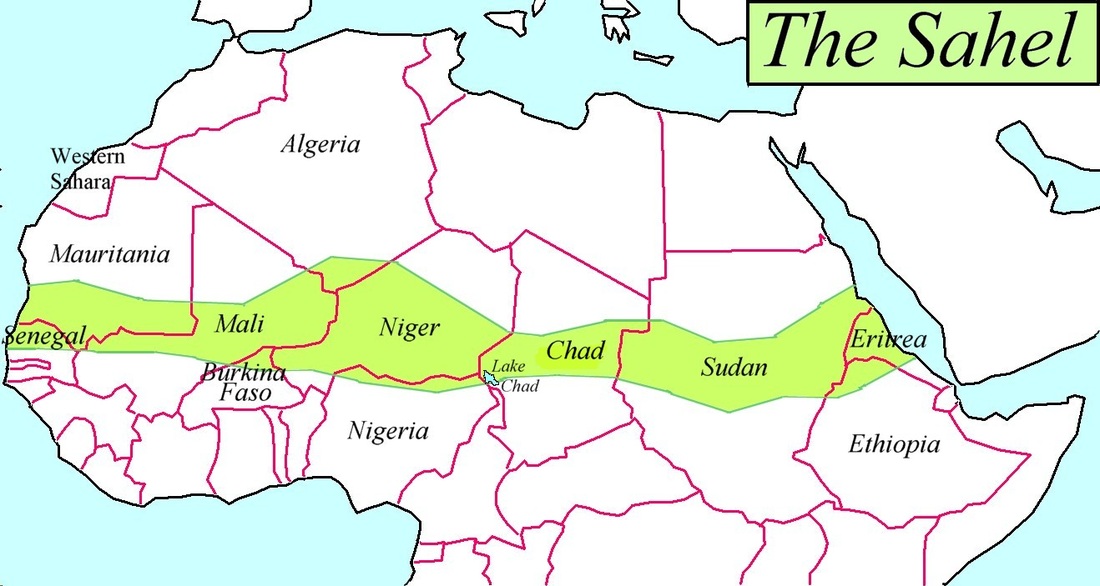
The European Commission has launched an “Emergency Trust Fund for stability and addressing root causes of irregular migration and displaced persons in Africa”, made up of €1.8 billion from the EU budget and European Development Fund, combined with contributions from EU Member States and other donors. The Trust Fund will benefit a wide range of countries across Africa that encompass the major African migration routes to Europe. These countries are among the most fragile and those most affected by migration. They will draw the greatest benefit from EU financial assistance. The countries and regions are:

The Sahel region and Lake Chad area: Burkina Faso, Cameroon, Chad, the Gambia, Mali, Mauritania, Niger, Nigeria and Senegal.

The Horn of Africa: Djibouti, Eritrea, Ethiopia, Kenya, Somalia, South Sudan, Sudan, Tanzania and Uganda.

The North of Africa: Morocco, Algeria, Tunisia, Libya and Egypt.

Neighbouring countries of the eligible countries may benefit, on a case by case basis, from Trust Fund projects with a regional dimension in order to address regional migration flo ws and related cross- border challenges. Read the full document here.

EU Economic and Military Investments in Africa Increase
Africa faces a number of security challenges, from terrorist groups such as Boko Haram and al Shabaab, to civil wars and violent conflicts in South Sudan and Libya, to severe droughts causing hunger crises in Somalia and Yemen.

This instability contributes to migration from Africa to Europe. In addition, a demographic boom is taking hold in Africa, stoking concerns about future mass migration. “Today, Africa is twice the population of Europe. In 2050, it will be four times the population of Europe, and it is projected at the end of this century to be 10 times the population of Europe. … There is a sense in many political circles in Europe that what’s happening today is just the beginning of a much bigger movement that could reach Europe tomorrow,” Philippe Fargues, founding Director of the Migration Policy Centre at the European University Institute in Italy, told The Cipher Brief.

The European Union is intervening. On the migration front, the EU is engaged in Partnership Framework Agreements with several African countries to stem the flow of migrants. “This was followed up with the setting up of the EU Emergency Trust Fund for Africa (a €2 billion aid program aimed at securing African countries’ cooperation in tackling irregular migration), leading to the initial signing of bilateral agreements with Niger, Nigeria, Mali, Senegal and Ethiopia” says the Abuja, Nigeria-based Director of the Centre for Democracy and Development, Idayat Hassan.

Niger, for example, is receiving €610 million to keep migrants from reaching Europe, Hassan says, and German Chancellor Angela Merkel has pledged €17 million to Niger to help develop the Agadez region, a major route for West African migrants.

Germany seems to be leading European action in Africa. Last year, German Development Minister Gerd Müller unveiled a “Marshall Plan” for the continent. “Germany and Europe have an interest to save people’s lives, to limit the effects of climate change and avoid ‘climate refugees,’ to prevent mass migration and to help create a future for Africa’s youth,” said Müller.

Asmita Parshotam, a researcher under the Economic Diplomacy Programme at the South African Institute of International Affairs, tells The Cipher Brief that this plan is intended to “cover a broad range of issues such as trade, increased private investment, bottom-up economic development, entrepreneurship, and job creation and employment.”

In addition to Germany’s unilateral aid to Africa, the EU recently announced its EU External Investment Plan that will help expand Africa’s private sector, with €3.35 billion in funding until 2020 and €88 billion if EU member states fully match that contribution.

The European Development Fund and African Investment Facility also provide economic development assistance from the EU to Africa.

In the development-security aid realm lies the EU Sahel Strategy, launched in April 2015. “The enhancement of security in the region through the fight against terrorism, illicit trafficking, radicalisation and violent extremism, remains the key objective of the EU,” according to a memo on the EU Sahel Strategy from the Council of the European Union.

EU member states also host a number of military bases in Africa. France, Germany, Italy, and Spain all have boots on the ground in Djibouti. France’s presence there is now around 1,700 personnel.

About 3,500 French troops operate in Burkina Faso, Chad, Mali, Mauritania, and Niger, and Gabon is a key base that France has used to send troops to interventions in the Central African Republic. France last year boosted its military presence in Cote d’Ivoire to about 900 men to serve as a forward operating base for West Africa.

The French, along with the Germans, are also in Niger. Germany has an air transport base at the Niamey international airport that supports its increasing troop contribution to the UN’s peacekeeping mission in Mali, a country that underwent a rebellion and coup in 2012 and a serious deterioration in the security environment in January 2013 when terrorist groups – Ansar Dine and the Movement for Unity and Jihad in West Africa, in addition to al Qaeda in the Islamic Maghreb – advanced south.

A majority of UN peacekeeping missions, in which many Europeans are involved, are in Africa.

The question remains, will the EU’s economic and military investment in Africa work in stabilizing a continent plagued by terror, war, drought and famine, extreme poverty, and inadequate governance?

Müller’s “Marshall Plan” acknowledges that African governments must take responsibility for fighting corruption, ensuring good governance, and improving opportunities for women.

The EU has made much of its development aid contingent on African governments’ cooperation in addressing the EU’s security concerns. For example, on migration, Parshotam notes that an EU-Mali deal will give Mali aid in exchange for Mali taking back all citizens whose asylum claims were rejected.

But with African countries that have no stable government to work with, it becomes harder for the EU to invest in and create stability. “Libya is a failing state – there’s no central authority,” Leonard Doyle, Spokesperson of the Director General at the International Organization for Migration, told The Cipher Brief. “So the Europeans have not been able to reach a coherent agreement with Libya [on migration]. Although there is a lot of pressure now, especially militarily, to stop the smugglers, and economically as well, to help Libya get back on its feet,” he said.

“I think we are completely wrong in our policies,” said Fargues. “The amount of money contributed to African development is too small, but also in the short term and medium term, development will not curb migration,” he said, because the African population continues to grow, while Europe’s continues to shrink. “We have to get prepared for migration.”

 

U.S. to Boycott U.N. Human Rights Council Meeting

The Israel apartheid report was authored by Richard Falk, a former U.N. human rights investigator for the Palestinian territories, and Virginia Tilley, professor of political science at Southern Illinois University. Before leaving his post as U.N. special rapporteur on human rights in the Palestinian territories in 2014, Falk said Israeli policies bore unacceptable characteristics of colonialism, apartheid and ethnic cleansing. More here.

Trump Admin to Boycott U.N. Council Over Anti-Israel Agenda

In First, U.S. Will Not Attend U.N. Human Rights Council Meeting

The Trump administration will boycott the United Nation’s Human Rights Council, or UNHRC, due to its efforts to advance an anti-Israel agenda, according to senior administration officials familiar with the effort who spoke to the Washington Free Beacon.

The UNHRC, which includes member countries cited for mass human rights abuses, is poised on Monday to adopt at least five anti-Israel resolutions, prompting outrage in the Trump administration over what officials described as the council’s unjust bias against the Jewish state.

The action on these items has prompted the Trump administration to boycott the council and refuse to attend the Monday meeting, according to administration officials apprised of the situation who spoke with the Free Beacon.

The boycott comes on the heels of the resignation of a Jordanian U.N. official who had sought to advance an anti-Israel agenda opposed by the United States and other nations.

Trump administration officials said the increased pressure on the U.N. is part of a larger effort by U.S. Ambassador Nikki Haley to significantly reform the international organization and root out those who use it as a platform to push anti-Israel initiatives.

On Monday, the UNHRC is set to consider an agenda known as the “human rights situation in Palestine and other occupied Arab territories.” It is said to include several anti-Israel declarations that the Trump administration fiercely objects to.

Senior Trump administration officials who spoke to the Free Beacon said the upcoming resolutions affirm the U.N.’s unacceptable bias against Israel, which remains the only member nation that has specific agenda items aimed against it.

The efforts to criticize Israel threaten the council’s credibility and are said to have motivated the Trump administration to boycott Monday’s meeting.

Haley and other senior administration officials have determined that this anti-Israel bias must be addressed before the U.S. rejoins the council and gives it legitimacy, according to sources.

The Trump administration told the Free Beacon it is fully committed to voting against “every resolution” targeting Israel and that it will encourage allies to do the same.

“The argument that the U.S. has to participate in bodies like the United Nations Human Rights Council or risk losing our influence over it is ridiculous,” said one senior administration official familiar with the boycott. “The UNHRC is, like its predecessor, morally bankrupt and the only good news is that its actions have little practical effect in the real world. We’ve wasted enough time and money on it.”

The declaration signals a vast departure from the Obama administration, which, in its final days in office, helped craft and garner support for a fiercely anti-Israel resolution. The Obama administration’s efforts, which were widely condemned by Israel and U.S. pro-Israel groups, broke with decades of U.S. policy when it promoted this effort.

Newly installed Secretary of State Rex Tillerson stated recently that the United States intends boycott the UNHRC until it implements much needed reforms, chiefly its anti-Israel bias.

The latest move is meant to bolster this policy and send a message that the UNHRC’s bias against Israel must cease before the U.S. considers the group legitimate.

The Trump administration intends to vote against every U.N. resolution against Israel and will urge other nations to do the same, according to officials.

The administration also is pushing other nations to criticize the UNHCR’s anti-Israel bias and promote significant reforms.

*** Just a few days ago VoA reported:

U.N. Under-Secretary General and ESCWA Executive Secretary Rima Khalaf reacts during a news

The head of the U.N. West Asia Commission has resigned under pressure, after refusing to withdraw a controversial report that said Israel has established an “apartheid regime” that discriminates against Palestinians.

Rima Khalaf, a Jordanian who heads the U.N. Economic and Social Commission for Western Asia (ESCWA), told reporters Friday in Beirut that she could not accept a demand by Secretary-General Antonio Guterres for her to withdraw the report.

“I asked him to rethink his decision, he insisted, so I submitted my resignation from the U.N.,” she said.

The report titled “Israeli Practices Toward the Palestinian People and the Question of Apartheid” was published earlier this week, and drew immediate criticism from U.N., U.S. and Israeli officials.

****

United Nations (United States) (AFP) – The United States on Wednesday demanded that UN Secretary-General Antonio Guterres withdraw a report by a UN body accusing Israel of imposing apartheid on the Palestinians.

Guterres distanced himself from the report by the UN Economic and Social Commission for Western Asia (ESCWA) but US Ambassador Nikki Haley said it should be scrapped altogether.

“The United States is outraged by the report,” said Haley in a statement.

“The United Nations secretariat was right to distance itself from this report, but it must go further and withdraw the report altogether.”

The study concluded that “available evidence established beyond a reasonable doubt that Israel is guilty of policies and practices that constitute the crime of apartheid.”

Based in Beirut, ESCWA is comprised of 18 Arab countries, according to its website, which lists the state of Palestine as a full member, and works to strengthen cooperation and promote development.

UN spokesman Stephane Dujarric said “the report as it stands does not reflect the views of the secretary-general” and was done without consultations with the UN secretariat.

One of the authors is Richard Falk, a former special UN rapporteur on Palestinian human rights.

“That such anti-Israel propaganda would come from a body whose membership nearly universally does not recognize Israel is unsurprising,” said Haley.

She described Falk as “a man who has repeatedly made biased and deeply offensive comments about Israel and espoused ridiculous conspiracy theories”.

Haley has accused the United Nations of being biased against Israel and has vowed as President Donald Trump’s envoy to staunchly defend Israel at the world body.

Israel’s ambassador Danny Danon condemned the report, describing it as an “attempt to smear and falsely label the only true democracy in the Middle East by creating a false analogy.”

Danon said to label Israel as an apartheid regime was “despicable” and “a blatant lie.”

The report found that Palestinians were subjected to a “strategic fragmentation” that allowed Israel to impose “racial domination” with different sets of laws by geographic regions.

The analysis showed “beyond a reasonable doubt” that “Israel is guilty of imposing an apartheid regime on the Palestinian people, which amounts to the commission of a crime against humanity.”

The furor came ahead of a Security Council meeting next week to hear the first report from the United Nations on implementing a resolution demanding an end to Israeli settlement building.

***

Member states include the list below and the administrative budget of ESCWA is funded from the financial resources of the United Nations, the major portion of which comes from the contributions of member States.

Member states

North Korea’s Weapons Program Includes More Countries

We can go back to 1968 when North Korea hijacked our naval intelligence ship USS Pueblo as a reminder for the basis on how to address North Korea today.

Image result for uss puelbo

Then as today, Russia collaborated with North Korea as does Iran. North Korea dispatched 2 MiG fighter jets along with several attack submarines in the capture of the Pueblo. At the time was also the Vietnam war of which Russia provided unmeasured military support to North Vietnam and did not want to add another theater of conflict with the United States, as noted by the Blue House raid.  noted by the In fact, China cannot be overlooked either for many reasons.

Newly placed U.S. Secretary of State Rex Tillerson is traveling the region meeting with Asian leaders on the matter of stopping North Korea. The question is how far and wide are these talks with regard to additional countries cooperation with North Korea.

As for Iran and North Korea, The Telegraph reported the following:

The Shahab-3 is a modified version of North Korea’s Nodong missile which itself is based on the old Soviet-made Scud.

The Nodong, which Iran secretly acquired from North Korea in the mid-1990s, is designed to carry a conventional warhead. But Iranian engineers have been working for several years to adapt the Shahab-3 to carry nuclear weapons.

“This is a major breakthrough for the Iranians,” said a senior US official. “They have been trying to do this for years and now they have succeeded. It is a very disturbing development.”

The Shahab 3 has a range of 800 miles, enabling it to hit a wide range of targets throughout the Middle East – including Israel.

Image result for north korea high thrust engine UPI

Further in 2015, Forbes reported collaboration between Iran and North Korea where the exchange of engineers and scientists between the two countries is common:

North Korea and Iran are believed to be exchanging critical stuff – North Korean experts and workers remaining in place while Iran sends observers to check out intermittent North Korean missile launches and see what North Korea is doing about staging a fourth underground nuclear explosion.

The nuclear exchange revolves around North Korea’s program for developing warheads with highly enriched uranium – with centrifuges and centrifuge technology in part acquired from Iran. At the same time, North Korea is able to assist Iran in miniaturizing warheads to fit on missiles – a goal the North has long been pursuing – and also can supply uranium and other metals mined in its remote mountain regions.

“North Korea continues to supply technology, components, and even raw materials for Iran’s HEU weaponization program,” says Bruce Bechtol, author of numerous books and studies on North Korea’s military and political ambitions. Moreover, he says, “They are even helping Iran to pursue a second track by helping them to build a plutonium reactor.”

That assessment supports the view of analysts that Iran is counting on North Korean expertise in constructing a reactor that produces warheads with plutonium. The reactor would be a more powerful version of the aging five-megawatt “experimental” reactor with which the North has built perhaps a dozen warheads at its nuclear complex at Yongbyon, including three that it’s tested underground — in October 2006, May 2009 and February 2013, two years ago this month.

Then comes China, where the entire North Korea internet platform used by North Korea is hosted by China. Beyond managing cyber systems for North Korea, China is also collaborating with North Korea on nuclear weapons at key production sites producing lithium for thermonuclear and boosted fission research and development.

Sanctions have been placed on North Korea due to violations of UN resolutions due to the weapons of mass destruction operations which does include missiles and the nuclear program. However, North Korea has not been affected with regard to the research/development and production due to out of country front operations where China and Malaysia are involved.

Forbes also reported:

Although the UN resolutions have highly restricted North Korea’s access to the financial system on paper, the report suggests that these sanctions have not affected the ability of North Korean networks such as Pan Systems Pyongyang to finance its operations, asserting that the network maintains bank accounts in China, Malaysia, Singapore, Indonesia, and the Middle East. By conducting financial transactions under the names of its affiliates such as Pan Systems Singapore, the company has been able to maintain sufficient financial access to the international financial system that it was able to transfer funds to a supply chain of more than twenty companies in China, and has also used front companies to conduct transactions via Hong Kong-registered companies that were cleared through U.S. correspondent banks in New York. The Panel of Experts report also provides details on the interception in the Suez Canal of the Cambodian-flagged and North Korean-crew piloted Jie Shun in what it categorizes as the “largest interdicted ammunition consignment in DPRK sanctions history,” superseding the 2013 interdiction of the North Korean flagged Chong Chon Gang ship that was loaded with vintage Cuban munitions and airplane parts. The interdiction of the Jie Shun by Egypt revealed a cargo from North Korea through the Suez Canal containing 30,000 PG-7 rocket propelled grenades (RPG) and related sub-components shipped in wooden crates concealed under 2,300 tons of limonite (iron ore). The Jie Shun evaded detection by cutting off GPS during most of its journey, with the exception of transit through heavily trafficked straits and ports. The shipment from Haeju in North Korea to an undisclosed Middle Eastern destination were falsely labeled as “assembly parts for an underwater pump,” and the bill of lading showed the address of the “Dalian Haoda Petroleum Chemical Company, Ltd.”

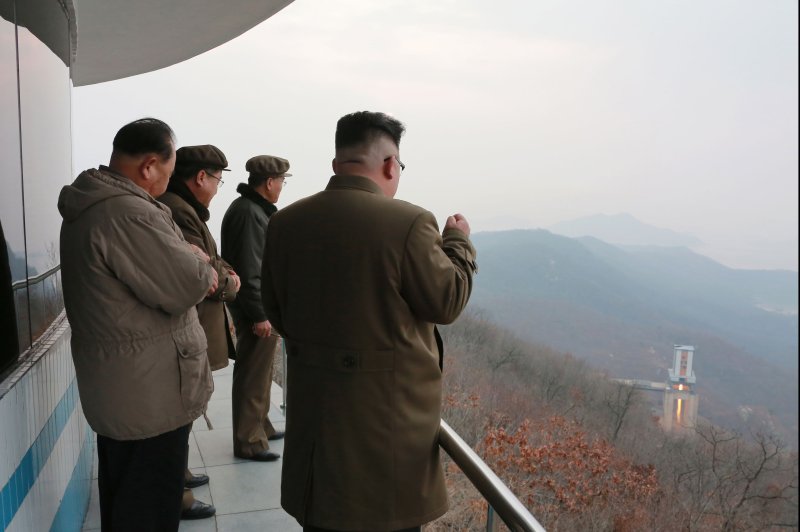
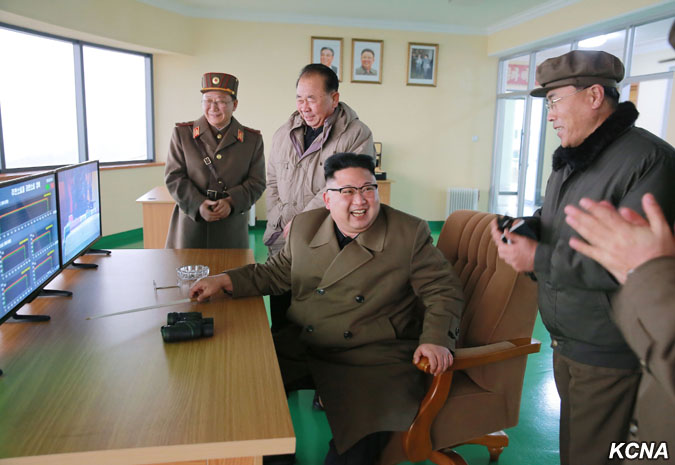
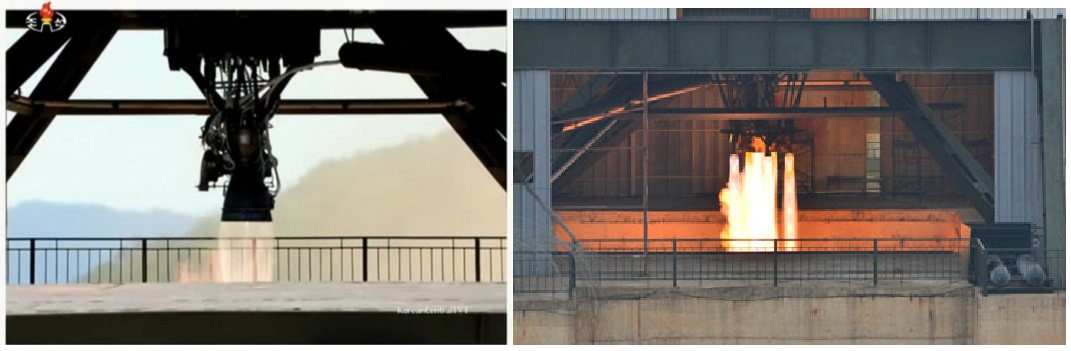
Rex Tillerson stated that ‘strategic patience’ has run out with regard to North Korea and all options remain on the table including preemptive strikes. North Korea has launched 46 missiles since 2011 and the most recent launch was to test a super high thrust rocket steering engine which was designed by Russian blueprints and engineers.

 Tillerson at the DMZ lexpress.fr

The addition of a four-chamber steering engine further points toward a design rooted in Soviet missile technology as RD-250 and its descendants – when used on the R-36 missile and Tsiklon-2/3 orbital launchers – were coupled with a four-chamber RD-68M steering engine.

Photo: KCNA

This engine adaptation in all likelihood uses Unsymmetrical Dimethylhydrazine and Nitrogen Tetroxide propellants – a more powerful combination in terms of specific impulse compared to the Nitric Acid / UDMH propellant used by North Korea’s Unha booster

September 2016 Test Setup vs- March 2017 Test Setup – Images: KCTV/KCNA