More than Half of Immigrants on Welfare

Contrary to declaration from the White House:

How do immigrants strengthen the U.S. economy? Below is our top 10 list for ways immigrants help to grow the American economy.

  1. Immigrants start businesses. According to the Small Business Administration, immigrants are 30 percent more likely to start a business in the United States than non-immigrants, and 18 percent of all small business owners in the United States are immigrants.
  2. Immigrant-owned businesses create jobs for American workers. According to the Fiscal Policy Institute, small businesses owned by immigrants employed an estimated 4.7 million people in 2007, and according to the latest estimates, these small businesses generated more than $776 billion annually.
  3. Immigrants are also more likely to create their own jobs. According the U.S. Department of Labor, 7.5 percent of the foreign born are self-employed compared to 6.6 percent among the native-born.
  4. Immigrants develop cutting-edge technologies and companies.  According to the National Venture Capital Association, immigrants have started 25 percent of public U.S. companies that were backed by venture capital investors. This list includes Google, eBay, Yahoo!, Sun Microsystems, and Intel.
  5. Immigrants are our engineers, scientists, and innovators. According to the Census Bureau, despite making up only 16 percent of the resident population holding a bachelor’s degree or higher, immigrants represent 33 percent of engineers, 27 percent of mathematicians, statisticians, and computer scientist, and 24 percent of physical scientists. Additionally, according to the Partnership for a New American Economy, in 2011, foreign-born inventors were credited with contributing to more than 75 percent of patents issued to the top 10 patent-producing universities.
  6. Immigration boosts earnings for American workers. Increased immigration to the United States has increased the earnings of Americans with more than a high school degree. Between 1990 and 2004, increased immigration was correlated with increasing earnings of Americans by 0.7 percent and is expected to contribute to an increase of 1.8 percent over the long-term, according to a study by the University of California at Davis.
  7. Immigrants boost demand for local consumer goods. The Immigration Policy Center estimates that the purchasing power of Latinos and Asians, many of whom are immigrants, alone will reach $1.5 trillion and $775 billion, respectively, by 2015.
  8. Immigration reform legislation like the DREAM Act reduces the deficit.  According to the nonpartisan Congressional Budget Office, under the 2010 House-passed version of the DREAM Act, the federal deficit would be reduced by $2.2 billion over ten years because of increased tax revenues.
  9. Comprehensive immigration reform would create jobs. Comprehensive immigration reform could support and create up to 900,000 new jobs within three years of reform from the increase in consumer spending, according to the Center for American Progress.
  10. Comprehensive immigration reform would increase America’s GDP.The nonpartisan Congressional Budget Office found that even under low investment assumptions, comprehensive immigration reform would increase GDP by between 0.8 percent and 1.3 percent from 2012 to 2016.

Report: More than half of immigrants on welfare

USA Today: More than half of the nation’s immigrants receive some kind of government welfare, a figure that’s far higher than the native-born population’s, according to a report to be released Wednesday.

About 51% of immigrant-led households receive at least one kind of welfare benefit, including Medicaid, food stamps, school lunches and housing assistance, compared to 30% for native-led households, according to the report from the Center for Immigration Studies, a group that advocates for lower levels of immigration.

Those numbers increase for households with children, with 76% of immigrant-led households receiving welfare, compared to 52% for the native-born.

The findings are sure to fuel debate on the presidential campaign trail as Republican candidates focus on changing the nation’s immigration laws, from calls for mass deportations to ending birthright citizenship.

Steven Camarota, director of research at the center and author of the report, said that’s a much-needed conversation to make the country’s immigration system more “selective.”

“This should not be understood as some kind of defect or moral failing on the part of immigrants,” Camarota said about the findings. “Rather, what it represents is a system that allows a lot of less-educated immigrants to settle in the country, who then earn modest wages and are eligible for a very generous welfare system.”

Linda Chavez agrees with Camarota that the country’s welfare system is too large and too costly. But Chavez, a self-professed conservative who worked in President Reagan’s administration, said it’s irresponsible to say immigrants are taking advantage of the country’s welfare system any more than native-born Americans.

Chavez said today’s immigrants, like all other immigrant waves in the country’s history, start off poorer and have lower levels of education, making it unfair to compare their welfare use to the long-established native-born population. She said immigrants have larger households, making it more likely that one person in that household will receive some kind of welfare benefit. And she said many benefits counted in the study are going to U.S.-born children of immigrants, skewing the findings even more.

“When you take all of those issues into account, (the report) is less worrisome,” she said.

Chavez, president of the Becoming American Institute, a conservative group that advocates for higher levels of legal immigration to reduce illegal immigration, said politicians should be careful about using the data. Rather than focus on the fact that immigrants are initially more dependent on welfare than the U.S.-born, she said they should focus on studies that show what happens to the children of those immigrants.

“These kids who get subsidized school lunches today will go on to graduate high school … will go on to college and move up to the middle class of America,” Chavez said. “Every time we have a nativist backlash in our history, we forget that we see immigrants change very rapidly in the second generation.”

The center’s report is based on 2012 data from the Census Bureau’s Survey of Income and Program Participation. It includes immigrants who have become naturalized citizens, legal permanent residents, those on short-term visas and undocumented immigrants.

Camarota said one of the most shocking findings from the report was the high number of native-born Americans also on welfare. About 76% of immigrant households with children are on welfare, but so are 52% of native-born households with children.

“Most people have a sense that if you were to work for $10 an hour, 40 hours a week, you couldn’t be receiving welfare, could you? You couldn’t be living in public housing, could you?” he said. “The answer is yes, you can. That’s one of the most surprising things about this study.”

Other findings in the report:

  • Immigrants are more likely to be working than their native-born neighbors. The report found that 87% of immigrant households had at least one worker, compared to 76% for native households.
  • The majority of immigrants using welfare come from Central America, Mexico and the Caribbean. The use of welfare is lower for immigrants from East Asia (32%), Europe (26%) and South Asia (17%).
  • Immigrants who have been in the U.S. more than 20 years use welfare less often, but their rates remain higher than native-born households.
  • If you need some immigration advice, contact a team of immigration lawyers who will help you out.


Truth of the Iran Lobby

All Republicans in the Senate are ‘NO’ votes on the Iran deal and there is an estimated 12 Democrats so far that are staying with a NO vote, the rest of the Democrats have declared they will vote with the White House, when not one Senator has had any access to the side deals.

The White House has declared they don’t need any part of Congress to approve the deal, it is done. Further, the Iran deal is non-binding which is to say Iran does not need to comply with any part of the JPOA.

Meanwhile, you may be interested to know who the Iran Lobby is in Washington DC and the influence they have with legislators and the White House. Simply, money votes.

The text below is the perfect model for how all politics work in Washington DC. Chilling but true.

Meet the Iran Lobby

In the fight over sanctions and the nuclear deal, how did the supposedly all-powerful pro-Israel lobby lose to the slick operatives of the National Iranian American Council?

The Words you Use can Be a Cause for Investigation

On the knife’s edge, Americans are threatened by some entity every day. It is the work of government to keep the homeland safe and the methods or tactics used can infringe on our protected rights.

Wonder what words are used in Hillary’s emails….

When it comes to words, the Department of Homeland Security has a list and they have systems to cultivate interactions on the internet where social media platforms such as Facebook and Twitter and YouTube are the top three locations where you are being watched. Have you ever posted something to Facebook and it was removed?

This is not a new circumstance, but often we need to be reminded.

Dept. of Homeland Security Forced to Release List of Keywords Used to Monitor Social Networking Sites

Forbes: If you are thinking about tweeting about clouds, pork, exercise or even Mexico, think again. Doing so may result in a closer look by the U.S. Department of Homeland Security.

In a story appearing earlier today on the U.K’s Daily Mail website, it was reported that the DHS has been forced to release a list of keywords and phrases it uses to monitor various social networking sites. The list provides a glimpse into what DHS describes as “signs of terrorist or other threats against the U.S.”

The list was posted by the Electronic Privacy Information Center who filed a request under the Freedom of Information Act, before suing to obtain the release of the documents. The documents were part of the department’s 2011 ’Analyst’s Desktop Binder‘ used by workers at their National Operations Center which instructs workers to identify ‘media reports that reflect adversely on DHS and response activities’.

The information sheds new light on how government analysts are instructed to patrol the internet searching for domestic and external threats. The Daily Mail’s article noted the Electronic Privacy Information Center wrote a letter to the House Homeland Security Subcommittee on Counter-terrorism and Intelligence, describing it’s choice of words as ‘broad, vague and ambiguous’.

What wasn’t disclosed is how the agency actually gains access to the various search engines and social networks to monitor the specified keywords. My guess is the DHS has a “special arrangement” with companies like Google GOOG -1.94%, Facebook FB -1.12%, Microsoft MSFT +0.00%, Yahoo and Twitter to gain secure direct API access. This type of access would allow it to use distributed cloud technologies to monitor the daily flow of social media and search activity in something close to real time.

I would love to learn more about the technologies used to accomplish this type of social / web monitoring. The applications for monitoring trends and social statics are fascinating when applied to other industry sectors. Given the extent of the monitoring, I’m sure this post itself is now coming up on the DHS radar, so please feel free to leave a comment with any insights.

2014:

(Update 1: Reading through the Desktop Binder, I discovered the DHS Twitter account is @dhsnocmmc1 and DHS appears to be using tweetdeck to monitor the various keywords. See Page 38 – Also interesting to note they seem to be using a Mac Mini as a server, and no password vaults. All Passwords appear to be shared in a plain text word document.)

(Update 2: On page 37, DHS instructs analysts to accept invalid SSL certificates forever without verification. Although invalid SSL warnings often appear in benign situations, they can also signal a man-in-the-middle attack. Not a good practice for the security conscious. Thanks to @obraon twitter for the tip.)

 List1

List

list3

For the full DHS document, click here.

Destruction by Foreign Hackers Cannot be Measured

The job of the future appears to be cyber soldiers, warriors trained to protect America from cyber-terrorism.

US Army Looks Inward for Next Batch of Cyber Specialists

The Army has turned to its own ranks in hopes of satisfying its growing need for talented cybersecurity professionals.

In June, the agency announced that all E-1- through E-8-ranked soldiers, regardless of their technical background, could apply to participate in a yearlong cyber training program, according to a recent Army press release.

Those successful candidates who complete the program would then be reclassified into the 17C military occupational specialty – also known as cyber operations specialist.

As cyber operations specialists, these soldiers will be tasked with supporting the military through offensive and defensive cyber operations.

China and Russia are using hacked data to target U.S. spies, officials say

LATimes:

Foreign spy services, especially in China and Russia, are aggressively aggregating and cross-indexing hacked U.S. computer databases — including security clearance applications, airline records and medical insurance forms — to identify U.S. intelligence officers and agents, U.S. officials said.

At least one clandestine network of American engineers and scientists who provide technical assistance to U.S. undercover operatives and agents overseas has been compromised as a result, according to two U.S. officials.

The Obama administration has scrambled to boost cyberdefenses for federal agencies and crucial infrastructure as foreign-based attacks have penetrated government websites and email systems, social media accounts and, most important, vast data troves containing Social Security numbers, financial information, medical records and other personal data on millions of Americans.


Counterintelligence officials say their adversaries combine those immense data files and then employ sophisticated software to try to isolate disparate clues that can be used to identify and track — or worse, blackmail and recruit — U.S. intelligence operatives.

Digital analysis can reveal “who is an intelligence officer, who travels where, when, who’s got financial difficulties, who’s got medical issues, [to] put together a common picture,” William Evanina, the top counterintelligence official for the U.S. intelligence community, said in an interview.

Asked whether adversaries had used this information against U.S. operatives, Evanina said, “Absolutely.”

Evanina declined to say which nations are involved. Other U.S. officials, speaking on condition of anonymity to discuss internal assessments, say China and Russia are collecting and scrutinizing sensitive U.S. computer files for counterintelligence purposes.

U.S. cyberspying is also extensive, but authorities in Moscow and Beijing frequently work in tandem with criminal hackers and private companies to find and extract sensitive data from U.S. systems, rather than steal it themselves. That limits clear targets for U.S. retaliation.

The Obama administration marked a notable exception last week when a U.S. military drone strike near Raqqah, Syria, killed the British-born leader of the CyberCaliphate, an Islamic State hacking group that has aggressively sought to persuade sympathizers to launch “lone wolf” attacks in the United States and elsewhere.

Junaid Hussain had posted names, addresses and photos of about 1,300 U.S. military and other officials on Twitter and the Internet, and urged his followers to find and kill them, according to U.S. officials. They said he also had been in contact with one of the two heavily armed attackers killed in May outside a prophet Muhammad cartoon contest in Garland, Texas. Hussain is the first known hacker targeted by a U.S. drone.

The Pentagon also is scouring the leaked list of clients and their sexual preferences from the Ashley Madison cheating website to identify service members who may have violated military rules against infidelity and be vulnerable to extortion by foreign intelligence agencies.

Far more worrisome was last year’s cyberlooting — allegedly by China — of U.S. Office of Personnel Management databases holding detailed personnel records and security clearance application files for about 22 million people, including not only current and former federal employees and contractors but also their families and friends.

“A foreign spy agency now has the ability to cross-check who has a security clearance, via the OPM breach, with who was cheating on their wife via the Ashley Madison breach, and thus identify someone to target for blackmail,” said Peter W. Singer, a fellow at the nonprofit New America Foundation in Washington and coauthor of the book “Cybersecurity and Cyberwar.”

The immense data troves can reveal marital problems, health issues and financial distress that foreign intelligence services can use to try to pry secrets from U.S. officials, according to Rep. Adam B. Schiff of Burbank, the top Democrat on the House Intelligence Committee.

“It’s very much a 21st century challenge,” Schiff said. “The whole cyberlandscape has changed.”

U.S. intelligence officials have seen evidence that China’s Ministry of State Security has combined medical data snatched in January from health insurance giant Anthem, passenger records stripped from United Airlines servers in May and the OPM security clearance files.

The Anthem breach, which involved personal data on 80 million current and former customers and employees, used malicious software that U.S. officials say is linked to the Chinese government. The information has not appeared for sale on black market websites, indicating that a foreign government controls it.

U.S. officials have not publicly blamed Beijing for the theft of the OPM and the Anthem files, but privately say both hacks were traced to the Chinese government.

The officials say China’s state security officials tapped criminal hackers to steal the files, and then gave them to private Chinese software companies to help analyze and link the information together. That kept the government’s direct fingerprints off the heist and the data aggregation that followed.

In a similar fashion, officials say, Russia’s powerful Federal Security Service, or FSB, has close connections to programmers and criminal hacking rings in Russia and has used them in a relentless series of cyberattacks.

According to U.S. officials, Russian hackers linked to the Kremlin infiltrated the State Department’s unclassified email system for several months last fall. Russian hackers also stole gigabytes of customer data from several U.S. banks and financial companies, including JPMorgan Chase & Co., last year.

A Chinese Embassy spokesman, Zhu Haiquan, said Friday that his government “firmly opposes and combats all forms of cyberattacks in accordance with the law.” The Russian Embassy did not respond to multiple requests for comment. U.S. intelligence officials want President Obama to press their concerns about Chinese hacking when Chinese President Xi Jinping visits the White House on Sept. 25.

After the recent breaches, U.S. cybersecurity officials saw a dramatic increase in the number of targeted emails sent to U.S. government employees that contain links to malicious software.

In late July, for example, an unclassified email system used by the Joint Chiefs and their staff — 4,000 people in all — was taken down for 12 days after they received sophisticated “spear-phishing” emails that U.S. officials suspect was a Russian hack.

The emails appeared to be from USAA, a bank that serves military members, and each sought to persuade the recipient to click a link that would implant spyware into the system.

Defense Secretary Ashton Carter said the hack shows the military needs to boost its cyberdefenses.

“We’re not doing as well as we need to do in job one in cyber, which is defending our own networks,” Carter said Wednesday. “Our military is dependent upon and empowered by networks for its effective operations…. We have to be better at network defense than we are now.”

Carter spent Friday in Silicon Valley in an effort to expand a partnership between the Pentagon, academia and the private sector that aims to improve the nation’s digital defenses. Carter opened an outreach office in Mountain View this year to try to draw on local expertise.

U.S. intelligence officers are supposed to cover their digital tracks and are trained to look for surveillance. Counterintelligence officials say they worry more about the scientists, engineers and other technical experts who travel abroad to support the career spies, who mostly work in U.S. embassies.

The contractors are more vulnerable to having their covers blown now, and two U.S. officials said some already have been compromised. They refused to say whether any were subject to blackmail or other overtures from foreign intelligence services.

But Evanina’s office, the National Counterintelligence and Security Center, based in Bethesda, Md., has recently updated pamphlets, training videos and desk calendars for government workers to warn them of the increased risk from foreign spy services.

“Travel vulnerabilities are greater than usual,” reads one handout. Take “extra precaution” if people “approach you in a friendly manner and seem to have a lot in common with you.”

Asylum Seekers Die Across the Globe

The United Nations Refugee Agency’s solution to global unrest appears to be the same as that of world leaders, report the crisis and force other countries to accept refugees and asylum seekers. Meanwhile, death tolls mount.

Between the fact that the Obama White House never had a strategic plan for the Middle East, nor one for Central and Latin America, while as Secretary of State Hillary Clinton and John Kerry do not have one either. Meanwhile people suffer and the whole consequence threatens national security, healthcare, education, taxpayers, crimes and more.

Germany

Poland

United Kingdom

Italy

United States

There is more for sure….

Bodies found dead in a truck near border, while asylum seekers flow into Hungary

GENEVA, Aug 28 (UNHCR) The UN refugee agency said it was “deeply shocked and saddened” at the grim discovery yesterday of the bodies of 71 people inside a truck abandoned near the Austrian border with Hungary.

“This tragedy underscores the ruthlessness of people smugglers who have expanded their business from the Mediterranean sea to the highways of Europe. It shows they have no regard for human life and are only after profit,” UNHCR spokesperson Melissa Fleming told a press briefing in Geneva.

Austrian police said that they believed the truck came from Hungary and entered Austria on Wednesday night or early on Thursday morning, and that the victims might have been dead for one or two days. Their identity is still unknown but it is presumed that they were being transported by smugglers.

After establishing that there were no survivors, the truck was closed again by the police and moved to another location for further investigations. Police said that they counted at least 20 bodies but the actual number is likely to be much higher.

“This tragedy also highlights the desperation of people seeking protection or a new life in Europe. UNHCR hopes this incident will result in strong cooperation among European police forces, intelligence agencies and international organisations to crack down on the smuggling trade while putting in place measures to protect and care for victims,” Fleming said.

UNHCR has reiterated its call to European countries to approach the refugee crisis in a spirit of solidarity and cooperation and to provide those seeking safety in Europe with safe legal alternatives to dangerous irregular voyages. These legal avenues include resettlement or humanitarian admission programs, flexible visa policies and family reunification.

“This week, the Hungarian border police have been intercepting more than 2,000 people crossing the border from Serbia every day. On Wednesday, police reported 3,241 new arrivals, including 700 children. This is the highest number in a single day so far this year,” Fleming detailed.

She added that these people, a majority of whom are refugees from Syria, including many women and children, are coming in large groups of over 200 people, walking along the rail tracks or crawling under barbed wire, as work continues on a 175 kilometres long wall at the border between Hungary and Serbia.

“Fear of police detection makes many of them rush through the razor wires, sustaining cuts and injuries in the process. UNHCR staff at the border report that many people are arriving on wheelchairs pushed by relatives, while others are in need of urgent medical assistance,” Fleming explained.

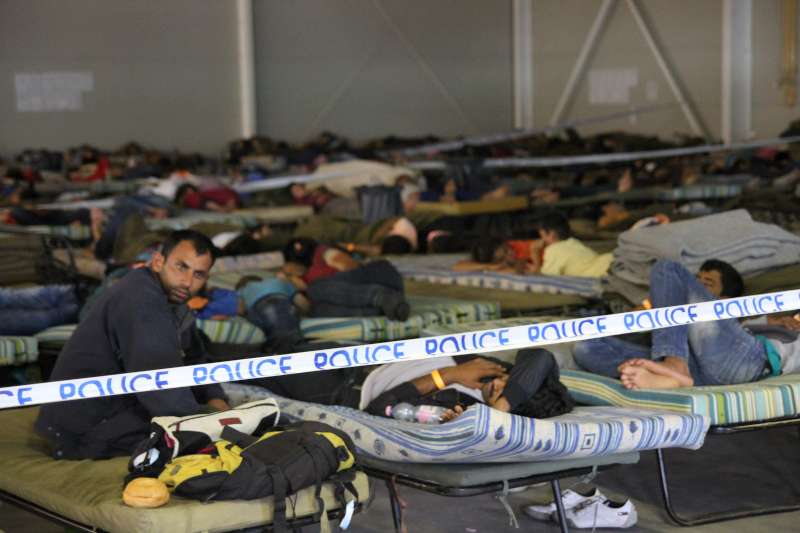
Police take the new arrivals to a pre-registration centre in Röszke in southern Hungary, near the Serbian border and some 184 kilometres away from the capital, Budapest. The centre in Röszke does not offer adequate conditions for the exhausted, hungry and thirsty asylum-seekers who have spent many days on the road.

In Röszke, new arrivals are searched by the police and their details recorded, before being sent to registration centres, further inland. Asylum-seekers are kept in mandatory detention between 12 and 36 hours, and then handed over to the Office of Immigration and Nationality to process their asylum claims. Hungary’s four reception centres have a maximum capacity of 5,000 people.

“Overcrowding and long waits result in frustration for the asylum-seekers. The Hungarian police do not have social workers or enough interpreters in Arabic, Dari, Pashto and Urdu, which makes it hard to communicate with asylum-seekers,” Fleming continued.

Over 140,000 people have sought asylum in Hungary so far this year, according to the latest official statistics, compared to 42,000 people last year. Most of those lodging asylum applications this year are nationals from Syria, Afghanistan, Iraq and Pakistan and they include around 7,000 unaccompanied children or separated from their parents.

Many refugees and migrants choose to leave Hungary for other countries in Europe. Every day up to 500 people sleep at the two main train stations in Budapest where volunteers look after their basic needs, including food, clothing and urgent medical attention, and where the city authorities give them access to sanitation facilities. In order to provide more adequate accommodation, the city authorities are planning to open a transit facility, with UNHCR’s technical advice.