
The Temerity of Mook, Podesta and Hillary in Campaign Policy

Beyond the whole server-gate email hell scandal, the Hillary campaign policy team led by Robby Mook and John Podesta; they concocted a campaign finance reform plan that leaves one shuddering and in shock.

Hillary Clinton set to unveil campaign finance proposal

“We have to end the flood of secret, unaccountable money.”

 NEW YORK — Kicking off a post-Labor Day push to rally support as Bernie Sanders maintains momentum and Joe Biden contemplates a White House bid of his own, Hillary Clinton on Tuesday will unveil a three-pronged campaign finance proposal that her team hopes will help her appeal to unconvinced liberals.

The policy platform — which largely reflects principles that Clinton regularly mentions on the campaign trail, to reliable cheers from Democrats — calls for the overturning of 2010’s Citizens United v FEC decision that paved the way for the creation of super PACs; the implementation of a more rigorous political spending disclosure regime; and a new public matching system for small donations to presidential and congressional campaigns.

“We have to end the flood of secret, unaccountable money that is distorting our elections, corrupting our political system, and drowning out the voices of too many everyday Americans,” Clinton said in a statement. “Our democracy should be about expanding the franchise, not charging an entrance fee. It starts with overturning the Supreme Court’s Citizens United decision, and continues with structural reform to our campaign finance system so there’s real sunshine and increased participation.”

The Democratic front-runner, who raised the most campaign funds of any candidate on either side of the aisle in the second quarter ($47.5 million), regularly rails against the Citizens United decision on the stump, using it as an example of the malfunctioning political system. She also frequently insists that she would use overturning the decision as a litmus test for appointing Supreme Court justices, a line that delights progressive voters, and a point that is included in her new proposal.

But portions of her plan are anathema to Republican candidates and their colleagues in Congress, and Clinton is not the only Democrat making such noises on the campaign trail. Sanders, for example, has also pushed public financing for campaigns.

To further complicate matters, a collection of liberal groups have questioned Clinton’s close ties to Wall Street and its big-money donors due to her time as first lady and as a senator from New York — not to mention the existence of Priorities USA Action, the primary super PAC backing her bid, which raised $15.6 million in the first half of 2015.

Still, her plan amounts to liberal red meat, hitting a handful of points championed by campaign finance reformers. And it comes as her campaign appears set to fight back more aggressively against Sanders’ surge and the negative headlines about her private email arrangement.

Clinton’s campaign finance proposal includes a plan to provide matching funds for small donations, along with lower limits for contributions to candidates who opt into the system. Campaigns would only be eligible to receive up to a certain level of the public matching funds, and they would have to raise a minimum number of small donations in the first place to qualify. The specific numbers and dollar figures are yet to be determined.

The campaign’s plan, which will come alongside a new video to be released on Tuesday, also formally repeats the candidate’s plan to only appoint Supreme Court justices who would overturn Citizens United — a case that was originally brought over an anti-Clinton video in 2008. It also reiterates her support for a constitutional amendment that would “establish common sense rules to protect against the undue influence of billionaires and special interests and to restore the role of average voters in elections.”

The third prong of the plan includes a proposal to force outside groups with large political spending budgets to disclose their largest donors in a timely fashion, as well as to disclose “significant transfers between” such groups. It also supports a proposal in front of the Securities and Exchange Commission to force publicly traded companies to disclose political spending to shareholders.

As a Republican-controlled Congress is unlikely to move on many of these proposals, Clinton also says she would sign an executive order that would require federal contractors to disclose their own political spending.

Clinton is set to campaign in the swing states of Ohio and Wisconsin this week, after an address explaining her support of the Iran agreement in Washington on Wednesday.

*** Now for just one interesting fact on Hillary and Bill:

Nemazee is well connected by the way.

There’s a Lot More to Arrested Financier Hassan Nemazee’s Past Than Just Being a ‘Clinton Fundraiser’

2009: Nemazee was much more than just a Clinton fundraiser — he was a bipartisan financier of the influence bazaar that American politics has become

WhoWhatWhy.com reports exclusively on the background of Hassan Nemazee, the top Hillary Clinton fundraiser who was arrested and charged with forging loan documents. Early media accounts cast the event as an embarrassment for Ms. Clinton and the Democratic Party involving the financial misdoings of one prominent backer. Actually it is much more.  Behind the Nemazee arrest lies a sprawling cautionary tale of presidents, would-be presidents, and the shadow world of wealthy operators who cozy up to them for their own gain.  It reaches into the Bush operation as well as that of the Clintons, and is a microcosm of an influence bazaar that has gone global along with the economy.

On August 25th, Hassan Nemazee, a top fundraiser for Hillary Clinton,  was arrested and charged with forging loan documents in order to borrow $74 million from Citibank. He could face up to 30 years in prison. Early media accounts cast the event as an embarrassment for Ms. Clinton involving the financial misdoings of one prominent backer. Actually it is much more.

Behind the Nemazee arrest lies a sprawling cautionary tale of presidents, would-be presidents, and the shadow world of wealthy operators who cozy up to them for their own gain.  It reaches into the Bush operation as well as that of the Clintons, and is a microcosm of an influence bazaar that has gone global along with the economy.

Hassan Nemazee, who served as a finance director for Hillary Clinton’s 2008 presidential campaign, began raising sizable sums for the Democratic National Committee in the mid-nineties. In 1998, in the midst of the Lewinsky affair, Nemazee collected $60,000 for Bill Clinton’s legal defense fund in $10,000 increments from relatives and friends.

The following year, President Clinton nominated the money manager and investor to be ambassador to Argentina. Then an article in Forbes raised questions about his business practices. Among other things, Nemazee, an Iranian-American, had magically turned himself into an “Hispanic” by acquiring Venezuelan citizenship in order to fulfill the minority-ownership requirement of a California public pension fund. The nomination was withdrawn.
That embarrassment did not, however, hamper Nemazee’s rise within the Democratic Party. By 2004 he was New York finance chair for John Kerry’s campaign, and in 2006 he served under Senator Chuck Schumer as the national finance chair of the Democratic Senatorial Campaign Committee (DSCC).  During this period the committee raised about $25 million more than its Republican counterpart.
By 2008, Nemazee was one of Hillary Clinton’s inner circle, and was being publicly touted as a top foreign policy adviser. When another major fundraiser, a clothing manufacturer named Norman Hsu, was arrested and unmasked as a swindler, it was Nemazee who was trotted out to defend Ms. Clinton and argue that she knew little about Hsu.
But she should have known plenty about Nemazee. In 2005, Nemazee and his business partner, Alan Quasha, went deep into the Clinton circle to hire Terry McAuliffe, the Clinton confidante and former chairman of the Democratic Party, for Carret Asset Management, their newly acquired investment firm. During the interregnum between McAuliffe’s party chairmanship and the time he officially joined Hillary Clinton’s campaign as chairman, Nemazee and Quasha set McAuliffe up with a salary and opened a Washington office for him.  There he worked on his memoirs and laid the groundwork for Ms. Clinton’s presidential bid.
In March 2007, Nemazee, at the behest of McAuliffe, threw a dinner for Ms. Clinton at Manhattan’s swank Cipriani restaurant, which featured Bill Clinton and raised more than $500,000. In 2008, after Barack Obama gained the nomination, Nemazee raised a comparable sum for him.
But it is not fair to characterize Nemazee as an embarrassment to Democrats alone. Nemazee’s profile is considerably more complicated. For legal representation in his current troubles, for example, Nemazee has retained Marc Mukasey, a partner in Rudolph Giuliani’s law firm and the son of Michael Mukasey, who served as George W. Bush’s last Attorney General.
There’s more than choice of counsel involved. Before moving into the Democratic camp, Nemazee had backed such Republican senators as Jesse Helms, Sam Brownback and Alfonse D’Amato. None could be described as Clinton fans. Nemazee’s business partner, Alan Quasha, who specializes in buying up troubled companies, has also played both sides of the partisan divide. Quasha gave to both Bush and Al Gore in 2000, and in the 2008 race gave to Republicans Mitt Romney and Rudy Giuliani as well as Democrats Barack Obama and Chris Dodd.
The strikingly trans-partisan and trans-national nature of this high-stakes influence game is best exemplified by the relationship between Quasha’s oil company, Harken Energy, and George W. Bush. Harken provided a home for Bush in the 1980’s when his own oil businesses failed, offering him handsome compensation and a solid financial base from which to enter politics. Bush was named to the Harken board and received a range of benefits from the company while devoting most of his time to his father’s presidential campaign and then his own outside career efforts.
Harken is a curious outfit. Its early funding sources were opaque, and its investors and board members had a dizzying array of connections into global power centers — and ties to the Saudi leadership and the former Philippine dictator Ferdinand Marcos, the Shah of Iran, as well as to the Swiss Bank, UBS, which has been charged by the US government with providing cover for  Americans who were evading taxes.
Around the time George W. Bush joined its board, Harken received an unusual and sizable cash infusion from the Harvard Management Company, which handles Harvard University’s endowment, the largest in the nation. Robert G. Stone, Jr., a figure with ties to US intelligence and to the Bushes, was head of the Harvard board of overseers that approved financial strategies. Former employees of Harvard Management have recently made highly-publicized charges that the company engaged in Enron-style investment practices. (Prior to going to work for Nemazee and Quasha, Terry McAuliffe had publicly criticized Bush for his financial dealings with Harken, disparaging that company’s own Enron-like accounting. Both Quasha and Nemazee, like Bush, have Harvard degrees, and both have sat on prestigious Harvard committees in recent years.)
Nemazee’s role as a foreign policy adviser to Hillary Clinton can be better understood through his own Iranian connections.  His father was a shipping magnate who was close with the Shah of Iran and served as the Shah’s commercial attaché in Washington; Nemazee was a founding member of the Iranian-American Political Action Committee, a lobbying group. Recent strains have been reported between President Obama and Secretary of State Hillary Clinton over policy toward Iran. Clinton has advocated a harder line toward the Islamic fundamentalists who took over when the Shah of Iran was overthrown in 1979, while Obama has stressed dialogue.
With Nemazee’s arrest for financial fraud certain to attract some sustained coverage, it remains to be seen whether it will be treated as yet another isolated case of financial wrongdoing, or lead to a deeper look at the influence bazaar that American politics has become.


Released Guantanamo Back in the Battlefield

U.S. suspects more freed Guantanamo inmates returned to battlefield

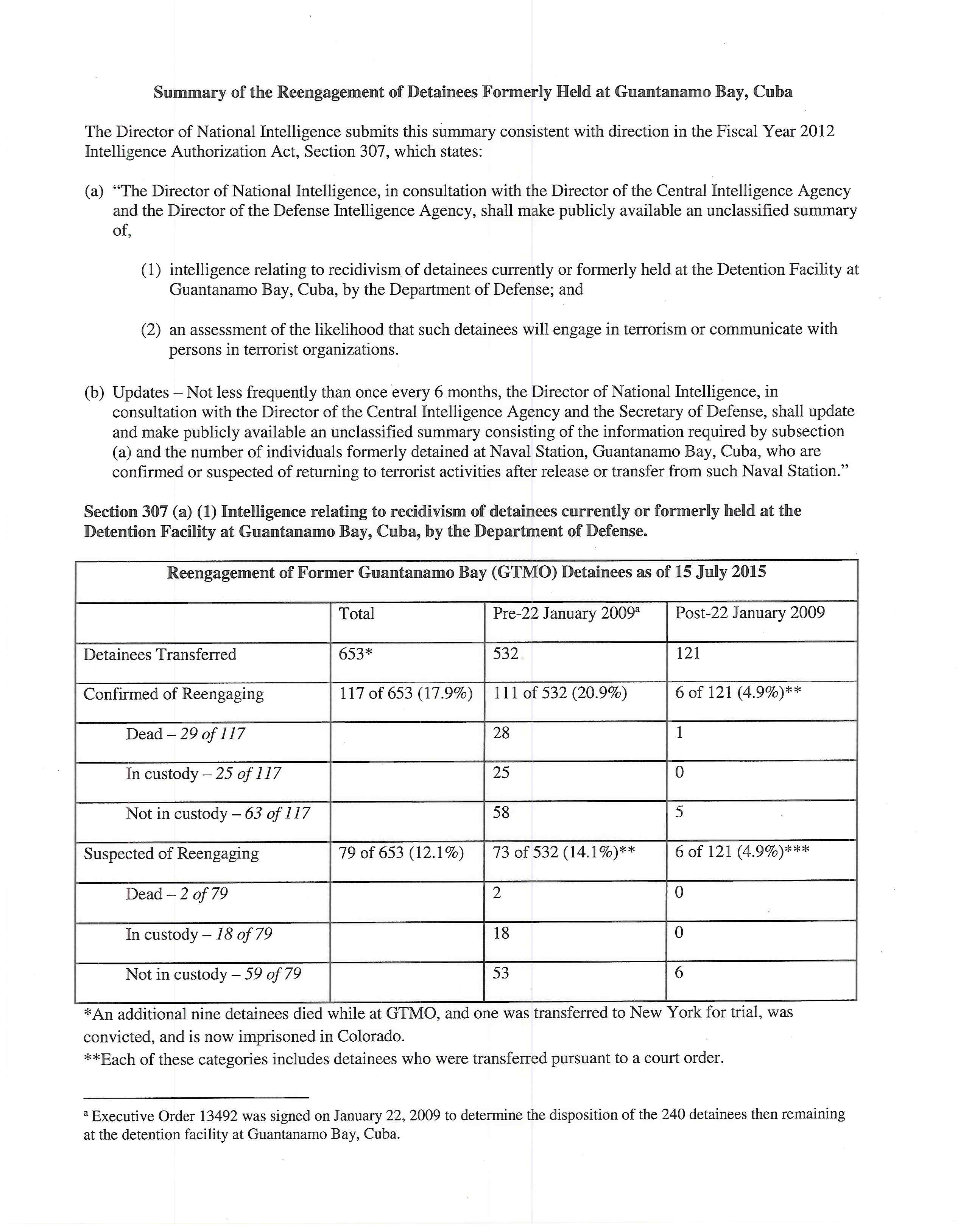
Reuters: The number of detainees freed from the U.S. Guantanamo detention camp who are suspected of “re-engaging” with militant groups overseas increased over the first six months of 2015, the Obama administration said on Thursday.

Figures released by the Office of the Director of National Intelligence showed that, as of July this year, of 121 detainees released since President Barack Obama took office in 2009, six were confirmed to have gone back to the battlefield and a further six were suspected of having done so.

Figures released in January had shown that Obama had released a total of 115 Guantanamo inmates, six of whom had returned to the battlefield, but only one of whom was then “suspected of re-engaging.”

Between January and July this year the administration released six detainees.

The data did not identify any individual detainees. The detention facility for terrorism suspects at the U.S. Naval base at Guantanamo, Cuba, which opened after the Sept. 11, 2001 attacks, now holds 116 prisoners.

The administration of Obama, a Democrat, has said the number of those who returned to fight after being transferred out of Guantanamo under his presidency is lower than under his Republican predecessor George W. Bush, who set up the facility.

Obama has vowed to close Guantanamo before he leaves office in January 2017 but he is hampered by a slow bureaucratic process and by laws passed by Republicans in Congress barring the transfer of detainees to prisons on U.S. soil.

Obama is due to submit a report to Congress soon outlining a new plan for closing the facility.

Gitmo detainee doc


The full 2 page document is located here.

TWS: In 2014, the report included: The semi-annual report on “Re-engagement of Detainees Formerly Held at Guantanamo Bay, Cuba” was released on Wednesday by the Director of National Intelligence (DNI). Out of a total of 614 former prisoners (up from 603 six months ago), intelligence has confirmed that 104 (up from 100) have re-engaged in terrorism/insurgent activities while another 74 are suspected of doing so. The latest report nudged the recidivism rate up to an even 29 percent from 28.9 percent last September.

If there is good news to be found in the report, it is that 3 of the 4 detainees confirmed to have reengaged are now deceased.  Only one of the newly confirmed relapsed terrorist is still at large, joining the 56 other previously confirmed and 48 other suspected of reengaging presently not in custody.

Furthermore, it appears that the Secretary of the Defense Department, Ash Carter has some issues with the movement of Gitmo detainees. His signature has to be applied for approval of transfer. Carter is assuming the same posture as the Secretary of Defense Hagel, before him, this is a problem.

DOD Sec. Says Gitmo Terrorists Need Indefinite Lockup as Obama Tries Closing Prison

SEPTEMBER 04, 2015

While President Obama works to deliver on his longtime promise to close the U.S. military prison in Guantanamo Bay, Cuba his Defense Secretary offers a jolt of reality; around half of the detainees—the world’s most dangerous terrorists—need to be locked up “indefinitely.”

So what are the commander-in-chief’s plans for the radical Islamic jihadists currently incarcerated in the top-security compound at the U.S. Naval base in southeast Cuba? The all-star terrorist roster includes 9/11 masterminds Khalid Sheikh Mohammed (KSM), Ramzi Binalshibh, Ali Abdul Aziz Ali and Mustafa Ahmed Adam al Hawsawi as well as Abd al-Rahim al-Nashiri, the Al-Qaeda terrorist charged with orchestrating the 2000 attack on the Navy destroyer USS Cole. Where will the U.S. government take these terrorists if the president goes through with his plan, which started out as a campaign promise to restore America’s position as a global leader on human rights.

In all the years that Obama has talked of closing the Gitmo prison, he has never touched on what would happen to the terrorists held there. The president has tried emptying out the compound by releasing dozens of prisoners—many of them have rejoined terrorist causes—to foreign countries, but at least half of the remaining 116 are too dangerous to free. Obama’s own Defense Secretary, Ashton Carter, confirmed that recently, saying that “some of the people who are there at Guantanamo Bay have to be detained indefinitely, they’ve just got to be locked up.” This evidently applies to many of those who have been released over the years. For instance, an al Qaeda operative (Saudi Ibrahim al-Rubaysh) released from Gitmo appears on the U.S. government’s global terrorist list and Uncle Sam is offering a $5 million reward for information on his whereabouts.

The administration has considered relocating the captives to military facilities in the U.S., including Ft. Leavenworth in Kansas and the Navy Brig in Charleston, South Carolina. This has ignited outrage among officials in both states. Kansas Senator Pat Roberts was quick to say “not on my watch will any terrorists be placed in Kansas.” Roberts also co-authored a mainstream newspaper op-ed with South Carolina Senator Tim Scott vehemently rejecting the idea. “The notion that Kansas, South Carolina or any other state would be an ideal home for terrorist detainees is preposterous,” the piece reads. “Transferring these prisoners to the mainland puts the well-being of states in danger, posing security risks to the public and wasting taxpayer dollars. The detention facilities at Guantanamo are doing a fantastic job of holding these terrorists.”

The governors of both states—Nikki Haley of South Carolina and Sam Brownback of Kansas—have also vowed to take any action in their power to stop the transfers, including suing the federal government. A South Carolina newspaper editorial points out that the state is already taking a hit for the team by serving as the “de facto permanent home” to high-level nuclear waste associated with the nation’s weapons programs. “Fearing South Carolina is again about to become the home that no other state wants to be has leaders rightly standing up against federal plans to transfer terrorist detainees from the U.S. prison facility at Guantanamo Bay near Cuba to military prisons in South Carolina and Kansas,” the editorial states. “This goes beyond the states’ collective call of duty as there is no agreement on a plan for what to do with the detainees in the long term.”

Judicial Watch has covered Guantanamo extensively and has repeatedly traveled there to monitor the U.S. military commission proceedings against the world’s most dangerous terrorists. JW has witnessed a deep commitment to justice by military and civilian lawyers defending the captives and has reported on many of the perks that the incarcerated terrorists receive from American taxpayers. For instance, they get laptops and computer lessons, “Islamically permissible” halal meals and better medical care than U.S. veterans. Last year the Obama administration let Gitmo inmates operate a “Business School Behind Bars” with an accused Al Qaeda financier as the self-appointed “dean of students.” Khalid Sheikh Mohammed was also permitted to dispatch propaganda from his Guantanamo jail cell (undoubtedly aiding and abetting more terrorism) and a fighter in Osama bin Laden’s 55th Arab Brigade was allowed to published a sob letter in an international media outlet describing the “humiliating and brutal treatments” he suffers at the U.S. military prison.


The End is Near for the EU and the Schengen Agreement?

It was an experiment, a treaty in 1985 and not implemented until 1995 where borders were eliminated in Europe. Stop and think about that a minute or two.

The Schengen Agreement covers two different agreements that were ratified in 1985 and 1990 respectively. Between them, they abolished border controls and made transit through Europe a lot easier. The two individual agreements said the following:

1985 – The Schengen Agreement of 1985 was made between the Benelux Economic Union, the French Republic and the Federal Republic Of Germany. All of those governments agreed to abolish border check on the borders that they shared. Instead of stop and search tactics, every vehicle that had a green visa disc in the windscreen could simply drive on through. There were still to be guards on the borders to visually check the vehicles as they crossed into another country. This is commonly known as Schengen I.
1990 – The 1990 Schengen Agreement, which is also known as Schengen II, went one step further. It made provisions for the complete elimination of border checks over a period of time.
Both Schengen Agreements were a major breakthrough for the traffic in Europe. Queues would often be a mile long waiting for border patrols to wave them through, but the agreements enabled this to be brought to an end. Now people can cross into neighbouring countries without having to show any form of ID. Of course, airlines still require you to show it for security purposes, but border controls are a lot easier to navigate and do not even exist in some cases.

Sixteen European countries have now adopted the Schengen Agreement. They are Austria, Belgium, Denmark, Finland, France, Germany, Greece, Iceland, Italy, Luxemburg, Norway, Portugal, Spain, Sweden, Switzerland and The Netherlands. This is because the original Schengen Agreements were actually referred to in the framework of the European Union and included in the law.

To create a common free travel condition, a new visa was issued. The Schengen Agreement was based on the Treaty of Rome whereby common policing would be used and well as judicial policy, economic policy (sharing) and more a common used of identity documents.

Most recently, the burden of sustaining Europe has fallen on Germany and it was not but a few months ago that Scotland voted to leave the United Kingdom where that initiative was defeated. Then the financial spiral of Greece, threatened to be the first country to possibly be forced out of the union. Then in recent months, there is a movement in Great Britain to reconsider the European Union membership.

Based on the immediate refugee crisis in the Middle East affecting all corners of Western and Eastern Europe, could it be that each country is having internal discussions about amending or terminating this agreement? If not, they should. Shared sacrifice and more forced policy for unique countries and cultures will no longer be a viable condition in coming years.

Simply noted is that Brits want out.

When this condition is brought home for a domestic debate, look no further than NAFTA and the policy of Barack Obama of the expanded Visa Waiver Program, the backdoor Dreamer White House project and worse the lifting of quotas on foreigners into the United States, known as the Johnson Reed Act, which was essentially an emergency piece of legislation and has been amended, updated and expanded to include a wide variety of foreign/international operations, trade and conditions.

The lesson for this article is watch Europe closely. There are citizens there not happy with the Schengen Agreement, remaining in the union and it could soon have new consequences. If it has never for the most part worked in Europe, it wont work here, and further, America has a U.S. Constitution and each respective state does as well.

Fair warning America.


Immediate yet Temporary Solution to Global Refugee Crisis?

There is some agreement with Barack Obama, the civil wars, the unrest, the terror conditions in the Middle East is an Islamic problem to solve. When however, outside influences have manifested the state of order in the region, not only is the Obama administration culpable due to lack of leadership, but filling that void is Iran, Russia, the Gulf States and China.

This is not a new condition by any stretch and the cost to the United States has yet to be realized or accounted. In 2013, the United States had already provided $339 million and additional humanitarian aid to the Syria crisis. That is but one small portion to the costs which have mounted still in 2015.

The refugee crisis festering across the globe is worse than what is being reported and the moving parts are countless.

So there are some short term and creative solutions that would provide some relief such that other cures can be devised in the interim.

  1. Call on affected nations to step up assets to rescue and safe haven to the refugees by offering respective naval vessels to the Mediterranean Sea and to ports involved. Each country has decommissioned ships or ships that are expendable for immediate use, including cruise ships. The United States alone has decommissioned countless naval assets and sold many of them to other countries for use. Further, after generally 25 years, cruise ships are taken out of service where some would take minor upgrades to deploy for the cause.
  2. The United Nations along with involved countries call to duty personnel to work resources for humanitarian means. This would include medical, safety, transportation, educational and early vetting.
  3. Place intelligence operations on the entry-way path to interview, fingerprint and background personnel files that are matched with global intelligence services that would and could find the terrorists and jihadis among the crowds.
  4. Set rules aboard the ships for order, when violations occur, aggressive consequences are invoked. This may include prison, deportation or other detention sentences.
  5. Contain the problem and then manage it. Stop spreading the destruction, crisis and despair. The cost of this program would come under that of the Gulf States, Russia and Iran that have offered zero assistance and are in fact guilty of exacerbating the calamity. The global community has a role and for those that ignore, sanctions and isolation is the consequence.
  6. Countries where war and unrest is proven are the target of a worldwide military solution beyond that of today’s feeble strategy. NATO membership is accountable for a tactical strategy in locations such as Libya, Sudan, Iraq, Turkey, Jordan, Yemen, Syria, Afghanistan, Pakistan and more.
  7. Determine Muslim countries that may be conditioned to take refugees on a medium term basis until stability is gained, one country at a time. Those countries may include Maldives, Malaysia or perhaps even Kyrgyzstan.

It is time to think out of the box for a semi-lasting yet immediate solution during which time Islamic State, al Nusra, Boko Harem, al Qaeda in the Arabian Peninsula are defeated.

This post is up for debate and further discussion, yet today, there must be robust collaboration, cures, humanitarian and military strategies on the table. Your comments are invited and welcomed.

The Global Refugee Crisis Snapshot

  1. Refugees travel light, for their trek is as dangerous as it is arduous. They are detained, shot at, hungry. Smugglers routinely exploit them, promising safety for a price, only to squeeze them like sardines into tiny boats. Most have no option but to shed whatever meager belongings they may have salvaged from their journeys. Those allowed to bring extra baggage aboard often toss it overboard, frantically dumping extra weight as the leaky boats take on water.

    Few arrive at their destinations with anything but the necessities of life. The International Rescue Committee asked a mother, a child, a teenager, a pharmacist, an artist, and a family of 31 to share the contents of their bags and show us what they managed to hold on to from their homes. Their possessions tell stories about their past and their hopes for the future. Much more here from Medium.

  2. No one is vetting these jihadists. And worse still, Pope Francis called on Sunday on every European parish and religious community to take in one migrant family each in a gesture of solidarity he said would start in the tiny Vatican state where he lives.

    The Westgate Mall massacre was gruesome even by Islamic standards. Muslims were released, while non-Muslims had their eyes gouged out and were murdered in cold blood. More here from PamelaGeller.

  3. Five of the wealthiest Muslim countries have taken no Syrian refugees in at all, arguing that doing so would open them up to the risk of terrorism. Although the oil rich countries have handed over aid money, Britain has donated more than Saudi Arabia, the United Arab Emirates and Qatar combined.

    Between 10 and 12 million Syrians have been displaced by the bloody civil war raging in their country. Most still remain within Syria’s borders, but around four million have fled over the borders into neighboring countries, mostly Turkey, Jordan and Lebanon and beyond. More here from Breitbart.

  4. Greek police are still searching for 10 illegal immigrants who escaped from a holding centre in Athens after a riot late on Saturday night. A protest over the extension of their detention turned violent as inmates clashed with police and security guards. The detainees hurled water bottles and set fire to rubbish bags and mattresses.

    Greece, struggling to exit its worst financial crisis in decades, has become a frontier for immigrants mainly from Asia and Africa, who seek a better life in Europe but often end up living in cramped detention centres.

  5. The Syrian operative claimed more than 4,000 covert ISIS gunmen had been smuggled into western nations – hidden amongst innocent refugees. The ISIS smuggler, who is in his 30s with a trimmed jet-black beard, revealed the ongoing clandestine operation is a complete success. “Just wait,” he smiled.

    The Islamic State operative spoke exclusively to BuzzFeed on the condition of anonymity and is believed to be the first to confirm plans to infiltrate western countries. Islamic State, also referred to as IS and ISIS, is believed to be actively smuggling deadly gunmen across the sparsely-guarded 565-mile Turkish border and on to richer European nations, he revealed.

  6. WASHINGTON, D.C. – Chairman Michael McCaul, of the House Homeland Security Committee, wrote a letter to President Obama last Thursday expressing concerns over the Administration’s announced plans to resettle some 2,000 Syrian refugees in the United States this year. Terrorists have made known their plans to attempt to exploit refugee programs to sneak terrorists into the West and the U.S. homeland. Chairman McCaul’s letter points out the potential national security threat this poses to the United States.

    Chairman McCaul: “Despite all evidence towards our homeland’s vulnerability to foreign fighters, the Administration still plans to resettle Syrian refugees into the United States. The Director of the National Counterterrorism Center and the Deputy Director of the FBI both sat before my Committee this Congress and expressed their concern with admitting refugees we can’t properly vet from the global epicenter of terrorism and extremism in Syria. America has a proud tradition of welcoming refugees from around the world, but in this special situation the Obama Administration’s Syrian refugee plan is very dangerous.”

    Read Chairman McCaul’s letter HERE.

    The Subcommittee on Counterterrorism and Intelligence will hold a hearing on June 24th to examine the refugee resettlement program and discuss vulnerabilities to our security exposed by the Administration’s plan.

The conditions in Europe will soon come to the United States.


Here’s a summary of the latest developments:

France and Germany are are to take an extra 55,000 refugees over the next two years. The plan, part of an initiative to taken an extra 120,000 across Europe, will be set out on Wednesday by EU commission president, Jean-Claude Juncker.
France is considering launching airstrikes against Islamic State militants in Syria president François Hollande announced as he confirmed plans to take an extra 24,000 refugees. “We have proof that attacks have been planned from Syria against several countries, notably France,” Hollande told a news conference.
Angela Merkel called on other European countries to pull their weight to help tackle the crisis. She described the number of people coming to Germany over the weekend as “breathtaking” and said Germany should be proud of its response.
Tensions between the authorities and migrants and asylum seekers have remained tense at a number of flash points across Europe. On Greek island of Lesbos the sight of thousands of frustrated refugees and migrants marching on Mytilini, the capital, prompted Greece’s migration minister to announce that transit of the newcomers would be speeded up immediately. Scuffles broke out earlier on between police and thousands of people attempting to enter Macedonia from with Greece. The Hungarian security forces struggled to contain migrants trying to break out of the Röszke camp on the Serbia border.
The Bavarian authorities have warned they are at “breaking point” after accepting two thirds of the 18,000 refugees who arrived in Munich via Austria over the weekend. “We’re right at our limit,” said Christoph Hillenbrand, meeting reporters at Munich train station.
David Cameron is to set out details of the government’s plans to resettle thousands of refugees fleeing the civil war in Syria. He will also announced further details of a counter terrorism strategy on Syria.
Hundreds of millions of pounds from Britain’s aid budget will be used to tackle the crisis, Chancellor George Osborne confirmed that every penny in the “uplift” in the aid budget – the automatic rises as the economy grows – would be spent on global challenges with a direct effect on Britain.
The ruling coalition in Germany has set out plans to spend an extra €6bn to cope with migration. After a meeting in Berlin lasting more than five hours, leaders from chancellor Merkel’s coalition also agreed to speed up asylum procedures and facilitating the construction of asylum shelters.
Hungary’s hardline PM, Viktor Orban, said people coming into the EU are “immigrants not refugees”. He also said that it was the EU primary interest that Hungary protects its borders.
The United Nations warned that its humanitarian agencies were on the verge of bankruptcy and unable to meet the basic needs of millions of people because of the size of the refugee crisis. “We are broke,” the UN high commissioner for refugees, António Guterres, told the Guardian.

Snapshots: