Will YOU Read General Kelley’s Speech? You Must

“Some people spend an entire lifetime wondering if they made a difference in the world. But, the Marines don’t have that problem.”
– President Ronald Reagan, 1985


Background

MOAA: There is no greater loss than that of one’s child. Military members know this loss far too well, especially when service to the nation is a family calling. For one of the Marines’ most influential generals, this Veterans Day became more meaningful and tragic due to the loss of his son just days before the holiday. Lieutenant General John F. Kelly held several command positions in the Iraq War, most recently as the Commanding General of the Multi National Force-West, a post he held until February of 2009. On November 9th of this year, his son, 1stLt. Robert M. Kelly, fell during battle while on his third combat deployment since 9/11. The overwhelming feeling of sadness would be enough to crush a normal person. Instead, General Kelly kept a commitment to speak in St. Louis in honor of the day of remembrance. This speech is becoming viral, and for all the right reasons. It exemplifies the spirit and honor of the Marine Corps, and of a terrible sacrifice.

Following the speech is a copy of the statement General Kelly put out regarding the loss of his son, as well as links to some of his other speeches that are worth every moment to read.


Veterans Day Speech

The following is a full transcript of the speech made by General Kelly in St. Louis to commemorate Veterans Day:

Nine years ago, four commercial aircraft took off from Boston, Newark, and Washington.  Took off fully loaded with men, women and children-all innocent, and all soon to die.  These aircraft were targeted at the World Trade Towers in New York, the Pentagon, and likely the Capitol in Washington, D.C…  Three found their mark.  No American alive old enough to remember will ever forget exactly where they were, exactly what they were doing, and exactly who they were with at the moment they watched the aircraft dive into the World Trade Towers on what was, until then, a beautiful morning in New York City.  Within the hour 3,000 blameless human beings would be vaporized, incinerated, or crushed in the most agonizing ways imaginable.  The most wretched among them-over 200-driven mad by heat, hopelessness, and utter desperation leapt to their deaths from 1,000 feet above Lower Manhattan.  We soon learned hundreds more were murdered at the Pentagon, and in a Pennsylvania farmer’s field.

Once the buildings had collapsed and the immensity of the attack began to register most of us had no idea of what to do, or where to turn.  As a nation, we were scared like we had not been scared for generations. Parents hugged their children to gain as much as to give comfort. Strangers embraced in the streets stunned and crying on one another’s shoulders seeking solace, as much as to give it.  Instantaneously, American patriotism soared not “as the last refuge” as our national-cynical class would say, but in the darkest times Americans seek refuge in family, and in country, remembering that strong men and women have always stepped forward to protect the nation when the need was dire-and it was so God awful dire that day-and remains so today.

There was, however, a small segment of America that made very different choices that day…actions the rest of America stood in awe of on 9/11 and every day since.  The first were our firefighters and police, their ranks decimated that day as they ran towards-not away from-danger and certain death.  They were doing what they’d sworn to do-“protect and serve”-and went to their graves having fulfilled their sacred oath.

Then there was your Armed Forces, and I know I am a little biased in my opinion here, but the best of them are Marines.  Most wearing the Eagle, Globe and Anchor today joined the unbroken ranks of American heroes after that fateful day not for money, or promises of bonuses or travel to exotic liberty ports, but for one reason and one reason alone; because of the terrible assault on our way of life by men they knew must be killed and extremist ideology that must be destroyed.  A plastic flag in their car window was not their response to the murderous assault on our country.  No, their response was a commitment to protect the nation swearing an oath to their God to do so, to their deaths.  When future generations ask why America is still free and the heyday of Al Qaeda and their terrorist allies was counted in days rather than in centuries as the extremists themselves predicted, our hometown heroes-soldiers, sailors, airmen, Coast Guardsmen, and Marines-can say, “because of me and people like me who risked all to protect millions who will never know my name.”

As we sit here right now, we should not lose sight of the fact that America is at risk in a way it has never been before.  Our enemy fights for an ideology based on an irrational hatred of who we are.  Make no mistake about that no matter what certain elements of the “chattering class” relentlessly churn out.  We did not start this fight, and it will not end until the extremists understand that we as a people will never lose our faith or our courage.  If they persist, these terrorists and extremists and the nations that provide them sanctuary, they must know they will continue to be tracked down and captured or killed.  America’s civilian and military protectors both here at home and overseas have for nearly nine years fought this enemy to a standstill and have never for a second “wondered why.”  They know, and are not afraid.  Their struggle is your struggle.  They hold in disdain those who claim to support them but not the cause that takes their innocence, their limbs, and even their lives.  As a democracy-“We the People”-and that by definition is every one of us-sent them away from home and hearth to fight our enemies.  We are all responsible.  I know it doesn’t apply to those of us here tonight but if anyone thinks you can somehow thank them for their service, and not support the cause for which they fight-America’s survival-then they are lying to themselves and rationalizing away something in their lives, but, more importantly, they are slighting our warriors and mocking their commitment to the nation.

Since this generation’s “day of infamy” the American military has handed our ruthless enemy defeat-after-defeat but it will go on for years, if not decades, before this curse has been eradicated.  We have done this by unceasing pursuit day and night into whatever miserable lair Al Qaeda, the Taliban, and their allies, might slither into to lay in wait for future opportunities to strike a blow at freedom.  America’s warriors have never lost faith in their mission, or doubted the correctness of their cause.
They face dangers everyday that their countrymen safe and comfortable this night cannot imagine.  But this has always been the case in all the wars our military have been sent to fight.  Not to build empires, or enslave peoples, but to free those held in the grip of tyrants while at the same time protecting our nation, its citizens, and our shared values.  And, ladies and gentlemen, think about this, the only territory we as a people have ever asked for from any nation we have fought alongside, or against, since our founding, the entire extent of our overseas empire, as a few hundred acres of land for the 24 American cemeteries scattered around the globe.  It is in these cemeteries where 220,000 of our sons and daughters rest in glory for eternity, or are memorialized forever because their earthly remains are lost forever in the deepest depths of the oceans, or never recovered from far flung and nameless battlefields.  As a people, we can be proud because billions across the planet today live free, and billions yet unborn will also enjoy the same freedom and a chance at prosperity because America sent its sons and daughters out to fight and die for them, as much as for us.

Yes, we are at war, and are winning, but you wouldn’t know it because successes go unreported, and only when something does go sufficiently or is sufficiently controversial, it is highlighted by the media elite that then sets up the “know it all” chattering class to offer their endless criticism. These self-proclaimed experts always seem to know better-but have never themselves been in the arena.  We are at war and like it or not, that is a fact.  It is not Bush’s war, and it is not Obama’s war, it is our war and we can’t run away from it.  Even if we wanted to surrender, there is no one to surrender to.  Our enemy is savage, offers absolutely no quarter, and has a single focus and that is either kill every one of us here at home, or enslave us with a sick form of extremism that serves no God or purpose that decent men and women could ever grasp.  St Louis is as much at risk as is New York and Washington, D.C…  Given the opportunity to do another 9/11, our merciless enemy would do it today, tomorrow, and every day thereafter. If, and most in the know predict that it is only a matter of time, he acquires nuclear, chemical, or biological weapons, these extremists will use these weapons of mass murder against us without a moment’s hesitation. These butchers we fight killed more than 3,000 innocents on 9/11.  As horrible as that death toll was, consider for a moment that the monsters that organized those strikes against New York and Washington, D.C. killed only 3,000 not because that was enough to make their sick and demented point, but because he couldn’t figure out how to kill 30,000, or 300,000, or 30 million of us that terrible day.  I don’t know why they hate us, and I don’t care.  We have a saying in the Marine Corps and that is “no better friend, no worse enemy, than a U.S. Marine.”  We always hope for the first, friendship, but are certainly more than ready for the second.  If its death they want, its death they will get, and the Marines will continue showing them the way to hell if that’s what will make them happy.

Because our America hasn’t been successfully attacked since 9/11 many forget because we want to forget…to move on.  As Americans we all dream and hope for peace, but we must be realistic and acknowledge that hope is never an option or course of action when the stakes are so high. Others are less realistic or less committed, or are working their own agendas, and look for ways to blame past presidents or in some other way to rationalize a way out of this war.  The problem is our enemy is not willing to let us go.  Regardless of how much we wish this nightmare would go away, our enemy will stay forever on the offensive until he hurts us so badly we surrender, or we kill him first.  To him, this is not about our friendship with Israel, or about territory, resources, jobs, or economic opportunity in the Middle East.  No, it is about us as a people.  About our freedom to worship any God we please in any way we want.  It is about the worth of every man, and the worth of every woman, and their equality in the eyes of God and the law; of how we live our lives with our families, inside the privacy of our own homes.  It’s about the God-given rights of life, liberty, and the pursuit of happiness and “that all men are created equal, that they are endowed by their Creator with certain inalienable right.”  As Americans we hold these truths to be self-evident.  He doesn’t.  We love what we have; he despises who we are.  Our positions can never be reconciled.  He cannot be deterred…only defeated.  Compromise is out of the question.

It is a fact that our country today is in a life and death struggle against an evil enemy, but America as a whole is certainly not at war. Not as a country.  Not as a people.  Today, only a tiny fraction-less than a percent-shoulder the burden of fear and sacrifice, and they shoulder it for the rest of us.  Their sons and daughters who serve are men and women of character who continue to believe in this country enough to put life and limb on the line without qualification, and without thought of personal gain, and they serve so that the sons and daughters of the other 99% don’t have to.  No big deal, though, as Marines have always been “the first to fight” paying in full the bill that comes with being free…for everyone else.

The comforting news for every American is that our men and women in uniform, and every Marine, is as good today as any in our history.  As good as what their heroic, under-appreciated, and largely abandoned fathers and uncles were in Vietnam, and their grandfathers were in Korea and World War II. They have the same steel in their backs and have made their own mark etching forever places like Ramadi, Fallujah, and Baghdad, Iraq, and Helmand and Sagin, Afghanistan that are now part of the legend and stand just as proudly alongside Belleau Wood, Iwo Jima, Inchon, Hue City, Khe Sanh, and Ashau Valley, Vietnam.  None of them have every asked what their country could do for them, but always and with their lives asked what they could do for America.  While some might think we have produced yet another generation of materialistic, consumerist and self-absorbed young people, those who serve today have broken the mold and stepped out as real men, and real women, who are already making their own way in life while protecting ours.  They know the real strength of a platoon, a battalion, or a country that is not worshiping at the altar of diversity, but in a melting point that stitches and strengthens by a sense of shared history, values, customs, hopes and dreams all of which unifies a people making them stronger, as opposed to an unruly gaggle of “hyphenated” or “multi-cultural individuals.”

And what are they like in combat in this war?  Like Marines have been throughout our history.  In my three tours in combat as an infantry officer and commanding general, I never saw one of them hesitate, or do anything other than lean into the fire and with no apparent fear of death or injury take the fight to our enemies.  As anyone who has ever experienced combat knows, when it starts, when the explosions and tracers are everywhere and the calls for the Corpsman are screamed from the throats of men who know they are dying-when seconds seem like hours and it all becomes slow motion and fast forward at the same time-and the only rational act is to stop, get down, save yourself-they don’t.  When no one would call them coward for cowering behind a wall or in a hole, slave to the most basic of all human instincts-survival-none of them do. It doesn’t matter if it’s an IED, a suicide bomber, mortar attack, sniper, fighting in the upstairs room of a house, or all of it at once; they talk, swagger, and, most importantly, fight today in the same way America’s Marines have since the Tun Tavern.  They also know whose shoulders they stand on, and they will never shame any Marine living or dead.

We can also take comfort in the fact that these young Americans are not born killers, but are good and decent young men and women who for going on ten years have performed remarkable acts of bravery and selflessness to a cause they have decided is bigger and more important than themselves.  Only a few months ago they were delivering your paper, stocking shelves in the local grocery store, worshiping in church on Sunday, or playing hockey on local ice.  Like my own two sons who are Marines and have fought in Iraq, and today in Sagin, Afghanistan, they are also the same kids that drove their cars too fast for your liking, and played the God-awful music of their generation too loud, but have no doubt they are the finest of their generation.  Like those who went before them in uniform, we owe them everything.  We owe them our safety. We owe them our prosperity.  We owe them our freedom.  We owe them our lives.  Any one of them could have done something more self-serving with their lives as the vast majority of their age group elected to do after high school and college, but no, they chose to serve knowing full well a brutal war was in their future.  They did not avoid the basic and cherished responsibility of a citizen-the defense of country-they welcomed it.  They are the very best this country produces, and have put every one of us ahead of themselves.  All are heroes for simply stepping forward, and we as a people owe a debt we can never fully pay.  Their legacy will be of selfless valor, the country we live in, the way we live our lives, and the freedoms the rest of their countrymen take for granted.

Over 5,000 have died thus far in this war; 8,000 if you include the innocents murdered on 9/11.  They are overwhelmingly working class kids, the children of cops and firefighters, city and factory workers, school teachers and small business owners.  With some exceptions they are from families short on stock portfolios and futures, but long on love of country and service to the nation.  Just yesterday, too many were lost and a knock on the door late last night brought their families to their knees in a grief that will never-ever go away.  Thousands more have suffered wounds since it all started, but like anyone who loses life or limb while serving others-including our firefighters and law enforcement personnel who on 9/11 were the first casualties of this war-they are not victims as they knew what they were about, and were doing what they wanted to do.  The chattering class and all those who doubt America’s intentions, and resolve, endeavor to make them and their families out to be victims, but they are wrong.  We who have served and are serving refuse their sympathy.  Those of us who have lived in the dirt, sweat and struggle of the arena are not victims and will have none of that. Those with less of a sense of service to the nation never understand it when men and women of character step forward to look danger and adversity straight in the eye, refusing to blink, or give ground, even to their own deaths.  The protected can’t begin to understand the price paid so they and their families can sleep safe and free at night.  No, they are not victims, but are warriors, your warriors, and warriors are never victims regardless of how and where they fall.  Death, or fear of death, has no power over them.  Their paths are paved by sacrifice, sacrifices they gladly make…for you.  They prove themselves everyday on the field of battle…for you.  They fight in every corner of the globe…for you.  They live to fight…for you, and they never rest because there is always another battle to be won in the defense of America.

I will leave you with a story about the kind of people they are…about the quality of the steel in their backs…about the kind of dedication they bring to our country while they serve in uniform and forever after as veterans.  Two years ago when I was the Commander of all U.S. and Iraqi forces, in fact, the 22nd of April 2008, two Marine infantry battalions, 1/9 “The Walking Dead,” and 2/8 were switching out in Ramadi.  One battalion in the closing days of their deployment going home very soon, the other just starting its seven-month combat tour. Two Marines, Corporal Jonathan Yale and Lance Corporal Jordan Haerter, 22 and 20 years old respectively, one from each battalion, were assuming the watch together at the entrance gate of an outpost that contained a makeshift barracks housing 50 Marines.  The same broken down ramshackle building was also home to 100 Iraqi police, also my men and our allies in the fight against the terrorists in Ramadi, a city until recently the most dangerous city on earth and owned by Al Qaeda.  Yale was a dirt poor mixed-race kid from Virginia with a wife and daughter, and a mother and sister who lived with him and he supported as well.  He did this on a yearly salary of less than $23,000.  Haerter, on the other hand, was a middle class white kid from Long Island.  They were from two completely different worlds.  Had they not joined the Marines they would never have met each other, or understood that multiple America’s exist simultaneously depending on one’s race, education level, economic status, and where you might have been born.  But they were Marines, combat Marines, forged in the same crucible of Marine training, and because of this bond they were brothers as close, or closer, than if they were born of the same woman.

The mission orders they received from the sergeant squad leader I am sure went something like: “Okay you two clowns, stand this post and let no unauthorized personnel or vehicles pass.”  “You clear?”  I am also sure Yale and Haerter then rolled their eyes and said in unison something like: “Yes Sergeant,” with just enough attitude that made the point without saying the words, “No kidding sweetheart, we know what we’re doing.”  They then relieved two other Marines on watch and took up their post at the entry control point of Joint Security Station Nasser, in the Sophia section of Ramadi, Al Anbar, Iraq.

A few minutes later a large blue truck turned down the alley way-perhaps 60-70 yards in length-and sped its way through the serpentine of concrete jersey walls.  The truck stopped just short of where the two were posted and detonated, killing them both catastrophically. Twenty-four brick masonry houses were damaged or destroyed.  A mosque 100 yards away collapsed.  The truck’s engine came to rest two hundred yards away knocking most of a house down before it stopped.  Our explosive experts reckoned the blast was made of 2,000 pounds of explosives.  Two died, and because these two young infantrymen didn’t have it in their DNA to run from danger, they saved 150 of their Iraqi and American brothers-in-arms.

When I read the situation report about the incident a few hours after it happened I called the regimental commander for details as something about this struck me as different.  Marines dying or being seriously wounded is commonplace in combat.  We expect Marines regardless of rank or MOS to stand their ground and do their duty, and even die in the process, if that is what the mission takes.  But this just seemed different.  The regimental commander had just returned from the site and he agreed, but reported that there were no American witnesses to the event-just Iraqi police.  I figured if there was any chance of finding out what actually happened and then to decorate the two Marines to acknowledge their bravery, I’d have to do it as a combat award that requires two eye-witnesses and we figured the bureaucrats back in Washington would never buy Iraqi statements.  If it had any chance at all, it had to come under the signature of a general officer.

I traveled to Ramadi the next day and spoke individually to a half-dozen Iraqi police all of whom told the same story.  The blue truck turned down into the alley and immediately sped up as it made its way through the serpentine.  They all said, “We knew immediately what was going on as soon as the two Marines began firing.”  The Iraqi police then related that some of them also fired, and then to a man, ran for safety just prior to the explosion.  All survived.  Many were injured…some seriously.  One of the Iraqis elaborated and with tears welling up said, “They’d run like any normal man would to save his life.”  “What he didn’t know until then,” he said, “and what he learned that very instant, was that Marines are not normal.”  Choking past the emotion he said, “Sir, in the name of God no sane man would have stood there and done what they did.”  “No sane man.”  “They saved us all.”

What we didn’t know at the time, and only learned a couple of days later after I wrote a summary and submitted both Yale and Haerter for posthumous Navy Crosses, was that one of our security cameras, damaged initially in the blast, recorded some of the suicide attack.  It happened exactly as the Iraqis had described it.  It took exactly six seconds from when the truck entered the alley until it detonated.

You can watch the last six seconds of their young lives.  Putting myself in their heads I supposed it took about a second for the two Marines to separately come to the same conclusion about what was going on once the truck came into their view at the far end of the alley.  Exactly no time to talk it over, or call the sergeant to ask what they should do.  Only enough time to take half an instant and think about what the sergeant told them to do only a few minutes before: “…let no unauthorized personnel or vehicles pass.”  The two Marines had about five seconds left to live.

It took maybe another two seconds for them to present their weapons, take aim, and open up.  By this time the truck was half-way through the barriers and gaining speed the whole time.  Here, the recording shows a number of Iraqi police, some of whom had fired their AKs, now scattering like the normal and rational men they were-some running right past the Marines.  They had three seconds left to live.

For about two seconds more, the recording shows the Marines’ weapons firing non-stop…the truck’s windshield exploding into shards of glass as their rounds take it apart and tore in to the body of the son-of-a-bitch who is trying to get past them to kill their brothers-American and Iraqi-bedded down in the barracks totally unaware of the fact that their lives at that moment depended entirely on two Marines standing their ground.  If they had been aware, they would have known they were safe…because two Marines stood between them and a crazed suicide bomber.  The recording shows the truck careening to a stop immediately in front of the two Marines.  In all of the instantaneous violence Yale and Haerter never hesitated.  By all reports and by the recording, they never stepped back.  They never even started to step aside.  They never even shifted their weight.  With their feet spread shoulder width apart, they leaned into the danger, firing as fast as they could work their weapons.  They had only one second left to live.

The truck explodes.  The camera goes blank.  Two young men go to their God. Six seconds.  Not enough time to think about their families, their country, their flag, or about their lives or their deaths, but more than enough time for two very brave young men to do their duty…into eternity.  That is the kind of people who are on watch all over the world tonight-for you.

We Marines believe that God gave America the greatest gift he could bestow to man while he lived on this earth-freedom.  We also believe he gave us another gift nearly as precious-our soldiers, sailors, airmen, Coast Guardsmen, and Marines-to safeguard that gift and guarantee no force on this earth can every steal it away.  It has been my distinct honor to have been with you here today.  Rest assured our America, this experiment in democracy started over two centuries ago, will forever remain the “land of the free and home of the brave” so long as we never run out of tough young Americans who are willing to look beyond their own self-interest and comfortable lives, and go into the darkest and most dangerous places on earth to hunt down, and kill, those who would do us harm.

God Bless America, and….SEMPER FIDELIS!


Statement Regarding 1stLt. Robert Kelly

On November 16th, 2010, General Kelly released a statement regarding the loss of his son, carried by Sgt Grit:

Family and Friends,

As I think you all know by now our Robert was killed in action protecting our country, its people, and its values from a terrible and relentless enemy, on 9 Nov, in Sangin, Afghanistan. He was leading his Grunts on a dismounted patrol when he was taken. They are shaken, but will recover quickly and already back at it. He went quickly and thank God he did not suffer. In combat that is as good as it gets, and we are thankful. We are a broken hearted – but proud family. He was a wonderful and precious boy living a meaningful life. He was in exactly the place he wanted to be, doing exactly what he wanted to do, surrounded by the best men on this earth – his Marines and Navy Doc.

The nation he served has honored us with promoting him posthumously to First Lieutenant of Marines. We will bury our son, now 1stLt Robert Michael Kelly USMC, in Arlington National Cemetery on 22 Nov. Services will commence at 1245 at Fort Myers. We will likely have a memorial receiving at a yet to be designated funeral home on 21 Nov. The coffin will be closed. Our son Captain John Kelly USMC, himself a multi-tour combat veteran and the best big brother on this earth, will escort the body from Dover Air Force Base to Arlington. From the moment he was killed he has never been alone and will remain under the protection of a Marine to his final resting place.

Many have offered prayers for us and we thank you, but his wonderful wife Heather and the rest of the clan ask that you direct the majority of your prayers to his platoon of Marines, still in contact and in “harm’s way,” and at greater risk without his steady leadership.

Thank you all for the many kindnesses we could not get through this without you all. Thank you all for being there for us. The pain in unimaginable, and we could not do this without you.

Semper Fidelis

John Kelly
General Kelly Pegged to Head DHS

This is going to take another waiver…. I hope that early on in the Trump administration there will be a final act to list and designate drug cartels as terror organizations. Fair warning however, the economies of Latin American countries could financially collapse.

 FreeBeacon

It is also notable that General Kelly lost a son to the enemy known as the Taliban in 2010 in Afghanistan.

WaPo: Donald Trump has chosen retired Marine Gen. John F. Kelly to run the Department of Homeland Security, turning to a blunt-spoken border security hawk who clashed with the Obama administration over women in combat and plans to close the prison at Guantanamo Bay, according to people familiar with the decision.

Kelly, who retired in February as chief of U.S. Southern Command, would inherit a massive and often troubled department responsible for overseeing perhaps the most controversial part of Trump’s agenda: his proposed crackdown on illegal immigration. DHS is the third-largest Cabinet department, with more than 240,000 employees who do everything from fight terrorism to protect the president and enforce immigration laws.

Kelly, 66, is a widely respected military officer who served for more than 40 years, and he is not expected to face difficulty winning Senate confirmation. Trump’s team was drawn to him because of his southwest border expertise, people familiar with the transition said. Like the president-elect Kelly has sounded the alarm about drugs, terrorism and other cross-border threats he seems as emanating from Mexico and Central and South America.

Yet Kelly’s nomination could raise questions about what critics see as Trump’s tendency to surround himself with too many military figures. Trump has also selected retired Marine Gen. James N. Mattis for defense secretary and retired Lt. Gen. Michael T. Flynn as national security adviser, while retired Army Gen. David Petraeus is under consideration for secretary of state.

Kelly, a Boston native, was chosen over an array of other candidates who also met with Trump after his surprise election victory last month. Those in contention included Frances Townsend, a top homeland security and counterterrorism official in the George W. Bush administration; Milwaukee County sheriff David Clarke and Kansas Secretary of State Kris Kobach. Clarke and Kobach are vocal Trump backers, with Kobach being nationally known for his strong views on restricting illegal immigration. More here.

 MilitaryTimes

**** Why is General Kelly a stellar choice for the Department of Homeland Security? In 2015, in part his testimony before the Senate Armed Services Committee gives us a huge clue:

Last year, almost half a million migrants1 from Central America and Mexico—including over 50,000 unaccompanied children (UAC) and families—were apprehended on our border, many fleeing violence, poverty, and the spreading influence of criminal networks and gangs. Assistant Secretary of State Roberta Jacobson testified that the “UAC migration serves as a warning sign that the serious and longstanding challenges in Central America are worsening.”2 In my opinion, the relative ease with which human smugglers moved tens of thousands of people to our nation’s doorstep also serves as another warning sign: these smuggling routes are a potential vulnerability to our homeland. As I stated last year, terrorist organizations could seek to leverage those same smuggling routes to move operatives with intent to cause grave harm to our citizens or even bring weapons of mass destruction into the United States. Mr. Chairman, Members, addressing the root causes of insecurity and instability is not just in the region’s interests, but ours as well, which is why I support President Obama’s commitment to increase assistance to Central America.

These and other challenges underscore the enduring importance of U.S. Southern Command’s mission to protect our southern approaches. We do not and cannot do this mission alone. Our strong partnerships with the U.S. interagency—especially with the Department of Homeland Security (DHS), the U.S. Coast Guard, the Drug Enforcement Administration (DEA), the Federal Bureau of Investigation (FBI), and the Departments of Treasury and State—are integral to our efforts to ensure the forward defense of the U.S. homeland. We are also fortunate to have strong, capable partners like Colombia, Chile, Brazil, El Salvador, and Panama, regional

leaders and outstanding contributors to hemispheric and international security. Given our limited intelligence assets, interagency relationships and bilateral cooperation are critical to identifying and monitoring threats to U.S. national security and regional stability.

I am also troubled by the financial and operational overlap between criminal and terrorist networks in the region. Although the extent of criminal-terrorist cooperation is unclear, what is clear is that terrorists and militant organizations easily tap into the international illicit marketplace to underwrite their activities and obtain arms and funding to conduct operations.4 It’s easy to see why: illicit trafficking is estimated to be a $650 billion industry—larger than the GDP of all but 20 countries in the world—and less than 1 percent of global illicit financial flows is currently being seized or frozen.5 The terrorist group Lebanese Hezbollah—which has long viewed the region as a potential attack venue against Israeli or other Western targets—has supporters and sympathizers in Lebanese diaspora communities in Latin America, some of whom are involved in lucrative illicit activities like money laundering and trafficking in counterfeit goods and drugs. These clan-based criminal networks exploit corruption and lax law enforcement in places like the Tri-Border Area of Brazil, Paraguay, and Argentina and the Colon Free Trade Zone in Panama and generate revenue, an unknown amount of which is transferred to Lebanese Hezbollah. Unfortunately, our limited intelligence capabilities make it difficult to fully assess the amount of terrorist financing generated in Latin America, or understand the scope of possible criminal-terrorist collaboration. You can read his presentation and testimony here.


Is General Mattis on a Collision Course with Keith Ellison?

For Gen. Mattis as SecDef, Mission is Iran

Keith Ellison’s Life as NIAC Cheerleader

The would-be head of the DNC has a long, cozy history with the Tehran lobby

**** Keith Ellison seems void of this information or he conveniently ignores it. Does the DNC really want him as Chairman?

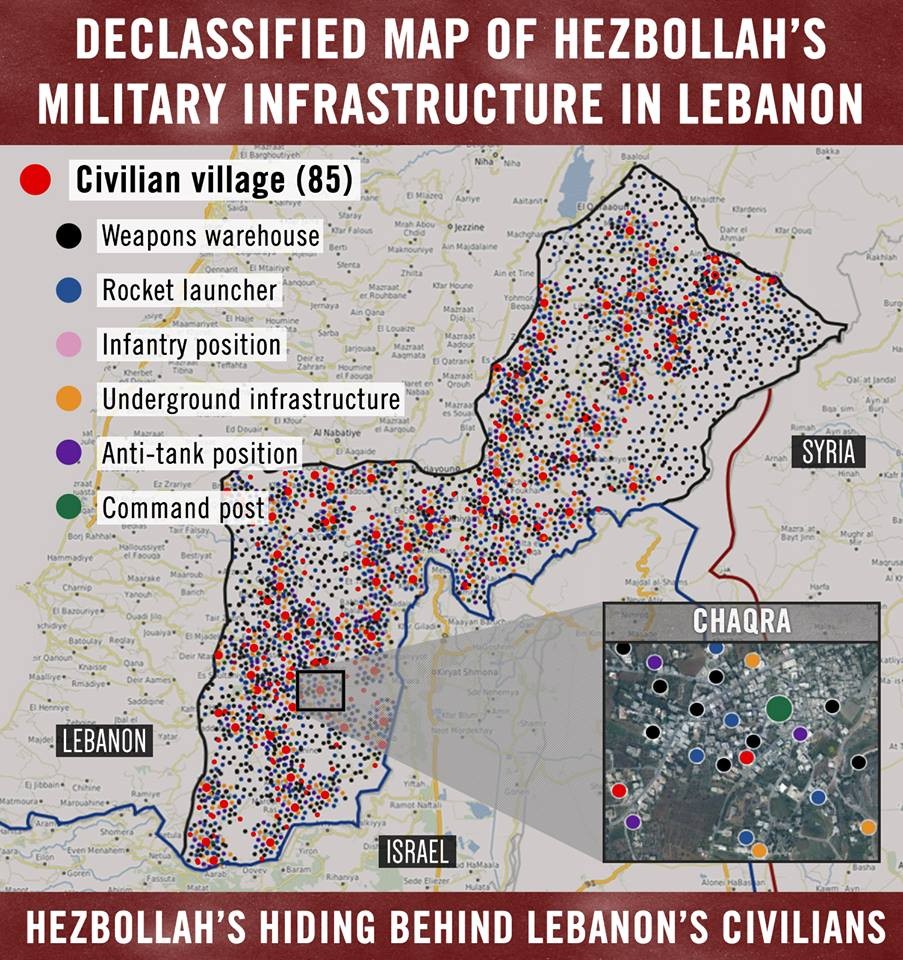
Declassified IDF Map Shows Hezbollah Installations Embedded in Civilian Areas

Tower: A map released Tuesday by the Israel Defense Forces shows the degree to which Hezbollah has embedded itself into the Lebanese civilian population. The map shows hundreds of military emplacements, including weapons depots, rocket launchers, and terror tunnels, that Hezbollah has constructed in preparation for its next war against Israel.

2016-12-06_idf_hezbollah_map

Hezbollah’s deliberate positioning of military infrastructure in Lebanese villages, a tactic that the IDF has called a “war crime,” is consistent with the Iran-backed terror organization’s history of exploiting civilians to launch wars against Israel.

It was reported in 2013 that Hezbollah was paying poor Shi’ite families in southern Lebanon to allow them to store weapons in their homes, effectively making them human shields.

An Israeli defense official told The New York Times in May 2015 that Hezbollah’s buildup in southern Lebanese villages meant that “civilians are living in a military compound….We will hit Hezbollah hard, while making every effort to limit civilian casualties as much as we can…[but] we do not intend to stand by helplessly in the face of rocket attacks.” A few days later, a newspaper linked to Hezbollah confirmed the Israeli assessment.

Hezbollah has “turned the Shiite villages…into essentially missile silos,” Jonathan Schanzer, the vice president for research at the Foundation for Defense of Democracies, said in July.

Noting the threat posed by Hezbollah’s extensive rocket arsenal and its placement among civilians, Geoff Corn, an international military law expert at the South Texas College of Law in Houston, observed earlier this year that the resulting devastation from a war with these conditions would “both legally and morally…lie solely at the feet of Hezbollah.”

United Nations Security Council Resolution 1701, which was passed unanimously to end the 2006 war between Israel and Hezbollah, forbids countries from transferring weapons to the terror organization. However, Iran has continued to arm Hezbollah, and the Security Council has refused to act to enforce the resolution.

The IDF released a similar map two years ago showing that Hamas—also an Iranian client—had used a civilian neighborhood in Gaza to house its terrorist infrastructure.

**** There is more:

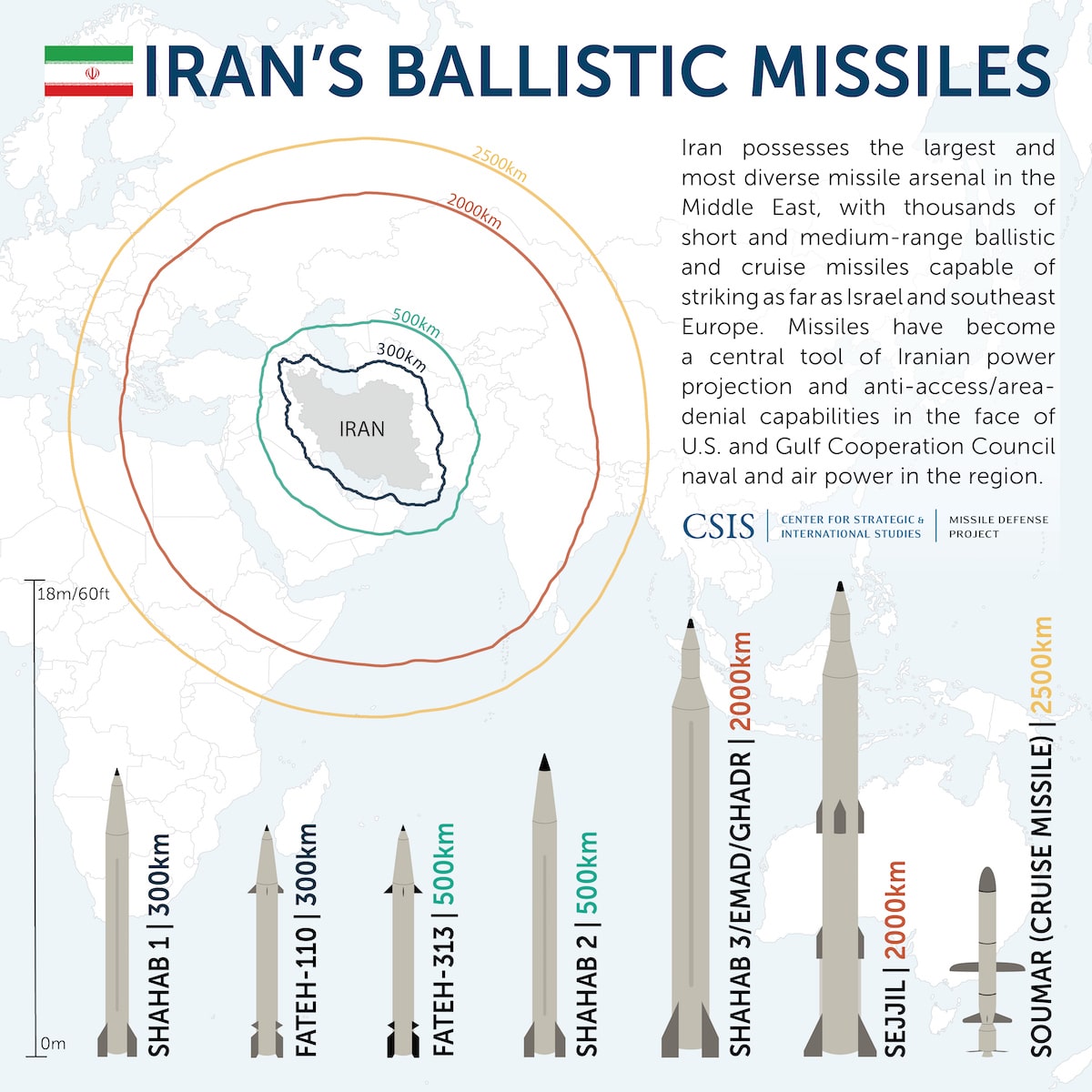
Iran possesses the largest and most diverse missile arsenal in the Middle East, with thousands of short and medium-range ballistic and cruise missiles capable of striking as far as Israel and southeast Europe.These weapon systems have become a central tool of Iranian power projection and anti-access/area-denial capabilities in the face of superior U.S. and Gulf Cooperation Council naval and air power in the Arabian Gulf region. While Iran has not yet tested or deployed a missile capable of striking the United States, it continues to hone longer-range missile technologies under the auspices of its space-launch program. In addition to increasing the quantity of its missile arsenal, Iran is investing in qualitative improvements to in its missile’s accuracy and lethality. Iran has also become a center for missile proliferation, supplying proxies such as Hezbollah and Syria’s al-Assad regime with a steady supply of missiles rockets, as well as local production capability. Furthermore, Iran is likely supplying Houthi rebel groups with short-range missiles in the ongoing conflict in Yemen.

Iranian Missiles

Obama Admin Illegally Raiding Funds to Pay for Refugees

There is still time to begin impeachment hearings on these people, schedule Oversight hearings and refer to DoJ from criminal prosecution as it is Congress alone that designates exactly where money is to be allocated and spent.

Meanwhile it seems HHS and the Office of Refugee Resettlement does not think some of these agencies need all the dollars assigned to them, perhaps that too is yet another place to eliminate waste, fraud and abuse if those agencies can in fact due without the raided funds. In the end, the Obama administration along with Sylvia Burwell have violated standing law with twisted priorities to non-citizens…yup illegals.

***

Feds cut $167 million in domestic programs to house, feed illegals for just 1 month

WT: The Department of Health and Human Services is raiding several of its accounts, including money for Medicare, the Ryan White AIDS/HIV program and those for cancer and flu research to cover a shortfall in housing illegal youths pouring over the border at a rate of 255 a day.

HHS is trying to come up with $167 million to fund the Office of Refugee Resettlement that is accepting the youths, according to the Center for Immigration Studies.

Policy Director Jessica Vaughan said that insiders have told her that the funding crisis has forced the department to squeeze programs for money.

She just revealed on the CIS website:

“An average of 255 illegal alien youths were taken into the custody of the Office of Refugee Resettlement (ORR) every day this month, according to the latest figures the agency provided to Congress. This is the largest number of illegal alien children ever in the care of the federal government. To pay for it, the agency says it will need an additional one or two billion dollars for the next year – above and beyond the $1.2 billion spent in 2016 and proposed for 2017 – depending on how many more arrive. For now, the Secretary of the Department of Health and Human Services (HHS), where ORR resides, is diverting $167 million from other programs to cover the cost of services for these new illegal arrivals through December 9, when the current continuing resolution expires.”

The money, she said, pays for “shelters, health care, schooling, recreation, and other services for the new illegal arrivals, who typically were brought to the border by smugglers paid by their parents, who often are living in the United States illegally.”

What’s more, it will pay for just one month.

Her sources said the following programs are being hit to pay for the illegals, about half of which the government will lose contact with.

— $14 million from the Health Resources and Services Administration, including $4.5 million from the Ryan White HIV/AIDS Program and $2 million from the Maternal and Child Health program.

— $14 million from the Centers for Disease Control and Prevention, for contagious disease prevention and treatment and other critical public health programs.

— $72 million from the National Institutes of Health, for research on cancer, diabetes, drug abuse, mental health, infectious diseases and much more.

— $8 million from the Substance Abuse and Mental Health Services Administration, for treatment and prevention programs.

— $8 million from the Centers for Medicare and Medicaid Services.

— $39 million from the Children and Families Services Program.

— $4 million from the Aging and Disability Services Programs.

— $3 million from the Public Health and Social Services Emergency Fund, including more than $1 million from the Pandemic Influenza and BioShield Fund.

France’s History of Terror, Murder and Iran

How bad was Iran during the Carter administration with the revolution and the hostages? It should be noted that nothing has changed in the last several decades.

‘A Darker Horizon’: The Assassination of Shapour Bakhtiar

1979

January 3 With strikes and street protests paralyzing the country, the Majles, Iran’s parliament, provisionally approves Shapour Bakhtiar as the new prime minister. During his five-and-a-half weeks in office he will oust the martial law governor of Tehran, General Gholam Ali Oveisi; lay the groundwork for the prosecution of other high officials close to the Shah; start to dismantle the secret police force SAVAK; order the release of all political prisoners; end press censorship; reopen the universities; cancel $7 billion in purchase orders for U.S. arms; and announce plans to hold elections for a constituent assembly to determine the monarchy’s fate. The Revolution continues. Shouts of “Bakhtiar nokar-e bee-ekhtiar” (Bakhtiar the powerless servant) ring through the Tehran streets.

BakhtiarShahJan16.jpgJanuary 6 Bakhtiar presents his cabinet to the Shah and is sworn into office. From the French village of Neauphle-le-Château, Khomeini rejects the new government, declaring it illegal. In a letter read out in Iranian mosques, he equates acceptance of Bakhtiar’s premiership with “obedience to false gods.” Bakhtiar is expelled from the Iran Party and the National Front.

January 16 The Majles gives Bakhtiar the constitutionally prescribed vote of confidence that officially makes him prime minister. He heads from the parliamentary building to Tehran’s international airport to bid a formal farewell to the Shah, who is about to depart for a supposedly “temporary” exile that will comprise the remaining 17 months of his life. (The two men are seen here facing each other immediately before the monarch boards his plane.) The Shah tells him, “I hope you will succeed. I give Iran into your care, yours and God’s.”

Late January Bakhtiar sends several cables to Neauphle-le-Château, saying he is ready to visit France to meet with Khomeini. The response to each request for an audience is the same: “First you must resign and then only shall you be received.”

February 1 Having previously announced, “We look forward to having the honor of soon welcoming home Ayatollah Khomeini,” Bakhtiar allows the charismatic cleric to return to Iran after years in exile. Khomeini immediately denounces Bakhtiar’s government, proclaiming, “I shall kick their teeth in. I appoint the government. I appoint the government by support of this nation.”

February 4 Responding to Khomeini’s threats — including one the previous day in which the ayatollah warned, “Do not provoke me to invite people to stage a jihad” — Bakhtiar says,

Iran has one government. More than this is intolerable, either for me or for you or for any other Iranian. As a Muslim, I had not heard that jihad refers to one Muslim against other Muslims. Those fomenting a civil war will be put in front of the firing squad. I will compromise neither with the Shah nor with Khomeini. I will not give permission to Ayatollah Khomeini to form an interim government. In life there comes a time when one must stand firm and say no…. I have never seen a book about an Islamic Republic; neither has anyone else for that matter…. Some of the people surrounding the Ayatollah are like violent vultures…. The clergy should go to Qom and build a wall around themselves and create their own Vatican.

February 5 Khomeini proclaims a provisional revolutionary government and introduces the prime minister he has selected to head it, Mehdi Bazargan. Khomeini declares, “Since I have appointed him, he must be obeyed. The nation must obey him. This is not an ordinary government. It is a government based on the sharia [Islamic law]. Opposing this government means opposing the sharia of Islam.”

Bakhtiar addresses the Majles in response:

The Iranian nation and Iranian state are indivisible entities: one country, one government, one constitution, or nothing else. We will tolerate this thing about anybody forming their own government as long as it is a joke and in words only, but if they take action in this regard, we shall reply with our own actions. If blood is spilled and aggression is committed against the people, I will expose the aggressors without regard to their name or position. I shall remain in the position of the legitimate prime minister of this country until free elections are held…. Whoever enjoys a majority, shall then govern.

2 p.m., February 11 With Tehran a virtual war zone, Iran’s Supreme Military Council announces itself “neutral in the current political disputes…in order to prevent further disorder and bloodshed.” Revolutionary forces take control of government buildings and media centers. The last government established under the monarchy collapses and Bakhtiar goes into hiding.

March 30 and 31 Iranians vote on a referendum asking, “Should the monarchy be abolished in favor of an Islamic government?” No other alternative to monarchy is proposed. The measures passes with 98 percent approving.

May 14 Ayatollah Sadegh Khalkhali, appointed by Khomeini to head the newly established Revolutionary Courts, tells Kayhan newspaper that Bakhtiar has been sentenced to death in absentia for “sowing corruption on earth.” Declaring that “those who left Iran after the Revolution were considered genuine criminals” and “incurred the death penalty,” he states that Bakhtiar is among 12 of the Shah’s relatives and officials then in hiding or exile who have been condemned for “making a campaign against Imam Khomeini.” He announces that any Iranian who carries out the death sentence on foreign territory will be considered an agent of the court.

May 16 In a public speech, Khomeini charges Bakhtiar with “treason.”

July 31 Bakhtiar emerges in Paris. While in hiding, he solicited the French government’s aid and was provided with a false passport by the Fourth Republic’s ambassador in Tehran. Successfully disguised as a Christian pastor returning home — former French Prime Minister Félix Gaillard once reportedly said that Bakhtiar spoke French better than a native — he flies from Iran to Paris-Orly Airport. Upon arrival, he speaks out publicly against the Islamic regime and describes Khomeini as “ignorant, uncultured, narrow-minded, and obstinate.”

Mid-September Bakhtiar organizes an anti-Khomeini rally in London and announces that he will continue to resist the new regime until the ayatollah relinquishes power.

December 7 Shahryar Shafiq, the son of Ashraf Pahlavi, the Shah’s twin sister, is gunned down on a Paris street. An Iranian suspect will be apprehended in Britain and extradited to France.

In Tehran, Khalkhali excoriates Bakhtiar for “actively opposing Ayatollah Khomeini from his exile in Paris.”

1980

May Amid escalating tensions between the Islamic Republic and the regime of Iraqi President Saddam Hussein, Bakhtiar visits Iraq with assurances that the Iranian people will not rally in defense of the Khomeini government. A new Baghdad-based radio station begins broadcasting pro-Bakhtiar messages intended for an Iranian audience.

Mid-June France’s L’Express magazine publishes a story featuring Khalkhali. (It is, at present, unclear whether the piece involved an original interview or was largely culled from statements that had already appeared in the Iranian media.) “I have sent a commando unit to get him,” the ayatollah is quoted as saying in reference to Bakhtiar. “He can not escape us.”

July 9 Iranian authorities discover and suppress a coup attempt involving a network of over 1,000 military personnel, policemen, and civilians. From Paris, Bakhtiar has channeled financial support to part of the network. More than 140 participants in what comes to be known as the Nuzhih plot are executed around Iran over the following month.

8:45 a.m., July 18 A five-man hit squad led by Anis Naccache, a Lebanese national and self-described former member of the Palestinian resistance group Fatah, carries out an assassination attempt on Bakhtiar at his then residence, an apartment in the Parisian suburb of Neuilly-sur-Seine.

The team members, using forged press credentials, talk their way past the French policemen stationed in front of the apartment building. Inside, they shoot and kill the officer assigned to vet visitors more rigorously. Upstairs, the hit squad heads to the wrong apartment and kills a neighbor of Bakhtiar’s when she opens her door; her sister is wounded. They head to the correct door and ring the bell, but Bakhtiar’s cousin, suspicious of the unexpected, early-hour visit, attaches the door’s security chain before opening it. The assailants’ attempts to shoot their way into the apartment fail and they take flight. Intercepted by the police outside, they shoot one, paralyzing him for life, before they are subdued. (For a short French television report on the attack, see here.)

July 22 Ali Tabatabaei, who served under the Shah as press attaché in Iran’s embassy in the United States and joined the opposition after the Revolution, is murdered at his home in Bethesda, Maryland. The killer is Dawud Salahuddin, an American convert to Islam, who later says he was paid $5,000 to commit the assassination. He makes his way via Paris and Geneva to Iran, where he continues to reside.

BakhtiarIntenseMics.jpgAugust Bakhtiar establishes the National Movement of Iranian Resistance (NAMIR; the organization, whose Farsi name is Nehzat-e Moghavemat-e Meli Iran, is also referred to as NRMI and NMIR). While the group officially promotes the establishment of a social-democratic government in Iran, Bakhtiar does not forswear the possibility of a constitutional monarchy, which helps to attract the support of some monarchists even as it repels other opponents of the Islamic regime.Early September An Iranian organization identifying itself as Neghab (Mask, or Veil) claims responsibility for the attempted “uprising” that was crushed by the regime two months earlier. Its communiqué declares that “the path of Mosaddegh is that of the people” and that “Bakhtiar is its authentic leader.” Decrying the new Islamic dictatorship, it states, “We have risen up to put an end to this curse and to entrust the affairs of our land to the faithful disciple of Mosaddegh — Shapour Bakhtiar.”

September 22 Iraq invades Iran, setting off a war that will last for eight years.

1982

March 10 Four members of the hit squad that attempted to kill Bakhtiar two years earlier, including Naccache, are sentenced to life imprisonment; the fifth is sentenced to 20 years. With the exception of one hearing, the accused men refused to attend the trial, announcing, “Only Allah is a judge.” During his single appearance, Naccache says the assassination plan was justified by a verdict issued by the Islamic Revolutionary Court in Tehran.

1984

February 7 General Gholam Ali Oveisi, the Tehran military governor who was forced out by Bakhtiar five years earlier, and his brother, Gholam Hossein Oveisi, are assassinated in Paris. The case remains unsolved.

1985-86

Between December 7, 1985, and September 17, 1986, Paris suffers from a bombing campaign in which 11 explosions kill 13 people and injure 255. An Islamist group calling itself the Committee of Solidarity with Arab and Middle East Political Prisoners — or CSPPA, the acronym for its French name — claims responsibility. The group is evidently closely linked with the Lebanese Hezbollah, which receives both ideological guidance and material support from the Islamic Republic. The CSPPA demands the release of three people imprisoned in France, including Anis Naccache “of the jihad.”

1987

January 16 Ali Akbar Mohammadi, a former pilot for Akbar Hashemi Rafsanjani, is assassinated by two men in Hamburg. He had flown a plane to Baghdad and defected the previous year. The case remains unsolved.

May 19 Hamid Reza Chitgar, first secretary of Iran’s Hezb-e Kaar (Labor Party), disappears after traveling from his Paris home to Vienna. Killed by a gunshot to the back of the head, his corpse is found two months later in a Vienna apartment. A man identifying himself as Ali Amiztab apparently corresponded with Chitgar from Iran for about two years and lured him to the Austrian capital, supposedly to discuss the establishment of a group for Labor Party supporters. The case remains unsolved.

June Information derived from wiretaps lead French investigators to identify Wahid Gordji, who has a position as a translator at the Iranian Embassy in Paris, of coordinating the CSPPA bombing campaign. He avoids imminent arrest by fleeing to the embassy, where Iran claims he is protected although he is not a registered diplomat. A months-long standoff ensues as French police surround the building, and Iranian police encircle the French Embassy in Tehran in retaliation.

July Iran and France sever diplomatic relations and Hezbollah takes several French citizens hostage in Lebanon.

November Gordji is briefly interviewed by French authorities, then flies to Iran. The hostages in Lebanon are released soon afterward. Iran claims that France expedited the repayment of Iranian loans, paid millions of dollars to the Lebanese kidnappers, and agreed to suppress the activity of French-based opponents of the Islamic Republic. French Prime Minister Jacques Chirac denies that there was any deal.

1988

June Full diplomatic relations are restored between France and Iran.

1989

July 13 Abdulrahman Ghassemlou, leader of the Democratic Party of Iranian Kurdistan (DPIK), and his aides Abdollah Ghaderi, Fadal Mala, and Mamoud Rassoul, meet with Iranian representatives Mohammad Jafari Sahraroudi, Amir Bozorgnia, and Kurdistan provincial governor Mostafa Ajoudi in a Vienna apartment. Shots are fired, killing Ghassemlou and his aides. The murders are reported to the police by the Iranian delegation, who deny any responsibility. The Austrian police, after taking statements, release the Iranian representatives. They are expelled from Austria, after which the police conclude that they were probably the culprits.

August 26 Bahman Javadi (aka Gholam Keshavarz), a member of the central committee of the Communist Party of Iran and a top figure in its Kurdish branch, Komaleh, is assassinated in Lanarca, Cyprus. The case remains unsolved.

Autumn According to his later testimony to French investigators, Fariborz Karimi, an Iranian exile in Paris, is solicited by a friend of his, Manouchehr Akasheh, to meet him in Frankfurt to discuss an important matter. Karimi and Akasheh know each other through their membership in NAMIR. Karimi discusses the solicitation with Bakhtiar, with whom he has become quite close, and they agree he should go and find out what Akasheh wants.

In Germany, Karimi is offered “$600,000, a house in Tehran, and anything else” to kill Bakhtiar by poisoning his vodka. According to Karimi, the VEVAK recruiter who makes the offer tells him the poison, half a small vial’s worth of white powder, “is colorless. No one will know. They will think he had a stroke.” On his third day in Frankfurt he receives a direct call from Hojatoleslam Ali Fallahian — then assistant to the chief of VEVAK — encouraging him to accept the mission.

Karimi returns to Paris without directly rejecting the proposal. A month later, he receives another call from Fallahian, using the name “Hossein,” pressuring him to do the job. Fearing for his life, Karimi publicly denounces Bakhtiar, moves to London, and tries to lie low, but Fallahian tracks him down a third time. Karimi flees to Canada and eventually the United States, where he is granted asylum.

1990

April 24 Dr. Kazem Rajavi, elder brother of Massoud Rajavi, leader of the Mojahedin-e Khalgh Organization (MKO), is assassinated in a village near Geneva. Rajavi, Iran’s first ambassador to the United Nations headquarters in Geneva after the Revolution, resigned and became active in the National Council of Resistance, MKO’s political arm. The case remains unsolved.

July 15 Ali Kashefpour, a member of the DPIK central committee residing in Turkey, is kidnapped, severely tortured, and killed. The case remains unsolved.

September 6 Effat Ghazi, daughter of Ghazi Mohammad, the Kurdish leader and president of the Mahabad Republic — a breakaway state formed in 1946 and soon crushed by government forces — is killed in Sweden by a letter bomb intended for her husband, Kurdish activist Amir Ghazi. The case remains unsolved.

July 28 The five men convicted of participating in the 1980 assassination attempt on Bakhtiar in which two people were murdered are pardoned and released by the French government. Accompanied by two officials from the Iranian Embassy in Paris, Naccache is flown immediately to Tehran. He later asserts that the pardons were part of a 1988 deal between France and Iran to secure the release of three French nationals held hostage by Shia paramilitaries in Lebanon.

October 24 Cyrus Elahi, a member of the opposition monarchist group Derafsh-e Kaviani (Flag of Freedom), is assassinated at his home in Paris. The case remains unsolved.

1991

BakhtiarAndBoroumand.jpgApril 18 Bakhtiar’s chief assistant in the National Movement of Iranian Resistance, Abdolrahman Boroumand (pictured here, in the foreground, with Bakhtiar), is stabbed to death in the lobby of his Paris apartment building. The case remains unsolved.Early summer Iranian secret agents establish an operations center in two Istanbul apartments, one owned and the other newly rented by Mesut Edipsoy, then 31, an Iranian Turk with alleged ties to Turkish organized crime. Edipsoy, also known as Edybnia in the United States, travels frequently to Los Angeles and Orange County.

July Bakhtiar calls a meeting to select a successor to Boroumand. Farydoun Boyerahmadi, a 38-year-old member of the resistance movement — whose brother happens to be a member of the Islamic Revolutionary Guard Corps — attends and lays flowers on the empty chair symbolically set aside for their dead comrade. (Boyerahmadi is referred to in many accounts as a “friend” of Bakhtiar’s. A former high-ranking Iranian official who was indisputably close to Bakhtiar challenges that description; he says that Boyerahmadi was able to ingratiate himself and work his way into the opposition leader’s circle by defending Bakhtiar in the media and leveraging some old tribal ties. The official concludes, “No. A friend? No.”) Afterward, Boyerahmadi puts in a call to Istanbul.

Mid- to late July Through the Iranian Ministry of Telecommunications and Islamic Republic of Iran Broadcasting, Ali Vakili Rad, then 32, and Mohammad Azadi, then 31 — later alleged to be intelligence agents — obtain French visas based on the claim that they are businessmen going on an electronics shopping trip. The Iranian Ministry of Foreign Affairs issues Vakili Rad and Azadi passports with false names. In Istanbul, investigators later say, a master forger is retained to counterfeit additional passports — Turkish — and visas — Swiss.

Upon their arrival in Paris, Vakili Rad and Azadi learn from Boyerahmadi, who frequently visits Bakhtiar’s home to do odd jobs, that the exile leader’s housekeeper and gardener are about to depart for vacation. Aside from his personal secretary and the French policemen who guard his house, Bakhtiar will be alone.

5 p.m., August 6 Boyerahmadi, accompanied by Vakili Rad and Azadi, drives his BMW to the home of Bakhtiar, who is expecting them. The visitors wear suits and black ties as a token of respect for the former prime minister, who is still grieving the death of his good friend Boroumand.

Like any other visitors, the three men turn over their passports to the guards, pass through the metal detector set up in front of the house, and are frisked without incident. The investigators’ account of what follows is based largely on forensic evidence.

5:15 p.m., August 6 Vakili Rad and Azadi join Bakhtiar in his living room. They present him with a picture frame that they have brought as a gift. Tea is served by Bakhtiar’s secretary, Soroush Katibeh, who then heads out to the kitchen terrace.

5:30 p.m., August 6 Police guards observe Boyerahmadi sitting with Katibeh. Bakhtiar is thus alone with Vakili Rad and the large, robust Azadi.

One of the men strikes a massive blow to Bakhtiar’s throat, possibly with a forearm, crushing his larynx. A lover of the passionate ghazals of Hafez, the piercingly ironic prose of Anatole France, reputed to have memorized 10,000 verses of poetry, he lies on his sofa, able neither to cry out nor even breathe.

As Bakhtiar suffocates to death, Vakili Rad and Azadi retrieve two knives from the nearby kitchen and stab him multiple times in the chest. Afterward, they use the serrated edge of one of the knives to carve at his throat and wrists. His Rolex watch is removed — a souvenir, a trophy, perhaps evidence of a mission well accomplished.

5:45 p.m., August 6 Katibeh returns from the terrace and is killed in a similar fashion. The assailants return the knives to the kitchen and wash as much blood from their clothing as is practical. They place a wastebasket in front of a window to conceal the secretary’s corpse. Bakhtiar’s corpse is left on the sofa, draped over with a tablecloth. The phone is removed from its hook.

6 p.m., August 6 The assassins exit the house. The guards notice nothing out of the ordinary, despite the remaining bloodstains on the two killers’ clothing. The three men drive off toward Paris proper. Pulling over in the Bois de Boulogne park, Vakili Rad and Azadi change into clean clothes, toss their bloody garments in a trash receptacle, and discard their false Iranian passports after shredding them.

Boyerahmadi takes them to a subway station, then abandons his bloodied BMW in the Iranian emigré neighborhood known as Téhéran-sur-Seine. It will sit there undisturbed for days.

Evening, August 6 All is quiet at the Bakhtiar compound. The police guards continue to make their rounds. Every 15 minutes, they enter “RAS” in their logs: rien à signaler — nothing to report.

Night, August 6 Having assumed the identities of Turkish citizens named Musa Kocer and Ali Haydar Kaya, Vakili Rad and Azadi travel without Boyerahmadi for the first time since their arrival in France. They are bound for the small resort town of Annecy, near the Swiss border. The route requires them to switch trains in Lyon, which has two stations. The operatives, neither of whom speaks French, get off at the wrong one. They miss their connection to Annecy.

Midnight, August 7 A call is placed to the Istanbul operations center from Lyon. Days later, a taxi driver will tell police investigators that “the big one,” Azadi, used the pay phone outside the rail station.

Morning to night, August 7 At the Bakhtiar compound, the guards fail to notice when his secretary does not make the customary morning delivery of the day’s agenda. In the vestibule of the house, sacks of groceries, dropped off as usual, go unretrieved. The phone is constantly busy, but this is unremarkable given how much time the former prime minister spends talking on it.

While the failure to discover the crime has given the murderers a substantial head start, it is making their handlers in Istanbul very nervous. There are no press reports to confirm the assassination. Despite the fact that Vakili Rad and Azadi have already made contact, a call is placed from the operations center to an Iranian woman in Paris, Fereshteh Jahanbani, who will later admit to investigators that she was employed by VEVAK. The Istanbul caller, her case officer, asks if there is any news of Bakhtiar. There is not, so she agrees to make inquires.

Late night, August 7 Vakili Rad and Azadi finally arrive at the Swiss border. A border guard examines their fake Turkish passports. In the course of their stop-and-start flight across France, they waited too long to stick in their counterfeit Swiss visa stamps. The stamps are still moist, arousing the guard’s suspicion. On further inspection, he determines that the visas, supposedly issued in Tehran, bear serial numbers of Swiss consulates in France. The Iranians are denied entry and handed over to French border guards — who release them almost immediately.

Noon, August 8 Bakhtiar’s son Guy, a local police officer, returns from a trip and arrives at the house in Suresnes. Forty-two hours after the killings, long enough for mold to bloom on the unfinished cups of tea in the parlor, the two decomposing bodies are discovered.

August 8-9 News spreads of Bakhtiar’s murder, and Iranians in France react. Aides to the NAMIR leader say that the French government, looking to improve its relationship with Iran, had been pressuring Bakhtiar to stop his political activity and had recently reduced his security detail. “France closed its eyes and let Iran kill Shahpour Bakhtiar,” says one aide, Iraj Soltani.

August 12 Meanwhile, Azadi and Vakili Rad at last make it across the border to Annecy. Their problems in getting out of France have obliged the Istanbul operations center to place calls to Tehran, Paris, London, Los Angeles, and elsewhere — each of those calls ultimately yielding clues to what investigators describe as VEVAK’s international network. More evidence will come from the wallet one of the two men leaves in an Annecy phone booth. Their next stop: Geneva.

August 13 Zeynalabedine (Zia) Sarhadi, a grandnephew of Rafsanjani’s, the Iranian president since 1989, enters Switzerland. Assigned to an archivist’s position at the Iranian Embassy in Bern, his order of mission from the Foreign Ministry is initialed by a top bureau official above the typed words “for the foreign minister” — Ali Akbar Velayati, one of the most powerful members of the Rafsanjani administration.

Mid-August Pictures of the last three visitors to Bakhtiar’s house are distributed to news outlets throughout Europe and international arrest warrants are issued. Swiss border police alert anti-terrorism authorities that the Iranian operatives tried to enter Switzerland a day after the killings.

Boyerahmadi, hiding in Paris, tells a confidant (and subsequent prosecution witness) that he is awaiting documents for a trip to the United States. Some time after August 15, he apparently departs France. Investigators later say he has relatives near Washington, D.C., and in Germany and likely changed identities to make his escape.

Arriving in Geneva, Vakili Rad and Azadi check into different hotels, parting ways to make it seem that each has been traveling solo. According to French investigators, phone data — supported by guest registers and the testimony of hotel staff — show that “archivist” Sarhadi was in touch with both the Istanbul center and the Geneva hotel where Azadi stayed.

Arrangements are made to get the operatives out of Europe. They are to meet their contacts outside the offices of Iran Air. Azadi makes his appointment and apparently returns home to Iran. Vakili Rad gets lost and arrives at his appointment 10 minutes late. His contact has gone.

Early morning, August 21 Vakili Rad, wandering aimlessly alongside the shore of Lake Geneva, is arrested by Swiss police. He has attempted to disguise himself by shaving off his mustache.

Afternoon, August 21 The Istanbul operations center shuts down. The last agent manning the phones departs for Iran.

Late August-early September Aided by the testimony of the Lyon cab driver and the abandoned wallet, French investigators, led by Magistrate Jean-Louis Bruguiere, are tracing the killers’ escape route. Using the national telephone system’s automated records, an analysis is run on 20,000 calls placed from public phones along their trail. Two of the numbers to which they are linked lead to the Istanbul apartments provided by Edipsoy for the operations center. A prostitute who works the Bois de Boulogne informs police of the bloody garments she found discarded in the park. Though she has cleaned them to give to a boyfriend, lab tests are later able to tie the clothes to both the Iranian operatives and the victims.

Switzerland extradites Vakili Rad to France. Interrogated by Bruguiere, he admits to being present at the killing of Bakhtiar and his secretary, but denies any connection to the Iranian government.

September 13 The operatives also left a paper trail. Poring over thousands of visa applications, investigators have found ones submitted by the two men — the endorsement on them comes from Syfax, a French electronics company. Syfax officials say they acted at the behest of Iranian businessman Massoud Hendi, a grandnephew of Khomeini’s and former IRIB Paris correspondent. Hendi is arrested while on vacation with his family in the French capital.

September 17 Hendi is indicted. He admits his involvement in attempting to acquire the visas, but claims to have acted innocently: by his account, Hossein Sheikhattar, a senior aide to Iran’s telecommunications minister, asked him to help out two “friends.” After his indictment is made public, IRIB issues a statement denouncing Hendi as a French agent and claiming he is “no relation to Imam Khomeini or to his family.”

October While Edipsoy eludes capture, the French investigators are able to analyze the calls made from his apartments. One leads to Jahanbani. A raid on her Paris home turns up encoding devices, a pen with disappearing ink, and other evidence identifying her as an Iranian intelligence agent. Before and just after the assassination, other calls were made from the Istanbul operations center to the Iranian Telecommunications Ministry, to IRIB headquarters, and to a Tehran number which other evidence also indicated was used by the Iranian secret service. Calls were also placed to the Geneva hotels where Vakili Rad and Azadi stayed.

October 27 The Independent in Britian publishes an interview with Naccache, the 1980 hit squad commander, in which he says,

I had no personal feelings against Bakhtiar, it was purely political. He had been sentenced to death by the Iranian Revolutionary Tribunal. They sent five of us to execute him…. I came to have contacts with the Iranian opponents of the Shah in Beirut and Tyre. That’s how I found myself involved in the Iranian revolution…. I became convinced that a revolution had to be safeguarded and protected…. With Bakhtiar, I felt there was a danger of a coup like the one against Mosadeq [sic]. That’s why we decided to assassinate him. It was a sentence of death against him, to be carried out as an execution. Bakhtiar was the head of a plot to carry out a coup against the revolution and come back to Iran.

December 23 Sarhadi is detained in Switzerland on an international arrest warrant. Investigators say that documents in his possession show he received support from various Iranian agencies to facilitate the arrangements for the Bakhtiar killers’ escape. After five months, he will be extradited to France.

1992

August 8 The corpse of Fereydoun Farrokhzad, a popular exiled Iranian singer, is found in his Bonn home. He has been stabbed 40 times and beheaded. The case remains unsolved.

August 30 In an interview aired on Iranian state television, Fallahian boasts of VEVAK’s foreign operations prowess. Speaking of the regime’s political opposition, he says, “We track them outside the country, too. We have them under surveillance…. Last year, we succeeded in striking fundamental blows to their top members.”

September 17 Dr. Sadegh Sharafkandi, Abdulrahman Ghassemlou’s successor as head of the Democratic Party of Iranian Kurdistan, and three aides, Homayoun Ardalan, Fattah Abdollahi, and Nouri Dehkordi, are assassinated in a Berlin restaurant. The event becomes known as the Mykonos Incident, after the name of the Greek eatery where the killings take place.

1993

January French investigators have followed the trail of the conspiracy to Los Angeles, where Edipsoy frequently traveled and from where logistical support for the killers may have come. Fariborz Karimi tells them how he was solicited to kill Bakhtiar four years earlier. Despite that, Edipsoy’s activity, and other evidence, the French team is frustrated when the regional U.S. attorney’s office, citing inadequate probable cause, turns down their search and arrest warrant requests. According to the Los Angeles Times, one French investigator later says of U.S. officials, “We told them there is a network of terrorists operating in your country. The Americans seemed to resent being told.”

1994

March A French judicial panel, having spent a month with the documents turned over by Bruguiere and his investigative team — 18 volumes worth — hears arguments from attorneys in the Bakhtiar assassination case. Speaking with Time anonymously, a French official says, “This case marks the first time that we have so many proofs of the implication of the state in an operation of this importance.” The most significant material evidence for that claim relates to Sarhadi, President Rafsanjani’s young relative, who is charged with facilitating the killers’ escape (or attempted escape) from Europe. His lawyer concedes that Sarhadi’s “passport arrived in Switzerland on Aug. 13, 1991,” but not the man himself; the passport was “stolen,” claims the lawyer, after it was handed over to Iranian airport police.

April The U.S. State Department issues a report on global terrorism that claims, “Tehran’s policy makers view terrorism as a valid tool to accomplish their political objectives, and acts of terrorism are approved at the highest levels of the Iranian government.” It continues,

Iranian intelligence continues to stalk members of the Iranian opposition in the United States, Europe, Asia, and the Middle East. Despite Tehran’s attempts to distance itself from direct involvement in terrorist acts, Iran has been linked to several assassinations of dissidents during the past year…. All of the murders were carried out by professional assassins; no arrests have been made.

Late October-early November “Terrorism is trying to destroy our society. It’s like a war,” says Bruguiere in an interview on the eve of the trial of nine Iranian nationals on charges related to the Bakhtiar assassination. “Organized crime has an understandable goal, to make profits for its members. But terrorism seeks to destroy our values, our democratic systems. We must fight it with the arm of the law.”

In the course of their lengthy investigation into the phone calls from the Istanbul center, French authorities have uncovered other apparent Iranian intelligence operatives around Europe. Evidence found in the office safe of an Iran Air official at Paris-Orly Airport indicates that he was involved in the forging of runway access badges. He was also holding the long-lost wallet and passport of a French businessman, suggesting that they might be used to create fake identities for Iranian agents. In England, investigators expose an Iranian interior decorator near Birmingham as what they call a “dormant mole” for VEVAK. He is detained by British authorities for interrogation.

Bracing for possible terrorist attacks similar to those that followed the trial of the unsuccessful 1980 hit squad, police ramp up security around train stations and department stores. Marksmen line the Palais de Justice roof. In an effort to minimize tensions with Iran, one French Justice Ministry spokesman insists, “This is a murder trial, not a trial of Khomeini or Rafsanjani. The issue will be simply this: Who is the murderer and who is the accomplice?”

In contrast, Ali Chakeri, who has replaced Bakhtiar as head of NAMIR, accuses Iran of pursuing an international campaign to extinguish dissent. “We don’t care so much if the accused suspects are convicted,” he says in an interview. “What is most important to us, the victims of this violence, is that Iran is convicted.” Speaking with the Los Angeles Times, a senior French justice official reveals a similarly broad view of the stakes: “Iran seems to regard political assassination as its national right, even on foreign soil. Any country that enforces its laws against murder is seen [as] interfering in the sovereign affairs of Iran.”

November 2 The trial begins under massive security. Three defendants are in the dock: Vakili Rad, Sarhadi, and Hendi, whose lawyer insists that his client’s efforts to obtain visas for Vakili Rad and Azadi “prove nothing,” since the two men actually entered the country on a different set of visas. All deny involvement in the alleged conspiracy, including Vakili Rad, notwithstanding his confession that he was at the murder scene.

Six men are being tried in absentia, including Azadi, Boyerahmadi, Edipsoy, and Sheikhattar, the Telecommunications Ministry official. The other two, businessmen Gholam Hossein Shoorideh Shriazinejad and Nasser Ghaseminejad, are accused of conspiring to aid the assassins during their Swiss sojourn. Investigators express confidence that they can show that four Islamic Republic ministries — Intelligence (VEVAK), Telecommunications, Foreign Affairs, and Interior — contributed to the murder plot. Continue reading here by PBS where more photos, videos and the balance of the timeline is explained. 

Declassified cable published by Wikileaks, one of many noted below:

1. DAVID NEWSOM AND BEN READ TALKED WITH AMBASSADOR SULLIVAN AT 2 P.M. EST TO CLARIFY A NUMBER OF QUESTIONS SURROUNDING THE ENVIRONMENT FOR POSSIBLE EVACUATION ACTIONS. STRIKING IRANIAN CIVIL AIR PERSONNEL HAVE DECLARED THAT U.S. AND ISRAELI PLANES WILL NOT BE ALLOWED TO LAND IN OR FLY OVER IRAN AND THAT THE STRIKERS WILL NOT BE RESPONSIBLE FOR ANY RISKS TAKEN BY THE AIRLINES OF THOSE COUNTRIES. Sheryl P. Walter Declassified/Released US Department of State EO Systematic Review 20 Mar 2014 Sheryl P. Walter Declassified/Released US Department of State EO Systematic Review 20 Mar 2014 2. SULLIVAN SAID THAT MILITARY PERSONNEL ARE NOW IN CONTROL OF AIR TRAFFIC, NOT IRANIAN FAA CONTROLLERS. HE CONFIRMED THAT THE OVERALL SECURITY OF THE AIRPORT ITSELF IS STILL ACCEPTABLE, AND SAID ACCESS TO THE AIRPORT FROM THE CITY WAS STILL POSSIBLE ALTHOUGH THAT COULD BECOME MORE DIFFICULT. 3. ASKED ABOUT HIS ACCESS TO PEOPLE IN AUTHORITY IN THE CITY, AMBASSADOR SULLIVAN SAID IT WAS NOT POSSIBLE AT THAT JUNCTURE TO REACH ANYONE (IT WAS 10:00 P.M. TEHRAN TIME). THE 9:00 P.M. CURFEW WAS IN EFFECT AND ROVING BANDS OF RIOTERS IN THE STREETS WERE ATTACKING ANY VEHICLES REGARDLESS OF NATIONALITY. THUS, SULLIVAN WAS DOUBTFUL HE COULD REACH ANYONE UNTIL MORNING, TEHRAN TIME. 4. SULLIVAN HAD NO ESTIMATE OF WHETHER A MAC FLIGHT, DUE INTO TEHRAN THE MORNING OF JANUARY 1 WOULD BE ALLOWED TO LAND. IT WILL BE A TEST CASE OF THE SUPPOSED BAN BY THE AIRPORT WORKERS ON ALL FOREIGN FLIGHTS. 5. TOLD OF PAN AM’S REQUIREMENT THAT, EVEN TO PUT IN THEIR PLANES ON A CHARTER BASIS, THEY WOULD NEED SOME ASSURANCE THAT THEIR FACILITIES AND PERSONNEL IN TEHRAN WOULD NOT BE SUBJECT TO REPRISAL, SULLIVAN SAID HE COULD SECRET SECRET PAGE 03 STATE 000001 NOT MAKE A MEANINGFUL EVALUATION. 6. SULLIVAN SAID THE EMBASSY WOULD TRY TO REACH THE CHIEF OF THE IRANIAN AIR FORCE TO SEE IF HE COULD GET SOME KIND OF ESTIMATE ON THE OVERALL SECURITY SITUATION, INCLUDING WHETHER IT WOULD BE POSSIBLE TO GIVE ASSURANCES OF ANY KIND TO PAN AM ABOUT THEIR FACILITIES AND PEOPLE. 7. WE HAVE NEARLY 500 OFFICIAL AMERICAN DEPENDENTS LEFT IN THE TEHRAN AREA. THERE ARE AN ESTIMATED 19,000 OTHER AMERICANS IN THE CITY (30,000-35,000 IN ALL IRAN). MAC FLIGHTS ARE SCHEDULED THROUGH THE WEEK WHICH CAN BRING OUT FROM 70-140 OFFICIALS AND DEPENDENTS DAILY IF NECESSARY. PAN AM AND COMMERCIAL CHARTERS ARE ESSENTIAL TO PROVIDE ADEQUATE SPACE FOR UNOFFICIAL AMERICANS. IF PAN AM DOES NOT FLY WE CAN EXPLORE CHARTERS BY OTHER AMERICAN CARRIERS OR INCREASED MAC FLIGHTS. NEWSOM AND READ ALSO EXPLORED WITH ADMIRAL LYONS (JCS) OUR OPTIONS IN A SERIOUSLY DETERIORATING SITUATION WHERE RAPID EVACUATION OF ALL BUT THE MOST ESSENTIAL AMERICANSWAS REQUIRED. MILITARY ARICRAFT CAN BEGIN ARRIVING IN TEHRAN WITHIN 12 HOURS OF OUR RECEIVING THE ORDER TO DO SO, FROM BASES IN EUROPE. Sheryl P. Walter Declassified/Released US Department of State EO Systematic Review 20 Mar 2014 Sheryl P. Walter Declassified/Released US Department of State EO Systematic Review 20 Mar 2014 THIS TIMING PRESUPPOSES ADEQUATE AIRPORT SECURITY. THE DELAY WOULD, OF COURSE, INCREASE SHOULD SECURITY ON THE GROUND DETERIORATE AND REQUIRE OUR SENDING IN OUR OWN ADVANCE SECURITY FORCES. 8. WE ARE CONTACTING THE BRITISH, FRENCH AND FRG EMBASSIES IN WASHINGTON TO GET A READING ON WHAT THEIR NATIONAL AIRLINES ARE DOING, AND WHAT THEIR INFORMATION IS ON THE SUPPOSED BAN ON FOREIGN FLIGHTS. 9. READ AND NEWSOM WILL HAVE A SECURE TELEX CONVERSATION WITH AMBASSADOR SULLIVAN AT 8:00 A.M. EST TOMORROW BY WHICH TIME THE SITUATION SHOULD BE SOMEWHAT CLARIFIED, AND WE WILL IN FACT KNOW WHETHER THE MAC FLIGHT WAS ALLOWED TO SECRET SECRET PAGE 04 STATE 000001 LAND. WE ARE BRIEFING CHAIRMAN CHURCH AND ZABLOCKI ON THIS SITUATION. 10. IN A MESSAGE JUST RECEIVED FROM SULLIVAN, THE CHIEF OF THE IRANIAN AIR FORCE HAS TOLD US THAT QUALIFIED AIR CONTROLLERS WILL BE IN THE AIRPORT TOWER TOMORROW TO ASSURE AIR SAFETY. WE WERE ALSO ASSURED OF SECURITY AT THE AIRFIELD AND FOR PAN AM GROUND PERSONNEL IN TEHRAN. WE HAVE CONVEYED THIS INFORMATION TO PAN AM. THE COMPANY’S POSITION IS THAT PAN AM WILL FLY NO PLANES TO TEHRAN TOMORROW AND WILL MAKE A DECISION ON TUESDAY FLIGHTS ON THE BASIS OF EXPERIENCE WITH MAC AND OTHER AIRLINES FLIGHTS (SWISS AIR, BA) ON MONDAY. 11. CONDITIONS IN TEHRAN AND MANY PROVINCIAL CITIES ARE NEARING THE STATE OF ANARCHY. TROOPS KEEP FIRING IN THE AIR, BUT ARE COMPLETELY INEFFECTIVE IN THEIR EFFORTS TO CONTROL ROVING GANGS AND MOBS. GANGS HAVE NOW STARTED LOOTING STORES. MOTORISTS WHO CAN FIND GASOLINE HAVE TO RUN GAUNTLETS OF FIRES AND BULLYING CROWDS TO REACH THEIR DESTINATIONS. STRIKES AND SHORTAGES (KEROSENE, FUEL OIL, BREAD) CONTINUE, WITH PRICES SKYROCKETING AND MANY ITEMS SIMPLY UNAVAILABLE AT ANY PRICE. TEHRAN IS APPROACHING COMPLETE PARALYSIS. 12. MORE AMERICANS HAVE FOUND OPPOSITION ANGER DIRECTED AT THEM. ONE EMBASSY OFFICER SUCCEEDED IN ESCAPING AFTER A MOB HAD TRAPPED HIS CAR IN AN EXCLUSIVE RESIDENTIAL SECTION OF TEHRAN. ANOTHER EMBASSY OFFICER BARELY AVOIDED A SIMILAR EXPERIENCE IN A NEARBY AREA. IF AMERICANS CANNOT TRAVEL SAFELY IN THESE AREAS WHERE MOST LIVE, THEY CANNOT DO SO ANYWHERE IN TEHRAN. SECRET Sheryl P. Walter Declassified/Released US Department of State EO Systematic Review 20 Mar 2014 Sheryl P. Walter Declassified/Released US Department of State EO Systematic Review 20 Mar 2014 SECRET PAGE 05 STATE 000001 13. EMBASSY TODAY MOVED TO PHASE ONE OF THE EMERGENCY EVACUATION PLAN AND RECOMMENDED THAT DEPENDENTS OF THE OFFICIAL AND THE PRIVATE COMMUNITIES TEMPORARILY DEPART IRAN. OUR AMBASSADOR HAS INFORMED THE IRANIAN GOVERNMENT OF THIS STEP AND HAS ALSO CONSULTED WITH REPRESENTATIVES OF OTHER GOVERNMENTS AND THE AMERICAN BUSINESS COMMUNITY. MANY AMERICAN COMPANIES ARE TRYING TO ARRANGE THEIR OWN CHARTER FLIGHTS. SEVERAL OTHER COUNTRIES HAVE MADE THE SAME RECOMMENDATION, AMONG THEM THE BRITISH AND THE WEST GERMANS. 14. DEMONSTRATIONS ALSO HIT NEARLY EVERY PROVINCIAL CITY, ALTHOUGH NOT ALL HAD TEHRAN-STYLE ROVING GANGS. IN MASHAD, PROBABLY THE WORST-HIT OF THE PROVINCIAL CITIES, MOBS REPORTEDLY DAMAGED ITS IRAN-AMERICAN SOCIETY BUILDING AND TWO POLICE PRECINCT STATIONS. SOME PRESS SOURCES CLAIM ATTACKS AGAINST RELIGIOUS LEADERS AND SEVERAL HUNDRED PERSONS KILLED OR WOUNDED. NO ACCURATE FIGURES ARE AVAILABLE. IN MANY OTHER TOWNS MOBS DESTROYED BUILDINGS AND AUTOMOBILES, AND THE EMBASSY HAS HAD REPORTS OF HEAVY CASUALTIES IN AHWAZ, CENTER OF THE SOUTHERN OIL FIELDS — AN AREA WHICH IS SEEING A FLOOD OF DEPARTURES BY MOST AMERICANS AND BRITISH CONNECTED WITH THE OIL INDUSTRY. SOME 1,000 U.S. OIL WORKERS AND THEIR FAMILIES WILL LEAVE IRAN OVER THE NEXT 3-4 DAYS. THERE ARE REPORTS OF SMALL DEMONSTRATIONS IN ISFAHAN AND SHIRAZ AND LARGER ONES BUILDING UP AT MID-DAY IN TABRIZ. TROOPS GUARDING THE AMERICAN CONSULATE COMPOUND IN TABRIZ NOW HAVE ORDERS TO FIRE INTO CROWDS IF DEMONSTRATORS ENTER COMPOUND AGAIN. 15. POLITICAL MANEUVERS HINGE ON THE PROPOSED GOVERNMENT THAT SHAHPUR BAKHTIAR IS STILL TRYING TO PUT TOGETHER. THE NATIONAL IRANIAN RADIO AND TV TODAY ANNOUNCED THAT BAKHTIAR WOULD SOON ORGANIZE A CABINET AND PRESENT IT TO SECRET SECRET PAGE 06 STATE 000001 PARLIAMENT FOR APPROVAL. THE GOVERNMENT RADIO ALSO ANNOUNCED THAT THE SHAH WOULD LEAVE IRAN FOR AN EXTENDED PERIOD OF MEDICAL TREATMENT, WITHOUT SPECIFYING WHEN. WE HAVE NO CONFIRMATION FROM THE EMBASSY. THE NEXT FEW DAYS WILL SHOW WHETHER BAKHTIAR EFFORTS WILL BE SUCCESSFUL. ONE INDEPENDENT AND KNOWLEDGEABLE OPPOSITION LEADER BELIEVES BAKHTIAR’S CHANCES FOR SUCCESS ARE QUITE GOOD BE- Sheryl P. Walter Declassified/Released US Department of State EO Systematic Review 20 Mar 2014 Sheryl P. Walter Declassified/Released US Department of State EO Systematic Review 20 Mar 2014 CAUSE, IN HIS VIEW, THE MODERATE RELIGIOUS LEADERSHIP AND SOME POLITICAL OPPOSITION LEADERS FAVOR BAKHTIAR’S EFFORTS ENOUGH TO REFRAIN FROM OPPOSING HIM. IF SO, THIS WOULD MORE THAN OFFSET THE PUBLIC REJECTION OF BAKHTIAR BY HIS FORMER NATIONAL FRONT COLLEAGUES. 16. OIL PRODUCTION AGAIN DECLINED TODAY, AMOUNTING TO ONLY 218,000 BARRELS (NORMAL 6 MILLION) WHICH WAS DELIVERED TO THE ABADAN REFINERY. MEDHI BAZARGAN, THE LEADER OF THE OPPOSITION LIBERATION MOVEMENT OF IRAN HAS BEEN EMPOWERED BY KHOMEINI, AND POSSIBLY SHARIAT-MADARI, TO HEAD A GROUP THAT WOULD AUTHORIZE PRODUCTION FOR DOMESTIC NEEDS. BAZARGAN IS IN THE SOUTH, AND HIS DEMANDS ARE THAT: A) THE SECURITY OF OIL FIELD INSTALLATIONS BE HANDLED BY OIL INDUSTRY PERSONNEL AND ALL MILITARY BE WITHDRAWN, B) THAT PRODUCTION BE LIMITED TO DOMESTIC REQUIREMENTS, AND C) THAT THERE BE NO STOCKPILING BY THE MILITARY. IT IS NOT CLEAR YET WHETHER THE IRANIAN GOVERNMENT IS READY TO MEET THESE DEMANDS, PARTICULARLY CONCERNING THE SECURITY OF INSTALLATIONS. NEWSOM SECRET NNN