Defamation Laws v. President Trump

The El Paso shooter left a 4 page manifesto laying out his political and society position(s) on several topics including the Hispanic invasion. He also addressed fake news and that Trump did not have anything to do with his evil decisions to go on a killing rampage. So, Cloudflare fired one of it’s customers, 8Chan. The shooter’s manifesto was posted on 8Chan. A cyber site known as ZDNet among others reporting the termination of 8Chan had it the subtitle the following: “8Chan has harbored a community of hate” (in part). No argument there.

Okay, yet consider the words ‘harbored a community of hate’. In a review of media and politicians, it is beyond dispute that they too have harbored a community of hate.

Image result for victims of mass shootings

Senator and presidential candidate Kamala Harris often has called President Trump a ‘predator‘.

Senator Cory Booker declared on Meet the Press that Trump is responsible for El Paso shooting.

Mayor Pete Buttigeig along with Elizabeth Warren and Julian Castro and others have said the same thing.  These politicians created the phrase ‘white nationalism’ to describe Trump and Trump supporters.

Bernie Sanders too? Yes.

While being one of the moderators of the Democrat debate, Don Lemon of CNN twice called Trump a racist. Not to be left out is the New York Times and for sure the Washington Post.

So we have yet another ‘community of hate’ and is anyone challenging these politicians or media to look inward and ask if they are complicit is all this?

So, what about defamation laws? Glad you asked. Consider the following:

What is Defamation?

Defamation is a common law tort, governed by state law, in which an individual makes a “publication” of a defamatory statement of and concerning the plaintiff that damages the reputation of the plaintiff. Defamation comes in two forms: slander and libel. Slander involves the oral “publication” of a defamatory remark that is heard by another, which injures the subject’s reputation or character. Libel is the written “publication” of a defamatory remark that has the tendency to injure another’s reputation or character.

What are the elements of a cause of action for defamation?

The elements of a defamation suit; whether slander or libel, are:

1. A defamatory statement;

2. Published to a third party;

3. Which the speaker knew or should have known was false;

4. That causes injury to the subject of the communication

So, just how many are really creating more hate and division and the manifestation of this into the full landscape of domestic tranquility or the that matter even when it comes to global relations between the United States and countries across the world?

Active shooters and deadly ambushes on soft targets where very innocent people die is the result of all this high octane rhetoric by some many. Evil pulled the trigger(s). Evil is a form of mental defect. See something say something? Okay, that does often work when it comes to public safety and nabbing criminals. Great. Yet here is another suggestion for a layered approach. How about the cyber wing of our government, suggesting the NSA create a search algorithm that searches online sites including dark parts of the web like that of 8Chan to flush out evil as spelled out in the El Paso shooter’s manifesto? Google, Facebook and Twitter all created and apply these kinds of software tactics. Suggesting the NRA is to blame is without basis, suggesting Trump is to blame is without basis, suggesting that white nationalism is to blame is without basis.

There is no single cure to this community of hate. There must be a layered approach, so having a cogent summit and plan is suggested. After the Parkland shooting, the Trump White House did host a summit and several approaches were suggested including a state by state Red Flag law system to keep schools safe.

How do you legislate away hate that may turn deadly? You don’t but politicians and media must become introspective in this community of hate.

For more consideration is the recent item published by the LA Times. In part:

For two years, we’ve been studying the life histories of mass shooters in the United States for a project funded by the National Institute of Justice, the research arm of the U.S. Department of Justice. We’ve built a database dating back to 1966 of every mass shooter who shot and killed four or more people in a public place, and every shooting incident at schools, workplaces, and places of worship since 1999. We’ve interviewed incarcerated perpetrators and their families, shooting survivors and first responders. We’ve read media and social media, manifestos, suicide notes, trial transcripts and medical records.

Our goal has been to find new, data-driven pathways for preventing such shootings. Although we haven’t found that mass shooters are all alike, our data do reveal four commonalities among the perpetrators of nearly all the mass shootings we studied.

First, the vast majority of mass shooters in our study experienced early childhood trauma and exposure to violence at a young age. The nature of their exposure included parental suicide, physical or sexual abuse, neglect, domestic violence, and/or severe bullying. The trauma was often a precursor to mental health concerns, including depression, anxiety, thought disorders or suicidality.

Second, practically every mass shooter we studied had reached an identifiable crisis point in the weeks or months leading up to the shooting. They often had become angry and despondent because of a specific grievance. For workplace shooters, a change in job status was frequently the trigger. For shooters in other contexts, relationship rejection or loss often played a role. Such crises were, in many cases, communicated to others through a marked change in behavior, an expression of suicidal thoughts or plans, or specific threats of violence.

Third, most of the shooters had studied the actions of other shooters and sought validation for their motives. People in crisis have always existed. But in the age of 24-hour rolling news and social media, there are scripts to follow that promise notoriety in death. Societal fear and fascination with mass shootings partly drives the motivation to commit them. Hence, as we have seen in the last week, mass shootings tend to come in clusters. They are socially contagious. Perpetrators study other perpetrators and model their acts after previous shootings. Many are radicalized online in their search for validation from others that their will to murder is justified.

Fourth, the shooters all had the means to carry out their plans. Once someone decides life is no longer worth living and that murdering others would be a proper revenge, only means and opportunity stand in the way of another mass shooting. Is an appropriate shooting site accessible? Can the would-be shooter obtain firearms? In 80% of school shootings, perpetrators got their weapons from family members, according to our data. Workplace shooters tended to use handguns they legally owned. Other public shooters were more likely to acquire them illegally. Go here for the full article.

QAnon Among Others in the FBI Report

The FBI for the first time has identified fringe conspiracy theories as a domestic terrorist threat, according to a previously unpublicized document obtained by Yahoo News. (Read the document below.)

The FBI intelligence bulletin from the bureau’s Phoenix field office, dated May 30, 2019, describes “conspiracy theory-driven domestic extremists,” as a growing threat, and notes that it is the first such report to do so. It lists a number of arrests, including some that haven’t been publicized, related to violent incidents motivated by fringe beliefs.

The document specifically mentions QAnon, a shadowy network that believes in a deep state conspiracy against President Trump, and Pizzagate, the theory that a pedophile ring including Clinton associates was being run out of the basement of a Washington, D.C., pizza restaurant (which didn’t actually have a basement).

“The FBI assesses these conspiracy theories very likely will emerge, spread, and evolve in the modern information marketplace, occasionally driving both groups and individual extremists to carry out criminal or violent acts,” the document states. It also goes on to say the FBI believes conspiracy theory-driven extremists are likely to increase during the 2020 presidential election cycle.

The FBI said another factor driving the intensity of this threat is “the uncovering of real conspiracies or cover-ups involving illegal, harmful, or unconstitutional activities by government officials or leading political figures.” The FBI does not specify which political leaders or which cover-ups it was referring to.

President Trump is mentioned by name briefly in the latest FBI document, which notes that the origins of QAnon is the conspiratorial belief that “Q,” allegedly a government official, “posts classified information online to reveal a covert effort, led by President Trump, to dismantle a conspiracy involving ‘deep state’ actors and global elites allegedly engaged in an international child sex trafficking ring.”

This recent intelligence bulletin comes as the FBI is facing pressure to explain who it considers an extremist, and how the government prosecutes domestic terrorists. In recent weeks the FBI director has addressed domestic terrorism multiple times but did not publicly mention this new conspiracy theorist threat.

Christopher Wray, Trump’s FBI Director Pick, Is the Anti ...

The FBI is already under fire for its approach to domestic extremism. In a contentious hearing last week before the Senate Judiciary Committee, FBI Director Christopher Wray faced criticism from Democrats who said the bureau was not focusing enough on white supremacist violence. “The term ‘white supremacist,’ ‘white nationalist’ is not included in your statement to the committee when you talk about threats to America,” Sen. Richard Durbin, D-Ill., said. “There is a reference to racism, which I think probably was meant to include that, but nothing more specific.”
***

FBI Conspiracy Theory Redacted by Kelli R. Grant on Scribd


Wray told lawmakers the FBI had done away with separate categories for black identity extremists and white supremacists, and said the bureau was instead now focusing on “racially motivated” violence. But he added, “I will say that a majority of the domestic terrorism cases that we’ve investigated are motivated by some version of what you might call white supremacist violence.”

The FBI had faced mounting criticism for the term “black identity extremists,” after its use was revealed by Foreign Policy magazine in 2017. Critics pointed out that the term was an FBI invention based solely on race, since no group or even any specific individuals actually identify as black identity extremists.

In May, Michael C. McGarrity, the FBI’s assistant director of the counterterrorism division, told Congress the bureau now “classifies domestic terrorism threats into four main categories: racially motivated violent extremism, anti-government/anti-authority extremism, animal rights/environmental extremism, and abortion extremism,” a term the bureau uses to classify both pro-choice and anti-abortion extremists.

The new focus on conspiracy theorists appears to fall under the broader category of anti-government extremism. “This is the first FBI product examining the threat from conspiracy theory-driven domestic extremists and provides a baseline for future intelligence products,” the document states.

The new category is different in that it focuses not on racial motivations, but on violence based specifically on beliefs that, in the words of the FBI document, “attempt to explain events or circumstances as the result of a group of actors working in secret to benefit themselves at the expense of others” and are “usually at odds with official or prevailing explanations of events.”

The FBI acknowledges conspiracy theory-driven violence is not new, but says it’s gotten worse with advances in technology combined with an increasingly partisan political landscape in the lead-up to the 2020 presidential election. “The advent of the Internet and social media has enabled promoters of conspiracy theories to produce and share greater volumes of material via online platforms that larger audiences of consumers can quickly and easily access,” the document says.

The bulletin says it is intended to provide guidance and “inform discussions within law enforcement as they relate to potentially harmful conspiracy theories and domestic extremism.”

The FBI Phoenix field office referred Yahoo News to the bureau’s national press office, which provided a written statement.

“While our standard practice is to not comment on specific intelligence products, the FBI routinely shares information with our law enforcement partners in order to assist in protecting the communities they serve,” the FBI said.

In its statement, the FBI also said it can “never initiate an investigation based solely on First Amendment protected activity. As with all of our investigations, the FBI can never monitor a website or a social media platform without probable cause.”

The Department of Homeland Security, which has also been involved in monitoring domestic extremism, did not return or acknowledge emails and phone requests for comment.

While not all conspiracy theories are deadly, those identified in the FBI’s 15-page report led to either attempted or successfully carried-out violent attacks. For example, the Pizzagate conspiracy led a 28-year-old man to invade a Washington, D.C., restaurant to rescue the children he believed were being kept there, and fire an assault-style weapon inside.

The FBI document also cites an unnamed California man who was arrested on Dec. 19, 2018, after being found with what appeared to be bomb-making materials in his car. The man allegedly was planning “blow up a satanic temple monument” in the Capitol rotunda in Springfield, Ill., to “make Americans aware of Pizzagate and the New World Order, who were dismantling society,” the document says.

Historian David Garrow, the author of a Pulitzer Prize-winning biography of Martin Luther King Jr. who has worked extensively with FBI archives, raised doubts to Yahoo News about the memo. He says the FBI’s default assumption is that violence is motivated by ideological beliefs rather than mental illness. “The guy who shot up the pizza place in D.C.: Do we think of him as a right-wing activist, or insane?” Garrow asked.

Garrow was similarly critical of the FBI’s use of the term “black identity extremists” and related attempts to ascribe incidents like the 2016 shooting of six police officers in Baton Rouge, La., to black radicalism. He said the shooter, Gavin Long, had a history of mental health problems. “The bureau’s presumption — the mindset — is to see ideological motives where most of the rest of us see individual nuttiness,” he said.

Identifying conspiracy theories as a threat could be a political lightning rod, since President Trump has been accused of promulgating some of them, with his frequent references to a deep state and his praise in 2015 for Alex Jones, who runs the conspiracy site InfoWars. While the FBI intelligence bulletin does not mention Jones or InfoWars by name, it does mention some of the conspiracy theories frequently associated with the far-right radio host, in particular the concept of the New World Order.

Jones claimed the Sandy Hook Elementary School shooting, in which 26 children were killed, was a hoax, a false flag operation intended as a pretext for the government to seize or outlaw firearms. The families of a number of victims have sued Jones for defamation, saying his conspiracy-mongering contributed to death threats and online abuse they have received.

While Trump has never endorsed Sandy Hook denialism, he was almost up until the 2016 election the most high-profile promoter of the birther conspiracy that claimed former President Barack Obama was not born in the United States. He later dropped his claim, and deflected criticism by pointing the finger at Hillary Clinton. He said her campaign had given birth to the conspiracy, and Trump “finished it.”

There is no evidence that Clinton started the birther conspiracy.

Joe Uscinski, an associate professor of political science at the University of Miami, whose work on conspiracy theories is cited in the intelligence bulletin, said there’s no data suggesting conspiracy theories are any more widespread now than in the past. “There is absolutely no evidence that people are more conspiratorial now,” says Uscinski, after Yahoo News described the bulletin to him. “They may be, but there is not strong evidence showing this.”

It’s not that people are becoming more conspiratorial, says Uscinski, but conspiracies are simply getting more media attention.

“We are looking back at the past with very rosy hindsight to forget our beliefs, pre-internet, in JFK [assassination] conspiracy theories and Red scares. My gosh, we have conspiracy theories about the king [of England] written into the Declaration of Independence,” he said, referencing claims that the king was planning to establish tyranny over the American colonies.

It’s not that conspiracy theorists are growing in number, Uscinski argues, but that media coverage of those conspiracies has grown. “For most of the last 50 years, 60 to 80 percent of the country believe in some form of JFK conspiracy theory,” he said. “They’re obviously not all extremist.”

Conspiracy theories, including Russia’s role in creating and promoting them, attracted widespread attention during the 2016 presidential election when they crossed over from Internet chat groups to mainstream news coverage. Yahoo News’s “Conspiracyland” podcast recently revealed that Russia’s foreign intelligence service was the origin of a hoax report that tied the murder of Seth Rich, a Democratic National Committee staffer, to Hillary Clinton.

Washington police believe that Rich was killed in a botched robbery, and there is no proof that his murder had any political connections.

Among the violent conspiracy theories cited in the May FBI document is one involving a man who thought Transportation Security Administration agents were part of a New World Order. Another focused on the High Frequency Active Auroral Research Program (HAARP), a government-funded facility in Alaska that has been linked to everything from death beams to mind control. The two men arrested in connection with HAARP were “stockpiling weapons, ammunition and other tactical gear in preparation to attack” the facility, believing it was being used “to control the weather and prevent humans from talking to God.”

Nate Snyder, who served as a Department of Homeland Security counterterrorism official during the Obama administration, said that the FBI appears to be applying the same radicalization analysis it employs against foreign terrorism, like the Islamic State group, which has recruited followers in the United States.

“The domestic violent extremists cited in the bulletin are using the same playbook that groups like ISIS and al-Qaida have used to inspire, recruit and carry out attacks,” said Snyder, after reviewing a copy of the bulletin provided by Yahoo News. “You put out a bulletin and say this is the content they’re looking at — and it’s some guy saying he’s a religious cleric or philosopher — and then you look at the content, videos on YouTube, etc., that they are pushing and show how people in the U.S. might be radicalized by that content.”

Though the FBI document focuses on ideological motivations, FBI Director Wray, in his testimony last week, asserted that the FBI is concerned only with violence, not people’s beliefs. The FBI doesn’t “investigate ideology, no matter how repugnant,” he told lawmakers. “We investigate violence. And any extremist ideology, when it turns to violence, we are all over it. … In the first three quarters of this year, we’ve had more domestic terrorism arrests than the prior year, and it’s about the same number of arrests as we have on the international terrorism side.”

Yet the proliferation of the extremist categories concerns Michael German, a former FBI agent and now a fellow with the Brennan Center for Justice’s Liberty & National Security program. “It’s part of the radicalization theory the FBI has promoted despite empirical studies that show it’s bogus,” he said.

German says this new category is a continuing part of FBI overreach. “They like the radicalization theory because it justifies mass surveillance,” he said. “If we know everyone who will do harm is coming from this particular community, mass surveillance is important. We keep broadening the number of communities we include in extremist categories.”

For Garrow, the historian, the FBI’s expansive definition has its roots in bureau paranoia that dates back decades. “I think it’s their starting point,” he said. “This goes all the way back to the Hoover era without question. They see ideology as a central motivating factor in human life, and they don’t see mental health issues as a major factor.”

Yet trying to label a specific belief system as prone to violence is problematic, he said.

“I don’t think most of us would do a good job in predicting what sort of wacky information could lead someone to violence, or not lead anyone to violence,” Garrow said. “Pizzagate would be a great example of that.”

 

The Other College Tuition Scandal, Give up Custody

Parents give up legal custody…what? Well, perhaps there is a silver lining in this…no more student loan debt….

Hat tip to ProPublica for great work and continued investigations.

In part:

Parents are giving up legal guardianship of their children during their junior or senior year in high school to someone else — a friend, aunt, cousin or grandparent. The guardianship status then allows the students to declare themselves financially independent of their families so they can qualify for federal, state and university aid, a ProPublica Illinois investigation found.

“It’s a scam,” said Andy Borst, director of undergraduate admissions at the University of Illinois at Urbana-Champaign. “Wealthy families are manipulating the financial aid process to be eligible for financial aid they would not be otherwise eligible for. They are taking away opportunities from families that really need it.”

While ProPublica Illinois uncovered this practice in north suburban Lake County, where almost four dozen such guardianships were filed in the past 18 months, similar petitions have been filed in at least five other counties and the practice may be happening throughout the country. ProPublica Illinois is still investigating.

Borst said he first became suspicious when a high school counselor from an affluent Chicago suburb called him about a year ago to ask why a particular student had been invited to an orientation program for low-income students. Borst checked the student’s financial aid application and saw she had obtained a legal guardian, making her eligible to qualify for financial aid independently.

The University of Illinois has since identified 14 applicants who did the same: three who just completed their freshman year and 11 who plan to enroll this fall, Borst said.

ProPublica Illinois found more than 40 guardianship cases fitting this profile filed between January 2018 and June 2019 in the Chicago suburbs of Lake County alone.

The process starts in the courthouse.

Nearly all the cases identified by ProPublica Illinois were handled by one of two law firms: The Rogers Law Group in Deerfield, which handled most of them, and the Kabbe Law Group in Naperville. The only case filed by a different firm involved the family of Rick Rogers, of the Rogers Law Group.

*** The college consultant is named Lora Georgieva.

Georgieva runs a Lincolnshire-based college consulting company, Destination College, which offers “strategies to lower tuition expenses.” The company’s logo is a graduation cap with dollar bills spilling out of it. In video testimonials, clients praise the company for saving them money.

She is tied to at least several of the families, as well as to Rogers, the attorney, who is also featured in the video.

The description for the company’s “premier” services includes a “College Financial Plan, Using Income and Asset Shifting Strategies to Increase Your Financial and Merit Aid and Lower Out of Pocket Tuition Expenses.”

Read the full summary here.

*** Is this happening in other states? We will soon know, questions are now being asked in Missouri.

1930’s Gangster Body Being Exhumed

Why you ask? The question has no answer from the family. Rather strange after 85 years.

John Herbert Dillinger, Jr. (1903-1934) was a Midwestern bank robber, auto thief, and fugitive who captured the national imagination between 1933 and 1934. In March 1934, Dillinger stole a car and crossed state lines following a sensational prison break, giving the FBI jurisdiction to join the manhunt. On July 22, 1934, FBI agents closed in on Dillinger outside of the Biograph Theater in Chicago and shot and killed him as he reached for his pistol. These files range from 1933 to the mid-1970s, covering Dillinger’s rise as a criminal and the FBI investigation of him, his gang, and other associates and continuing well past his death due as a result of ongoing public interest.

***

Criminal Profile of John Dillinger

In adolescence, the flaws in his bewildering personality became evident, and he was frequently in trouble. Finally, he quit school and got a job in a machine shop in Indianapolis. Although intelligent and a good worker, he soon became bored and often stayed out all night. His father, worried that the temptations of the city were corrupting his teenage son, sold his property in Indianapolis and moved his family to a farm near Mooresville, Indiana. However, John reacted no better to rural life than he had to that in the city and soon began to run wild again.

A break with his father and trouble with the law (auto theft) led him to enlist in the Navy. There he soon got into trouble and deserted his ship when it docked in Boston. Returning to Mooresville, he married 16-year-old Beryl Hovius in 1924. A dazzling dream of bright lights and excitement led the newlyweds to Indianapolis. Dillinger had no luck finding work in the city and joined the town pool shark, Ed Singleton, in his search for easy money. In their first attempt, they tried to rob a Mooresville grocer, but were quickly apprehended. Singleton pleaded not guilty, stood trial, and was sentenced to two years in prison. Dillinger, following his father’s advice, confessed, was convicted of assault and battery with intent to rob and conspiracy to commit a felony, and received joint sentences of two to 14 years and 10 to 20 years in the Indiana State Prison.

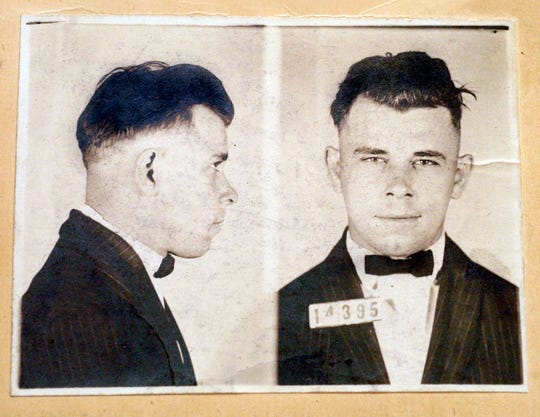
Indiana Reformatory booking shots of John Dillinger, stored in the state archives, and shows the notorious gangster as a 21-year-old. Records show that Dillinger was admitted into the reformatory on Sept. 16, 1924. Indiana Reformatory booking shots of John Dillinger, stored in the state archives, and shows the notorious gangster as a 21-year-old. Records show that Dillinger was admitted into the reformatory on Sept. 16, 1924. (Photo: CHARLIE NYE, AP)

Indianapolis – The body of notorious 1930s gangster John Dillinger is expected to be exhumed in September at an Indianapolis cemetery but it could be a tough job because his grave is encased in concrete.

Digging up the remains more than 85 years after Dillinger was killed by FBI agents also could resolve conspiracy theories that the man some considered a hero during the Great Depression isn’t buried in his marked grave, said Susan Sutton, a historian with the Indiana Historical Society.

The Indiana State Department of Health approved a permit July 3 sought by Dillinger’s nephew, Michael C. Thompson, to have the body exhumed from Crown Hill Cemetery and reinterred there.

The permit doesn’t give a reason for the request, and Thompson couldn’t immediately be reached for comment.

Indiana health department spokeswoman Jeni O’Malley said that based on the permit, the agency expects Dillinger’s body will be exhumed and reinterred on Sept. 16 – the date listed on the document.

But digging up Dillinger’s grave might prove a difficult task because days after his son’s funeral, Dillinger’s father had the casket reburied under a protective cap of concrete and scrap iron topped by four reinforced-concrete slabs, Sutton said.

“I think they’re going to have a hard time getting through that,” Sutton said.

The reason for the concrete-encased grave was to thwart would-be vandals, she said, citing “Crown Hill: History, Spirit, and Sanctuary” a 2013 book the historical society published about the cemetery’s history.

“The main fear was that someone would come in and dig up the grave and either desecrate the corpse or steal it,” Sutton said. “The Dillingers had actually been offered money to ‘lend out’ his body for exhibits, so they were concerned.”

The Indianapolis-born Dillinger was one of America’s most notorious criminals. The FBI says Dillinger’s gang killed 10 people as they pulled off a bloody string of bank robberies across the Midwest in the 1930s.

Dillinger was never convicted of murder and he was lauded by some for robbing banks during the Great Depression as many Americans lost their homes and farms to foreclosure, Sutton said.

“So somebody who had, as maybe people would say now – ‘Stuck it to the banker’ – would easily become a folk hero,” she said. “He was also known by some people to be very polite even while he was stealing. It’s an odd combination.”

Dillinger was awaiting trial in the slaying of an East Chicago police officer when he escaped from jail in Crown Point, Indiana, in March 1934 with a gun carved out of wood. While on the run, he underwent plastic surgery to alter his face and was said to have tried to remove his fingerprints with acid.

Dillinger, who was portrayed by Johnny Depp in the 2009 movie “Public Enemies,” was fatally shot in July 1934 by FBI agents outside the Biograph theater in Chicago after he was betrayed by a woman who became known in the papers as the “Lady in Red.”

Crown Hill Cemetery spokeswoman Crystal King said the cemetery has no information about the plans to exhume Dillinger, whose tomb is an attraction at the hilltop graveyard on Indianapolis’ near north side.

Messages seeking comment were also left Tuesday for Jeffery Scalf, whose grandmother was Dillinger’s half-sister, and for Savanah Light, the funeral director whose name is listed on the permit.

Meet These FBI Agents that Worked for Mueller

Let’s begin with Michael Gaeta. There is a specialized group of FBI agents in lower Manhattan. The Eurasian organized crime unit, led by a veteran mob investigator named Michael Gaeta, scrutinized criminal groups from Georgia, Russia and Ukraine that were running sophisticated scams in the U.S. As Randall and Gaeta linked street-level criminal operators to figures in Eastern Europe’s business and political elite, they started piecing together a string of rumors that led them to an unsettling conclusion: Russia might be bribing its way to host the 2018 World Cup.

Remember when AG Loretta Lynch prosecuted some people for FIFA embezzlement and corruption? ON MAY 27, 2015, Loretta Lynch — in her new role as U.S. attorney general — announced the indictment of 14 defendants, mostly foreign nationals, in the FIFA case. It all started with Chuck Blazer, a former FIFA official who had an apartment in Trump Tower.

Now dead of rectal cancer, the native New Yorker hardly resembled his image as a statesman of soccer — an infamous bon vivant who made so much money for the game’s international governing body, FIFA, that he was hailed as its virtuoso deal maker. He dined often with sheikhs and heirs at the trendiest restaurants and attended society events with a rotating cast of striking companions. His personal travel blog pictured him with the likes of Bill Clinton and Vladimir Putin and Miss Universe. At 400 pounds, with an unruly white beard and mane, he looked like Santa Claus, talked like a bricklayer and lived like a 1-percenter.

Meet Chuck Blazer - the ex-Fifa official and parrot ...

Blazer’s big secret, as he looked down on the Manhattan streets, seems so obvious now: He had embezzled his fortune through kickbacks and bribes.

How did the FBI get involved in the first place? Christopher Steele actually and he brought the case to the FBI. Now why is Michael Gaeta important? He was Josef Mifsud‘s handler. This has been confirmed by George Papadopoulos. Gaeta, Mifsud and Steele all had a working relationship operating out of Rome. Mifsud was a professor at Link Campus University in Rome. The school is under proprietary ownership of the University of Malta. Link University is but one of the major ‘go-to’ places for FBI agents to teach and train. Oh, it is also a location where up and coming spies for the UK and sometimes the United States have sessions.

Beginning to see how nuts all this is? When it comes to John Solomon, Senior Editor of The Hill, he confirmes that Mifsud worked with the FBI beginning in 2016. It was Mifsud too that introduced George Papadopoulos to Dr. Ivan N. Timofeev who is described as being a director of a think tank located in Moscow.

So, during the House Intelligence hearing with Mueller, Congressman Devin Nunes provided a couple of key names. One interesting person he mentioned was Steven Schrage. He is an interesting person as he is the former Deputy Assistant Secretary of State and is currently at Cambridge University as a PhD candidate.Schrage as a PhD student was under Stephan Halper. Schrage hosted a conference in July of 2011 in Cambridge that had Madeleine Albright as a keynote speaker. Here was the moment that Stephan Halper was deployed to dangle Carter Page.

And so begins the plot for naming a special council, Robert Mueller due to James Comey, some agents, the DoJ operatives like Bruce Ohr and at least Victoria Nuland at the State Department.

The choreographed operation continues.

So, how about the rest of the FBI agents to confound this story? Ready?

Assigned to the Mueller/Zebley team were the following:

  1. Omer Meisel, (an SEC investigator, formerly assigned to Enron, read Andrew Weissman)
  2. Robert Gibbs, an expert in Chinese espionage
  3. Sherine Ebadi, previously prosecuted multi million dollar corporate fraud cases
  4. Jennifer Edwards, expert at identity theft, internet accounting, managed the Papadopoulos case
  5. Jason Alberts, expert at public corruption
  6. Brock Domin, a techie on Russian operations, assigned to prosecute Manafort
  7. David Archey, a rather utility agent who previously worked in Bahrain, Jordan, Algiers and Rwanda in counterterrorism
  8. Greg Andres, a lawyer with IRS specialty
  9. Kyle Freeny, a lawyer with the FBI specializing in money laundering
  10. Walter Giardina
  11. Curtis Heide, he forced Papadopoulos to wear a wire
  12. Francesco Corral, specializing in cyber security and foreign intelligence

So, hoping this gives the reader some jumping off point if you choose to research more on all this Russia probe. Meanwhile, let’s hear what Congressman Jim Jordan has to say after the Mueller hearing. He wants to continue to investigate the investigators and so do we.

One last item/factoid. Keep a close watch on Perkins Coie and Marc Elias. The law firm Perkins Coie provided office space for Fusion GPS to use. It was Marc Elias that hired Fusion GPS and it was Marc Elias that was the law firm to the DNC and the Hillary campaign. By the way, Marc Elias now is the lawyer of record for the Kamala Harris presidential campaign.

Oooops, remember when the FBI went to the Hillary campaign several times to talk about foreign cyber intrusions of the Hillary campaign servers? The campaign refused to allow the cyber team at the FBI any access to the login files. The campaign instead hired Crowdstrike at the behest of Perkins Coie.  It was Perkins Coie that blocked the FBI access to the DNC servers and those of the Hillary campaign. Crowdstrike was under agreement with the FBI to provide the forensic computer evidence, which never happened. One must argue now that Crowdstrike under orders from Perkins Coie destroyed all server, computer and operating systems in 2016 or just brought in new servers and evidence is still out there unless Bleachbit was used.