What do you Know About H.R. 4174?

Conservatives declared that CommonCore was bad for education and needed to be terminated in all states. Sadly, in many cases it was just renamed.

Are you fine with social engineering in education? Are you good with peer to peer teaching? Are you aware of the changing syllabus and use of textbooks? Did you know the data on you, the family and the student is being collected from pre-Kindergarten all the way through entry into the workforce? How about medical and personal data being sold to third parties for a profit without your knowledge or approval? Can you opt out? Nope.

It appears the government believes it now owns individual military data, IRS data, Census data, and all citizen-level data in any federal agency. One exception to this ownership assumption exists in medical data, which as defined and protected by HIPPA, belongs to the patient (or their guardian).  However, medical data is “leaking” into other data streams such as education data. This blurs the lines for HIPPA protections and allows medical information to become part of the integrated, government data system.

USPIE’s primary mission is to close the U.S. Department of Education, repeal all federal education mandates and return control of education to parents and local communities.  Our efforts include protecting the privacy of student data from government-directed collection, integration, and sharing. Big data is big business and America’s children are not for sale. More here.

Do you as a taxpayer have a voice in this legislation? Are there are protections to the data regarding you?

So, what is P20W anyway?

Data governance is both an organizational process and a structure. It establishes
responsibility for data, organizing program area/agency staff to collaboratively and
continuously improve data quality through the systematic creation and enforcement of
policies, roles, responsibilities, and procedures. Data governance is necessary for creating
clear roles and responsibilities for each member of the project team.
This document relates to P-20W or interagency data governance rather than K12 or
intra-agency data governance. While there are many similarities in structure and process
between inter- and intra-agency data governance, there are key differences. For example,
among the various P-20W agencies, there are varying security requirements, data uses,
reporting requirements, and timelines. There is also a different, broader research agenda at
the P-20W level. (See Figures 1 and 2, next page, for depictions of single agency vs. P-20W
data governance structures.)
When data governance is effectively established, the quality of data collected, reported, and
used by state and local education agencies (SEAs and LEAs)—as well as early childhood,
postsecondary, and other agencies (Department of Labor, Department of Health, etc.)—
is enhanced; staff burden is reduced; and communication, collaboration, and relationships
with the various agencies, information technology (IT) staff, and program areas are
improved.
It is also a grant program to the States. Read the document here.
There is also an annual summit, a data summit.
Scrolling through this document as it relates to P20W is actually terrifying. The Department of Education is collaborating with the Department of Labor and the entire student education history and behavior is recorded including that of the family of record and will stay in a data system for decades…
Simply scroll here to see how the data is collected, where it originates and how it is used and shared. People in government and private enterprise that don’t know you are scoring behavior and psychology of the entire family structure but is that a good thing? Hardly.

H.R. 4174 was introduced by Congressman Paul Ryan and co-sponsored by Trey Gowdy. Yep…believe it. What is really shady is the legislation was not in the education committee…

Note the following:

Sponsor: Rep. Ryan, Paul D. [R-WI-1] (Introduced 10/31/2017)
Committees: House – Oversight and Government Reform | Senate – Homeland Security and Governmental Affairs
Committee Reports: H. Rept. 115-411
Latest Action: Senate – 11/16/2017 Received in the Senate and Read twice and referred to the Committee on Homeland Security and Governmental Affairs.  (All Actions)

Is the Homeland Prepared for NoKo Missiles?

Or China or Russia?

Ever wonder why there is no defense system in Hawaii or other remote Pacific Island? Unless, we are poised to deploy the new SM-6 which has had remarkable recent test results.

The Standard Missile-6 is built in a state-of-the-art Raytheon facility in Huntsville, Alabama. <a href ="/news/rtnwcm/groups/gallery/documents/image/six_things_sm-6_pic_01_lg.jpg" target="_blank">(Download high-resolution photo)</a>

(Is there a defense system for electronic warfare or cyber?)

What if North Korea or Iran launched a nuclear missile aimed at the United States? Could we prevent it from arriving?

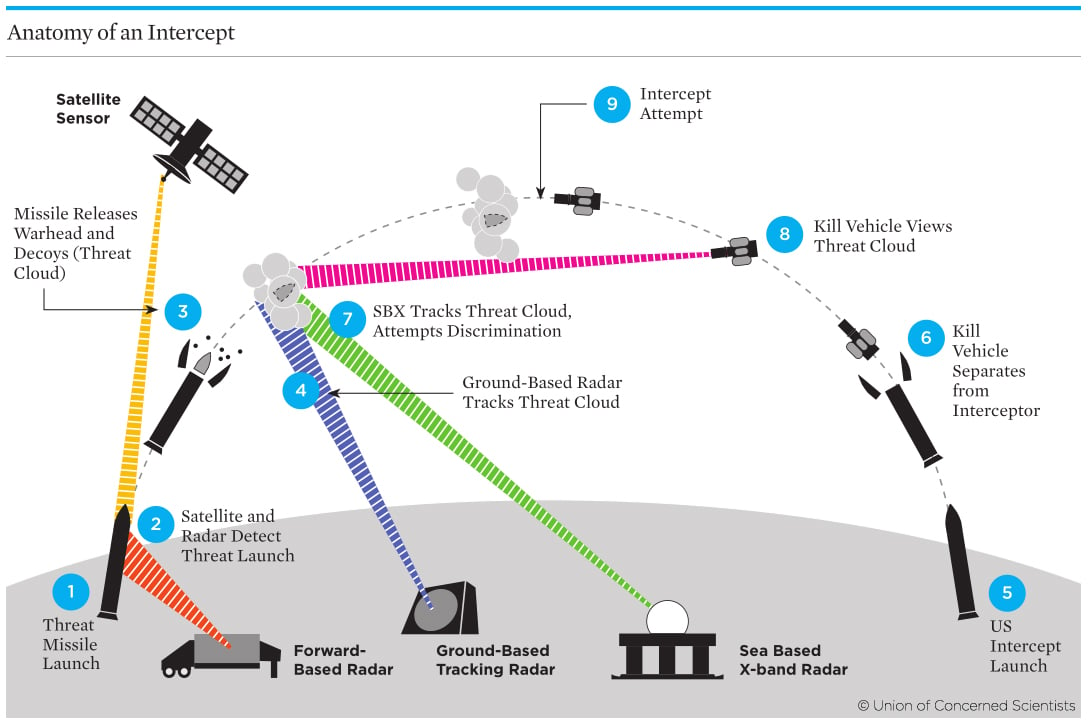
That’s the basic motivation behind US homeland missile defense, a complex system of ground-based radars, satellite sensors, and interceptor missiles designed to destroy incoming warheads. If the system operated as promised, sensors would track intercontinental ballistic missiles (ICBMs) throughout their launch and flight. Interceptor missiles based in Alaska and California would then collide with and destroy the incoming weapons.

Diagram of how missile defense works ICBM launches have three distinct phases of flight. During the boost phase, a rocket launches the warhead at high speeds above the atmosphere, where it continues in free-fall through the vacuum of space. The midcourse phase begins with the rocket separating from the warhead, which continues unguided and unpowered, hundreds of miles above the Earth. The reentry, or terminal, phase sees the warhead descend at high speeds back through the Earth’s atmosphere toward the ground.

US homeland missile defense (also called “strategic missile defense”) is designed to destroy ICBMs during their midcourse phase, using interceptor missiles launched from the ground (hence the official name, “ground-based midcourse defense,” or GMD).

The process begins with infrared sensors on satellites, which monitor known launch locations for the tell-tale heat signature produced by launching rockets. Once a launch is established, tracking is transferred to radar systems, which help verify the missile’s trajectory. More here.

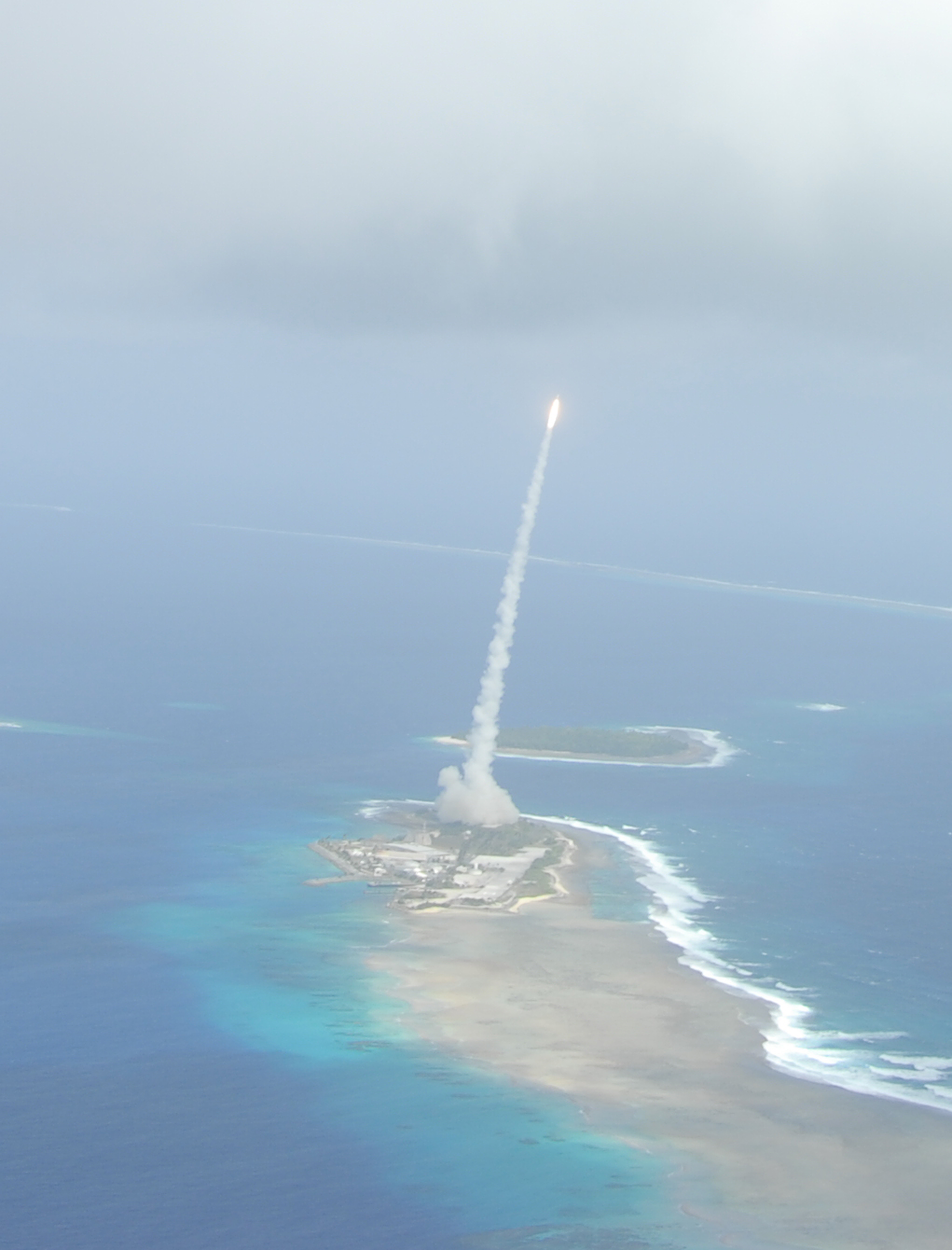
A target missile launch from Kwajalein Atoll in the Republic of the Marshall Islands A target missile launches from the Marshall Islands during a test intercept run. Photo: US Missile Defense Agency

The U.S. agency tasked with protecting the country from missile attacks is scouting the West Coast for places to deploy new anti-missile defenses, two Congressmen said on Saturday, as North Korea’s missile tests raise concerns about how the United States would defend itself from an attack.

West Coast defenses would likely include Terminal High Altitude Area Defense (THAAD) anti-ballistic missiles, similar to those deployed in South Korea to protect against a potential North Korean attack.

The accelerated pace of North Korea’s ballistic missile testing program in 2017 and the likelihood the North Korean military could hit the U.S. mainland with a nuclear payload in the next few years has raised the pressure on the United States government to build-up missile defenses.

Congressman Mike Rogers, who sits on the House Armed Services Committee and chairs the Strategic Forces Subcommittee which oversees missile defense, said the Missile Defense Agency (MDA), was aiming to install extra defenses at West Coast sites. The funding for the system does not appear in the 2018 defense budget plan indicating potential deployment is further off.

When asked about the plan, MDA Deputy Director Rear Admiral Jon Hill‎ said in a statement: “The Missile Defense Agency has received no tasking to site the Terminal High Altitude Air Defense System on the West Coast.”

THAAD is a ground-based regional missile defense system designed to shoot down short-, medium- and intermediate-range ballistic missiles and takes only a matter of weeks to install.

A Lockheed Martin representative declined to comment on specific THAAD deployments, but added that the company “is ready to support the Missile Defense Agency and the United States government in their ballistic missile defense efforts.” He added that testing and deployment of assets is a government decision.

In July, the United States tested THAAD missile defenses and shot down a simulated, incoming intermediate-range ballistic missile (IRBM). The successful test adds to the credibility of the U.S. military’s missile defense program, which has come under intense scrutiny in recent years due in part to test delays and failures. More here. 


Deport Those Chinese Operatives Now

Have you read the newly released book titled ‘Bully of Asia’ by Steven W. Mosher? China is the single largest threat to global stability and Russia and Iran in second and third place.

Have you heard of the Thucydides Trap? China is an ascending power and just who is paying attention? Have you studied the fact that China is a major enabler of North Korea’s aggression behavior including the most recent launch of the intercontinental ballistic missile?

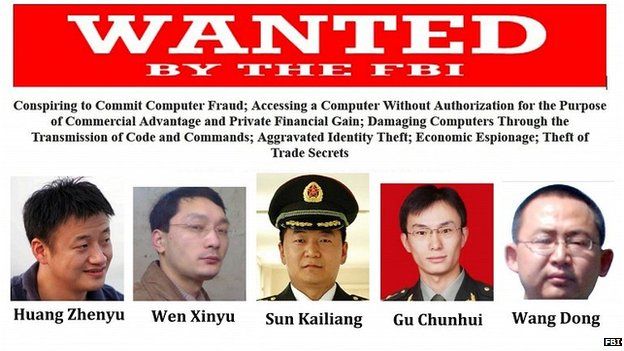
China is a thief. China has dispatched operatives throughout the West under the guise of cultural exchanges, students, temporary workers and journalists. It is all about espionage and cyberwar.

Image result for china spies photo

Hey State Department and DHS, get these operatives outta here. By the way, are there any sanctions on China with regard to PLA Unit 61398?

photo

Have you wondered what happened to that Obama Asia Pivot that he announced in 2011? The United States needs to pivot again and now.

Why?

This Beijing-Linked Billionaire Is Funding Policy Research at Washington’s Most Influential Institutions

The Chinese Communist Party is quietly reshaping public opinion and policy abroad.

FP: The Johns Hopkins University’s School of Advanced International Studies (SAIS), located just a short walk from Dupont Circle in Washington, D.C., is one of the top international relations schools in the United States. Its graduates feed into a variety of government agencies, from the State Department to the CIA, and the military. Its China studies program is especially well known; many graduates come away with expert knowledge of the language, culture, and politics of the United States’ most important strategic competitor.

In August, SAIS announced a new endowed professorship in the China Studies department as well as a new research project called the Pacific Community Initiative, which aims to examine “what China’s broader role in Asia and the world means for its neighbors and partners.”

What the SAIS press release did not say is that the money for the new initiatives came in part from the China-United States Exchange Foundation (CUSEF), a Hong Kong-based nonprofit. CUSEF is a registered foreign agent bankrolled by a high-ranking Chinese government official with close ties to a sprawling Chinese Communist Party apparatus that handles influence operations abroad, known as the “united front.”

The China-U.S. Exchange Foundation’s partnership with a premier U.S. academic institution comes amid a Chinese Communist Party push to strengthen its influence over policy debate around the globe. The Chinese government has sought to repress ideas it doesn’t like and to amplify those it does, and its efforts have met with growing success.

Even as Washington is embroiled in a debate over Russian influence in U.S. elections, it’s China that has proved adept at inserting itself in American politics.

“The Chinese approach to influence operation is a bit different than the Russian one,” said Peter Mattis, a fellow at the Jamestown Foundation. “The Russian one is much more about an operational objective and they work backward from that objective, saying, ‘How do we achieve that?’” But on the Chinese side, Mattis said, “they focus on relationships — and not on the relationships having specific takeaway value, but that someday, some way, those relationships might become valuable.”

The Chinese seek a kind of “ecological change,” he explained. “If they cultivate enough people in the right places, they start to change the debate without having to directly inject their own voice.”

The China-U.S. Exchange Foundation was founded in 2008 by Tung Chee-hwa, a Hong Kong shipping magnate who later served as the chief executive of the former British colony, where he championed the benefits of close ties to Beijing. Tung’s Hong Kong-based nonprofit conducts academic and professional exchanges, bringing U.S. journalists, scholars, and political and military leaders to mainland China. It also has funded research projects at numerous U.S. institutions, including the Brookings Institution, the Center for Strategic and International Studies, the Atlantic Council, the Center for American Progress, the East-West Institute, the Carter Center, and the Carnegie Endowment for Peace.

Tung’s foundation’s ties to the united front are indirect, but important. Tung currently serves as the vice chairman of one of the united front’s most important entities — the so-called Chinese People’s Political Consultative Conference, which is one of China’s two rubber-stamp assemblies.

The body is one of Beijing’s most crucial tentacles for extending influence.

In its newest project with SAIS, the foundation describes the Pacific Community Initiative as a “joint research project.” David Lampton, director of the university’s China Studies Program, said in an August press release that the new professor “will also be responsible for running our Pacific Community Initiative and work closely with the China-U.S. Exchange Foundation in Hong Kong.”

Lampton also confirmed that CUSEF funded the new programs. “Both the Initiative and the Professorship were made possible through the support of the China-U.S. Exchange Foundation,” he said in an emailed statement to Foreign Policy.

But he denied that CUSEF had attached any intellectual strings to its funding.

“There are absolutely no conditions or limitations imposed upon the Pacific Community Initiative or our faculty members by reason of a gift or otherwise,” Lampton told FP. “We have full confidence in the academic integrity and independence of these endeavors.”

CUSEF denies it acts as a vehicle for Beijing’s ideological agenda or has “any connections” to the united front. “We do not aim to promote or support the policies of any one government,” wrote a spokesperson for the foundation in an email.

This isn’t the first time SAIS and the foundation have worked together; they co-sponsored a conference on China’s economy in Hong Kong in March 2016, according to the school’s website. But a professorship and a major research project offer an opportunity for broader reach — the kind of global influence that Chinese President Xi Jinping has made a centerpiece of his policies. In October, at the meeting of the Communist Party that sets the national agenda for the next five years, Xi called for an expansion of the party’s overseas influence work, referring to the united front as a “magic weapon” of party power.

That quest to shape the global view of China isn’t the same thing as soft power, said James Leibold, a professor at La Trobe University in Melbourne who researches Chinese influence in Australia, where Beijing’s recent influence operations have sparked a national controversy.

China is an authoritarian state where the Communist Party rules with an iron fist, Leibold said — and that is what Beijing is trying to export.

“What we’re talking about here is not Chinese influence per se, but the influence of the Chinese Communist Party.”

In a joint project like the one at SAIS, that influence can be subtle rather than being heavy-handed, said Jamestown’s Mattis. “It’s the ability to privilege certain views over others, to create a platform for someone to speak,” he said. “When you have a role in selecting the platform and generating what I presume they hope are some of the bigger reports on U.S.-China relations in the next few years, that’s important.”

One goal of the joint research project is, in fact, to “yield a white paper to be submitted for endorsement by both the U.S. and Chinese governments,” a CUSEF spokesperson wrote in an emailed statement to FP.

While CUSEF representatives stress that it is not an agent of the Chinese Communist Party, the foundation has cooperated on projects with the the People’s Liberation Army and uses the same Washington public relations firm that the Chinese Embassy does.

One of those PLA projects is the Sanya Initiative, an exchange program that brings together U.S. and Chinese former high-ranking military leaders. On the Chinese side, the Sanya Initiative is led by a bureau of the PLA that engages in political warfare and influence operations, according to Mark Stokes, executive director of the Project 2049 Institute.

Sometimes the results of such high-level exchanges aren’t subtle. In February 2008, PLA participants in the Sanya Initiative asked their U.S. counterparts to persuade the Pentagon to delay publishing a forthcoming report about China’s military buildup, according to a segment excised from the 2011 annual report of the congressional U.S.-China Economic and Security Review Commission.

The U.S. members complied, though their request was not successful.

Exchanges and partnerships are not CUSEF’s only initiatives. As a registered foreign agent, in 2016 it spent just under $668,000 on lobbying, hiring the Podesta Group and other firms to lobby Congress on the topic of “China-U.S. relations.” The foundation has spent $510,000 on lobbying to date in 2017.

CUSEF also keeps on retainer the consulting and public relations firm BLJ Worldwide LTD, the same firm the Chinese Embassy in the United States uses. According to FARA filings, CUSEF currently pays the firm $29,700 a month to promote the foundation’s work and run a pro-Beijing website called China US Focus.

Whether through websites, partnerships, or endowments, China has learned to wrap its message in a palatable wrapper of U.S. academics and intellectuals, according to Mattis.

“Who better to influence Americans than other Americans?” he said.

Due to N Korea, Hawaii Goes to Nuclear Warning Systems

Image result for north korea ballistic missile test

photo

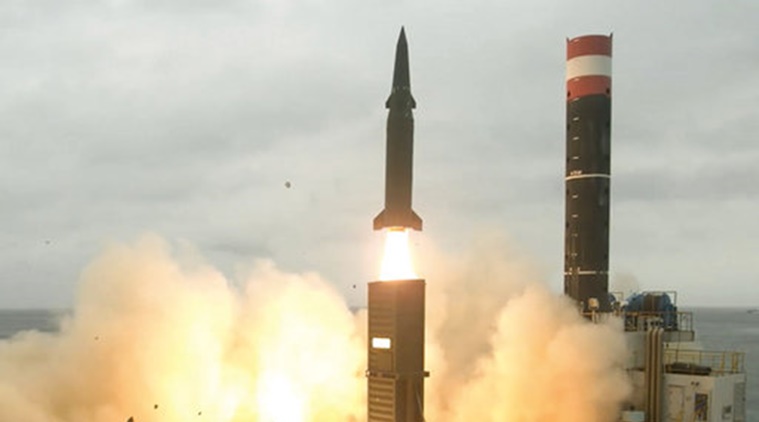
TOKYO/WASHINGTON (Reuters) – Japan has detected radio signals suggesting North Korea may be preparing for another ballistic missile launch, although such signals are not unusual and satellite images did not show fresh activity, a Japanese government source said on Tuesday.

After firing missiles at a pace of about two or three a month since April, North Korean missile launches paused in September, after Pyongyang fired a rocket that passed over Japan’s northern Hokkaido island.

“This is not enough to determine (if a launch is likely soon),” the source told Reuters.

Japan’s Kyodo news agency reported late on Monday that the Japanese government was on alert after catching such radio signals, suggesting a launch could come in a few days. The report also said the signals might be related to winter military training by the North Korean military.

South Korea’s Yonhap news agency, citing a South Korean government source, also reported that intelligence officials of the United States, South Korea and Japan had recently detected signs of a possible missile launch and have been on higher alert.

Image result for hi-ema photo

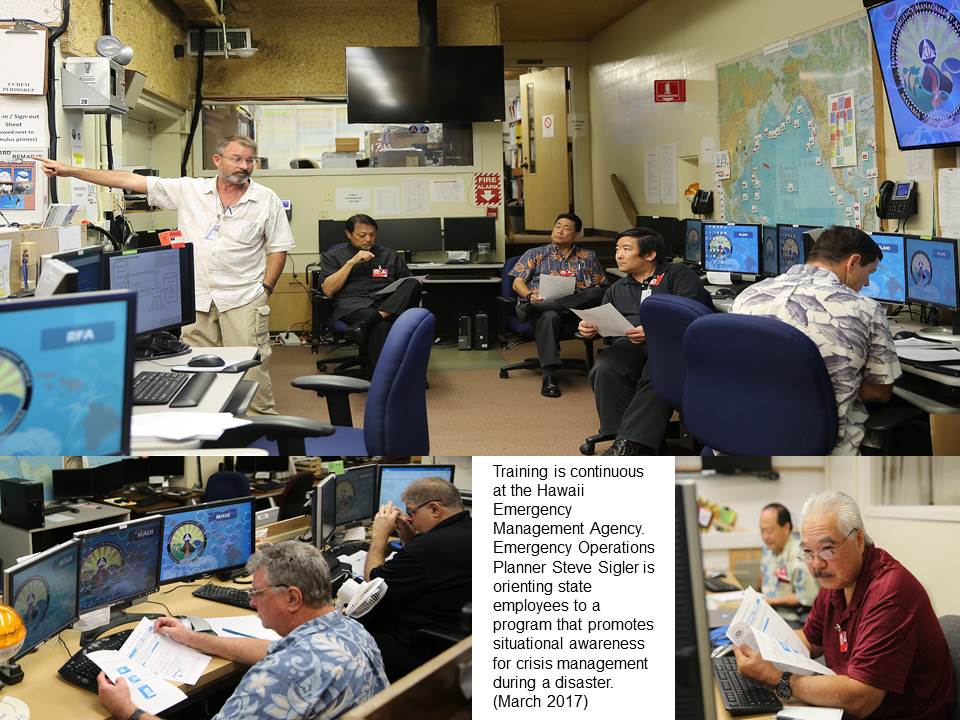
Hawaii reinstates Cold War-era nuclear attack warning signal amid North Korea tension

Hawaii is reinstating a statewide nuclear attack warning signal in December to prepare for a potential attack from North Korea.

The alarm, which has not been used since the Cold War, will be reinstated on Dec. 1 as part of a ballistic missile preparedness program, according to the Hawaii Emergency Management Agency (HI-EMA).

The agency instructed residents to immediately “Get inside, stay inside and stay tuned” if they hear the siren. Alerts will be sent to resident’s phones and broadcast on television and radio. “When [HI-EMA] started this campaign, there were concerns we would scare the public. What we are putting out is information based on the best science that we have on what would happen if that weapon hit Honolulu or the assumed targets,” said HI-EMA Administrator Vern Miyagi during an emergency preparedness presentation.

Since officials would have only 15 minutes or less of warning time before a North Korean missile’s impact, Hawaii residents are advised to have a designated place to go for shelter. “There will be no time to call our loved ones, pick up our kids and find a designated shelter. We should all prepare and exercise a plan ahead of time so we can take some comfort in knowing what our loved ones are doing,” said Miyagi in an interview with The Honolulu Star Advertiser.

Although the U.S. has conducted successful missile interception tests, there is no guarantee that the Navy would detect and intercept a target, the HI-EMA warns.

An HI-EMA fact sheet explains that, based on the estimated yield of North Korean missiles, there could be anywhere from 50,000 to 120,000 burn casualties and nearly 18,000 fatalities if an attack occurs.

After an attack, residents would have to stay sheltered in place until the HI-EMA has fully assessed the radiation and fallout, which could take a few hours or as long as 14 days, the agency says on its website.

State officials have been holding town halls to answer questions from residents.

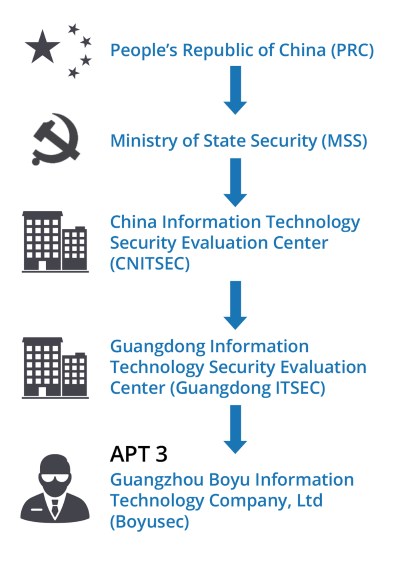
3 Chinese Nationals Charged with Hacking, Stealing Intellectual Property

Indictment found here.

Wonder if President Trump has called President Xi….The U.S. Treasury should at least sanction Guangzhou Bo Yu Information Technology Company Limited….

Pittsburgh:

The Justice Department on Monday unsealed an indictment against three Chinese nationals in connection with cyberhacks and the alleged theft of intellectual property of three companies, according to US officials briefed on the investigation.

But the Trump administration is stopping short of publicly confronting the Chinese government about its role in the breach. The hacks occurred during both the Obama and Trump administrations.
The charges being brought in Pittsburgh allege that the hackers stole intellectual property from several companies, including Trimble, a maker of navigation systems; Siemens, a German technology company with major operations in the US; and Moody’s Analytics.
US investigators have concluded that the three charged by the US attorney in Pittsburgh were working for a Chinese intelligence contractor, the sources briefed on the investigation say. But missing from court documents filed in the case is any explicit mention that the thefts were state-sponsored.
A 2015 deal between then-President Barack Obama and Chinese President Xi Jinping prohibits the US and China from stealing intellectual property for the purpose of giving advantage to domestic companies.
In recent months some US intelligence agencies have concluded that China is breaking the agreement, sources briefed on the matter say. But there’s debate among intelligence officials about whether there’s sufficient evidence to publicly reveal the Chinese government’s role in the infractions, these people say.
Obama administration officials had touted the Obama-Xi agreement, as well as 2014 Justice Department charges against members of the Chinese People’s Liberation Army for commercial espionage, for reducing some of the Chinese cyberactivity against companies in the US.
But the 2015 Obama-Xi deal was met with skepticism inside the US agencies whose job it is to guard against Chinese cyberactivity targeting US companies. Some now say there was only a brief drop in the number of cyberspying incidents, if at all.
In the waning months of the Obama administration, intelligence officials briefed senior White House officials on information showing that the Chinese cyberattacks were back to levels previously seen, sources familiar with the matter told CNN. Early in the Trump administration, US intelligence officials briefed senior officials, including the President and vice president, as well as advisers Jared Kushner and Steve Bannon. More here.
***

Acting U.S. Attorney for Western Pennsylvania Soo C. Song charged Wu Yingzhuo, Dong Hao and Xia Lei with conspiracy to commit computer fraud and abuse, conspiracy to steal trade secrets, wire fraud and identity theft.

The most serious charge, wire fraud, carries a sentence of up 20 years in federal prison. Each conspiracy charge has a possible sentence of up to 10 years and the identity theft carries a sentence of up to two years.

The indictment alleged that Wu, Dong and Xia worked with Guangzhou Bo Yu Information Technology Company Limited, a Chinese cybersecurity firm in Guangzhou, but used their skills to launch attacks on corporations in the U.S.

Between 2011 and May 2017, the trio stole files containing documents and data pertaining to a new technology under development by Trimble, along with employee usernames and passwords and 407 gigabytes of proprietary data concerning Siemens’ energy, technology and transportation efforts, according to the indictment. The trio gained access to the internal email server at Moody’s Analytics and forwarded all emails sent to an “influential economist” working for the firm, the indictment stated. Those emails contained proprietary and confidential economic analyses, findings and opinions. The economist was not named in the indictment.

A Siemens spokesperson said that the company “rigorously” monitors and protects its infrastructure and continually detects and hunts for breaches. The company did not comment on the alleged breach by the Chinese hackers and declined to comment on internal security measures.

Michael Adler, a spokesman for Moody’s Analytics, said that to the company’s knowledge no confidential consumer data or other personal employee information was exposed in the alleged hack.

“We take information security very seriously and continuously review and enhance our cybersecurity defenses to safeguard the integrity of our data and systems,” Adler wrote in an email to the Tribune-Review.

Trimble, in a statement sent to the Trib, wrote that no client data was breached. The company concluded that the attack had no meaningful impact on its business.

Song, however, said the loss to the companies targeted was considerable.

“The fruit of these cyber intrusions and exfiltration of data represent a staggering amount of dollars and hours lost to the companies,” Song said.

Wu, Dong and Xia used “spearphish” emails to gain access to computers, spread malware to infect networks and covered their tracks by exploiting other computers known as “hop points.”

Hop points allow users to hide their identities and locations by routing themselves through third-party computer networks.

“But there were missteps that led our investigators right to them,” said FBI Special Agent in Charge Bob Johnson of the Pittsburgh office.

Johnson would not elaborate on the missteps the accused hackers took, claiming doing so could jeopardize future investigations.

The U.S. Attorney’s Office led the investigation and was assisted by the FBI’s Pittsburgh Division, the Navy Criminal Investigative Service Cyber Operations Field Office and the Air Force Office of Special Investigations.