
An affordable price is probably the major benefit persuading people to buy drugs at www.americanbestpills.com. The cost of medications in Canadian drugstores is considerably lower than anywhere else simply because the medications here are oriented on international customers. In many cases, you will be able to cut your costs to a great extent and probably even save up a big fortune on your prescription drugs. What's more, pharmacies of Canada offer free-of-charge shipping, which is a convenient addition to all other benefits on offer. Cheap price is especially appealing to those users who are tight on a budget
Service Quality and Reputation Although some believe that buying online is buying a pig in the poke, it is not. Canadian online pharmacies are excellent sources of information and are open for discussions. There one can read tons of users' feedback, where they share their experience of using a particular pharmacy, say what they like or do not like about the drugs and/or service. Reputable online pharmacy canadianrxon.com take this feedback into consideration and rely on it as a kind of expert advice, which helps them constantly improve they service and ensure that their clients buy safe and effective drugs. Last, but not least is their striving to attract professional doctors. As a result, users can directly contact a qualified doctor and ask whatever questions they have about a particular drug. Most likely, a doctor will ask several questions about the condition, for which the drug is going to be used. Based on this information, he or she will advise to use or not to use this medication.

Trump/Pompeo Mission Against Iran Regime Working

DUBAI (Reuters) – Iran’s currency hit a new record low on Sunday, dropping past 100,000 rials to the U.S. dollar as Iranians brace for Aug. 7 when Washington is due to reimpose a first lot of economic sanctions.

The rial has lost about half of its value since April because of a weak economy, financial difficulties at local banks and heavy demand for dollars among Iranians who fear the effects of sanctions.

The central bank blamed “enemies” for the fall of the currency and a rapid rise in the prices of gold coins and the judiciary said 29 people had been arrested on charges that carry the death penalty.

On Aug. 7, Washington will reimpose sanctions on Iran’s purchase of U.S. dollars, its trade in gold and precious metals and its dealings with metals, coal and industrial-related software.

Sanctions also will be reapplied to U.S. imports of Iranian carpets and foodstuffs and on certain related financial transactions.

Iran’s oil exports could fall by as much as two-thirds by this year due to sanctions, straining oil markets amid supply outages elsewhere.

***  Diverse, Decentralized, Non-Binary: Iran Popular Uprising ...  photo

As it stands at the moment, it is still possible to characterize the damage done to a Saudi oil tanker in the Red Sea by a Houthi missile as a continuation of the occasional Houthi attacks on Saudi coalition vessels that started in late 2016.  That may be a reason why the latest attack, which occurred on Wednesday 25 July, has gotten little coverage in Western media.

But the sequence of events on Wednesday and Thursday suggests it’s more than that.  The morning of 25 July, Houthi sources reportedly took credit for targeting a Saudi vessel in the Red Sea. Regional reporting suggested their intended target was Saudi frigate Al-Dammam (F-816). Read more in detail here.

Iran Protests: US condemns arrest of 'peaceful' protesters  photo

***Additional reports of regime changes:

The change in the Rouhani administration awaited by both critics and supporters appears to have started on July 25 with the replacement of Iran’s central bank governor and news of the Planning and Budget Organization (PBO) chief’s offer to resign.

This comes as Vice President Eshaq Jahangiri has said economic hardship could prompt the government to resort to food rationing.

Abdolnasser Hemmati was appointed central bank governor,and PBO Chief and Administration spokesman Mohammad Baqer Nobakht told the press he has offered to step down in order to give President Hassan Rouhani a free hand in reshuffling his economic team.

Nobakht added that Rouhani had still not accepted his resignation as of Wednesday afternoon, ISNA reported. Rouhani’s chief of staff also told reporters in Tehran, “Whatthe media quoted Nobakht as saying is not true.”

Iranian media had reported that Rouhani had offered Nobakht’s job to former Economy Minister Ali Tayebnia but that he rejected the offer.

ISNA noted that the fact that the first change in the administration took at the central bank reveals Rouhani’s priorities in tackling the country’s economic crisis.

Reports from Tehran say that changes are also under way at the industry, economy, and housing ministries.

*** A lot of help for the Iranian people coming from the United States. In part:

Pompeo said, “You should know that the United States is not afraid to spread our message on the airwaves and online in Iran, either. For 40 years, the Iranian people have heard from their leaders that America is the Great Satan, we do not believe they’re interested in hearing the fake news any longer.”

***

Mr Pompeo stopped short of calling for regime change, but he announced stepped-up US government broadcasting in Farsi that is likely to foment further unrest against the government.

He said the US Broadcasting Board of Governors is taking steps to circumvent internet censorship in Iran, and creating a round-the-clock Farsi channel across television, radio, digital and social media formats, “so that ordinary Iranians inside Iran and around the globe will know that America stands with them”.

Mr Pompeo said the Trump administration would be willing to hold talks with the Iranian government if it stops repressing dissidents and religious minorities and stops supporting militant groups in conflicts elsewhere in the region. But the one sentence offer in a long speech suggests that Mr Pompeo deems any behaviour change by Iran unlikely.

Many of the Iranian Americans in the audience either fled or are descendants of those who fled the country after the Islamic Revolution toppled the Shah in 1979. Southern California is home to about 250,000 Iranian Americans.

“To our Iranian American and Iranian friends,” Mr Pompeo said, “tonight I tell you that the Trump administration dreams the same dreams for the people of Iran as you do, and through our labours and God’s providence, that day will come true.” More here.
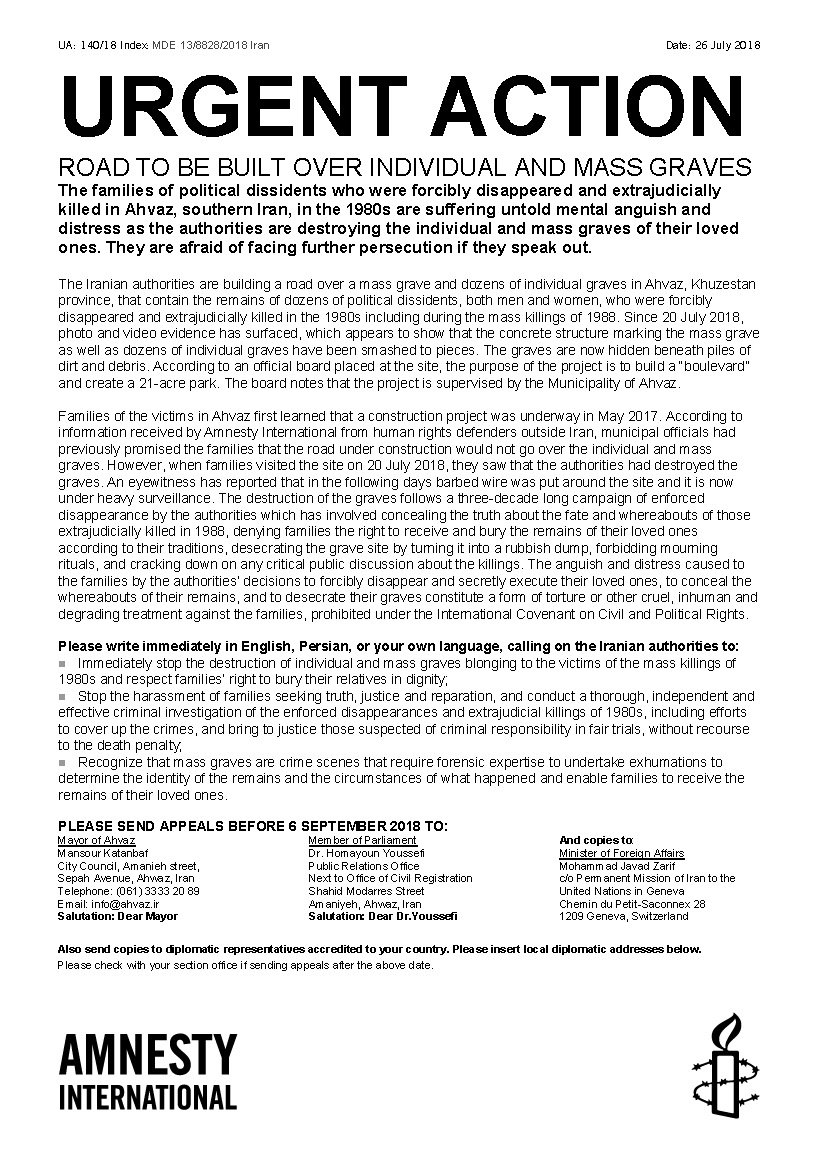
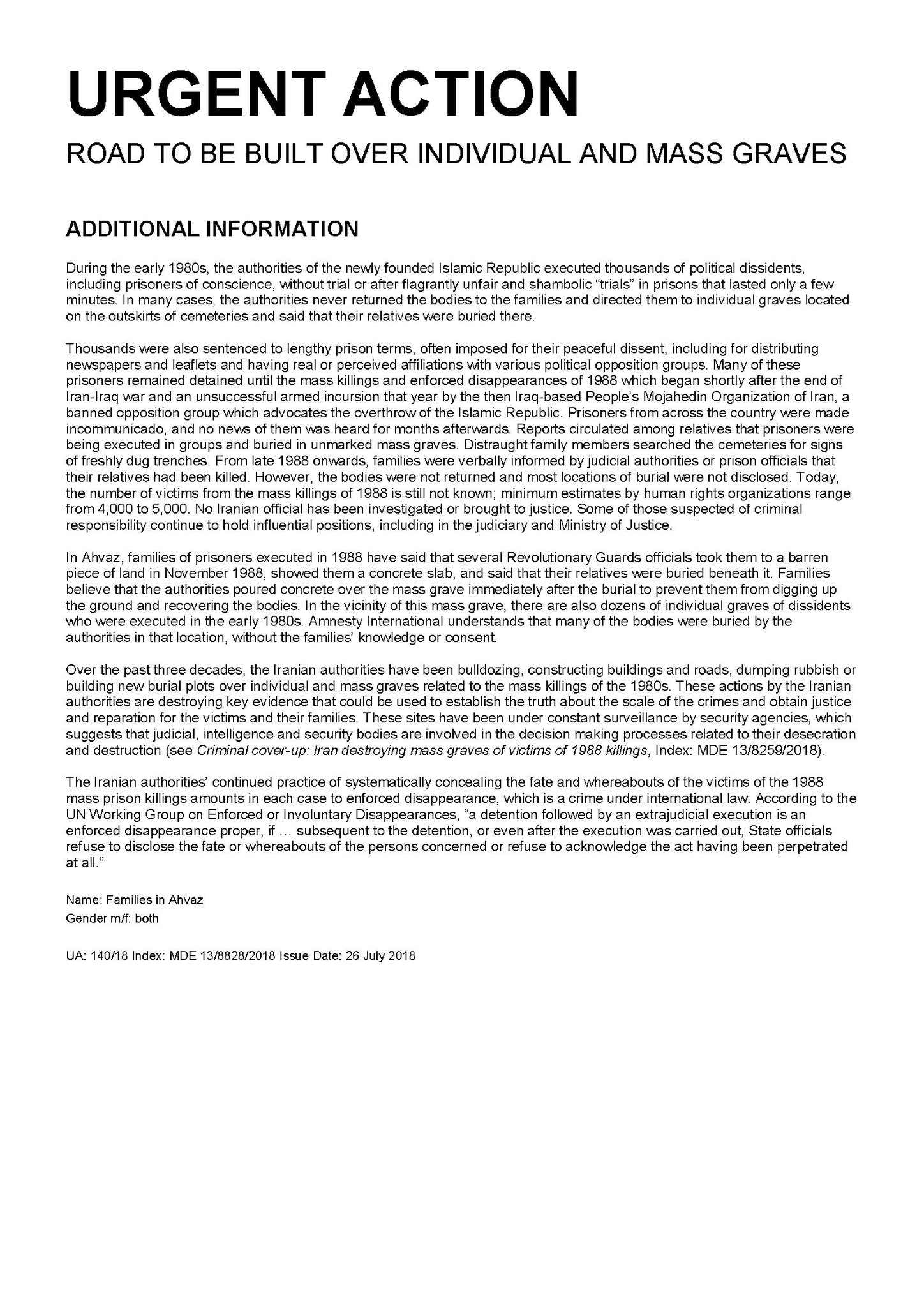
Mass Graves Covered up in Iran

Iran: Road to be built over individual and mass graves

The families of political dissidents who were forcibly disappeared and extrajudicially killed in Ahvaz, southern Iran, in the 1980s are suffering untold mental anguish and distress as the authorities are destroying the individual and mass graves of their loved ones. They are afraid of facing further persecution if they speak out.

***

Amnesty International reports that Iran’s regime is destroying a mass grave of the victims of the 1988 massacre. According to estimates from the opposition, these victims number in the 10s of 1000s (the vast majority from the MEK).

Meanwhile:

The Trump administration must now prepare for near-term Iranian terrorist attacks against the U.S. homeland, because the leader of Iran’s revolutionary guards, or IRGC, external action force gave a very aggressive speech on Thursday.

Addressing followers in the ancient city of Hamedan (a location probably chosen as a metaphor of Iranian durability), Qassem Soleimani warned Americans, “We are closer to you than what you think. You should know that I am your foe. The Quds Force alone and not all the Armed Forces is enough to be your rival. You are aware of Iran’s power in asymmetric war.”

Soleimani means for his words to be taken as references to terrorist attacks. In specific terms, IRGC modus operandi and tactical capability render “closer to you than what you think” and “asymmetric war” as references to Quds force attack cells and cyber-strike teams in the U.S. homeland, South America, and Europe.

But Soleimani wasn’t done there.

Again emphasizing “We are so close to you in places that you might not even think of,” Soleimani declared “You should know that there is not even a single night that we don’t think of destroying you.” Soleimani also drew a sharp reference to his role subjecting U.S. forces in Iraq to explosively formed penetrator attacks, stating “”have you forgotten when you had provided adult-size diapers for your battle tank crews?” EFP attacks killed hundreds of Americans and wounded many more.

Soleimani loved the EFPs for their brutality. In David Finkel’s The Good Soldiers, we hear about U.S. Army Specialist Joshua Reeves, whose vehicle was hit by an EFP in Baghdad. Reeves “wasn’t breathing, his eyes weren’t moving, his left foot was gone, his backside was ripped open, his stomach was filling with blood …” Reeves died the same day that his wife had told him that she had given birth.

And in a reference to Iranian martyrdom ideology, deeply vested in the revolution’s theological appropriation of the Battle of Karbala, Soleimani concluded, “We are thirsty for martyrdom and annihilation of arrogant powers.”

He wants the U.S. to know the IRGC will proudly die for their cause.

The U.S. may now have to help them on that course, because the U.S. must respond deliberately to this speech.

First off, President Trump should recognize that the Iranians aren’t playing around here. Soleimani has the pedigree to render very bloody terrorist attacks into action. He also has no qualms about massacring U.S. civilians (the Quds force nearly blew up a Washington, D.C., restaurant in 2011) and recently tried to blow up a Paris conference attended by U.S. officials. Indeed, Soleimani’s words exemplify why we argued this week that Trump must be more focused in his red-line warnings to Iran.

But what specifically should be done?

Both Trump and Secretary of State Mike Pompeo should take the lead in warning that any terrorist attacks on the U.S. will result in two immediate effects.

First, aggressive U.S. military strikes on IRGC infrastructure belonging to the Quds force and the IRGC at large. Pompeo’s role is important here because the former CIA director took a tough line against the IRGC, and Soleimani knows he means business.

Second, the U.S. should make clear that Soleimani and his senior leadership figures will be personally targeted. While some, like former Obama administration official Tommy Vietor, believe such threats would be outrageous, it is important that the Iranian hardliners know any terrorist attacks will not meet a standard fare response. They must know that the U.S. will metaphorically gut them if they come for our citizens. If Soleimani and his cadre do not understand that U.S. deterrent posture, they will kill innocent Americans. Evidencing their willingness to up the ante, the Quds Force directed Houthi rebel forces in Yemen to target cargo vessels passing through the Red Sea on Wednesday.

But the Trump administration should also be clear about where this is heading. As it attempts to destabilize the Iranian regime with economic pressure, the Iranian regime is showing that it will not go down without a fight.

Ultimately, Qassem Soleimani’s threats should be taken very seriously. He is a skilled commander with significant terrorist capabilities and an ideologically vested hatred for America. He must be dealt with as such.


Is John Brennan Exploiting his Security Clearance for Money?

Did Brennan Start Russia Investigation Because of Liberal ...

Hat tip to Senator Rand Paul:

Former Obama National Security Council advisor and Director of the CIA, John Brennan is constantly on CNN. When there is a commercial break, Brennan is tweeting:

Why does Brennan still have security clearance?

Brennan spent 25 years at CIA. He was once the station chief in Saudi Arabia and worked as an Near East and South Asia analyst. Given his history and security clearance, Brennan is a paid national security and intelligence analyst for NBC, MSNBC and CNN. Sidebar reminder, in 1976, he voted for Gus Hall for president. Gus was the Communist Party USA candidate. Another sidebar, when he was CIA station chief in Saudi Arabia, the Khobar Towers were bombed killing 19 U.S. servicemen. Oh yeah, he was quite critical of the intelligence community for missing the signs of Umar Farouk Abdulmutallab, the Christmas Day bomber….ahem….what about Crimea and Ukraine? Oh yeah….ISIS the JV team? How was it too that his own personal emails were hacked and posted on Wikileaks in 2015? A British hacker, Kane Gamble posed as Brennan and hacked into Brennan’s private email and iCloud accounts as well as Brennan’s wife’s iPad.

A little over the top isn’t it?

Well meanwhile:

Congressman Goodlatte has a subpoena for Brennan and Comey. This is due to the released FISA document. One of the FISA applications was signed by Brennan and others also included Comey’s signature. Seems Goodlatte is gonna bring in Loretta Lynch as well. Let’s see about all that impartiality shall we?

***

The Trump-Russia sleuthers have been back in the news, again giving Americans cause to doubt their claims of nonpartisanship. Last week it was Federal Bureau of Investigation agent Peter Strzok testifying to Congress that he harbored no bias against a president he still describes as “horrible” and “disgusting.” This week it was former FBI Director Jim Comey tweet-lecturing Americans on their duty to vote Democratic in November.

But the man who deserves a belated bit of scrutiny is former Central Intelligence Agency Director John Brennan. He’s accused President Trump of “venality, moral turpitude and political corruption,” and berated GOP investigations of the FBI. This week he claimed on Twitter that Mr. Trump’s press conference in Helsinki was “nothing short of treasonous.” This is rough stuff, even for an Obama partisan.

That’s what Mr. Brennan is—a partisan—and it is why his role in the 2016 scandal is in some ways more concerning than the FBI’s. Mr. Comey stands accused of flouting the rules, breaking the chain of command, abusing investigatory powers. Yet it seems far likelier that the FBI’s Trump investigation was a function of arrogance and overconfidence than some partisan plot. No such case can be made for Mr. Brennan. Before his nomination as CIA director, he served as a close Obama adviser. And the record shows he went on to use his position—as head of the most powerful spy agency in the world—to assist Hillary Clinton’s campaign (and keep his job).

Mr. Brennan has taken credit for launching the Trump investigation. At a House Intelligence Committee hearing in May 2017, he explained that he became “aware of intelligence and information about contacts between Russian officials and U.S. persons.” The CIA can’t investigate U.S. citizens, but he made sure that “every information and bit of intelligence” was “shared with the bureau,” meaning the FBI. This information, he said, “served as the basis for the FBI investigation.” My sources suggest Mr. Brennan was overstating his initial role, but either way, by his own testimony, he as an Obama-Clinton partisan was pushing information to the FBI and pressuring it to act.

Keep reading Kimberley Strassel’s column in the Wall Street Journal.

Iran to Hit Infrastructure with Cyber Attack

Primer: (Reuters) – Iran has built a factory that can produce rotors for up to 60 centrifuges a day, the head of its atomic agency said on Wednesday, upping the stakes in a confrontation with Washington over the Islamic Republic’s nuclear work.

Under the terms of the 2015 agreement, which was also signed by Russia, China, Britain, France and Germany, Iran agreed to curb its nuclear program in exchange for sanctions relief.

The other signatories have been scrambling to save the accord, arguing it offers the best way to stop Iran developing a nuclear bomb.

The Aspen Security Forum Releases 2017 Agenda - Aspen ...

*** At the Aspen Security Summit on Iran

In part:

ASPEN, Colo. — Iranian hackers have laid the groundwork to carry out extensive cyberattacks on U.S. and European infrastructure and private companies, and the U.S. is warning allies, hardening its defenses and weighing a counterattack, say multiple senior U.S. officials.

Despite Iran having positioned cyber weapons to carry out attacks, there is no suggestion an offensive operation is imminent, according to the officials, who requested anonymity in order to speak.

Cyber threats have been a major theme of the 2018 Aspen Security Forum, with administration officials from Director of National Intelligence Dan Coats, FBI Director Chris Wray, and Deputy Attorney General Rod Rosenstein all warning of the pervasive danger from Russia, China, Iran, and North Korea.

In Aspen Thursday, DNI Coats said that Russia was a more active cyber foe than Iran or China — “by far” the most aggressive, he said.

While Russia may be the most aggressive, the U.S. officials said Iran is making preparations that would enable denial-of-service attacks against thousands of electric grids, water plants, and health care and technology companies in the U.S., Germany, the U.K. and other countries in Europe and the Middle East.

“Iran has a penchant for using such tools against the West,” said Ben Taleblu. “The cyber domain permits the Islamic Republic to engage in graduated escalation, a hallmark of Iranian security policy.”

U.S. officials have alerted America’s allies in Europe and the Middle East to the potential Iranian threat and have begun preparing a menu of possible responses, according to both current and former US officials. It’s unclear if the options include a preemptive cyberattack to deter Iran from launching one.

Senior U.S. officials remain divided over the use of a preemptive cyberattack. More here.

Perhaps it is almost important to be reminded about the bomb plot last month in Paris. For a full summary of events at the #FreeIran event in Paris, go here.

Israel’s Mossad spy agency thwarted a terror attack in a Paris suburb last month, giving authorities in France, Germany, and Belgium crucial intelligence that led to arrests of a cell headed by an Iranian diplomat, Hebrew media reported Thursday.

The cell, headed by an Iranian diplomat at the Austrian embassy in Vienna, also consisted of  two Belgian nationals and an alleged accomplice in France. They planned to bomb a June 30 conference organized by an Iranian dissident group, the People’s Mujahedeen of Iran.

The operation included tracking the suspects and eavesdropping on them,  Hadashot said.

The Belgian nationals, a husband and wife identified as Amir S. and Nasimeh N., were charged earlier this month with their role in the plot.

The couple, described by Belgian prosecutors as being “of Iranian origin,” carried 500 grams (about a pound) of the volatile explosive TATP along with a detonation device when an elite police squad stopped them in a residential district of Brussels.

The arrests came days before Iranian Foreign Minister Mohammed Javad Zarif met with European nations to try to shore up the 2015 nuclear accord, after US President Donald Trump walked away from the deal.

Israeli Prime Minister Benjamin Netanyahu alluded to the operation ahead of the meeting.

“There is a meeting this week by the P4 without the United States…” and “the P4 invited Iran’s President Rouhani to attend,” Netanyahu said derisively at an event to mark US Independence Day. More here.


Elections’ Voter Registration System and the Russian Investor

Remember the outrage when sites all over the internet published items that Soros owned the voting machines? Remember that same outrage when Soros invested heavily in the State’s secretaries that were responsible for the respective elections process?

Remember the outrage that a Russian investor was able to buy American uranium in a deal concocted by Hillary? We learned then about the Committee for United States Foreign Investment.

Remember the outrage when Obama deferred the ‘red-line’ chemical weapons removal in Syria to Moscow that killed thousands? Anyone remember the anger when Russia shot down MH17, a civilian airliner, killing everyone on board?

Remember that we have lost regard for the top ranks of the FBI due to the Russian investigation and the Hillary investigation?

Remember

Remember the horror and voting rigging reported across various states in the recent elections?

Our votes are the most sacrosanct privilege Americans have. Okay so how about the very under reported matter in Maryland?

See, it was not until AFTER the Justice Department announced the indictment of 12 Russian military intelligence officers for computer hacking that Maryland officials reached out to Rod Rosenstein. FBI officials in the Maryland office held a briefing with the Maryland officials and did not want to make the information public….that is due to a wider investigation on the matter. What matter is that?

Well….

In part:

Four FBI agents informed state officials Thursday that a vendor Maryland has contracted with — ByteGrid LLC — to host data for statewide elections has ties to a Russian oligarch, Miller and Busch said.

Vladimir Potanin Vladimir Potanin

Potanin acquired his wealth notably through the controversial loans-for-shares program in Russia in the early to mid-1990s.

He is one of the wealthiest men in Russia, with an estimated net worth of $15.9 billion, ranking 83rd on the 2018 Forbes The World’s Billionaires list, and 6th in Russia. His long-term business partner was Mikhail Prokhorov until they decided to split in 2007. Subsequently, they put their mutual assets in a holding company, Folletina Trading, until their asset division was agreed upon.

In January 2018, Potanin appeared on the US Treasury’s “Putin list” of 210 individuals closely associated with Russian president Vladimir Putin.

ByteGrid LLC owns the servers that hold the data for voter registration, candidacy, election management, and election night results, state elections officials said. An ownership stake in the company was purchased by AltPoint Capital Partners, whose largest investor is a Russian oligarch named Vladimir Potanin, the election officials said.

Busch said that Potanin is “very close” to Russian Pesident Vladimir Putin and that Altpoint’s managing partner is Gerald T. Banks, a Russian millionaire who changed his name from Guerman Aliev.

But Busch said the state has no evidence that Potanin or Banks had done anything untoward.

“We don’t have any idea whether they meddled in any elections at all,” Busch said.

Attempts to reach the companies were unsuccessful.

The Maryland officials also said they had no indication the Russian-linked firm had anything to do with the problems that arose shortly before June’s primary election in which more than 80,000 voters’ change of address and party affiliation requests were never forwarded from the Motor Vehicle Administration to election officials.

The Maryland news came hours after the Department of Justice indicted 12 Russian intelligence officers, charging that they hacked the computer networks of Hillary Clinton’s 2016 presidential campaign, the Democratic National Committee and the Democratic Congressional Campaign Committee.The 11-count indictment alleges that the Russian agents infiltrated the networks, implanting malicious computer code and stealing documents on field operations, opposition research and campaign analytics as a way of interfering with the election.

The charges include conspiracy to commit an offense against the U.S., aggravated identity theft and money laundering.

According to the indictment, the Russians posted stolen documents online and worked with an organization — unnamed but believed to be WikiLeaks — to spread them further, and take advantage of continuing tensions between supporters of Clinton and primary opponent Bernie Sanders.

The federal indictment charging 12 Russian includes an allegation that a Twitter account, @BaltimoreIsWhr, was set up to invite people to join a “flash mob” and to post images using the hashtag “#BlacksAgainstHillary.”

It is the latest revelation of how social media were used locally and nationally in an attempt to influence the election. Cyber security analysts in September told The Baltimore Sun that a Facebook ad that referred to the Black Lives Matter movement and targeted Baltimore users in the months following the 2015 riots was likely part of a broader effort by Russia to sow discontent and deepen racial tension.

In response to such ads, the General Assembly in April passed a bill requiring social media platforms and websites with significant traffic to track all political ads and record which users are being targeted. In May, Hogan expressed reservations that the law could be found unconstitutional and allowed the bill to become law without his signature.

The @BaltimoreIsWhr account has been suspended.  Read more here.

Election officials in Maryland along with Governor Hogan have asked the Department of Homeland Security for technical assistance to evaluate the network used by the State elections board. ByteGrid, interesting name, was bought by the Russian investor in 2015 without the knowledge of Maryland officials. ByteGrid hosts the entire state system including registration, online ballot delivery systems and unofficial election night results.

Oh yeah, one last item, Maryland was one of the states that had very suspicious online activity in the 2016 election according to DHS and the FBI. That suspicious activity was for online registration and in the ballot request system.

IT Solution Providers

According to the ByteGrid website, they offer: With ByteGrid’s Compliant Hosting Solutions you get security, compliance and control over your business-critical data. Our CISA and CRISC certified experts have you covered. Industry sectors include: Life Sciences, Health IT, Financial and Government.