Pelosi’s Saturday Night Call over Russia Hacked Ploys

Seems there is some talking point being launched that whatever Russia did do with regard to hacking the Democrats…watch out because the actual text could be altered and false…seems Politico is carrying the water for that talking point as well.

Admittedly, Russia does publish false propaganda for sure and the use of Russia Today (RT) and Sputnik News are the go to methods…but in this case….does Russia need to do this? Okay, read on as the Democrats are in fear and setting the table to promote an early new warning.

Democrats’ new warning: Leaks could include Russian lies
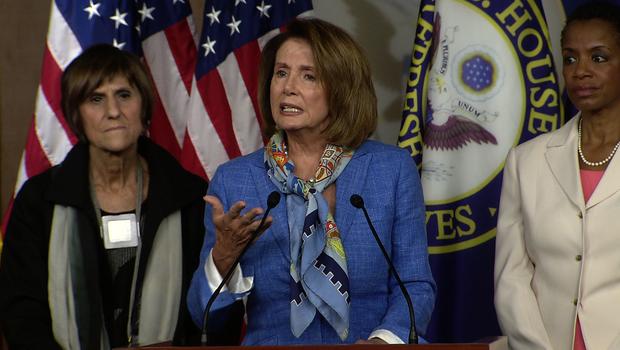
 Photo: CBS

The move could help inoculate Hillary Clinton against an October cyber surprise.

Politico: Democratic leaders are putting out a warning that could help inoculate Hillary Clinton against an October cyber surprise: Any future mass leaks of embarrassing party emails might contain fake information inserted by Russian hackers.

House Minority Leader Nancy Pelosi is among those sounding that alarm, echoing security experts who say Russian security services have been known to doctor documents and images or bury fictitious, damaging details amid genuine information. For hackers to resort to such tactics would be highly unusual, but security specialists say it’s a realistic extension of Moscow’s robust information warfare efforts.

Pelosi aired her concerns during a Saturday night conference call with Democratic lawmakers and aides who had been stung by a dump of their emails and phone numbers, according to a source on the call.

Democratic strategists say the party would be wise to trumpet warnings about faked leaks as it braces for the possibility of hackers releasing damaging information about Clinton or other candidates close to Election Day. Preemptively casting doubt on the leaks may be easier now than trying to mount a full response days before voters go to the polls.

“It is certainly a valid issue to raise, because clearly the people who are doing these attacks have a political agenda that’s against the Democratic Party,” said Anita Dunn, who was White House communications director in the early part of President Barack Obama’s first term.

If Russia is indeed attempting to destabilize Clinton’s candidacy through the widespread digital assault on Democratic institutions — as many researchers believe, and Democrats are alleging, but Moscow strongly denies — “why wouldn’t you want to raise the potential [for tampering]?” asked Dunn, now a partner at communications firm SKDKnickerbocker. “I think it’s only prudent for people to raise that possibility.”

Republicans say Democrats are just trying to distract the public from the most important issue: the content of the leaks. They say the Democrats already tried to do that with the first batch of 20,000 Democratic National Committee emails that leaked in July, which forced the resignation of Chairwoman Debbie Wasserman Schultz after showing that some DNC staffers had favored Clinton over primary rival Sen. Bernie Sanders.

“First, they made it all about Russia instead of the substance of what was actually in the emails,” said Matt Mackowiak, a veteran Republican strategist. Now, he added, “If there is a massive trove of emails or documents relating to the Clinton campaign or the Clinton Foundation … they may just say, ‘Look, the authenticity of the emails hasn’t been confirmed.’”

Intelligence officials — including NSA Director Adm. Michael Rogers and Director of National Intelligence James Clapper — have long argued that data manipulation more broadly is a disturbing possibility, and potentially the next front in both cybercrime and the budding digital warfare between countries.

Last month, a bipartisan group of 32 national security experts at the Aspen Institute Homeland Security Group warned of a specific type of fakery following the DNC hack, arguing that the suspected Russian hackers who struck the DNC and the Democratic Congressional Campaign Committee could “salt the files they release with plausible forgeries.”

In Saturday’s call, Pelosi was underlining a point made by cyber experts at CrowdStrike, the firm the party has hired to investigate the breaches at the DNC and the DCCC. The conference call was prompted by the late Friday release of DCCC spreadsheets containing nearly all House Democrats’ and staffers’ personal emails and phone numbers, which led to a flood of harassing emails and phone calls over the weekend.

In total, the hackers have reportedly infiltrated more than 100 party officials and groups, leaving progressives fearful that the entire Democratic Party apparatus is potentially compromised. During Saturday’s call, House members in competitive races voiced concerns about what damning information might be out there.

But hacking specialists say the most harmful information might not even be genuine.

“You may have material that’s 95 percent authentic, but 5 percent is modified, and you’ll never actually be able to prove a negative, that you never wrote what’s in that material,” CrowdStrike co-founder Dmitri Alperovitch told POLITICO. “Even if you released the original email, how will you prove that it’s not doctored? It’s sort of damned if you do, damned if you don’t.”

Several Democratic operatives said they even expect fake information, though mixed with enough truth to cause damage.

“The most powerful lie contains truth,” said Craig Varoga, a D.C.-based Democratic strategist. “Whether it’s the devil or it’s Russian intelligence services, they traffic in things that are true in order to put across a greater lie.”

Historically, it’s not unprecedented for intelligence agencies — including those in the U.S. — to release fake reports for propaganda purposes. The FBI’s COINTELPRO program infamously used forged documents and false news reports to discredit or harass dissenters during the 1950s and 1960s, including civil rights leaders, anti-war protesters and alleged communist organizations.

Hackers have adopted similar strategies.

In 2013, Syrian hackers backing embattled President Bashar Assad hijacked The Associated Press’ Twitter account, tweeting out falsified reports of two explosions at the White House that had injured Obama. The Dow plummeted in minutes, wiping out $136 billion in market value, according to Bloomberg. It stabilized shortly thereafter, once the report was revealed to be a hoax.

Russia has long been known for engaging in such propaganda warfare, going back to the days of the Soviet Union, when the KGB spread conspiracy theories about the FBI and CIA’s involvement in President John F. Kennedy’s assassination. In the 1980s, the KGB planted newspaper articles alleging that the U.S. had invented HIV during a biological weapons research project.

The security agency also secretly helped an East German journalist write a book, “Who’s Who in the CIA,” that accurately outed numerous undercover CIA agents but also intentionally included a raft of people who were simply American officials stationed overseas, according to a former top Soviet security official.

In the weeks since the DNC email leaks, cyber specialists on Twitter have been circulating a passage from the memoirs of a former East German spymaster who wrote about the “creative” use of forgeries in conjunction with genuine leaks.

“Embarrassed by the publication of genuine but suppressed information, the targets were badly placed to defend themselves against the other, more damaging accusations that had been invented,” wrote Markus Wolf, who had headed East Germany’s foreign intelligence division for more than three decades. (On the other hand, he added that, “my principle was to stick as close to the truth as possible, especially when there was so much of it that could easily further the department’s aims.”)

In recent years, the Kremlin has adapted these tactics for a digital age.

The Kremlin was caught in 2014 manipulating satellite images to produce “proof” that Ukraine had shot down the Malaysia Airlines flight that was downed over Ukraine, killing 298 passengers. Last year, a Russian lawmaker’s staffer was exposed filming a fake war report, pretending to be near the front line in eastern Ukraine, where Moscow has seized territory.

“Standard Russian modus operandi,” said James Lewis, an international cyber policy expert at the Center for Strategic and International Studies, via email. “They’ve done it before in the Baltics and other parts of Europe: Leak a lot of real data and slip in some fakes (or more often, things that have been subtly modified rather than a complete fake).”

Digital forensics experts even noted that the metadata on some of the early documents leaked from the DNC — which included opposition research files — had been altered, although it didn’t appear that any content was compromised. But the discovery showed how easy such an edit would be.

“They have information warfare as a core tenet of what they do form a geopolitical perspective,” said Steve Ward, director of communications for digital security firm FireEye, which tracks many Russian hacking groups. “It’s really in their wheelhouse.”

But Ward and other digital security experts acknowledge that the exact scenario Pelosi was discussing would be novel, and that so far, hackers have had little incentive to manipulate leaked data. As anonymous digital actors, hackers already have the deck stacked against them when trying to expose information.

“You’ve got to suspend disbelief and trust the bad guys when you’re looking at this stuff,” Ward said. If they make just one discredited leak, hackers are “effectively losing the value of the operation by creating distrust with the data,” he added.

This leads many cyber experts to suspect that any release of faked emails, if it comes at all, would probably not come until days before the Nov. 8 election. At that point, the Democrats wouldn’t have time to definitively prove a forgery.

So it makes sense, strategists said, for Democrats to put the concept in the public’s mind now.

“What Pelosi is doing is making the response now,” said Brad Bannon, a longtime Democratic consultant. “Democrats do have their antenna up over this thing. They are anticipating.”

Eric Geller, Martin Matishak and Heather Caygle contributed to this report.


The Russians Hacked the NSA? Ah…What?

This is bad bad bad….and panic has struck Washington DC ….payment is to be in Bitcoins…

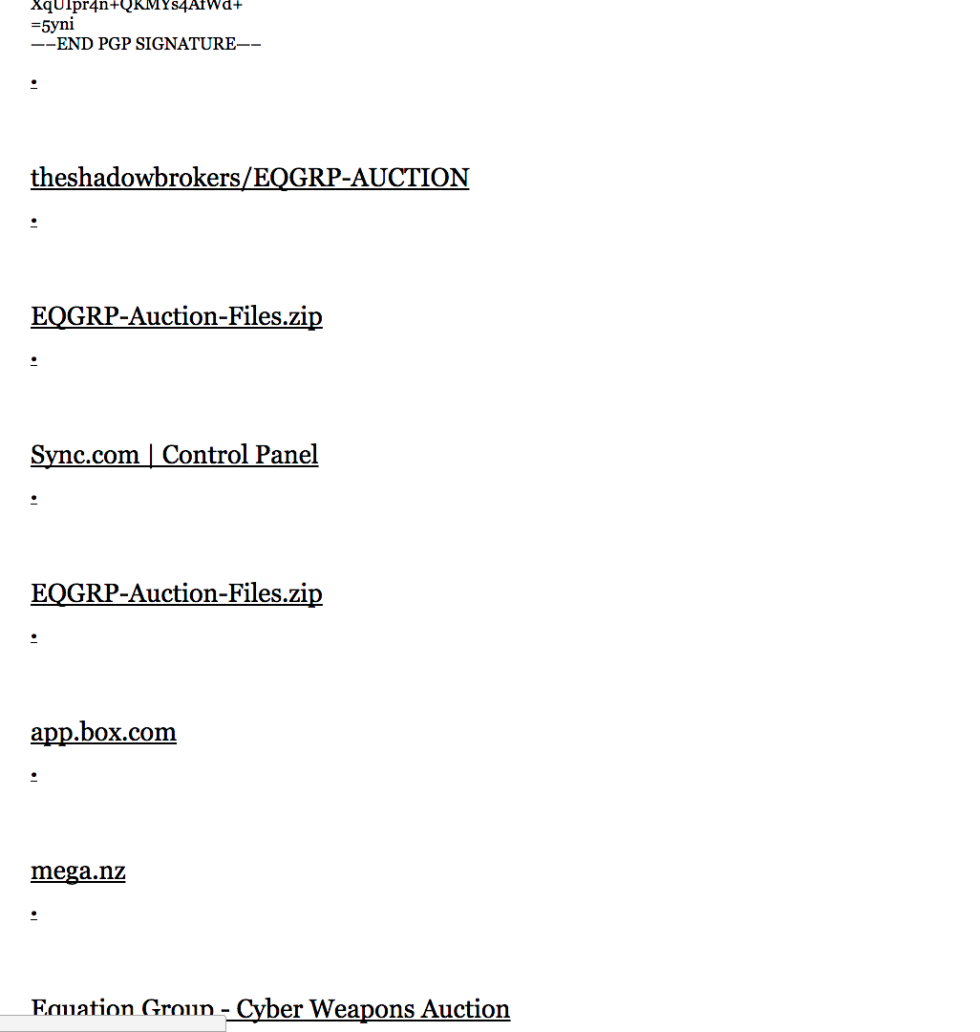
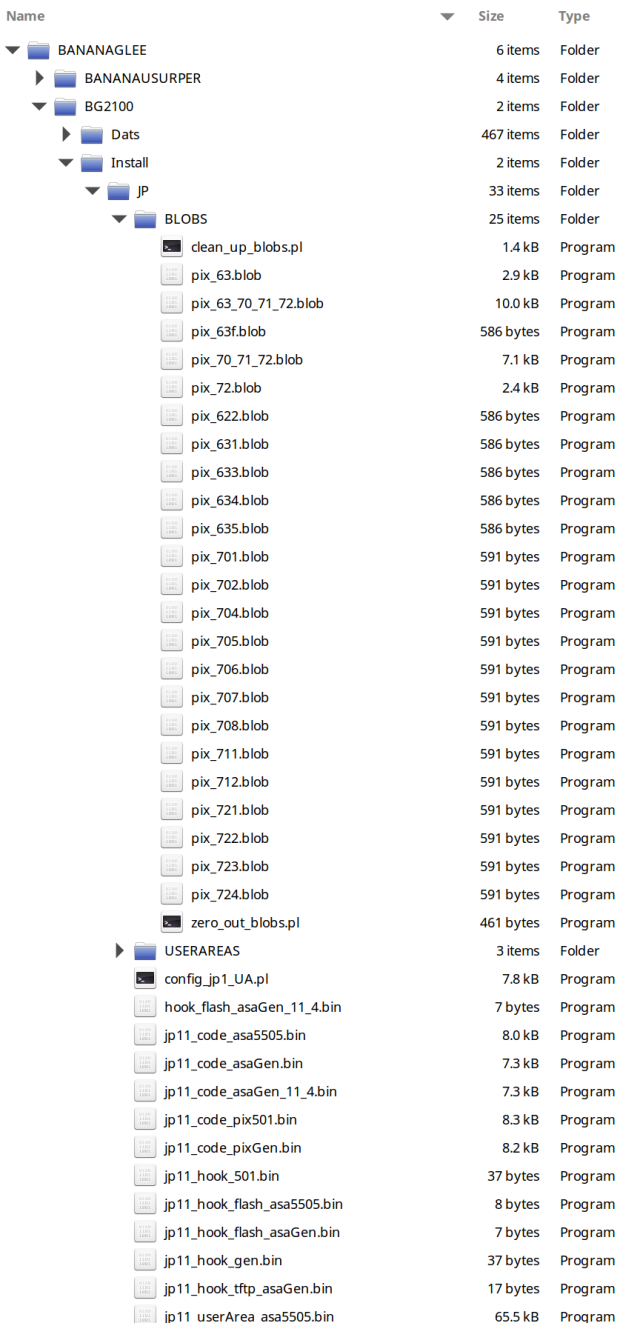
Graphics of files below courtesy of Arstechnica.


More here in further detail.

*****

Most outside experts who examined the posts, by a group calling itself the “Shadow Brokers,” said they contained what appeared to be genuine samples of the code — though somewhat outdated — used in the production of the NSA’s custom-built malware. Most of the code was designed to break through network firewalls and get inside the computer systems of competitors like Russia, China and Iran. That, in turn, allows the NSA to place “implants” in the system, which can lurk unseen for years and be used to monitor network traffic or enable a debilitating computer attack.  More here.

NSA and the No Good, Very Bad Monday

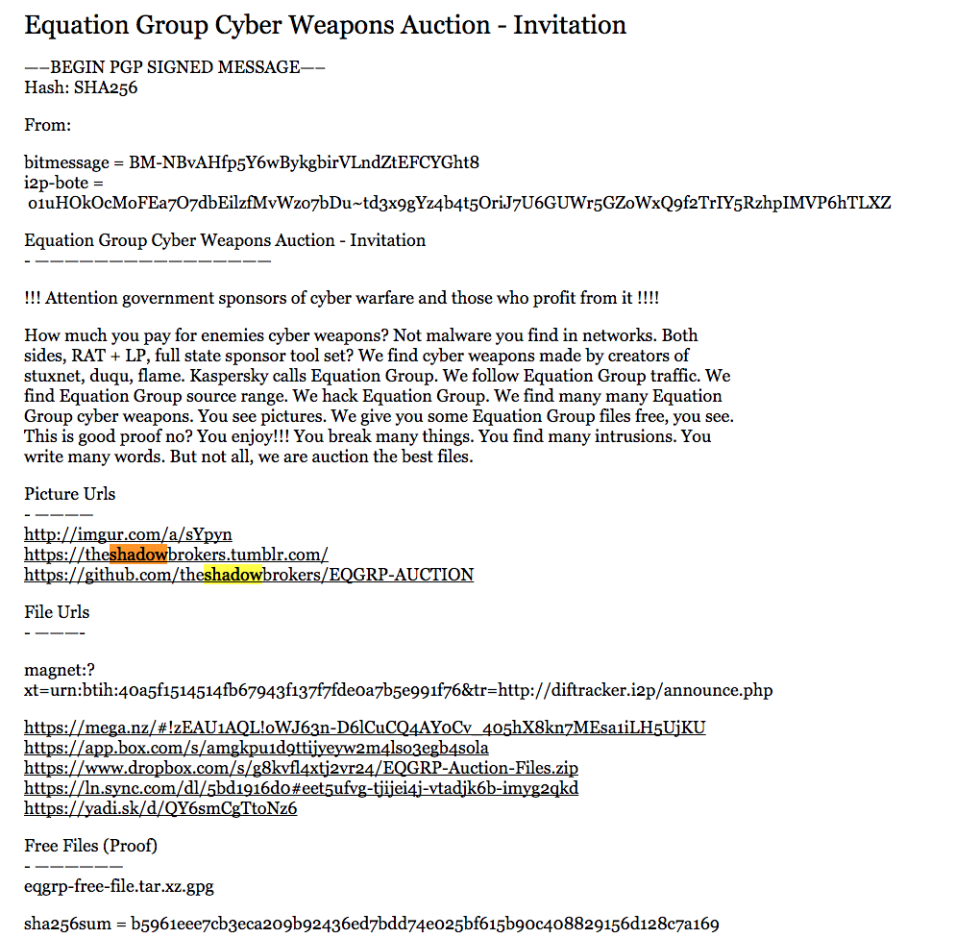
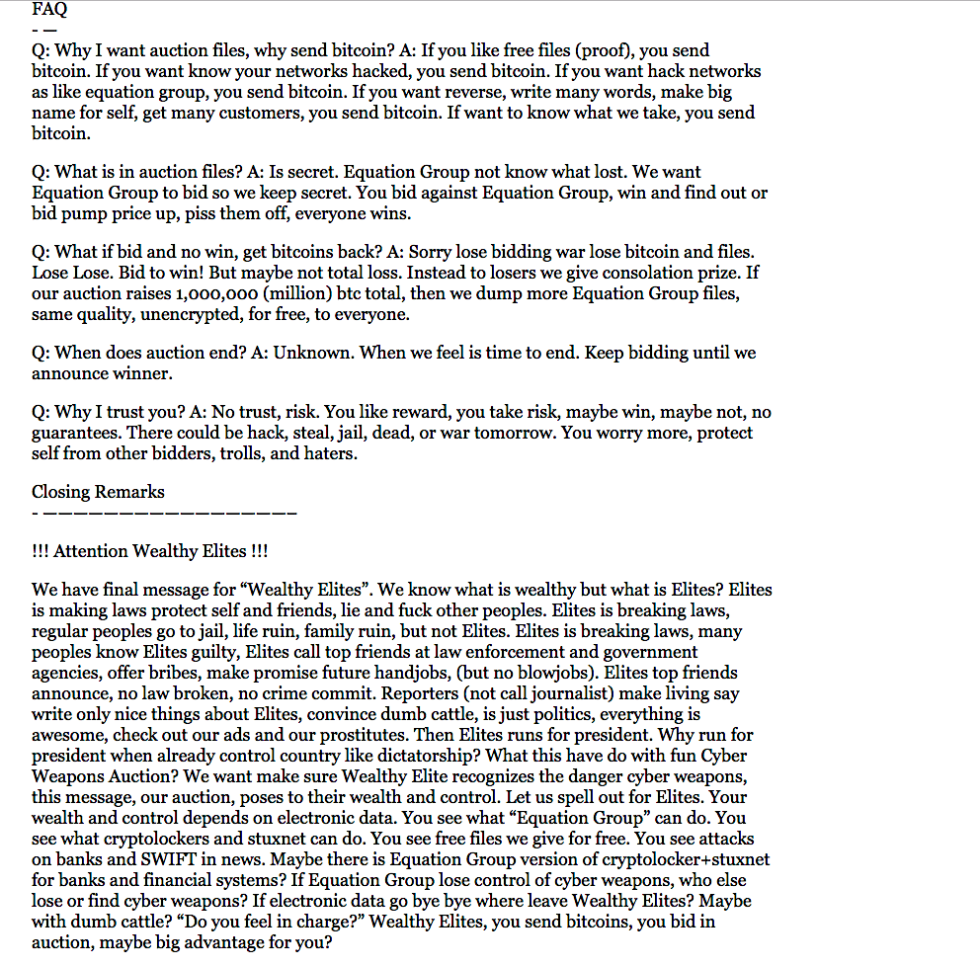
LawFare: Monday was a tough day for those in the business of computer espionage. Russia, still using the alias Guccifer2.0, dumped even more DNC documents. And on Twitter, Mikko Hypponen noted an announcement on Github that had gone overlooked for two days, a group is hosting an auction for code from the “Equation Group,” which is more commonly known as the NSA. The auctioneer’s pitch is simple, brutal, and to the point:

How much you pay for enemies cyber weapons? Not malware you find in networks. Both sides, RAT + LP, full state sponsor tool set? We find cyber weapons made by creators of stuxnet, duqu, flame. Kaspersky calls Equation Group. We follow Equation Group traffic. We find Equation Group source range. We hack Equation Group. We find many many Equation Group cyber weapons. You see pictures. We give you some Equation Group files free, you see. This is good proof no? You enjoy!!! You break many things. You find many intrusions. You write many words. But not all, we are auction the best files.

This release included two encrypted files, and the password to one was provided as proof while the other remains encrypted. The attackers claim that they will provide the password to the second file to the winner of a Bitcoin auction.

The public auction part is nonsense. Despite prevailing misconceptions on cryptocurrency, Bitcoin’s innate traceability means that no one could really expect to launder even $1M out of a high profile Bitcoin wallet like this one without risking detection, let alone the $500M being requested for a full public release. The auction is the equivalent of a criminal asking to be paid in new, marked, sequential bills. Because the actors here are certainly not amateurs, the auction is presumably a bit of “Doctor Evil” theater—the only bids will be $20 investments from Twitter jokesters.

But the proof itself appears to be very real. The proof file is 134 MB of data compressed, expanding out to a 301 MB archive. This archive appears to contain a large fraction of the NSA’s implant framework for firewalls, including what appears to be several versions of different implants, server side utility scripts, and eight apparent exploits for a variety of targets.

The exploits themselves appear to target Fortinet, Cisco, Shaanxi Networkcloud Information Technology (sxnc.com.cn) Firewalls, and similar network security systems. I will leave it to others to analyze the reliability, versions supported, and other details. But nothing I’ve found in either the exploits or elsewhere is newer than 2013.

Because of the sheer volume and quality, it is overwhelmingly likely that this data is authentic. And it does not appear to be information taken from compromised targets. Instead, the exploits, binaries with help strings, server configuration scripts, 5 separate versions of one implant framework, and all sort of other features indicate that this is analyst-side code—the kind that probably never leaves the NSA.

It is also unlikely that this data is from the Snowden cache. Those documents focused on PowerPoint slides and shared data, not detailed exploits. Besides NSA, the only plausible candidate for ownership is GCHQ—and the implications of stealing Top Secret data from GCHQ and modifying it to frame the NSA would themselves be startling.

All this is to say that there is relatively high confidence that these files contain genuine NSA material.

From an operational standpoint, this is not a catastrophic leak. Nothing here reveals some special “NSA magic.” Instead, this is evidence of good craftsmanship in a widely modular framework designed for ease of use. The immediate consequence is probably a lot of hours of work down the drain.

But the big picture is a far scarier one. Somebody managed to steal 301 MB of data from a TS//SCI system at some point between 2013 and today. Possibly, even probably, it occurred in 2013. But the theft also could have occurred yesterday with a simple utility run to scrub all newer documents. Relying on the file timestamps—which are easy to modify—the most likely date of acquisition was June 11, 2013 (see Update, however). That is two weeks after Snowden fled to Hong Kong and six days after the first Guardian publication. That would make sense, since in the immediate response to the leaks, as the NSA furiously ran down possible sources, it may have accidentally or deliberately eliminated this adversary’s access.

As with other recent cyber conflicts, the  espionage aspect is troubling but not entirely new. It’s very, very bad that someone was able to go rummaging through a TS//SCI system—or even an unclassified Internet staging system where the NSA operator unwisely uploaded all this data—and to steal 300 MB of data. But whoever stole this data now wants the world to know—and that has much graver implications. The list of suspects is short: Russia or China. And in the context of the recent conflict between the US and Russia over election interference, safe money is on the former.

Right now, I’d imagine that the folks at NSA are having rather unpleasant conversations about what the other encrypted file might contain, and what other secrets this attacker may have gained access to. Even if they were aware of the attack that resulted in this leak, there’s no way of knowing what is in the other archive. Is there evidence of another non-Snowden insider who went silent three years ago? Was a TS//SCI system remotely compromised? Was there some kind of massive screw-up at an agency which prides itself on world class OPSEC? Some combination of the three?

And—most chillingly—what else might be released before this war of leaks is over?


Update:  Thanks to @botherder for pointing out that a couple files have a newer date:  One file has a date of June 17th, 2013; another has a date of July 5th, 2013; three setup strips are dated September 4th, 2013; and two have dates of October 18th 2013.  One of those files (which I’m currently investigating) is the database of allocated Ethernet MAC addresses, which may be able to identify a later minimum date of compromise.  If the latter date of October 18th, 2013 is correct, this is even more worrysome, as this suggests that the compromise happened four months after the initial Snowden revelations—a period of time when the NSA’s systems should have been the most secure.

Update 2: Looking at the dates again, it now does seem somewhat likely that this was data copied on June 11th, 2013 with a few updates with a compromise after October 18th.  This does make it more likely that this was taken from a set of files deliberately moved onto a system on the Internet used for attacking others.  To my mind, this is actually an even scarier possibility than the NSA internal system compromise: This scenario would have the NSA, after the Snowden revelations, practicing some incredibly awful operational security.  Why should the NSA include five different versions of the same implant on a system used to attack other systems on the Internet?  Let alone implants which still have all the debugging strings, internal function names, and absolutely no obfuscation?

Update 3: Kaspersky confirms that the particular use of RC6 matches the unique design present in other Equation Group malcode.  XORcat apparently confirmed that the Cisco exploit works and, due to the versions it can attack, was a zero day at the time.  This exploit would generally work to take over a firewall from the inside of a target network since it did require limited access that is almost always blocked from the outside.

*****

In part from the WashingtonPost:

A cache of hacking tools with code names such as Epicbanana, Buzzdirection and Egregiousblunder appeared mysteriously online over the weekend, setting the security world abuzz with speculation over whether the material was legitimate.

The file appeared to be real, according to former NSA personnel who worked in the agency’s hacking division, known as Tailored Access Operations (TAO).

“Without a doubt, they’re the keys to the kingdom,” said one former TAO employee, who spoke on the condition of anonymity to discuss sensitive internal operations. “The stuff you’re talking about would undermine the security of a lot of major government and corporate networks both here and abroad.”

Said a second former TAO hacker who saw the file: “From what I saw, there was no doubt in my mind that it was legitimate.”

“Faking this information would be monumentally difficult, there is just such a sheer volume of meaningful stuff,” Nicholas Weaver, a computer security researcher at the University of California at Berkeley, said in an interview. “Much of this code should never leave the NSA.”

The tools were posted by a group calling itself the Shadow Brokers using file-sharing sites such as BitTorrent and DropBox.

At the same time, other spy services, like Russia’s, are doing the same thing to the United States.

It is not unprecedented for a TAO operator to accidentally upload a large file of tools to a redirector, one of the former employees said. “What’s unprecedented is to not realize you made a mistake,” he said. “You would recognize, ‘Oops, I uploaded that set’ and delete it.”

Critics of the NSA have suspected that the agency, when it discovers a software vulnerability, frequently does not disclose it, thereby putting at risk the cybersecurity of anyone using that product. The file disclosure shows why it’s important to tell software-makers when flaws are detected, rather than keeping them secret, one of the former agency employees said, because now the information is public, available for anyone to employ to hack widely used Internet infrastructure. Read the full article here.

That $1.3 Billion to Iran was Paid, How? Classified…

How was it delivered? Classified. How do you put $1.3 billion on pallets and shrink wrap it and get it to Iran? Classified. We thought the $400 million was for ransom but now it appears it was ALL of it, $1.7 billion and Iran along with Russia coupled with the Iranian militia and Hezbollah will enjoy it all.

Related reading: United States is Buying Nuclear Material from Iran

US paid Iran $1.3 billion in cash to settle old dispute

NYP: WASHINGTON — The Obama administration’s $400 million payoff to Iran was followed by a second transfer of $1.3 billion, it was reported Tuesday.

President Obama took considerable flak for the first payment, which coincided with the release in January of four Americans being held by Tehran.

Critics charged that the move smacked of ransom, which the US has pledged never to pay.

The $400 million was the first installment of a $1.7 billion settlement with Iran to resolve a dispute over a failed arms deal signed before the 1979 fall of the shah.

But there was no word about what happened to the rest of the debt — $1.3 billion.

On Tuesday, The Weekly Standard reported that the second payment was also quietly delivered.

Assistant Secretary of State for Legislative Affairs Julia Frifield sent a letter to Congress on March 17, 2016, stating, “Iran received the balance of $400 million in the Trust Fund as well as roughly $1.3 billion representing a compromise on the interest,” according to the magazine.

This payment was likely made in cash, since the US has no banking relationship with Tehran.

Wooden pallets stacked with euros, Swiss francs and other currencies were flown into Iran in an unmarked cargo plane to cover the first $400 million.

“The reason that we had to give them cash is precisely because we are so strict in maintaining sanctions — and we don’t have a banking relationship with Iran — that we couldn’t send them a check,” Obama said in an Aug. 4 press conference.

Although he insisted there was no connection to the hostages, one of them described waiting for “another plane” to land before being freed from Iran.

“I just remember the night at the airport sitting for hours and hours there, and I asked police, ‘Why are you not letting us go?’” former hostage Pastor Saeed Abedini told Fox Business.

“He said, ‘We are waiting for another plane, so if that plane doesn’t come, we never let [you] go.’”

In part from Reuters:

The White House announced on Jan. 17, a day after the prisoner exchange, it was releasing $400 million in funds frozen since 1981, plus $1.3 billion in interest owed to Iran. The remaining interest has since been fully paid from the U.S. Treasury-administered Judgment Fund, according to a U.S. official.

The funds were part of a trust fund Iran used before its 1979 Islamic Revolution to buy U.S. military equipment that was tied up for decades in litigation at the tribunal.

The Treasury Judgment Fund?

The Judgment Fund was established to pay court judgments and Justice Department compromise settlements of actual or imminent lawsuits against the government.

It is administered by the Judgment Fund Branch, which is a part of the United States Department of the Treasury, Bureau of the Fiscal Service. The Judgment Fund Internet Claims System (JFICS) is the application used to process all Judgment Fund claims.

The Judgment Fund is a permanent, indefinite appropriation available to pay judicially and administratively ordered monetary awards against the United States. The Judgment Fund is also available to pay amounts owed under compromise agreements negotiated by the U.S. Department of Justice in settlement of claims arising under actual or imminent litigation, if a judgment on the merits would be payable from the Judgment Fund. The statutory authority for the Judgment Fund is 31 U.S.C. 1304.

If funds for paying an award are otherwise provided for in the appropriations of the defendant agency, the Judgment Fund may not pay an award. A federal agency may request that payment of an award be made on its behalf from the Judgment Fund only in those instances where funds are not legally available to pay the award from the agency’s own appropriations.

Amounts paid vary significantly from year-to-year. Federal agencies are not required to reimburse the Judgment Fund except when cases are filed under the Contract Disputes Act (CDA) or the No FEAR Act (Notification and Federal Employee Antidiscrimination and Retaliation Act).


The Authority of the Internet is Turned Over in 2 Months

This is surrender of the one place in the world where there is some freedom, the internet. The transfer date is September 30, 2016. Is this a big deal? Yes…..China and Russia don’t have a 1st amendment and it appears only one senator is waging the war to stop the transfer, Ted Cruz.

“From the very first days of the internet, the American government has maintained domain names and ensured equal access to everyone with no censorship whatsoever,” Cruz says in the video. “Obama wants to give that power away.”

That move poses a “great threat” to national security, Cruz said. Starting on the transfer date of Sept. 30, ICANN control could allow foreign governments to prohibit speech that they don’t agree with, he added.

Cruz has added an amendment to the Senate’s Highway Bill that would require an up-or-down vote on the administration’s plan to give ICANN control over names and numbers. And Cruz’s Protecting Internet Freedom Act, proposed with Republican Rep. Sean Duffy (Wis.), would prevent the transfer of authority to the global group. More from The Blaze.

*****

Twenty-five advocacy groups and some individuals have told leaders in the Senate and the House of Representatives that key issues about the transition are “not expected to be fully resolved until summer 2017.”

“Without robust safeguards, Internet governance could fall under the sway of governments hostile to freedoms protected by the First Amendment,” wrote the groups, which include TechFreedom, Heritage Action for America and Taxpayers Protection Alliance. “Ominously, governments will gain a formal voting role in ICANN for the first time when the new bylaws are implemented.” Read more here from PCWorld.

America to hand off Internet in under two months

WashingtonExaminer: The Department of Commerce is set to hand off the final vestiges of American control over the Internet to international authorities in less than two months, officials have confirmed.

The department will finalize the transition effective October 1, Assistant Secretary Lawrence Strickling wrote on Tuesday, barring what he called “any significant impediment.”

The move means the Internet Assigned Numbers Authority, which is responsible for interpreting numerical addresses on the Web to a readable language, will move from U.S. control to the Internet Corporation for Assigned Names and Numbers, a multistakeholder body that includes countries like China and Russia.

Critics of the move, most prominently Texas Republican Sen. Ted Cruz, have pointed out the agency could be used by totalitarian governments to shut down the Web around the globe, either in whole or in part.

Opponents similarly made the case that Congress has passed legislation to prohibit the federal government from using tax dollars to allow the transition, and pointed out that the feds are constitutionally prohibited from transferring federal property without approval from Congress. A coalition of 25 advocacy groups like Americans for Tax Reform, the Competitive Enterprise Institute, and Heritage Action sent a letter to Congress making those points last week.

While those issues could, in theory, lead to a legal challenge being filed in the days following the transfer, the administration has expressed a desire to finish it before the president leaves office, a position that Strickling reiterated.

“This multistakeholder model is the key reason why the Internet has grown and thrived as a dynamic platform for innovation, economic growth and free expression,” Strickling wrote. “We appreciate the hard work and dedication of all the stakeholders involved in this effort and look forward to their continuing engagement.”

Russia v. Ukraine Real Conflict Coming?

For Putin, it is all financial and likely to flush out NATO operations if possible.

**** 

BusinessInsider: Ukraine says it thinks Vladimir Putin is planning a new invasion, and it’s not hard to see why: the Russian leader has built up troops on its border and resumed the hostile rhetoric that preceded his annexation of Crimea two years ago.

But despite appearances, some experts say Putin is more likely seeking advantage through diplomacy than on the battlefield, at least this time around.

“It’s about sanctions,” Andrey Kortunov, director general of the Russian International Affairs Council, a Moscow-based foreign policy think tank close to the Russian Foreign Ministry, told Reuters.

“It looks like a way of increasing pressure on Western participants of the Minsk peace process,” he said of a peace deal set up for eastern Ukraine, where pro-Russian separatists have battled against government forces.

For two years, Russia has been under U.S. and EU sanctions over its annexation of Crimea and support for the separatists in eastern Ukraine. European leaders say the sanctions cannot be lifted unless the Minsk peace deal is implemented, but for now it looks moribund, with fighting occasionally flaring and both sides blaming each other for failing to implement truce terms. More here.

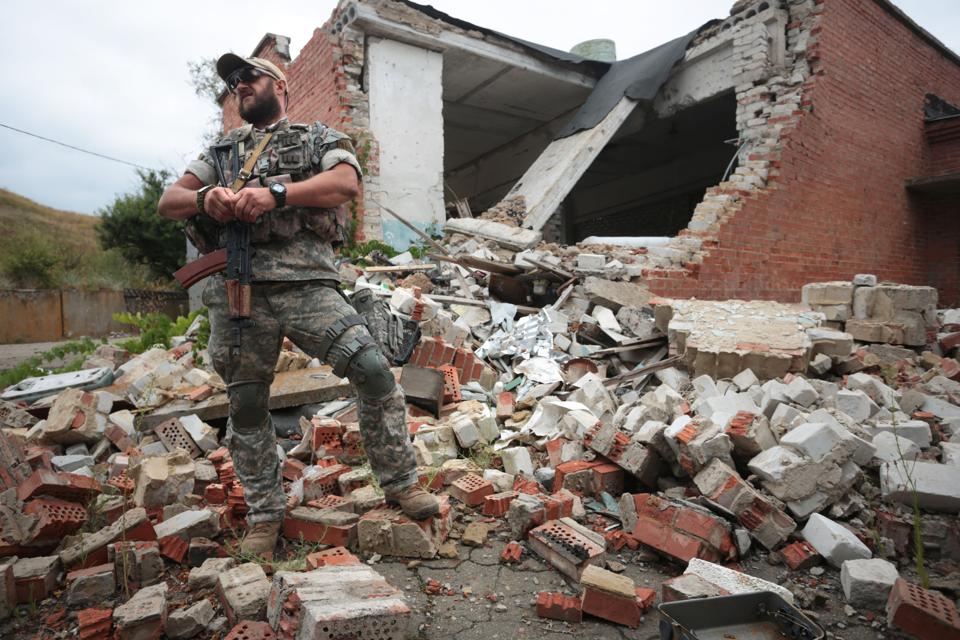
A Ukrainian paratrooper walks among the ruins of building destroyed by pro-Russian separatists shelling on August 14, 2016. Pro-Russian rebels allegedly have ramped up their shelling of one key village: the once quiet coastal resort village of Shyrokyne in Donetsk has turned into one of the bloodiest battlefields of the 27-month separatist revolt. (Photo by ALEKSEY FILIPPOV/AFP/Getty Images)

Forbes: The fog of war has become a Russian specialty.  Did they invade Ukraine? Did they not? Did Crimeans vote for secession on their own volition? Did they not? In any event, the market seems to be ignoring the recent escalation of tensions between Ukraine and Russia. Tensions do not bode well for sanctions removal, even though it seems pretty certain to everyone that a Hillary Clinton presidency will keep sanctions in place come January.

The latest fiasco: a border skirmish in Crimea with Ukrainian forces led to the death of two Russian soldiers.

Nevertheless, the skirmish may not have even happened. The New York Times reported Monday from Moscow that Ukraine denied the killing of two soldiers. The official word from Kiev is that the Kremlin invented the story to escalate tensions in order to whip up nationalist passions ahead of parliamentary elections in September. A Russian television report documenting the arrest of a couple of Ukrainian commandos in Crimea included shots of a full moon at dusk, though the moon was waning on the date of the alleged incident, the Times reported. The shot may have been stock footage, however.

And while all this tit-for-tat was going on, the Market Vectors Russia (RSX) fund rose 2.27%, two times more than the MSCI Emerging Markets Index.

The jury is out as to why this is happening in Crimea. One theory is that Ukraine was the instigator. Ukraine has a strong, even existential, interest in ensuring that the U.S. continues to provide support. To this end, it is advantageous for Ukraine to paint Putin and Russia as bad guys, an increasingly easy task.

Pro-Russia political analyst Sergei Markov even says U.S. intelligence agencies and the Hillary Clinton campaign itself were behind it in order to make pro-Russia Republican Donald Trump look to be supportive of a rogue nation.

“An escalation of tensions between Russia and Ukraine would be highly expedient for Hillary Clinton, who has repeatedly issued sharp-worded, aggressive statements against Putin and Russia,” he was quoted as saying by the Khodorkovsky Center’s editorial writers on Monday.

RSX sold off only a tad late after market hours on Monday.

Why would Vladimir Putin want to cause more trouble in Ukraine than he already has? His United Russia party has very little opposition. His approval rating remains high. But a little bit of Russian firepower, especially where Russia is looked at as being picked on by Western back forces, plays well with United Russia fans.

Putin has state Duma elections coming up and he may take the view that both Europe and the U.S. are too weak to seriously punish him beyond extending sanctions, which is a given if in a Clinton presidency.

Putin may also take the view that a foreign policy distraction is a good pretext for a bit of political housecleaning at

home, explaining the exit of long-standing supporter, Chief of Staff Sergei Ivanov, notes Jan Dehn, head of research for emerging market investment firm Ashmore in London.

As for the investment implications, Russia’s ability and willingness to pay its debts to foreign banks remain solid. If bond spreads should blow out materially, buyers are likely to outweigh sellers in a rather short period of time. This happened back in November of 2014 when the central bank changed its currency trading band and raised interest rates three times in less than a month. Spreads were over 900 basis points over Treasurys. The Russian bond lords were the first to pile in.

That made Russia one of the best bond trades in the world and stood as evidence that the market has faith in Russia debt, at least. It will get paid. It actually yields. Holy lord…

Meanwhile, the Russian economy is turning a corner and investors are hoping to see GDP crack zero this year. Year on year growth rates were -0.6% in the second quarter from -1.2% in the first. Inflation is stabilizing but not enough yet for a rate cut. So long as inflation doesn’t go the other way, the central bank will cut rates and that will be supportive of equities.

The only thing to pull the rug out of Russia would be oil heading to the $30s again. It’s not unlikely. But it’s definitely not consensus.