
U.S. Confrontation, Obama Tells Navy Put Tail Between Propellers

U.S. Navy video

Obama Blocks Navy from Sailing Near Disputed Chinese islands

FreeBeacon: The Obama administration has restricted the U.S. Pacific Command from sending ships and aircraft within 12 miles of disputed Chinese-built islands in the South China Sea, bolstering Beijing’s illegal claims over the vital seaway, Pentagon leaders revealed to Congress on Thursday.

“The administration has continued to restrict our Navy ships from operating within 12 nautical miles of China’s reclaimed islands,” Senate Armed Services Committee Chairman Sen. John McCain (R., Ariz.) said in opening remarks criticizing the failure to guarantee safe passage for international commercial ships in Asia.

“This is a dangerous mistake that grants de facto recognition of China’s man-made sovereignty claims,” he said.

The South China Sea is a strategic waterway used to transport $5 trillion annually in goods, including $1.2 trillion in trade to the United States.

David Shear, assistant defense secretary for Asian and Pacific affairs, sought to play down the restrictions on Navy ship transits close to the islands. According to Shear, a regional freedom of navigation exercise took place in April and the tactic is “one tool in a larger tool box … and we’re in the process of putting together that tool box.”

Shear acknowledged that “we have not recently gone within 12 miles of a reclaimed area,” noting the last time a Navy ship sailed that close to a Chinese-built island was 2012.

The disclosure undermines statements made Wednesday by Defense Secretary Ash Carter who said the United States would not be coerced by China into not operating ships or aircraft in Asia. Carter said the United States “will continue to protect freedom of navigation and overflight.”

Shear insisted that in recent years the U.S. military has challenged “every category of Chinese claim in the South China Sea, as recently as this year.”

Blocking China from militarizing the new islands could include a range of options, including freedom of navigation operations, he said.

McCain, however, noted that the U.S. restrictions on close-in island military flights and ship visits were continuing despite the provocative dispatch of five Chinese warships in an unprecedented deployment to waters within 12 miles of Alaska’s Aleutian Islands—at the same time President Obama was concluding a recent visit to the state earlier this month.

A visibly angered McCain told Shear the best way to assert that international waters around the islands do not belong to China would be for American ships to make 12-mile passages by the disputed islands. “And we haven’t done that since 2012. I don’t find that acceptable, Mr. Secretary,” he said.

Adm. Harry Harris, commander of the U.S. Pacific Command, was asked if he is authorized to order ships to travel within 12 miles of any of the man-made islands and answered, no. Harris also said no U.S. surveillance aircraft have flown directly over any of the islands.

Asked why not, Harris stated: “I’ll just [say] that Pacom presents options, military options to the secretary. And those options come with a full range of opportunities in the South China Sea, and we’re ready to execute those options when directed.”

The restrictions appear to be an element of the Obama administration’s conciliatory policies toward China that have increased in the months leading up to the planned visit to Washington next week by Chinese President Xi Jinping.

The administration also has not taken steps to penalize China for large-scale hacking of U.S. government and private sector databases, although sanctions are planned.

China has been building islands on several reefs within the South China Sea for the past several years near the Paracels, in the northwestern sea, and near the Spratlys, near the Philippines. Several nations, including Vietnam, Philippines, and Malaysia have challenged Chinese claims to maritime sovereignty.

After ignoring the island building for several years, the Obama administration earlier this year began pressing the Chinese to halt the construction. The U.S. appeals were ignored.

A Chinese admiral recently declared that the entire South China Sea is China’s maritime territory.

“The South China Sea is no more China’s than the Gulf of Mexico is Mexico’s,” said Harris, who described himself as critic of China’s maritime behavior and large-scale military buildup.

Harris made clear implicitly during the hearing he did not agree with the restrictions on transit near the disputed islands but has been overruled by the president and secretary of defense.

“I think that we must exercise our freedom of navigation throughout the region …,” Harris said.

Pressed for his views on whether close passage of U.S. ships in the sea should be permitted, Harris said: “I believe that we should [be] allow[ed] to exercise freedom of navigation and flight—maritime and flight in the South China Sea against those islands that are not islands.”

Asked if he has requested permission for close-in island transits, Harris would not say, stating only that he has provided policy options for doing so to civilian leaders.

Harris said Pacific command surface ship commanders and crews, as well as Air Force pilots and crews, have orders when operating near China to “insist on our right to operate in international airspace and maritime space” and to respond professionally when challenged by Chinese warships or interceptor jets.

The four-star admiral warned that more incidents, such as the dangerous aerial intercept of a P-8 surveillance jet by a Chinese jet in 2014, are possible after China finishes building runways on Fiery Cross Reef and two other reefs.

With missiles, jet fighters, and warships stationed on the islands, “it creates a mechanism by which China would have de facto control over the South China Sea in any scenario short of war,” he said.

In a conflict the sites could be easily targeted, but “short of that, militarization of these features pose a threat, and certainly it poses a threat against all other countries in the region,” he said.

Shear also said the island militarization is a concern.

“The Chinese have not yet placed advanced weaponry on those features and we are going to do everything we can to ensure that they don’t,” Shear said. “This is going to be a long-term effort. There are no silver bullets in this effort. But we’re certainly complicating Chinese calculations already.”

Shear said U.S. forces are continuing to operate freely in the region and have deterred Chinese coercion of regional states.

“That we freely operate in the South China Sea is a success? It’s a pretty low bar, Mr. Secretary,” McCain said.

China’s dispatch of five warships to waters near the Bering Strait followed recent joint exercises with the Russians, after which the Chinese ships sailed near Alaska to demonstrated the ships’ ability to operate in the far north, Harris said, noting that he viewed the timing to the president’s Alaska visit as “coincidental.”

Sen. Dan Sullivan, (R., Alaska) said the Chinese action was a “provocation” and criticized the administration’s weak response. The Pentagon dismissed the Chinese ship transit as legal under international law.

“I thought it was more of a provocation and a demonstration of their interest in the Arctic,” Sullivan said. “I’m not sure that this White House would recognize a provocation if it was slapped in the face, and we need to be aware of that.”

Harris also said he is concerned by China deploying submarines, including nuclear missile submarines, further from its shores.

“We’re seeing Chinese submarine deployments extend further and further, almost with every deployment,” he said. “It has become routine for Chinese submarines to travel to the Horn of Africa region and North Arabian Sea in conjunction with their counter piracy task force operations. We’re seeing their ballistic missiles submarines travel in the Pacific at further ranges and of course all of those are of concern.”

China’s claims to have halted island construction and militarization on some 3,000 acres are false, McCain said.

“Recently released satellite images show clearly this is not true,” the senator said. “What’s more, China is rapidly militarizing this reclaimed land, building garrisons, harbors, intelligence, and surveillance infrastructure, and at least three air strips that could support military aircraft.”

Surface-to-air missiles and radars also could be added enabling China “to declare and enforce an air defense identification zone in the South China Sea, and to hold that vital region at risk,” McCain added.

Shear said the island building is nearly completed.

Meanwhile in the House, Rep. J. Randy Forbes (R., Va.), chairman of the House Armed Services subcommittee on seapower, led a group of 29 members of Congress in writing to President Obama and Carter, the defense secretary, urging the lifting of the restrictions on naval and air operations near the disputed islands.

“The longer the United States goes without challenging China’s unfounded claims to sovereignty over these artificial formations—and to territorial waters and exclusive economic rights in the surrounding water—the greater the consequences will be for regional security,” the lawmakers stated in the Sept. 17 letter.

“It is our belief that the Defense Department should act immediately to reaffirm the United States’ commitment to freedom of navigation and the rule of law.”
Hacking the Department of Energy, the Threat to You

The USDOEnergy is a cabinet level department and while responsibility includes power, laboratories, it includes nuclear. The agency secretary is Earnest Moniz, most notable for being at the side of John Kerry during the Iran nuclear talks.

Hacking this agency is terrifying and added into this equation, in 1999 the FBI investigated how China obtained specific specifications for a particular nuclear device from Los Alamos National Laboratory.

Records: Energy Department struck by Cyber Attacks

USAToday: Attackers successfully compromised U.S. Department of Energy computer systems more than 150 times between 2010 and 2014, a review of federal records obtained by USA TODAY finds.

Cyber attackers successfully compromised the security of U.S. Department of Energy computer systems more than 150 times between 2010 and 2014, according to a review of federal records obtained by USA TODAY.

Incident reports submitted by federal officials and contractors since late 2010 to the Energy Department’s Joint Cybersecurity Coordination Center shows a near-consistent barrage of attempts to breach the security of critical information systems that contain sensitive data about the nation’s power grid, nuclear weapons stockpile and energy labs.

The records, obtained by USA TODAY through the Freedom of Information Act, show DOE components reported a total of 1,131 cyberattacks over a 48-month period ending in October 2014. Of those attempted cyber intrusions, 159 were successful.

“The potential for an adversary to disrupt, shut down (power systems), or worse … is real here,” said Scott White, Professor of Homeland Security and Security Management and Director of the Computing Security and Technology program at Drexel University. “It’s absolutely real.”

Energy Department officials would not say whether any sensitive data related to the operation and security of the nation’s power grid or nuclear weapons stockpile was accessed or stolen in any of the attacks, or whether foreign governments are believed to have been involved.

“DOE does not comment on ongoing investigations or possible attributions of malicious activity,” Energy Department spokesman Andrew Gumbiner said in a statement.

In all cases of malicious cybersecurity activity, Gumbiner said the Energy Department “seeks to identify indicators of compromise and other cybersecurity relevant information, which it then shares broadly amongst all DOE labs, plants, and sites as well as within the entire federal government.”

The National Nuclear Security Administration, a semi-autonomous agency within the Energy Department responsible for managing and securing the nation’s nuclear weapons stockpile, experienced 19 successful attacks during the four-year period, records show.

While information on the specific nature of the attacks was redacted from the records prior to being released, numerous Energy Department cybersecurity vulnerabilities have been identified in recent years by the department’s Office of Inspector General, an independent watchdog agency.

After a cyber attack in 2013 resulted in unauthorized access to personally identifying information for more than 104,000 Energy Department employees and contractors, auditors noted “unclear lines of responsibility” and “lack of awareness by responsible officials.” In an audit report released in October of last year, the Inspector General found 41 Energy Department servers and 14 workstations “were configured with default or easily guessed passwords.”

Felicia Jones, spokeswoman for the Energy Department Office of Inspector General, said while there have been some improvements, “threats continue and the Department cannot let down its guard.”

Records show 53 of the 159 successful intrusions from October 2010 to October 2014 were “root compromises,” meaning perpetrators gained administrative privileges to Energy Department computer systems.

Manimaran Govindarasu, a professor in the Department of Electrical and Computer Engineering at Iowa State University who studies cybersecurity issues involving the power grid, said the root compromises represent instances where intruders gained “super-user” privileges.

“That means you can do anything on the computer,” he said. “So that is definitely serious. Whether that computer was critical or just a simple office computer, we don’t know.”

Govindarasu said while there could be information in Energy Department computer systems concerning security plans or investments related to the nation’s power grid, the grid’s real-time control systems are operated by utilities and are not directly connected to the Energy Department’s computer systems.

The Energy Department federal laboratories, however, sometimes pull data on the operation of the grid from utilities for research and analysis.

Records show 90 of the 153 successful cyber intrusions over the four-year period were connected to the DOE’s Office of Science, which directs scientific research and is responsible for 10 of the nation’s federal energy laboratories.

A USA TODAY Media Network report in March found a physical or cyber attack nearly once every four days on the nation’s power infrastructure, based on an analysis of reports to the U.S. Department of Energy through a separate reporting system which requires utility companies to notify the federal agency of incidents that affect power reliability.

Amid mounting concerns, the oversight and energy subcommittees of the House Committee on Science, Space and Technology will hold a joint hearing at 10 a.m. Thursday to examine vulnerabilities of the national electric grid and the severity of various threats.

The congressional committee’s charter for Thursday’s meeting, citing USA TODAY’s report in March, notes the growing vulnerability of the nation’s increasingly sophisticated bulk electric system.

“As the electric grid continues to be modernized and become more interconnected,” the charter states, “the threat of a potential cybersecurity breach significantly increases.”

Example: Depths of Chinese Hacking the U.S.

Former Top FBI Lawyer and Counterintelligence Official Admits Chinese Hacked His Home Computer

September 8, 2015

China Allegedly Hacked Top Former FBI Lawyer 

Jeff Stein, Newsweek

Marion “Spike” Bowman, a top former FBI lawyer and U.S. counterintelligence official who heads an influential organization of retired American spies, says a hacker from China penetrated his home computer, beginning with an innocent-looking email last spring.

“It was an email supposedly from a woman in China, and I exchanged correspondence with her a couple of times,” says Bowman, who was deputy general counsel to three FBI directors between 1995 and 2006. “She sent me a document that a friend of hers had supposedly written, in English, and wanted my opinion on it,” he tells Newsweek. She also sent him her picture.

“I never got around to replying, so I never heard from her again,” says Bowman, who went on to become deputy director of the National Counterintelligence Executive, which is tasked with developing policies to thwart foreign spies and terrorists.

But then, a week ago, he says, he got another message from China via his email account at George Washington University, where he has lectured on national security law since 2003.

“It was apparently from a university in China asking me come to speak at a conference on the environment”—not even remotely one of his areas of expertise, Bowman says. He called the FBI.

After a forensic examination of his machine, the FBI told him “they had found a malware type that’s designed to find out what’s on my computer,” Bowman says. “It wasn’t anything to infect it.” Still, just being able to read the contents of a target’s computer can reveal lots of valuable information like emails and documents, contact files with phone numbers and other personal data, like home addresses.

“Somebody who really knows what they’re doing” can wreak havoc, he says.

The FBI didn’t tell him exactly who was behind the hack, he says, “but they think they identified the woman” in a picture she sent along with one of her emails last spring. “It was somebody that they knew,” Bowman says. “I didn’t inquire any further.”

Before joining the FBI, Bowman was a Navy lawyer assigned to advise SEAL teams on clandestine operations, among other sensitive matters. His portfolio at the FBI gave him intimate knowledge of the details of operations to counter threats from foreign spy agencies.

“I still carry lots of deep Cold War secrets in my head,” he says, although not on his computer. But he is still very active in national security circles as chairman of the board of directors of the Association of Former Intelligence Officers, an organization with several thousand members nationwide, about half of them former CIA personnel.

Bowman’s revelation follows several months of bad news about the vulnerability of government computers to foreign hackers, the latest being a report published Monday saying that Chinese and Russian intelligence agencies are “aggressively aggregating and cross-indexing hacked U.S. computer databases” to catch American spies working overseas. China-based hackers breached about 22 million files held by the federal Office of Personnel Management, officials say.

“At least one clandestine network of American engineers and scientists who provide technical assistance to U.S. undercover operatives and agents overseas has been compromised as a result” of the Russian and Chinese exploitation of the files, the Los Angeles Times reported, citing two U.S. officials.

The story, Bowman says, was “pretty much on target.”

*** It obviously is much worse than we know for the Obama administration to sign off on a sanction and or other consequence ahead of the Xi’s visit to the United States next week.

U.S. may punish Chinese hacking before Xi’s visit

Imposing sanctions before this month’s summit could derail other priorities.

Top government officials are floating the idea of retaliating within the next week to Chinese cyberattacks, possibly by imposing targeted sanctions on some officials and firms, people familiar with the discussions say. But outside experts say it would be wiser to wait until after this month’s White House summit with Chinese President Xi Jinping.

“I heard from one person that it could be as early as next week,” Jim Lewis, director of the Center for Strategic and International Studies’ Strategic Technologies Program, told POLITICO. He added, “I still think it would be best to wait for the summit.”

Calls for U.S. retalation to Chinese hacking have risen to a furor since the China-linked breach of highly sensitive security clearance forms from 21.5 million current and former federal employees, disclosed in June.

But imposing sanctions before the late-September summit would risk derailing a serious conversation on cyber issues along with myriad other topics, including China’s economic troubles, Chinese belligerence in the South China Sea and cooperation on climate change.

Some China watchers even suspect that the White House is trying to improve its bargaining position in advance of the summit by floating the possibility of sanctions in a serious way.

“My sense is that they’re floating the idea to try to create some kind of leverage in the meetings,” said Adam Segal, a China scholar and director of the Digital and Cyberspace Policy Program at the Council on Foreign Relations.

If the White House did impose sanctions before the meeting, it would be deeply embarrassing to the Chinese and to Xi personally and risk the Chinese doing something to downgrade the summit’s importance, Segal said. “I think if they’re going to do it before the summit, they’ve got to be prepared for the summit to really take a downward turn,” he said.

Business leaders are also dubious about imposing sanctions before Xi’s visit.

The White House should use the summit “as an opportunity to engage in effective dialogue on the cyber issue. If sanctions jeopardize that opportunity, we’d rather see them put it off,” the leader of a major industry organization said in an interview, speaking without attribution because he was speculating about government policy.

If the White House ultimately imposes targeted sanctions, the association leader added, the sanctions should be “based on transparent, credible evidence that’s legally sound.” They should also be designed with a clear path forward that, ultimately, leads to fewer China-linked cyberattacks, he said.

“Most business executives we’ve spoke with felt the indictments against Chinese PLA officers didn’t meet that test,” he added, referring to the May 2014 U.S. indictments of five hackers employed by China’s People’s Liberation Army. That was the Obama administration’s most significant diplomatic strike against Chinese hacking to date.

“[The indictments] didn’t seem to advance anything and they seemed to increase tension rather than reduce it around the issue,” the official said.

In the wake of the OPM hacks, some political leaders have called for much more belligerent responses to Chinese hacking. They include GOP White House contenders Mike Huckabee, who has urged the U.S. to hack back against the communist nation, and Wisconsin Gov. Scott Walker, who has suggested canceling the Obama-Xi summit entirely.

But even cyber hawks warned that aggressive action could backfire in advance of the summit.

“I think everything is going to basically be on hold until the Iran deal goes through and until after President Xi comes to meet with [President Obama],” said Rep. Dutch Ruppersberger (D-Md.), who was formerly ranking member on the House Intelligence Committee.

Ruppersberger added that “we have to eventually draw a line on cyberattacks,” and that the U.S. bargaining position relative to China may be improved now because of the tailspin in the Chinese stock market and other financial difficulties.

The White House has routinely declined to speak publicly about the possibility of sanctioning China for cyberattacks or any more forceful follow-up to the PLA indictments. Press secretary Josh Earnest has said several times that Obama plans to raise cyber concerns with Xi during their summit.

“There’s no doubt that the president will certainly raise, as he has in every previous meeting with his Chinese counterpart, concerns about China’s behavior in cyberspace,” Earnest said during an Aug. 26 news conference.

White House officials have determined they must respond to China’s hacking of OPM, but have been debating for months what the appropriate response should be and when to impose it, Lewis said.

The option of targeted cyber sanctions, which Obama created by executive order in April, has long been on the table along with additional indictments or some form of diplomatic protest, he said.

White House officials have fingered China for the OPM hack anonymously but have not done so, thus far, on the record.

A forceful response to the OPM hack and to Chinese theft of U.S. companies’ intellectual property and trade secrets has also been delayed by more pressing diplomatic priorities, Lewis said, including securing Chinese cooperation for a deal to halt Iran’s nuclear weapons program

“This administration has done more than any other on cybersecurity, but, in a lot of cases, it ends up being No. 2 because of the need to get agreement on other things,” Lewis said. “Cyber always ends up coming in second place, particularly when it comes to China.”


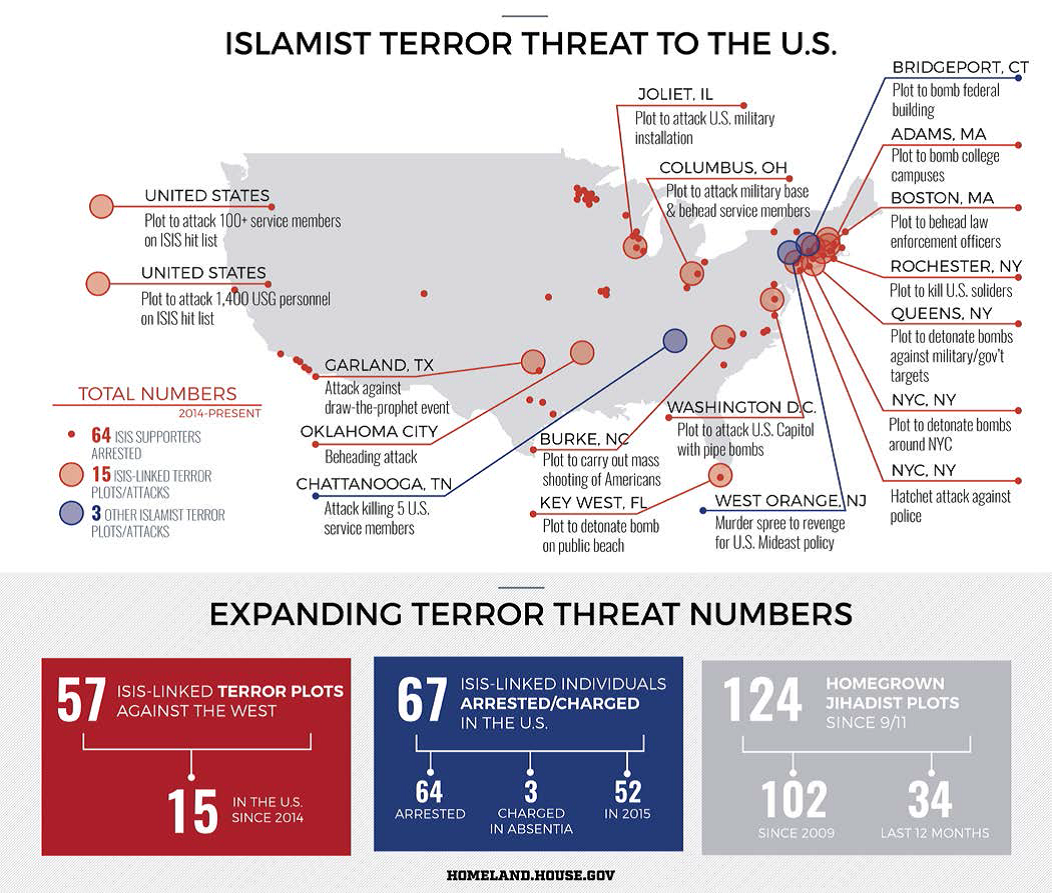
Congress: Islamist Terror Threat Matrix

U.S. Terror Matrix


The full House of Representatives 8 page report is here.


KEY TAKEAWAYS

The jihadist threat in the U.S. homeland is high and has escalated dramatically this year. There have been more U.S.-based jihadist terror cases in 2015 than in any full year since 9/11. The number of U.S. terrorist cases involving homegrown violent jihadists has gone from 38 in July 2010 to 124 today—more than a three-fold increase in just five years.

ISIS is fueling the Islamist terror wildfire across the globe at unprecedented speed. As of the end of August, the group has inspired or directed 57 terror attack plots against Western targets, including 15 in the United States. A recent train attack in France would have been a mass-casualty attack had it not been for an alert group of Americans. There have now been nearly twice as many ISIS-linked attack plots against the West this year (37) as there were in all of 2014 (20).

Islamist terrorists are intent on killing American law enforcement and military personnel, in addition to innocent civilians. Radicals are increasingly targeting men and women in uniform here in the United States. In August, ISIS supporters released another “hit list” of American government personnel, including service members. Since early 2014, the majority of Islamist terror plots on U.S. soil have featured plans to kill police or U.S. service members.

ISIS has largely maintained its terror safe havens in Syria and Iraq while expanding globally more than a year after the U.S. and its allies launched operations against it. Al Qaeda affiliates from Syria to Yemen have also carved out sanctuary and seized additional terrain. ISIS retained control over its major strongholds in Syria and Iraq while undertaking disruption attacks and offensives in key territory; ISIS-affiliated militants have simultaneously consolidated control in Libya. Foreign fighters continue to swell the ranks of Islamist extremist groups looking to recruit foot soldiers and activate followers to launch attacks in their home countries.

HOMEGROWN ISLAMIST EXTREMISM

The jihadist threat in the U.S. homeland is high and has escalated dramatically this year.

By the numbers

Since September 11, 2001, there have been 124 U.S. terrorist cases involving homegrown violent jihadists. Over 80 percent of these cases—which include plotted attacks and attempts to join foreign terrorist organizations—have occurred or been disrupted since 2009.1


• Authorities have arrested or charged at least 52 individuals in the United States this year – 67 since 2014 – in ISIS-related cases. The cases involve individuals: plotting attacks; attempting to travel to join ISIS overseas; sending money, equipment and weapons to terrorists; falsifying statements to federal authorities; and failing to report a felony.2

• FBI Director James Comey has said authorities have hundreds of open investigations of potential ISIS-inspired extremists that cover all 56 of the bureau’s field offices in all 50 states. He stated there may be hundreds or thousands of Americans who are taking in recruitment propaganda over social media applications: “It’s like the devil sitting on their shoulders, saying ‘kill, kill, kill.”

Recent Developments

August 24: Ahmed Mohammed El Gammal, 42, was arrested in Avondale, Arizona, for helping a 24-year-old New York City resident travel to Syria to receive military training from ISIS. El Gammal was an avid ISIS supporter online and engaged the recruit through social media before in-person meetings. El Gammal and the recruit communicated with an unnamed co-conspirator based in Turkey.

TERROR PLOTS AGAINST THE WEST

ISIS is fueling the Islamist terror wildfire across the globe at unprecedented speed.

By the numbers

• Since early 2014, there have been 57 planned or executed ISIS-linked terror plots against Western targets, including 15 inside in the United States.3

• There have been nearly twice as many ISIS-linked plots against Western targets in the first seven months of this year (37) than in all of 2014 (20).4

Recent Developments

• August 21: A 25-year-old Moroccan national, Ayoub El Khazzani, attacked passengers on a train in Thalys, France, before a group led by three Americans, including two service members on vacation, subdued him. Khazzani was armed with an arsenal of weapons and 270 rounds of ammunition. He watched a jihadist propaganda video before attempting to launch his attack. He had lived in and attended a radical mosque in Spain before relocating to France. He had also lived in Belgium and traveled from Germany to Turkey in early May before returning to Europe in June. This trip was reportedly part of a plot to fight with ISIS in Syria.

• August 13: ISIS’s “hacking division” released information regarding 1,400 American government personnel, including service members, and encouraged supporters to track down and attack them. The list included names, e-mail addresses, and phone numbers. ISIS operative and hacker Junaid Hussain had been central to similar plots targeting servicemembers; Hussain was eliminated in an August 24th drone strike in Syria.

FOREIGN FIGHTERS

Undeterred by airstrikes, foreign fighters continue to pour into the conflict zone in Syria and Iraq, bolstering ISIS and representing a potential threat to their home countries—including America—upon return.

By the numbers

• More than 25,000 fighters from 100 countries have traveled to Syria and Iraq to join extremists—the largest convergence of Islamist terrorists in world history. U.S. estimates reportedly put its current manpower at 20,000-30,000 members. “We’ve seen no meaningful degradation in their numbers” since last August, according to a defense official.

• Approximately 4,500 Western fighters have traveled to Syria and Iraq.5 Europol recently assessed that the high-end estimate of EU citizens who left to fight in Syria may have been as high as 5,000 at the beginning of this year.

• An estimated 550 Western women have traveled to the conflict zone.

Read the whole report here.


China Russia Military Parade, During Economic Spiral

In part LATimesPresident Xi Jinping announced Thursday that China will cut its military by 300,000 troops, a significant reduction in one of the largest militaries in the world and a move that the Chinese leader called a gesture of peace. China’s ruling Communist Party staged a massive military parade in central Beijing, sending a stream of goose-stepping troops, tanks, and ballistic missiles down a major east-west thoroughfare as fighter jets zoomed overhead trailing multicolored smoke.

Xi’s speech kicked off the parade — officially called the “Commemoration of the 70th anniversary of the Victory of Chinese People’s Resistance Against Japanese Aggression and World Anti-Fascist War.”

An estimated 12,000 troops – about 1,000 of whom hailed from Belarus, Cuba, Tajikistan, and other countries – marched along the 10-lane Changan Avenue from the commercial center Wangfujing to Tiananmen Square, about 1.5 miles away. They were joined by 200 fighter jets and 500 pieces of military hardware, including tanks and ballistic missiles.

Representatives from 49 countries were in attendance, including Russian leader Vladimir Putin, South Korean President Park Geun-hye and U.N. Secretary General Ban Ki-moon.

Rory Medcalf, head of the national security college at Australian National University, said that Beijing may have decided to cut 300,000 troops “in the name of efficiency and cost saving so that the defense budget can be reallocated to 21st century capabilities.” More here.

The friendship between Russia’s Putin and China’s Xi is becoming strained

BEIJING: They have met more than a dozen times and stood shoulder to shoulder during Thursday’s military parade here. But the once-vaunted relationship between the Chinese president, Xi Jinping, and Russia’s leader, Vladimir Putin, has come under strain as the economies of their countries have faltered.

Two landmark energy deals signed last year for Russian natural gas to flow to China have made little progress and were barely mentioned when the two men met for talks after watching the show of weapons Thursday on Tiananmen Square. The bilateral trade that was predicted to amount to more than $100 billion this year instead reached only about $30 billion in the first six months, largely because of a reduced Chinese demand for Russian oil.

Putin has enjoyed basking in the stature of Xi, who leads one of the world’s largest economies. But with the recent stock market turmoil in China and the slowest economic growth in a quarter-century, Beijing will be unable to provide the ballast Putin has sought against economic sanctions imposed on Russia by Europe and the United States after its annexation of Crimea, not to mention plummeting oil prices worldwide.

“Russia was dependent on China growing and driving the demand for its commodities: oil, gas and minerals,” said Fiona Hill, a Russia specialist at the Brookings Institution in Washington. “China was an alternative to Europe.”

The linchpin of the relationship between Xi and Putin was a May 2014 accord on a 30-year deal for China to buy natural gas from fields in Eastern Siberia, for a reported $400 billion with first delivery between 2019 and 2021. During the signing in Shanghai, Putin bragged that the deal was an “epochal event,” and expressed relief that Russia, under pressure from European sanctions, would be able to diversify its gas sales. More details here.

Analysts: Beijing Parade a ‘Bazaar’ of Stolen Technology

Saibal Dasgupta, Voice of America

The massive military parade in Beijing this week showcased China’s latest weapons, unveiling many to the public for the first time. But weapons experts say the systems on display showed hallmarks of China’s reputation for stealing technology and adapting it to its requirements.
 
The show involved long, medium and short range missiles, a range of tanks and 200 fighter aircraft. The Chinese government said that all the equipment had been made indigenously, attesting to the success of the country’s military industrial capability and the estimated $145 billion spent on the military in 2015.

“The parade was a bazaar of stolen intellectual property,” said Michael Raska, senior fellow at the Singapore-based Institute of Defense and Strategic Studies.

The researcher said it is possible to identify components and designs in different equipment, which have been sourced from other countries in a dubious manner.

Cloned Technology

Citing a specific example, Raska said, “The HQ-6A launchers that we saw at the parade are based conceptually on the cloned Italian Alenia Aspide missile, itself which is based on the US RIM-7E/F Sparrow.”

Raska said the Chinese J-15 naval fighter is based on adaptation of Russia’s Sukhoi Su-33.
 
The United States has repeatedly accused China in recent years of cybertheft of U.S. technology and weapons systems on a grand scale. U.S. defense contractors have alleged that China’s J-31 stealth fighter is largely based on stolen technology of the U.S. F-35.

The United States last year said that Chinese army hackers had stolen trade secrets from six U.S. nuclear, steel and clean-energy companies, directly resulting in “substantial” loss of jobs, competitive edge and markets.
 
“This is a case alleging economic espionage by members of the Chinese military… to advantage state-owned companies and other interests in China,” then-U.S. Attorney General Eric Holder said.

But Raska said China has passed the stage where they were “emulators and copiers” and reached what experts describe as the point of “IDAR,” which means identify, digest, absorb and reinvest technologies.
 
Mix-and-Match

Analysts said it is not easy for countries and companies that produced an original technology to prove that it was stolen by China. Component designs are mixed and matched across different categories of weapons before they are remodeled and manufactured in China.
 
China may also be using its diplomatic relationships with countries that have acquired Western weapons and do not mind passing on acquired technologies to Chinese scientists.
 
But even with such technology sharing from countries friendly with China, Jagganath Panda, a research fellow at the Institute of Defense Studies and Analysis, said the country’s investments in its military have paid off.

“We need to accept that China has been hugely successful in developing a strong military industrial production capability,” he said.
 
In recent years China has sold drones, warships, submarines and air defense systems to developing countries, becoming the world’s third largest arms exporter behind the United States and Russia.
 
Indeed, one major point of Thursday’s military parade may have been to display the country’s newest advanced systems to interested buyers, and bolster China’s reputation as an emerging military power.