An affordable price is probably the major benefit persuading people to buy drugs at www.americanbestpills.com. The cost of medications in Canadian drugstores is considerably lower than anywhere else simply because the medications here are oriented on international customers. In many cases, you will be able to cut your costs to a great extent and probably even save up a big fortune on your prescription drugs. What's more, pharmacies of Canada offer free-of-charge shipping, which is a convenient addition to all other benefits on offer. Cheap price is especially appealing to those users who are tight on a budget
Service Quality and Reputation
Although some believe that buying online is buying a pig in the poke, it is not. Canadian online pharmacies are excellent sources of information and are open for discussions. There one can read tons of users' feedback, where they share their experience of using a particular pharmacy, say what they like or do not like about the drugs and/or service. Reputable online pharmacy canadianrxon.com take this feedback into consideration and rely on it as a kind of expert advice, which helps them constantly improve they service and ensure that their clients buy safe and effective drugs. Last, but not least is their striving to attract professional doctors. As a result, users can directly contact a qualified doctor and ask whatever questions they have about a particular drug. Most likely, a doctor will ask several questions about the condition, for which the drug is going to be used. Based on this information, he or she will advise to use or not to use this medication.
MOSUL: Islamic State fighters have executed scores more people around Mosul this week and are reportedly stockpiling ammonia and sulphur in civilian areas, possibly for use as chemical weapons, U.N. human rights spokeswoman Ravina Shamdasani said on Friday.
A mass grave with over 100 bodies found in the town of Hammam al-Alil was one of several Islamic State killing grounds, Shamdasani said, citing information gleaned from sources on the ground including a man who played dead during a mass execution.
Public executions were being carried out for “treason and collaboration” with Iraqi forces trying to recapture the city, or for the use of banned mobile phones or desertion.
People with explosive belts, possibly teenagers or young boys, were being deployed in the alleys of Old Mosul, while abducted women were being “distributed” to fighters or told they would be used to accompany Islamic State convoys, she said.
ISIS Killed over 70 Mosul Civilians as Iraqi Forces Advancing
Troops of Iraq’s elite Counter-Terrorism Service (CTS) resumed their offensive against ISIS on the streets of Mosul on Friday after several days of relative quiet as the United Nations said ISIS militants have executed scores more people around the city this week.
The battle to retake Mosul, the ISIS terrorist last major stronghold in Iraq, is now in its fourth week, while Iraqi troops have pushed into the east of the city.
“Our forces have begun the attack on Arbajiyah. The clashes are ongoing,” Staff Lieutenant Colonel Muntadhar Salem said, referring to an area in the east of the city.
According to United Nation ISIS (ISIL, IS and Daesh) shot dead 40 civilians on Tuesday in the northern Iraqi city of Mosul after accusing them of treason, the United Nations says.
Their bodies were then hung from electricity poles in several districts, the office of the UN Human Rights Commissioner said, citing sources.
A man was also reportedly shot dead in public in central Mosul for ignoring an ISIS ban on using mobile phones.
The killings of the civilians appeared to have been carried out on the orders of self-appointed “courts”, according to the UN report.
The UN says 20 civilians were also shot dead on Wednesday evening at the Ghabat military base in northern Mosul, supposedly for leaking information.
The UN also expressed concern at ISIS deployment of teenagers and young boys. Children are apparently seen in an ISIS video issued on Wednesday shooting dead four people for spying.
ISIS also announced on 6 November that it had beheaded seven militants for deserting the battlefield in the Kokjali district of eastern Mosul, the UN says.
Among the sources cited for the UN’s information was a man who played dead during a mass killing by ISIS terrorists.
UN High Commissioner for Human Rights Zeid Raad al-Hussein called for the government to “act quickly to restore effective law enforcement in areas retaken from ISIL (ISIS) to ensure that captured fighters and their perceived supporters are dealt with according to the law”.
Troops have reportedly been consolidating gains made in the eastern outskirts of Mosul, which they entered nine days ago amid fierce fighting.
Above Footage shows Peshmerga forces continue to clear the recently recaptured town of Bashiqa of improvised explosive devices left by Islamic State militants.
****What next for Islamic State? Incubating areas of sanctuary and they are.
In part from Rand: First, insurgent groups that lose territory generally need to find sanctuaries that allow them to rest, resupply their depleted forces, and plan future operations. In some cases, these safe havens are outside the country. In Afghanistan, the Taliban’s leadership and many of its fighters fled to neighboring Pakistan after their defeat in 2001 at the hands of U.S. and Afghan forces. Over the next several years, the Taliban used its safe havens in Pakistan to restart the war in Afghanistan, where it remains a significant threat to the Afghan state today. Similarly, Fidel Castro and his surly band of communist rebels suffered a debilitating defeat in July 1953 against the Cuban government in the city of Santiago de Cuba. But Castro eventually reorganized in Mexico, plotted his next steps in relative security, and eventually overthrew the government of Fulgencio Batista in 1959.
Sometimes adequate sanctuaries are available inside the country. In Somalia, al-Shabab lost virtually all of the territory it once controlled following military operations by the African Union Mission in Somalia, Somali government, allied clan militias, and U.S. forces from 2011 to 2015. But al-Shabab found a sanctuary in the Jubba River valley in southern Somalia among allied clans, and it has since waged a violent terrorist campaign in Somalia and neighboring countries like Kenya.
Islamic State leaders already appear to appreciate the importance of sanctuaries. Where the Islamic State has already lost territory in Iraq, such as in Ramadi and Fallujah, its fighters have melted away into the dense agricultural and desert areas around urban centers. Operating out of these jazirah (“isolated”) areas, the Islamic State could replicate the model it perfected a decade ago under the name “al Qaeda in Iraq” by sustaining itself through low-level criminal activity, storing weapons caches for extended operations, and executing a grueling murder and intimidation campaign. Islamic State fighters can also leverage the territory the group currently controls in Syria, which extends north of Raqqa and southeast along the Euphrates River to the Syrian-Iraqi border. This sanctuary was essential for the Islamic State’s resurgence in 2014.
Insurgent groups that face more powerful adversaries generally adopt a guerrilla strategy.
Second, insurgent groups that face more powerful adversaries generally adopt a guerrilla strategy rather than attempting to wage a conventional campaign and fight their enemies in pitched battles. A guerrilla strategy involves the use of military and political resources to mobilize a local population, conduct hit-and-run attacks rather than face the enemy directly on the battlefield, and undermine the government’s will to fight. Guerrilla warfare is attractive to groups that are significantly weaker than government security forces, which is why a guerrilla campaign is sometimes likened to a “war of the flea.”
For T.E. Lawrence, the British officer and advisor to Arab insurgents against the Ottoman Empire, guerrilla campaigns were the sine qua non of insurgent warfare, and mobility and hit-and-run attacks were their essential tactic. He wrote in The Evolution of a Revolt: “Granted mobility, security (in the form of denying targets to the enemy), time, and doctrine (the idea to convert every subject to friendliness), victory will rest with the insurgents, for the algebraical factors are in the end decisive.”
Most successful insurgent groups have utilized guerrilla strategies. In Guinea-Bissau, Amilcar Cabral and his African Party for the Independence of Guinea and Cape Verde (PAIGC) adopted a successful guerrilla campaign to win independence from Portugal. The PAIGC spent more than a decade conducting hit-and-run attacks against Portuguese forces until Guinea-Bissau became independent from Portugal in 1974. In South Africa, African National Congress (ANC) leaders began preparations in 1963 for Operation Mayibuye, which involved organizing and implementing a guerrilla strategy against the government. It was orchestrated by the ANC’s military wing, Umkhonto we Sizwe, and contributed to the end of the apartheid government in South Africa by 1994.
Today, the Islamic State faces a powerful coalition of adversaries that includes seasoned Kurdish Peshmerga, Iraqi security forces, Sunni Arab militias, Shiite militias, and U.S. and other coalition military power. If the Islamic State has any hope of surviving the loss of Mosul, its leaders will likely shift to a classic guerrilla campaign that includes ambushes, raids, sabotage, targeted assassinations, and suicide attacks. The Islamic State waged a successful conventional campaign in 2014 when its fighters from Syria surged across the border into Iraq’s Anbar province in large columns of mechanized and even armored vehicles, joining operatives that had already been active in Fallujah and Ramadi. Clashes often took the form of set battles, trench warfare, and town sieges. But the Islamic State no longer faces such parity, making guerrilla warfare its only viable option. More here.
Base of Operation:Mountain territory near Benghazi and al-Akhdar aside the Libyan northeast coasts. The Libyan Islamic Fighting Group began formation from return Libyan Afghans from the war against the soviets ending in 1989; however, was not officially established as a group until the year of 1995. Between then and the present, the group has gone through several mischievous movements of acting out against the government. Per the United Nations under the direction of the U.S. State Department during the Bush administration:
LIFG is believed to have several hundred members or supporters, mostly in the Middle East and Europe. Since the late 1990s, many LIFG members have fled from Libya to various Asian, Arabian Gulf, African, and European countries, particularly the United Kingdom. It is likely that LIFG has maintained a presence in eastern Libya and has facilitated the transfer of foreign fighters to Iraq.
Related listed individuals and entities:
Al-Itihaad al-Islamiya / AIAI (QDe.002), listed on 6 October 2001
Al-Qaida (QDe.004), listed on 6 October 2001
Moroccan Islamic Combatant Group (QDe.089), listed on 10 October 2002
The Tunisian Combatant Group (QDe.090), listed on 10 October 2002
Aiman Muhammed Rabi al-Zawahiri (QDi.006), listed on 25 January 2001
Zayn al-Abidin Muhammad Hussein (QDi.010), listed on 25 January 2001
Hassan Dahir Aweys (QDi.042), listed on 9 November 2001
Ibrahim Ali Abu Bakr Tantoush (QDi.057), listed on 11 January 2002
Merai Zoghbai (QDi.223), listed on 2 August 2006
Aly Soliman Massoud Abdul Sayed (QDi.229), listed on 8 June 2007
Salem Nor Eldin Amohamed al-Dabski (QDi.231), listed on 8 June 2007
Adil Muhammad Mahmud Abd Al-Khaliq (QDi.255), listed on 10 October 2008
Hillary Clinton Knew She Was Helping Islamists Move Into Power In Libya
Howley/DC: Hillary Clinton received intelligence that her effort to bring down Libyan president Muammar Gaddafi was leading to the rise of al-Qaeda militants and the Muslim Brotherhood in the country, according to emails released by WikiLeaks.
More than a year before the Benghazi attack, Clinton learned that al-Qaeda terrorists were infiltrating the post-Gadaffi transitional government. Clinton also acknowledged that the Muslim Brotherhood wielded the “real power” in the rebel movement that Clinton was supporting — and that their Brotherhood allies in Egypt were waiting in the wings to move into Libya’s oil sector.
Blumenthal explained that “radical/terrorist” groups were “infiltrating the NLC,” or National Libyan Council, a rebel quasi-government that earned French recognition as Libya’s governing body that very same month. Clinton was warned that al-Qaeda could become major players in the region.
Blumenthal wrote:
“This situation has become increasingly frustrating for French President Nicolas Sarkozy, who, according to knowledgeable individuals, is pressing to have France emerge from this crisis as the principal foreign ally of any new government that takes power. Sarkozy is also concerned about continuing reports that radical/terrorist groups such as the Libyan Fighting Groups and Al Qa’ida in the Islamic Maghreb (AQIM) are infiltrating the NLC and its military command. Accordingly, he asked sociologist who has long established ties to Israel, Syria, and other B6 nations in the Middle East, to use his contacts to determine the level of influence AQIM and other. terrorist groups have inside of the NLC. Sarkozy also asked for reports setting out a clear picture of the role of the Muslim Brotherhood in the rebel leadership…
…(Source Comment: Senior European security officials caution that AQIM is watching developments in Libya, and elements of that organization have been in touch with tribes in the southeastern part of the country. These officials are concerned that in a post-Qaddafi Libya, France and other western European countries must move quickly to ensure that the new government does not allow AQIM and others to set up small, semi- autonomous local entities—or “Caliphates”—in the oil and gas producing regions of southeastern Libya.)”
On May 30, 2011, Hillary aide Jake Sullivan sent the secretary of state a full list of known “Libya emissaries.” By then, the National Libyan Council had given way to the Transitional National Council (TNC), but the “real power” still lay with the Muslim Brotherhood.
Sullivan’s intelligence memo noted:
“The Qadhafi regime has also met with the Libyan Muslim Brotherhood leadership in Egypt. According to Qadhafi chief of staff Fouad Zlitni, the Muslim Brotherhood asserts that TNC may be the political leadership of the opposition, but the real power lies with the Libyan Brotherhood and they are apparently willing to bide their time. The Qadhafi regime also offered to send senior tribal leaders to Benghazi to negotiate with the TNC, but the TNC rejected the proposal.”
Clinton forwarded that email to an aide, acknowledging that she had received it and assessed its contents.
Sidney Blumenthal wrote to Clinton again on July 3, 2012, two months before Benghazi, to talk about the upcoming election. The election, Blumenthal noted, was how the Muslim Brotherhood in Egypt was hoping to use the new Brotherhood party in Libya to get into the Libyan oil game.
Blumenthal wrote:
“Source Comment: In the opinion of a knowledgeable individual, the division of the 200 seats in the GNC lies at the heart of this matter, with 120 seats allotted for the Tripolitania, 60 for Barqa, and 18 for the Fezzan area. At present, the Libyan Muslim Brotherhood (LMB) and its political arm, the Justice and Construction Party (JCP), are attempting to mount a national campaign, receiving discreet advice and technical support from the Egyptian Muslim Brotherhood (EMB). With this assistance, Jalil is convinced that the JCP is the party that operates most effectively throughout the country. Jalil has established ties to the EMB, from whom he has learned that JCP leader Mohamad Sowan and his associates are working with the leadership of the EMB.) 4.According to his sources, Jalil believes that he can work with Sowan and the LMB/JCP; however, he is concerned that Mohammed Morsi, the newly elected EMB President of Egypt, and EMB Supreme Guide Mohammed Badie are focused on developing Egyptian influence in Libya. Jalil has been informed privately that these EMB leaders want to establish a strong position in Libya, particularly in the oil services sector as part of their effort to improve Egypt’s economic situation.
Over in Egypt, Clinton helped spur the uprising that led to the Muslim Brotherhood briefly taking power in that country around the same time. And a young Clinton Foundation employee, Gehad El-Haddad, was already working in Cairo to help the Muslim Brotherhood gain power.
El-Haddad was arrested in 2013, following the brief and disastrous reign of Muslim Brotherhood leader Mohammed Morsi, for inciting violence. He was reportedly one of Morsi’s top advisers. El-Haddad was sentenced to life in prison in 2015.
Militant fighters of the Islamic State. File photo
As we witness tragedy beyond definition in Syria, it is becoming clear why Barack Obama has been largely absent on a policy in Syria. He has an old Chicago friend in the mix.
WikiLeaks: 29 Feb 1960 Foreign Service Dispatch from the US Embassy in Baghdad to the US Department of State, six scanned pages, declassified.
The document reports the terms of imprisonment and other sentences, imposed as a result of the 7 Oct 1959 Baath party assassination plot against the then Iraqi Prime Minister, Abdul al-Karim Qassim.
Notable figures sentenced include Saddam Hussien (“Saddam Husayn al-Tikriti”, Trial Group I) and the British-based Iraqi billionaire, Nadhmi Auchi, who was sentenced to three years “rigorous imprisonment” (“Nadhmi Shakir Awji”, Trial Group IV). More here.
ARANews: Raqqa– A top security official in the ranks of the Islamic State (ISIS) radical group was reported dead on Sunday, after a US-led coalition hit his car with an airstrike in the western countryside of Raqqa Governorate, in northeastern Syria.
“The airstrike killed at least five ISIS members, including al-Othman who used to lead the ISIS security department in Tabqa,” local media activist Abdulkarim al-Yousef told ARA News.
The raid comes as part of the coalition’s policy to target and hunt ISIS jihadi leaders.
“The drone attack was carried out based on information from local sources trusted by the Syrian Democratic Forces,” an SDF spokesman told ARA News.
The strike coincided with the announcement of the battle for Raqqa by the Kurdish-Arab alliance of the Syrian Democratic Forces (SDF).
Raqqa is deemed a de-facto capital for the ISIS’ self-declared Caliphate.
The US-backed SDF has established a new operations room to coordinate the battle for Raqqa against the Islamic State (ISIS). “On November 5th, the SDF established a new operations room known as the Euphrates Wrath to intensify coordination between the various military factions participating in the battle for Raqqa.”
Reporting by: Jamil Mukarram | Source: ARA News
***
Assad Regime’s Grotesque PR Conference in Damascus Uses ‘New York Times,’ ‘Washington Post,’ NPR, and ‘New Yorker’ Reporters to Whitewash War Crimes
Syrian propagandists have found the ideal launderers for their message: Western journalists
Tablet: Bashar al-Assad’s regime has pulled off a grotesque PR coup by corralling a number of prominent American journalists from outlets like The New York Times, National Public Radio, The Washington Post, and The New Yorker to participate in a conference designed to legitimize the rule of Syria’s genocidal head of state. The conference held Sunday and Monday in Damascus, was organized by the British Syrian Society, a “foundation” chaired by Assad’s father-in-law, the London-based physician Fawaz Ahkras. The larger purpose of the conference appears to be raising money for the regime and its war effort, in part by relieving sanctions against major regime figures.
Many of the participants (here is a partial list of attendees) are British journalists, like Christina Lamb of The Sunday Times, and other UK figures drawn from Akhras’ London contacts. Indeed, the conference is meant to have something of a British ambiance, which is why it’s being conducted according to “Chatham House rules”—a phrase that misleadingly (and hilariously) suggests that the British foreign office is convening the panels. It seems unlikely that the Syrian intelligence officers speaking at the event, like Col. Samer, know Chatham House Rules from Hama Rules, nor do they care. The point is to legitimize the regime’s message with a vague atmosphere of Western ideas and methods—which is why having Western journalists in the audience, and even on panels, is important to the regime. Attending a conference that features at least four Syrian regime officials who are currently sanctioned for their role in Assad’s war crimes, are, among others, the New York Times’ Beirut correspondent Anne Barnard, NPR’s Alison Meuse, and Dexter Filkins of The New Yorker
The stated purpose of the Damascus conference is to “facilitate a better understanding of a very complicated crisis.” And presumably journalists in attendance have rationalized their participation to their editors along those exact lines: Since we’re covering the other side of a war, they’re no doubt explaining, it’s a good thing to hear the Assad regime’s side of the story. And since we can’t get into Damascus safely otherwise, it’s fine if we go under the protection of the regime. How else could we get in there?
There’s a simple test for whether such excuses are valid: Will the Assad government provide access to non-regime figures, like the citizens that Assad and his allies have starved in the town of Madaya? Will the regime provide them access to the countless opposition figures, including peaceful activists, the regime has put in prison and tortured? The answers are “of course not” and “under no circumstances.”
So, why go? For the camaraderie? For the sheer joy of doing journalism with other journalists in comfortable surroundings, while 200,000 Syrians are trapped, starving and under military assault, in the ruined city of Aleppo? For the great Middle Eastern food?
To get a sense of what attending a conference put on by a genocidal regime is like, here are some pictures from the twitter feed of Suzan Haidamous of The Washington Post, one of the journalists attending the Damascus conference. She deleted them after posting the pictures Sunday, the first day of the conference, perhaps after one of the subjects expressed concern that pictures of journalists being fed lavishly in the middle of Damascus—perhaps courtesy of the Syrian regime—as Assad and his allies starved Syrian civilians close by might damage the reputations of those depicted in the photos.
In the first picture, from left to right, are Dexter Filkins of The New Yorker; Haidamous; Nour Samaha, who has written for Foreign Policy and The Atlantic, Rania Abouzeid, who has contributed to TIME and The New Yorker; and Nabih Bulos, a special correspondent with the Los Angeles Times. Hashtags for this picture included #Goodtimes and #journalism.
*** Suzan Haidamous, who was enthusiastically promoting her participation in the Assad whitewash “conference” in Damascus, deleted these pics 1/
So, here they are, for the record: with Dexter Filkins, Haidamous, Nour Samaha, Rania Abouzeid, and Nabih Bulos. 2/
In the second picture, from left to right, are Anne Barnard, The New York Times Beirut bureau chief, Heba Saleh of the Financial Times; Hwaida Saad of The New York Times; and Haidamous. Hashtags here included #news and #reporting
And here’s the second deleted pic, with Haidamous, Hwaida Saad, Heba Saleh, and Anne Barnard. For the record. 4/4 pic.twitter.com/82fxmJ0lXu
A number of controversies have arisen during the course of the conference. Christina Lamb, the Sunday Times chief foreign correspondent, tweeted that she was incorrectly listed as a speaker at the event, when she was only going there to cover the conference. Electronic Intifada staffer Rania Khalek was also listed as a speaker at the conference, but then released a statement saying she was going only to report. She then announced that the critical response she got to her appearance had compelled her to step down from her post at EI, but former colleagues suggest she was more likely fired.
That even Khalek, a political activist and openly pro-Assad apologist, had some sense that this looks really, really bad does not reflect well on mainstream media organizations like The Washington Post, NPR, and The New Yorker.
For the reality is that the distinction between “speakers” and journalists merely covering the event as journalists is entirely irrelevant to the purpose of the conference, which was to eliminate such fine distinctions. That is why Western journalists were invited—to launder Assad’s information operation so that the regime’s political, military, security, and media officials, including those already sanctioned for their involvement in war crimes, were perceived to be no less serious than the American journalists they shared information and meals with: If The New York Times’ Beirut bureau chief sits at the same panel, and then at the same table at dinner, and walks away with the same swag as Bouthaina Shaaban, an Assad adviser sanctioned by the Department of Treasury in 2001, they are both legitimate voices, right?
This kind of information operation is more or less standard procedure for the Syrian regime, which has always used very simple images to send somewhat sophisticated messages. American policymakers who have visited Damascus over the last half-century to deliver what they typically described, in diplomatic terms, as “strong” messages to the regime of Hafez al-Assad and then his son Bashar failed to understand that their messages fell on deaf ears, and that the fact that they visited was actually the message. What the Assads gained by inviting them was pictures to prove to their domestic and regional adversaries, as well as their allies, that the United States was talking to them, which meant that they were legitimate.
The regime’s media love-in in Damascus serves the same purpose. The Assad regime wanted to legitimize its narrative of the five-and-a-half year conflict. All those people you think are innocent civilians are jihadi terrorists. They’re all ISIS, whether they’re armed or not. The tens of thousands of dead children are collateral damage. It doesn’t matter to the regime that some American journalists will leave the conference and report stories that don’t entirely jibe with the regime’s narrative. Indeed, the Assad government is encouraging “dissent” since it further corroborates their big message—there are different sides to this story, and ours is just as legitimate as theirs.
@im_PULSE@Nour_Samaha Funny. I thought I was a better writer than that. Anyway, I’m off 2 do my job, which is 2 report both sides of war.
The information operation is likely serving a more particular purpose as well. It’s a fund-raising campaign to assist a regime that’s broke, and under heavy sanctions. That’s why sanctioned regime figures like Shaaban, Ali Haider, Fares Shehabi, and Humam al-Jazaeri are at the conference—to give them a forum to address Western journalists, thereby effectively pronouncing them to be legitimate, too.
The fact that billionaire Iraqi-British businessman Nadhmi Auchi, a one-time business partner of now-imprisoned financier Tony Rezko, is also listed as a conference participant, is evidence of the seriousness of the enterprise. Syria will be rebuilt, the campaign argues, and serious men like Auchi are getting in on the ground floor, so it’s time for the Americans to stop fighting the future. “The regime has launched a concerted information campaign whose purpose is to begin focusing on the issue of reconstruction,” said Foundation for Defense of Democracies research fellow and Tablet contributor Tony Badran. “Specifically, how international donors should give money to a Syria still ruled by Assad. A major problem in this picture is U.S. and EU sanctions imposed on Assad and his regime. Hence, the information campaign, which involved allies of the regime in international organizations, the media and even the Syrian Christian clergy, has focused on the harm sanctions have caused Syrian citizens, and on the need to remove them in order for Syria to have a new start and rebuild. Some of the journalists attending the conference were part of this information campaign.”
Badran is referring to Nour Samaha, who reported from Damascus for The Atlantic to make the case for relieving sanctions. Khalek wrote against sanctions in an article for the Intercept, which was recycled by the Syrian press agency, SANA.
The argument is now supposed to circle back the other way, from the conference hall in Damascus via the editorial boardrooms of some of America’s top media organizations and to the next White House: It’s time to stop the bloodshed and accept that Assad is the president of Syria, for the foreseeable future. Syria needs to be rebuilt, but that can’t happen unless sanctions are removed.
It’s understandable that the Syrian regime and its propagandists are working hard to get their message out: After all, the alternative is further prosecutions for war crimes. The idea that major American news organizations are lending their brands and name reporters alike to the regime’s PR campaign to evade responsibility for its crimes is beyond shameful. It’s criminal.
RCP: A British citizen of Iraqi descent, Mr. Auchi, 70, is a billionaire, the 279th richest man in the world, according to aForbesmagazine survey last year. A great deal of Mr. Auchi’s money was made doing business with the regime of Saddam Hussein, much of it under the table. In 1987, Mr. Auchi helped French and Italian firms win a huge oil pipeline contract inIraq, chiefly by paying off Iraqi officials, according to testimony given by an Italian banker to prosecutors inMilan. In 2003, he was convicted for his role in what was then the largest scandal in French history, involving payoffs from executives of the oil company now known as Total to political figures inSpain,GermanyandAfrica.
“‘He has been able to collect British politicians the way other people collect stamps,’ wrote Nick Cohen in a 2003 profile of Mr. Auchi in the left wing British newspaper theObserver.
“Mr. Auchi was a leading supplier of arms to Saddam’s regime. A former Belgian ambassador toLuxembourgcharged that a bank inLuxembourgowned principally by Mr. Auchi laundered funds — including Oil-For-Food money — for Saddam and other Islamic dictators.
“‘The name Nadhmi Auchi was just another name for Saddam’s intelligence service, or so we thought,’ said Nibras Kazimi, a former Iraqi dissident who is now a visiting scholar at the Hudson Institute inWashingtonD.C.
“Mr. Auchi is a business partner of Syrian-born businessman Antoin ‘Tony’ Rezko, who has supported Mr. Obama financially since his first run for theIllinoisstate senate in 1996.
“Mr. Rezko currently is in jail awaiting trial on charges he extorted money from firms seeking to do business with the state ofIllinois…. Rezko’s bail was revoked Jan. 28 when the trial judge learned that he, friends and relatives had been wired $3.5 million [in May 2005] from firms inLebanoncontrolled by Mr. Auchi. The judge feared Mr. Rezko was about to flee the country….
“Mr. Rezko has described Mr. Auchi as a ‘close friend.’ Mr. Auchi says they have only a business relationship. They’ve been partners in a chain of pizza restaurants inWisconsinand in a major real estate development inRiversideParkinChicago.
“The connection between Mr. Auchi and Sen. Obama is tenuous. But given Mr. Auchi’s shady past, his history of bribing politicians, it’s not unreasonable to ask if [he], through Mr. Rezko, was trying to buy influence with a rising political star [Obama].”
WiB: A soldier from the Iraqi Army’s Golden Brigade ushers a party of journalists down a dusty side street in the town of Bartella and points to a flattened pile of concrete. The rubble is all that’s left of a building after a coalition air strike.
When the bomb hit, at least one Islamic State militant was hiding in the structure. We know this because a large blackened piece of a foot lies baking in the midday sun.
It has been sitting there for at least two days. The smell is ripe.
One member of our group, a translator called Ali, starts happily taking pictures with his iPhone. Six months ago, he barely escaped Mosul with his wife and children.
The journey involved sneaking through Islamic State lines and luckily finding a safe path through the minefields that surround Iraq’s second largest city. Ali still has relatives living in Mosul under the brutal terrorist group’s rule.
For him, this is personal.
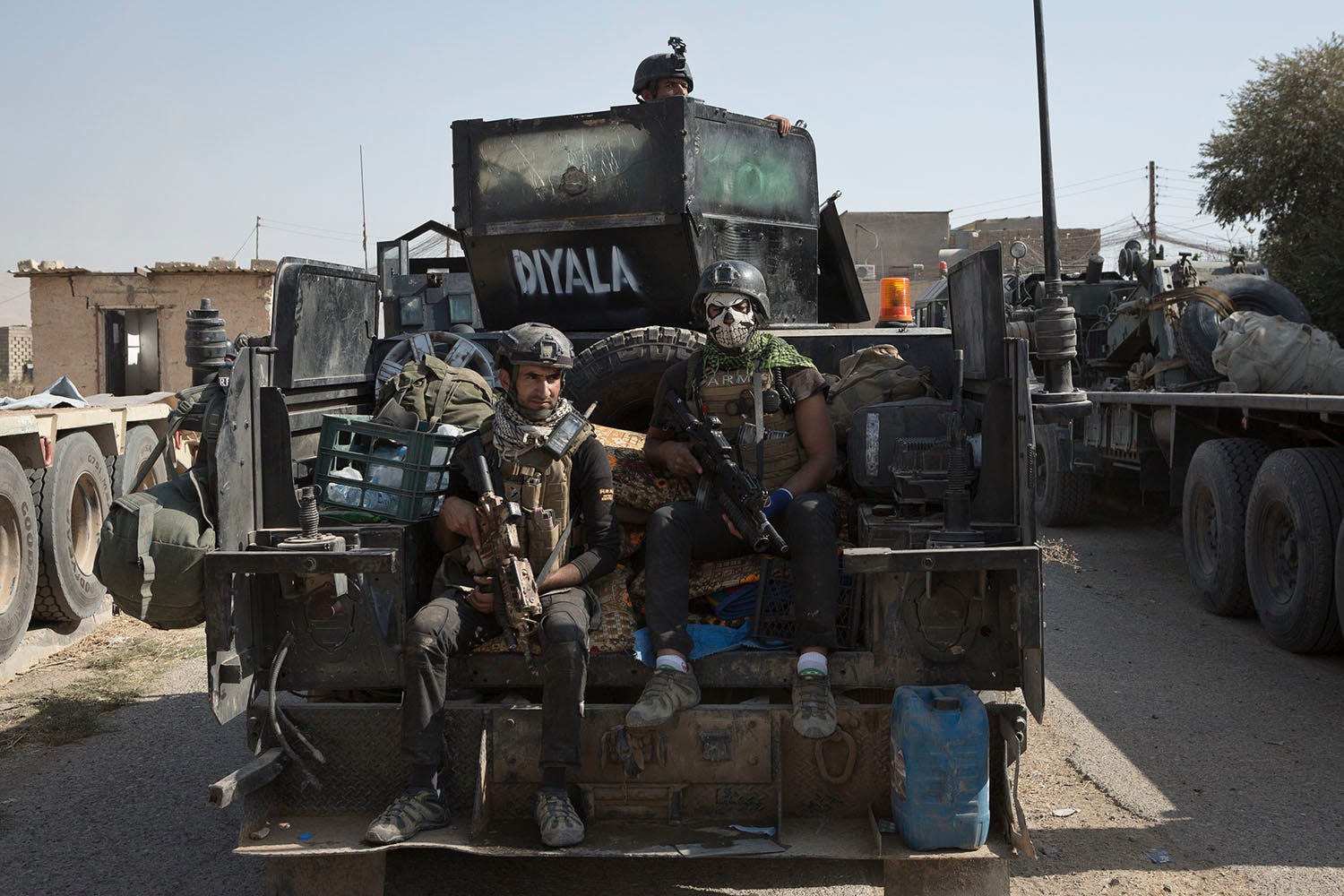
Golden Brigade soldiers travel through Bartella on the back of an armored Humvee. Matt Cetti-Roberts photo
On Oct. 21, 2016, the Golden Brigade, one of Iraq’s elite special operations units, recaptured Bartella. Islamic State fighters took over the town as they pushed into the Nineveh plains in August 2014. At that time, approximately 30,000 Iraqis lived here, mainly Christians and Assyrians.
Situated on the main highway between Erbil and Mosul, Bartella is a strategic point. On Oct. 17, 2016, the Iraqi Army’s started down the route as part of a multi-pronged push towards Islamic State’s de facto capital in the country.
This marking on the door of a former Islamic State headquarters warns troops there is an improvised bomb inside. Matt Cetti-Roberts photo
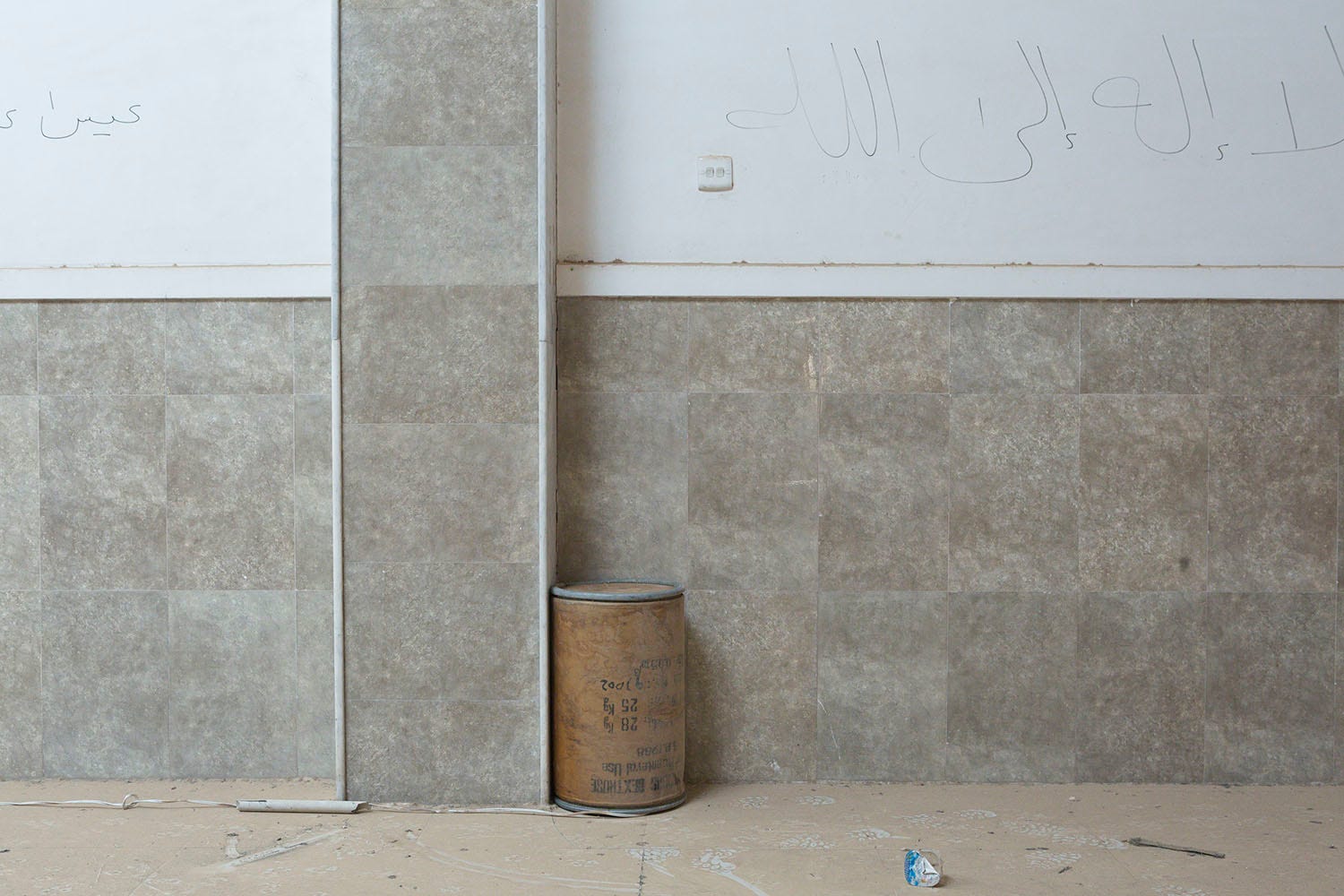
The Golden Brigade found that two years of Islamic State occupation were not kind to Bartella. Many streets are full of rubble and overgrown weeds. We see the occasional burned-out shop and a lot of militant graffiti.
Right now, the town is still a front line. Before residents can return and rebuild, someone will have to remove hundreds of improvised explosive devices and other dangerous ordnance the extremists left behind.
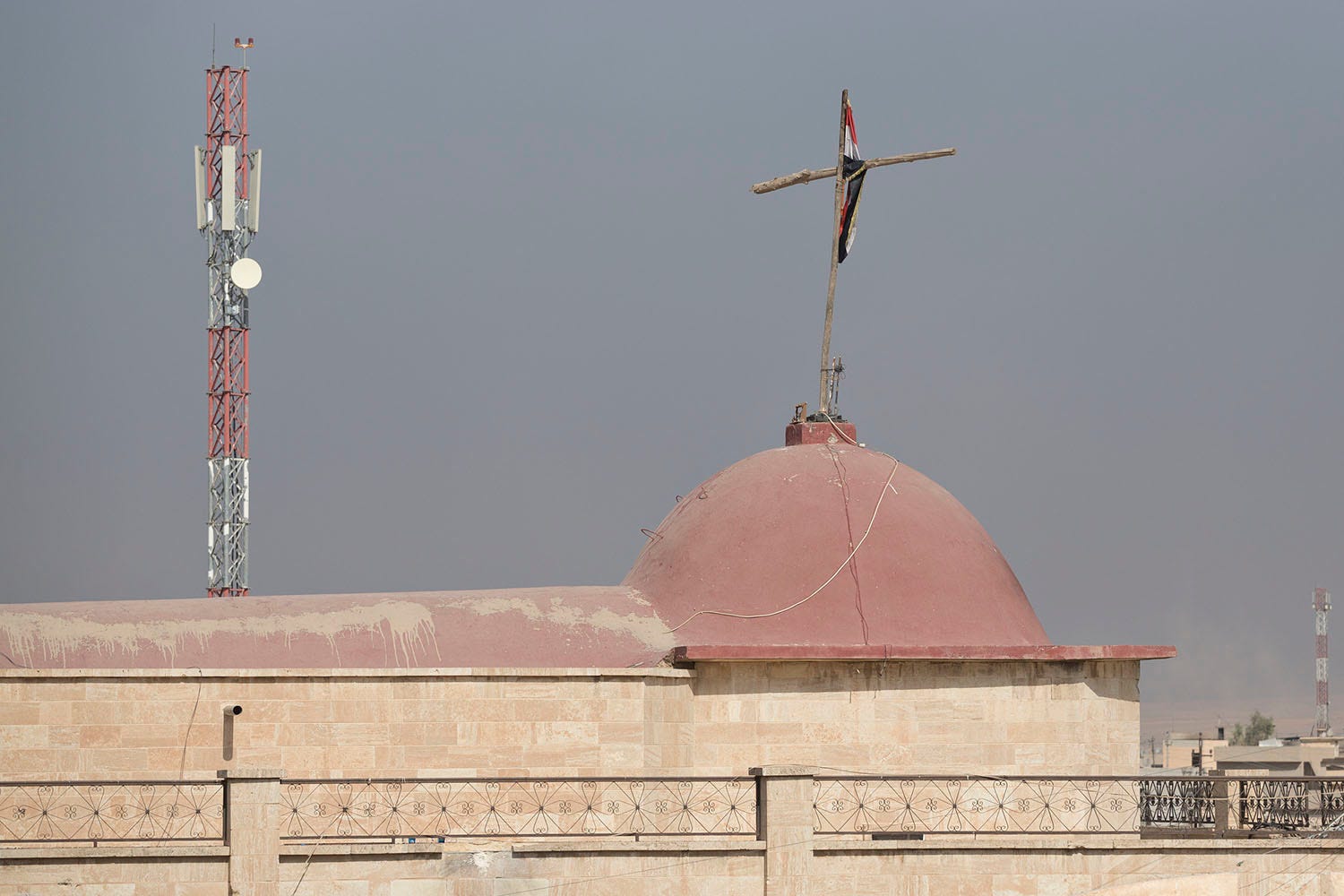
Iraqi soldiers put up this Christian cross after retaking Bartella, a now routine practice after liberating Christian and Assyrian towns. Matt Cetti-Roberts photo
Beyond Bartella, in other parts of the Nineveh Governorate, the Iraqi Army and Kurdish Peshmerga have gradually retaken more ground from Islamic State. Christian and Assyrian militias contributed to some of the operations.
Many of these local troops escaped just before the extremists arrived. Some fled Mosul after militants demanded non-Muslims convert to Islam, pay a tax or suffer execution.
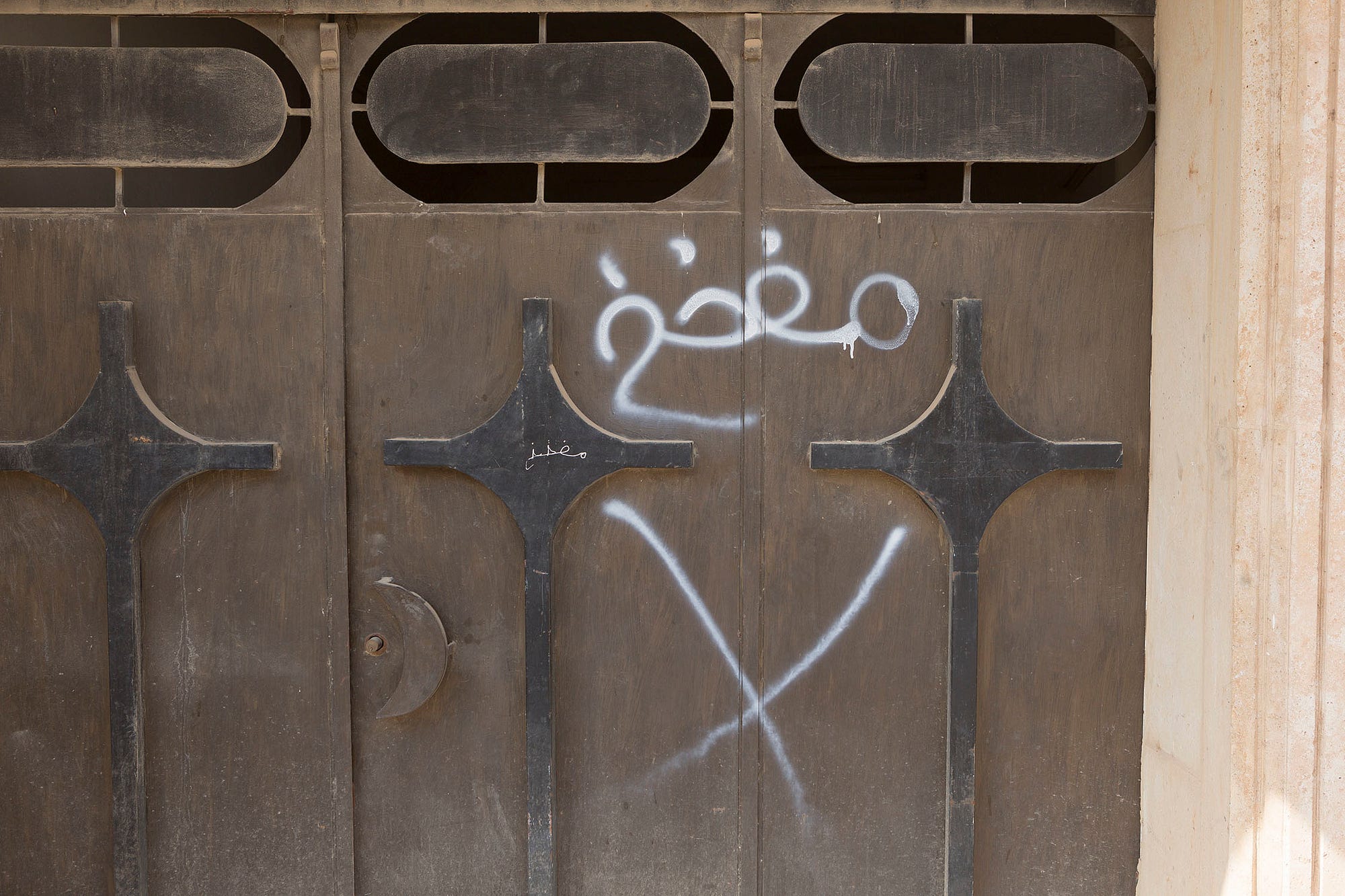
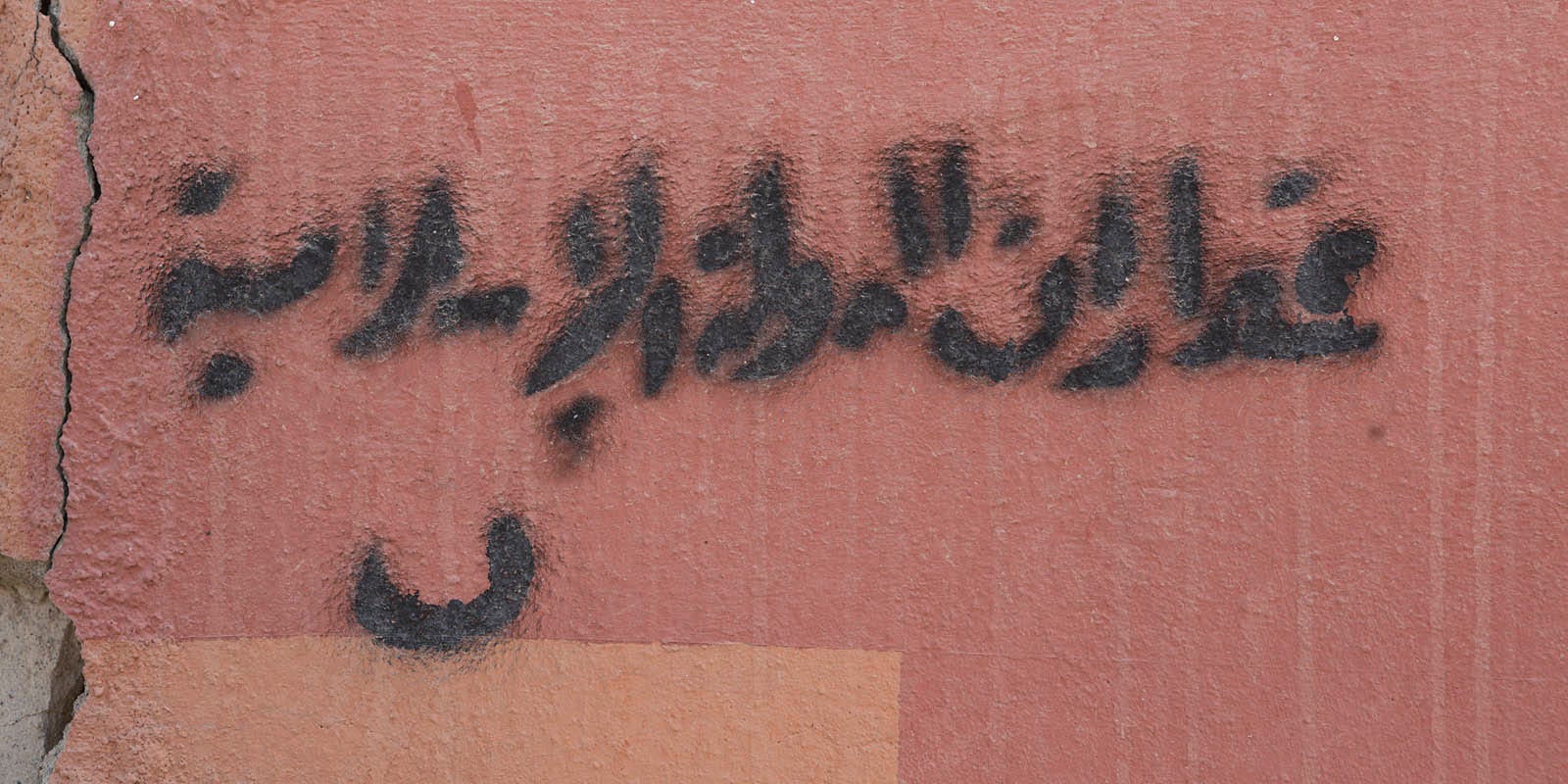
This stencil says the house is property of Islamic State. Below is the Arabic letter “nun,” which militants used to mark Christian or Assyrian homes. Matt Cetti-Roberts photo
After seizing Bartella and other towns, Islamic State disparagingly branded non-Muslim homes with the Arabic letter nun. In some passages, the Koran refers to Christians as Nasarah, or inhabitants of Nazareth, the birthplace of Jesus Christ. The symbol is reminiscent of the Nazis marking Jews with a yellow Star of David.
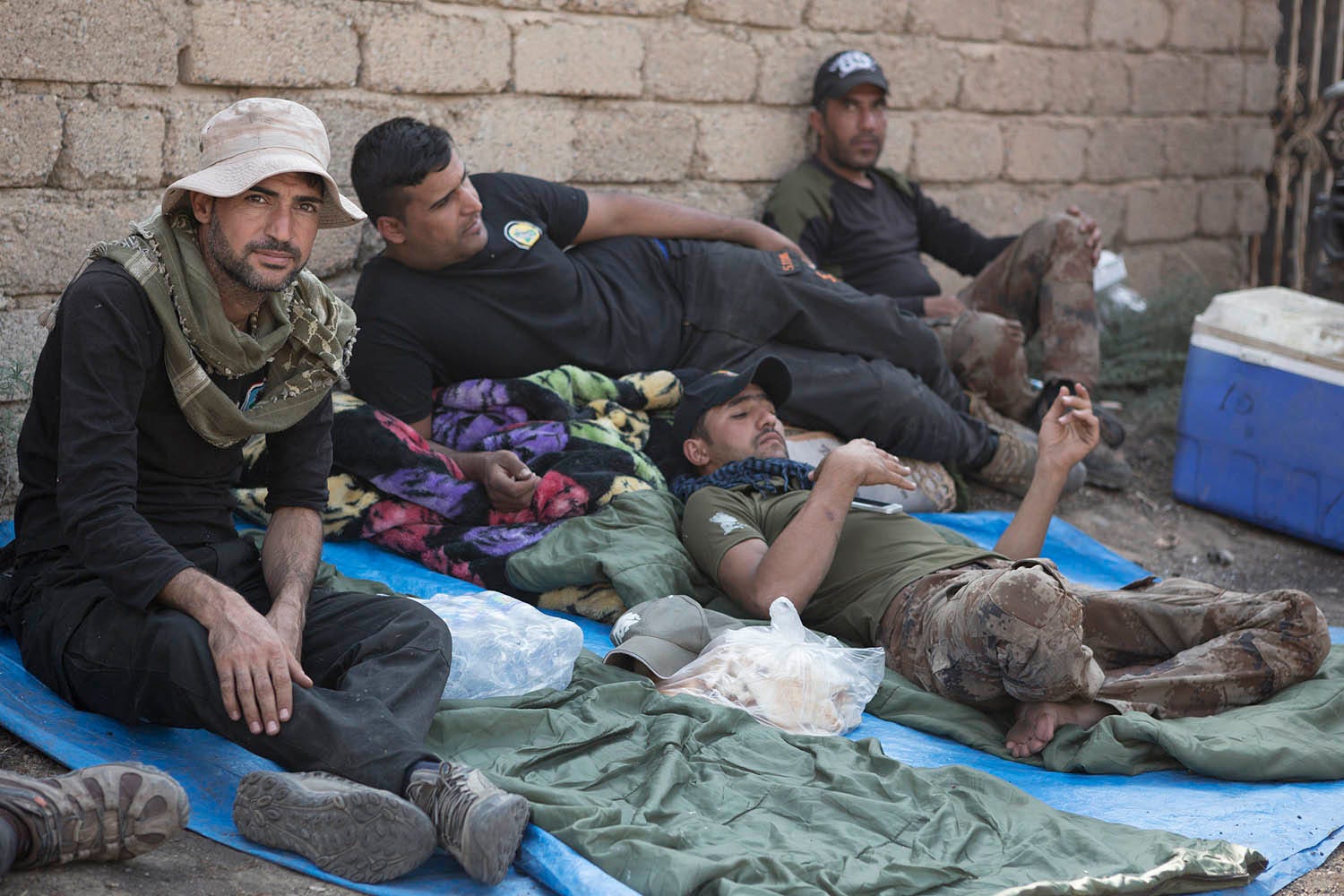
Golden Brigade soldiers relax in the shade. Matt Cetti-Roberts photo
During War Is Boring’s visit to Bartella, some of the Golden Brigade troops were resting, while others were still clearing portions of the town. Soldiers mentioned a militant appeared that morning, shot at their comrades and then disappeared.
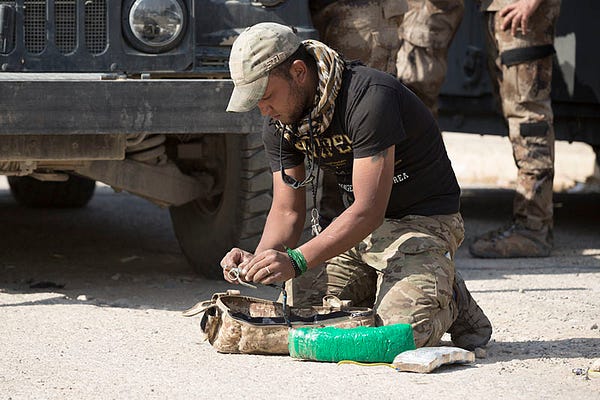
An Iraqi Army engineer deals with a discarded suicide belt. Matt Cetti-Roberts photo
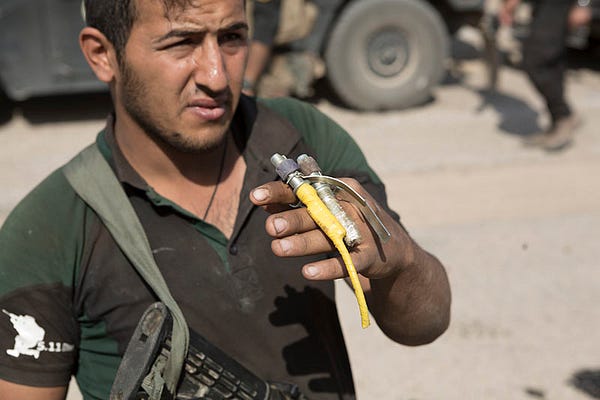
Islamic State hid improvised bombs throughout Bartella. Trying to advance quickly toward Mosul, the Iraqi Army couldn’t stop to disarm all of the devices. Someone else will have to clear the rest out later.
Iraqi Army engineers disarmed this improvised explosive device inside Bartella’s Mart Shmony Church. Matt Cetti-Roberts photo
Although rigged with explosives, Islamic State left the Mart Shmony Church standing as the Golden Brigade approached Bartella. Despite the well-publicized demolition of churches in Mosul, the terrorists used this Christian house of worship for their own purposes.
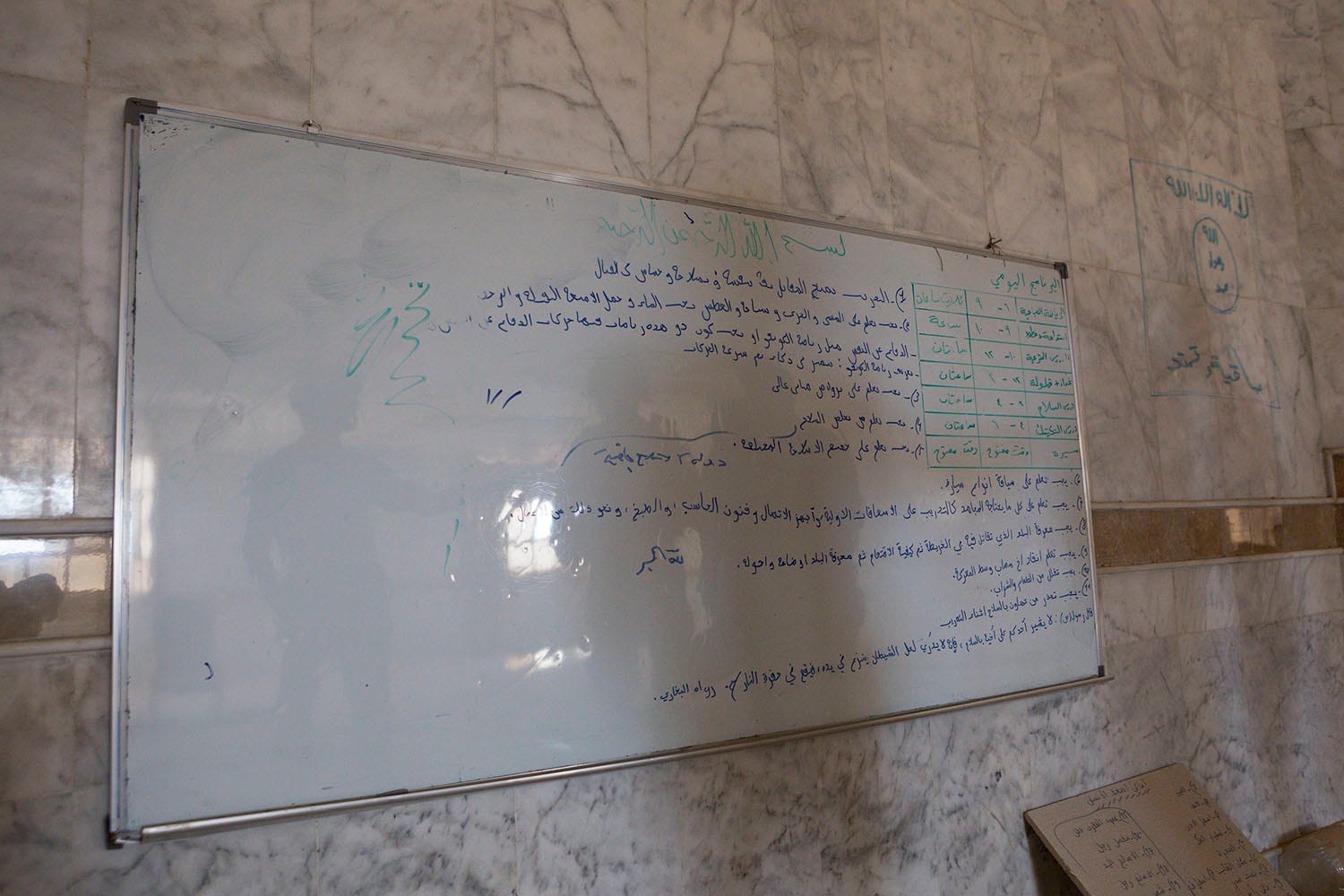
A list of banal tasks for ISIS fighters on a whiteboard in the Mart Shmony Church. Matt Cetti-Roberts photo
Empty ammunition boxes, stripper clips and bandoliers lie on a floor of the Mart Shmony Church. Matt Cetti-Roberts photo
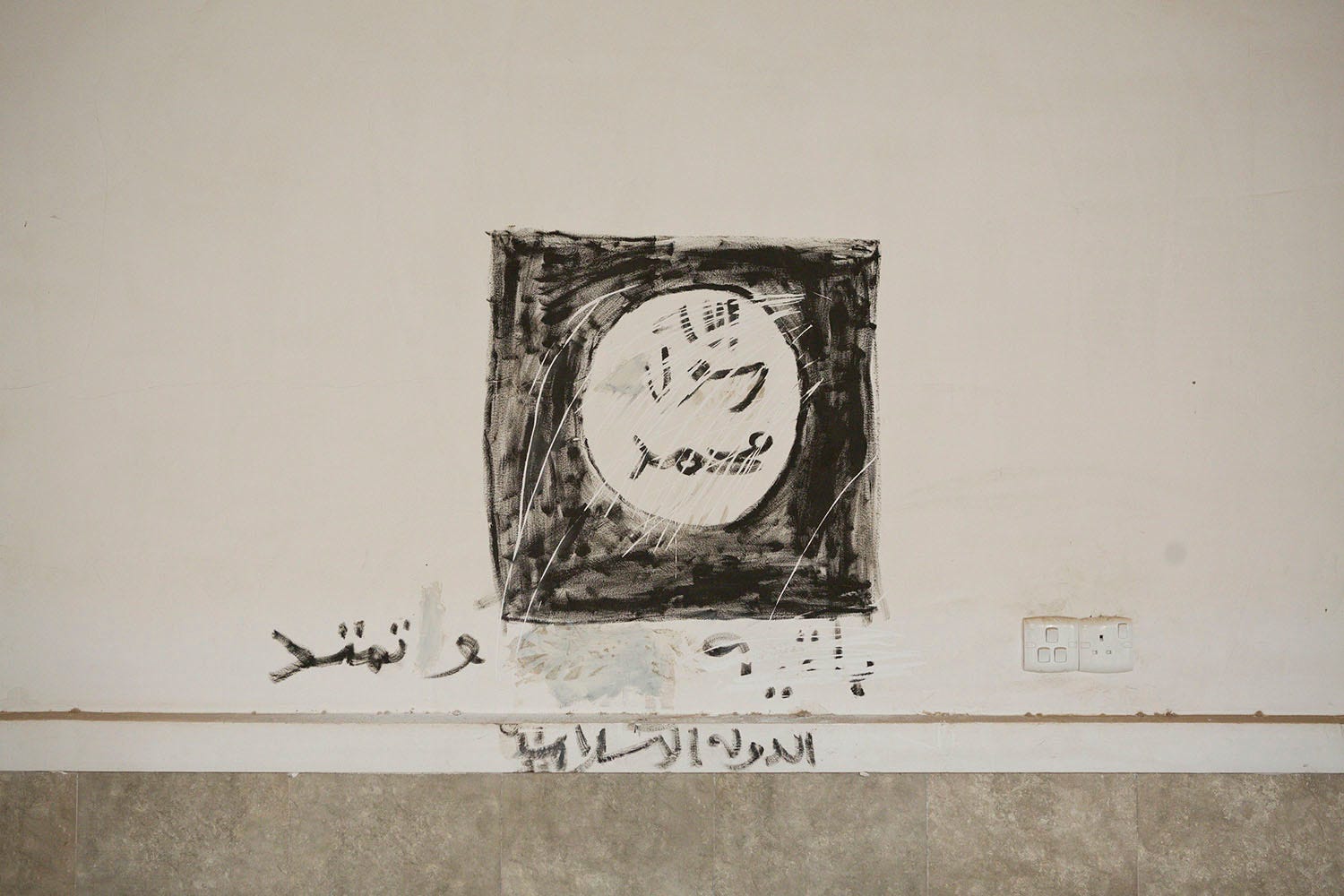
Militants drew this flag on a wall of the Mart Shmony Church. After Iraqi troops liberated the town, someone came hit it with a boot as an insult. Matt Cetti-Roberts photo
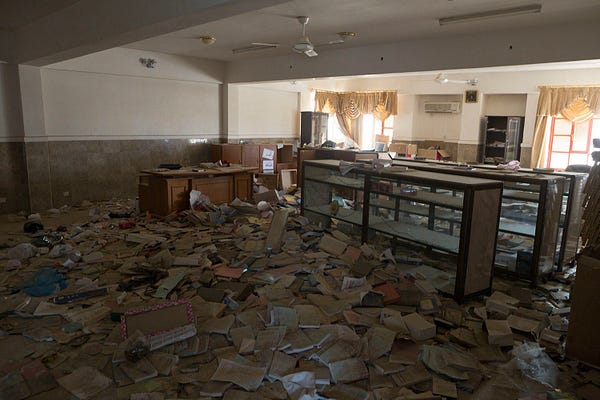
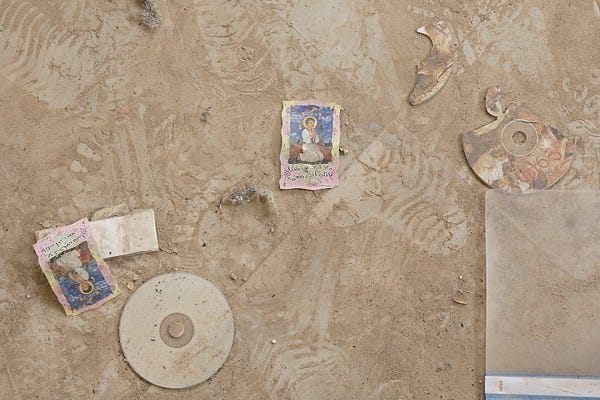
A Christian card saying “Do not be afraid, I am with you” lies on a tiled floor outside the ransacked library. Matt Cetti-Roberts photo
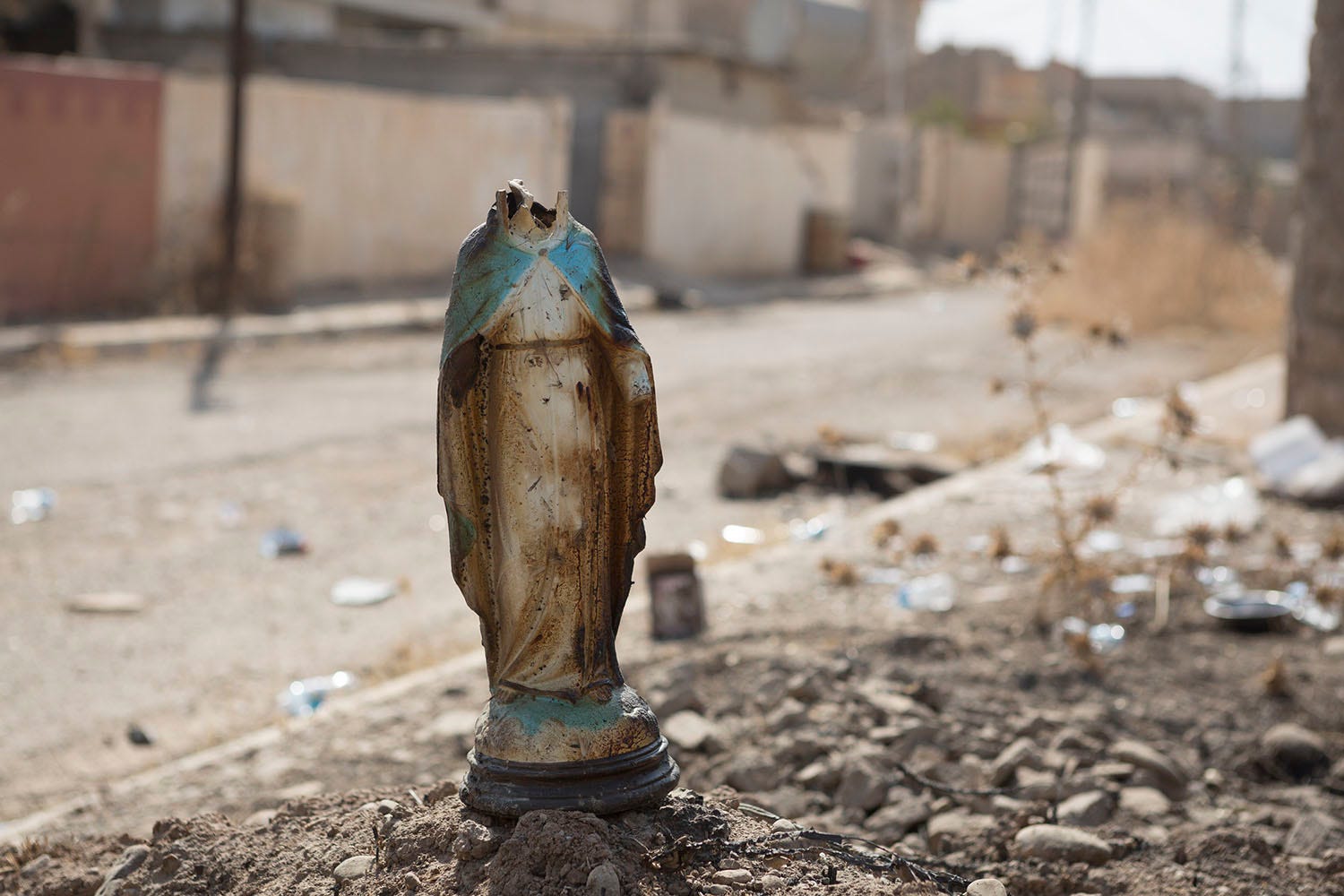
A Golden Brigade stands near a defaced statue in Bartella. Matt Cetti-Roberts photo
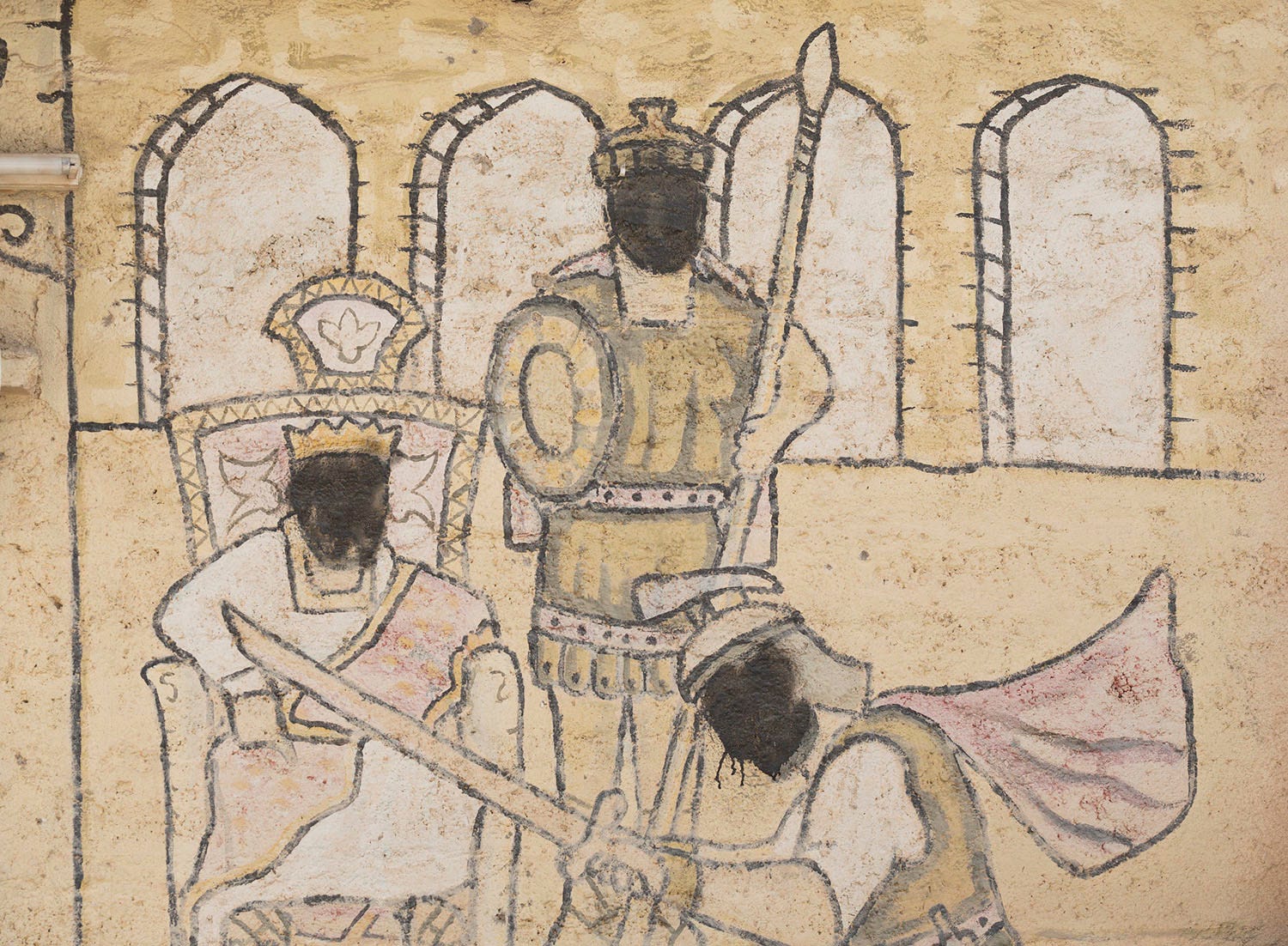
Islamic State fighters blotted out the faces on this Christian mural. Matt Cetti-Roberts photo
While in control of Bartella, Islamic State fighters defaced numerous statues, murals and other depictions of non-Muslim figures. The extremist group claimed these icons were an affront to their puritanical, exclusionary beliefs.
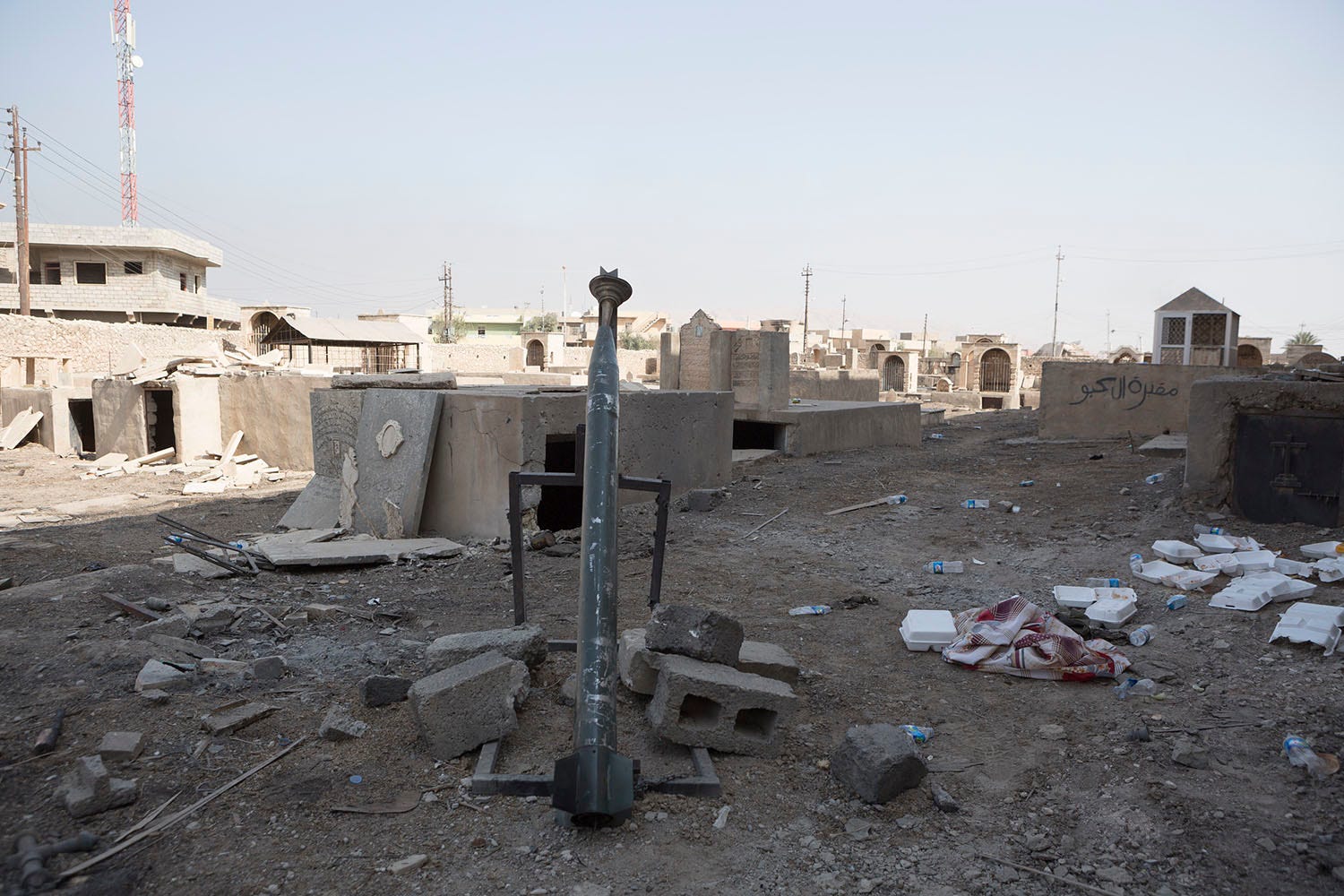
One of Islamic State’s home-built rocket sits abandoned in a graveyard attached to the Mart Shmony Church. Matt Cetti-Roberts photo
The militants also smashed Christian gravestones and vandalized parts of the church.
A Christian flag hangs in the chapel of the Mart Shmony Church on the day that high ranking priests were due to arrive for the first time since August 2014. Matt Cetti-Roberts photo
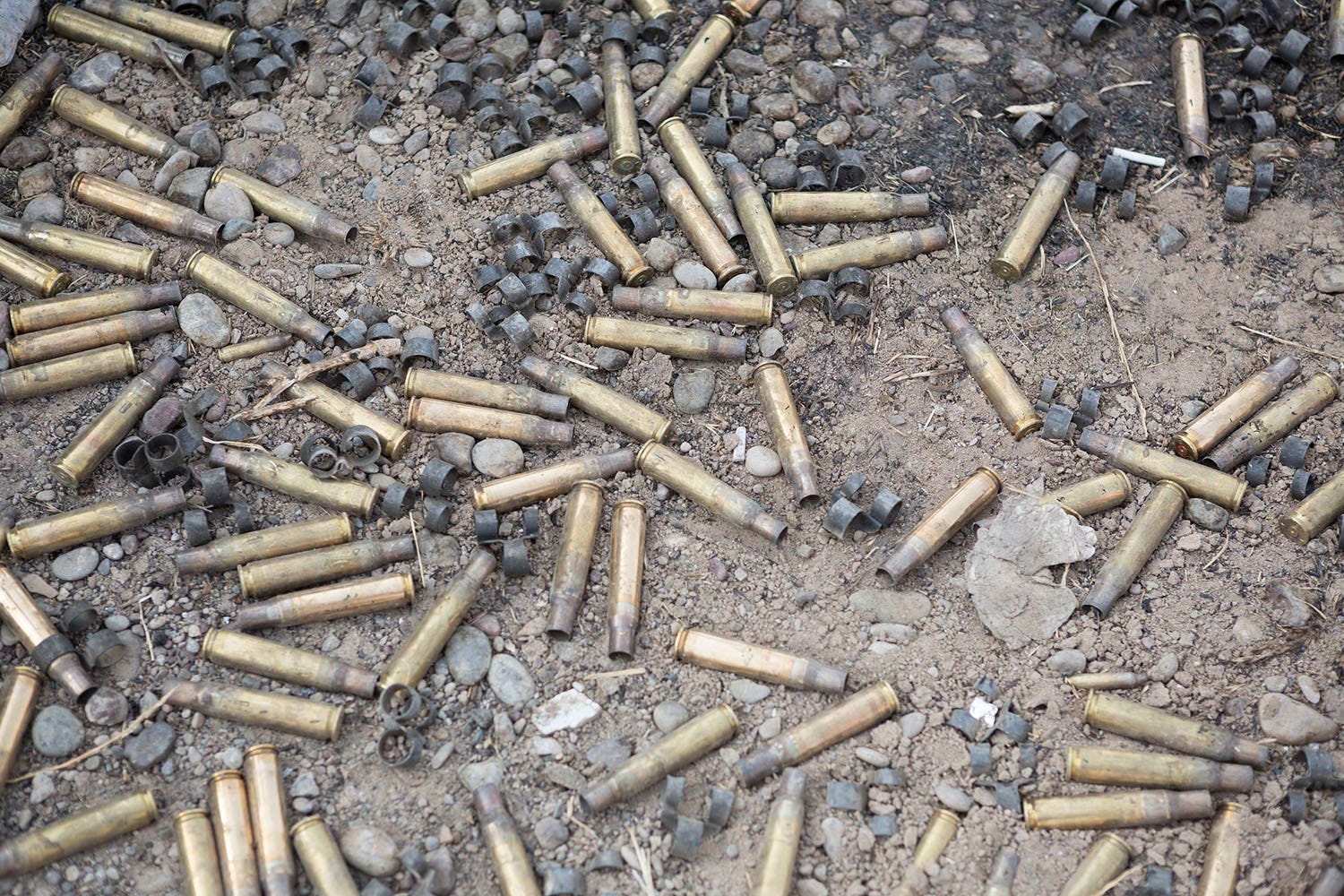
Empty shell cases and machine gun belt links litter the ground inside Bartella. Matt Cetti-Roberts
The Iraqi Army’s fight for the town and the surrounding area was not easy. Although we don’t have official casualty figures, Golden Brigade soldiers mentioned comrades who died in the battle.
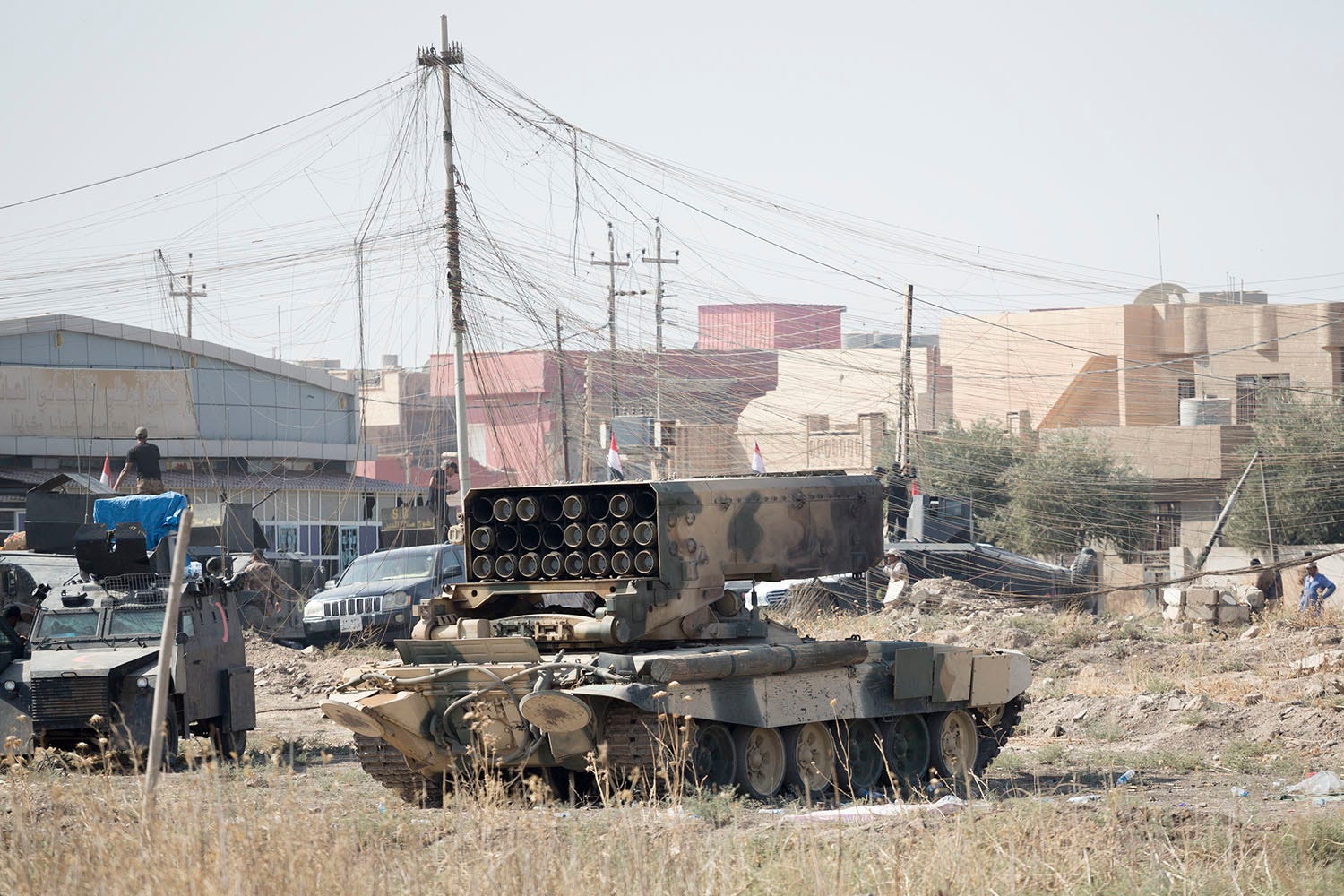
This TOS-1 thermobaric rocket launcher in Bartella is ready to support the Iraqi Army push on toward Mosul. Matt Cetti-Roberts
Beheaded by extremists, this statue depicting the Virgin Mary perches on a dirt pile where it was placed by Iraqi soldiers. Matt Cetti-Roberts
The deserted main street of what was once Bartella’s bazaar. Matt Cetti-Roberts
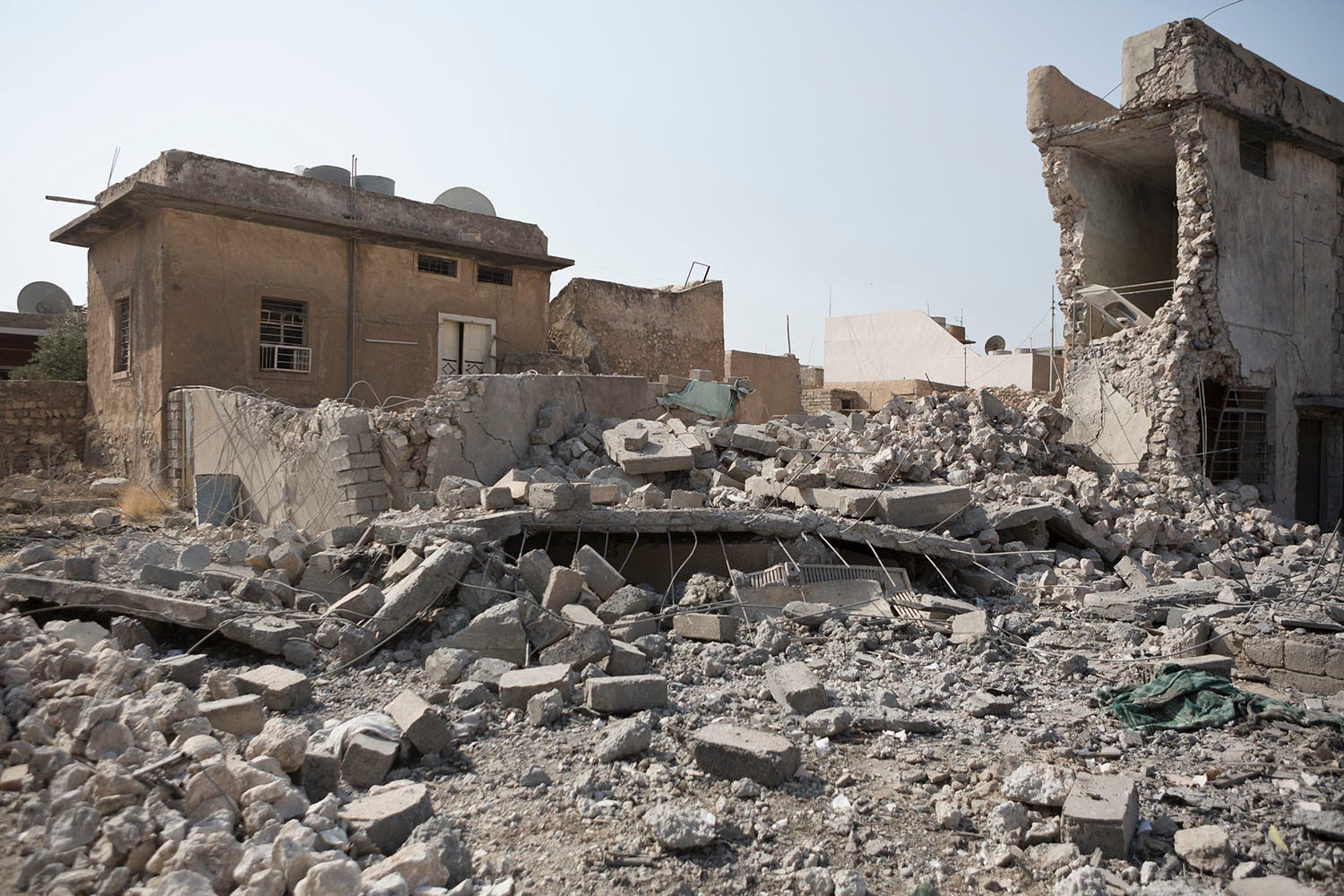
It’s hard to work out how much damage militants wrought on Bartella before the Iraqi Army arrived to liberate the town. In spite of the fighting, most houses seem intact.
The resting place of an Islamic State fighter. His severed foot was out in the street. Matt Cetti-Roberts
Still, when we visited Bartella, the aftermath of battle was obvious. Pieces of clothing poked from under nearby rubble.
The remains of a body is in there somewhere, but no one is in a hurry to bury it. For now, the remains will mark the spot where the coalition hit its mark.
The smell in certain parts of town hints at more corpses hidden in the debris. When the front line has moved far enough beyond Bartella, troops will clear the bodies and bombs Islamic State abandoned in the city.
Only then will the town be ready for its displaced residents to return and begin again.
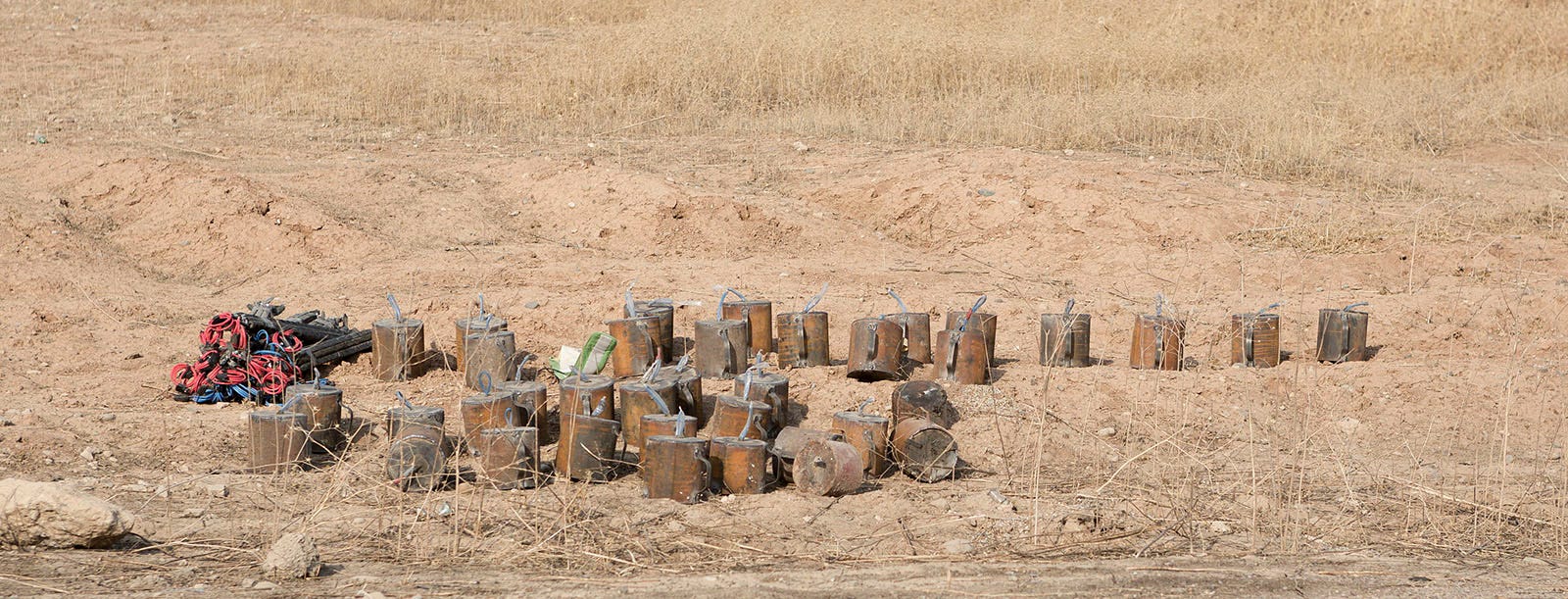
Defused improvised explosive devices sit by the side of highway from Erbil to Mosul. Matt Cetti-Roberts
****
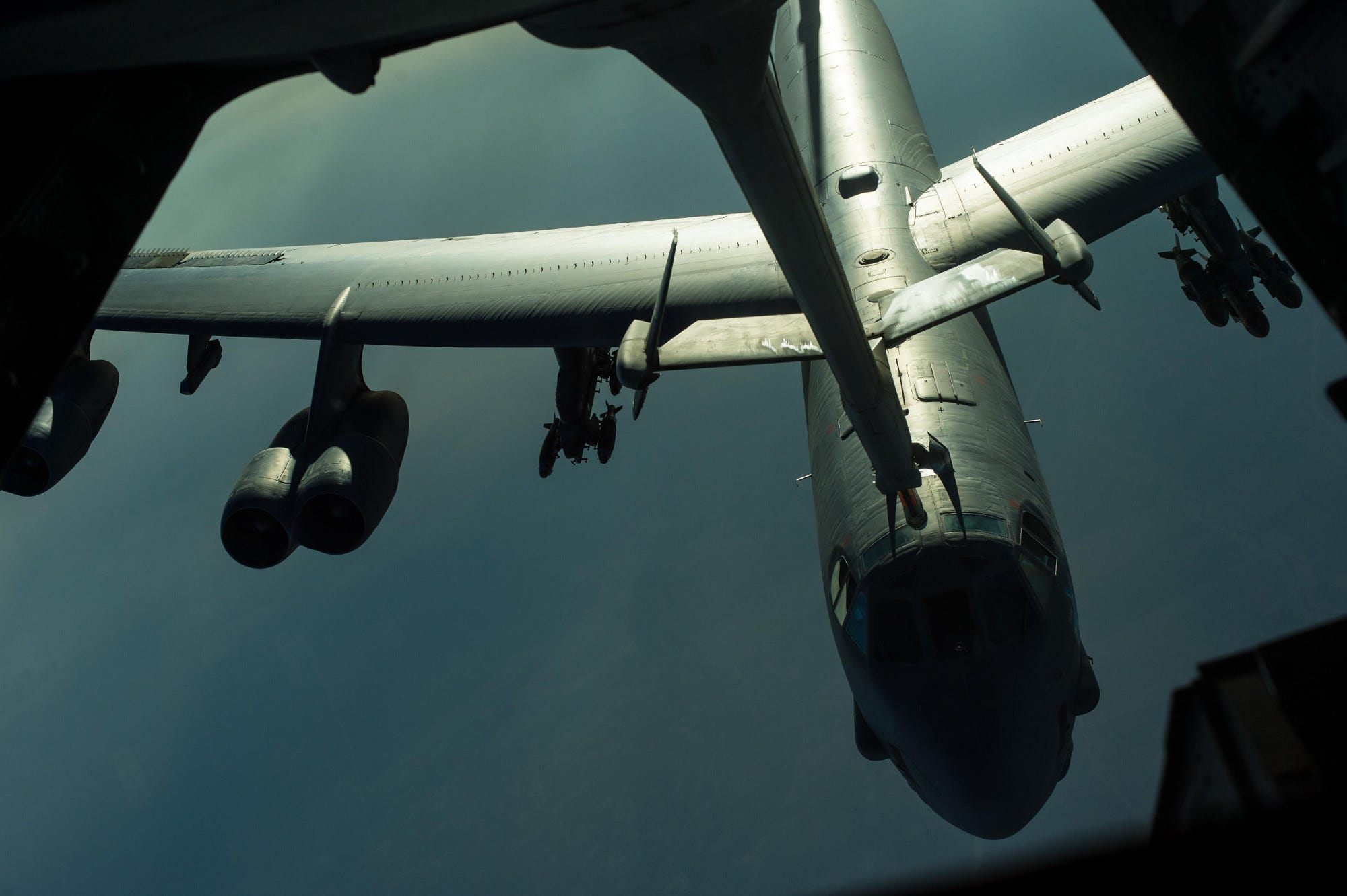
A B-52 bomber refuels during a mission over Mosul in October 2016. U.S. Air Force photo
U.S. Military Blasts Islamic State’s Tunnels in Mosul
But getting at underground networks from the air is difficult
by JOSEPH TREVITHICK
WiB: On Oct. 17, 2016, Iraqi troops and Kurdish Peshmerga fighters — backed by American and other foreign forces — began to liberate Mosul and its surrounding environs from Islamic State. The offensive quickly uncovered extensive terrorist tunnels in the city.
The Pentagon responded by blasting the underground network for the sky.
“Many of you have seen and noted the enemy’s developed extensive tunneling networks in some of the areas that they use for tactical movement and to hide weapons,” U.S. Air Force Col. John Dorrian, a Pentagon spokesman, told reporters on Oct. 28, 2016.
In total, American strikes destroyed “46 of those tunnels since the liberation battle for Mosul started on October 17th, reducing the threat from a favored enemy tactic.”
However, despite decades of experience, destroying below-ground linkages from the air is still difficult, especially in areas full of innocent civilians. According to the U.S. Air Force, American planes didn’t drop any bunker busting bombs during these missions.
“The BLU-118, BLU-121 or BLU-122 warheads or the GBU-57 Massive Ordnance Penetrator have not been used in the Liberation of Mosul campaign,” Kiley Dougherty, the head of media operations for U.S. Air Force’s Central Command told War Is Boring by email. “ In fact, these weapons have not been used at all in support of Operation Inherent Resolve.”
Inherent Resolve is the Pentagon’s nickname for the campaign against Islamic State in Iraq and Syria.
The Mosul operation is not the Pentagon’s first experience with tunnels. During the Vietnam War, the Viet Cong insurgents famously dug wide-ranging subterranean mazes throughout South Vietnam.
In the 1970s, North Korea dug at least four large tunnels under the Demilitarized Zone to sneak spies and commandos into the South. The top American command on the peninsula created a “tunnel neutralization team” to assess and seal the passages.
Underground bunkers and cave complexes were features in the first Gulf War in 1991, the intervention in Afghanistan in 2001 and the invasion of Iraq in 2003. The Pentagon has taken note of Egyptian and Israeli efforts to stop Palestinian and other militants from digging under their borders.
In December 2001, the American commandos famously tried to flush out Osama Bin Laden and his cohorts from the Tora Bora caves near the Afghanistan-Pakistan border. Massive B-52 bombers pounded the mountains, but could only keep the terrorists hunkered down.
“Entire lines of defense were immolated by cascades of precisely directed 2,000-lb. bombs,” U.S. Army historians wrote in 2005. “But the depths of the caves and extremes of relief limited their effectiveness considerably.”
Air Force MC-130 special operations transports dropped 15,000 pound “Daisy Cutter” bombs, but couldn’t uproot the militants. The Al Qaeda leader eventually slipped across the border to settle near the Pakistani city of Abbottabad.
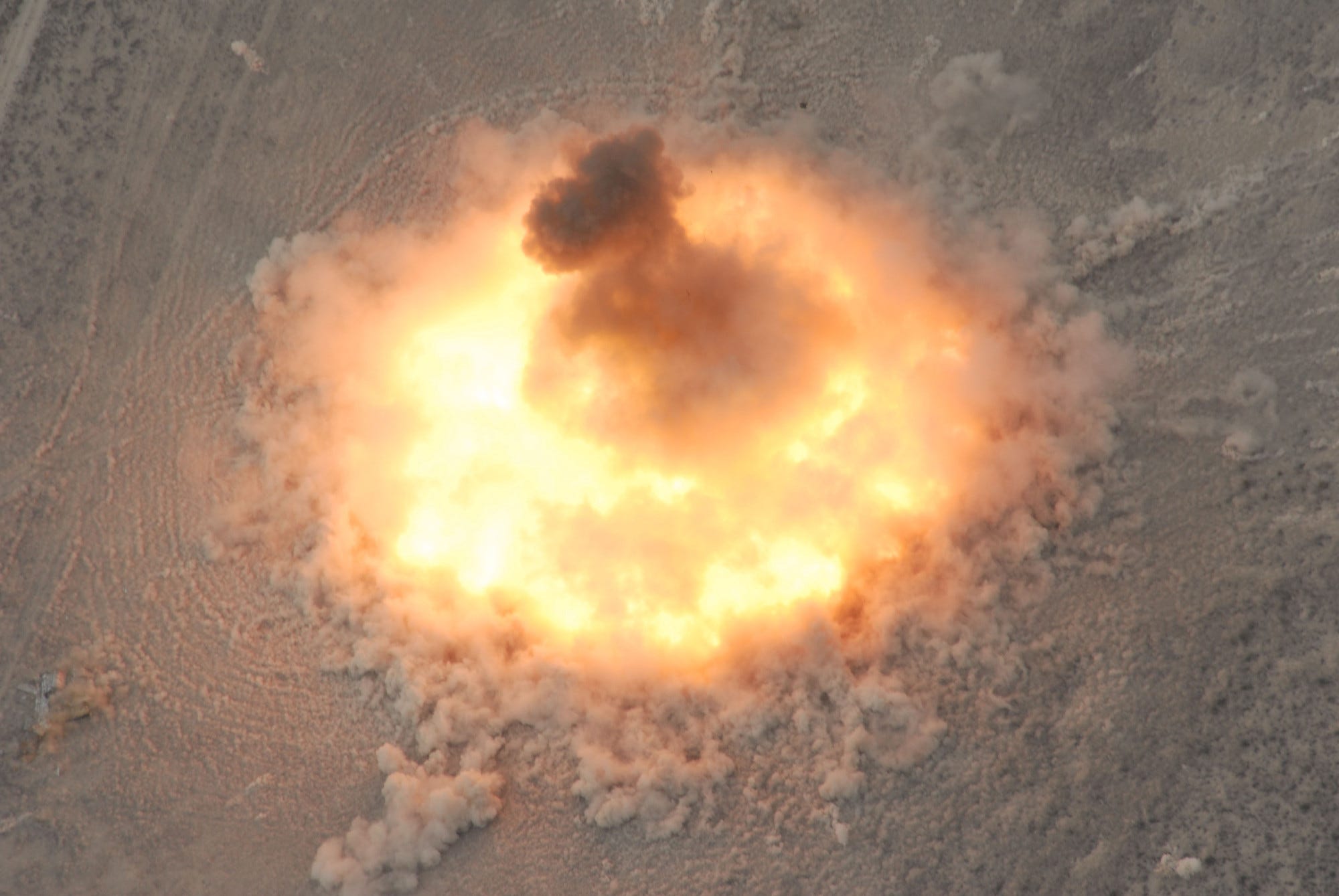
The last Daisy Cutter bomb explodes on a training range in Utah in 2008. U.S. Air Force photo
Within two years, the Pentagon had flown similar missions in Iraq. Despite the bombardment, on Dec. 13, 2003, a team of regular and elite U.S. troops found long-time Iraqi dictator Saddam Hussein very much alive in a makeshift bunker outside the city of Tikrit.
By November 2015, tunnels again appeared as a factor in the fight against Islamic State. Faced with deadly American air strikes, the terrorists had literally gone to ground.
“In November 2015, when Kurdish forces entered Sinjar, Iraq, … they found that ISIL had adapted to air attacks by building a network of tunnels that connected houses,” U.S. Army analysts explained in a February 2016 report, using a common acronym for Islamic State.
“The sandbagged tunnels, about the height of a person, contained ammunition, prescription drugs, blankets, electrical wires leading to fans and lights, and other supplies.”
War Is Boring obtained this and other Army reviews of enemy tactics through the Freedom of Information Act.
But by the time the terrorist tunnels became an issue in Iraq and Syria, the U.S. Air Force had replaced the Vietnam-era Daisy Cutters. Instead, American crews had access to a number of newer specialized bombs.
Shortly after the Tora Bora debacle, American fliers received the first BLU-118s. Pentagon weaponeers cooked up the 2,000 pound thermobaric bombs specifically to blow up caves and tunnels.
Thermobaric warheads create massive, fireball-like explosions. If you can get one into a bunker or other confined space, the blast will bounce off the walls for an even more devastating effect.
In 2005, the Pentagon bought improved BLU-121s with a new delay fuze. This meant the bomb could bury itself deeper inside a tunnel before going off, causing maximum damage. Crews can fit both weapons with laser guidance kits for precise attacks.
And then there are bunker-busters such as the BLU-122 and GBU-57. These bombs have specialized features to break through reinforced sites, deep underground. Only the B-52 and B-2 bombers can carry the 30,000 pound Massive Ordnance Penetrator.
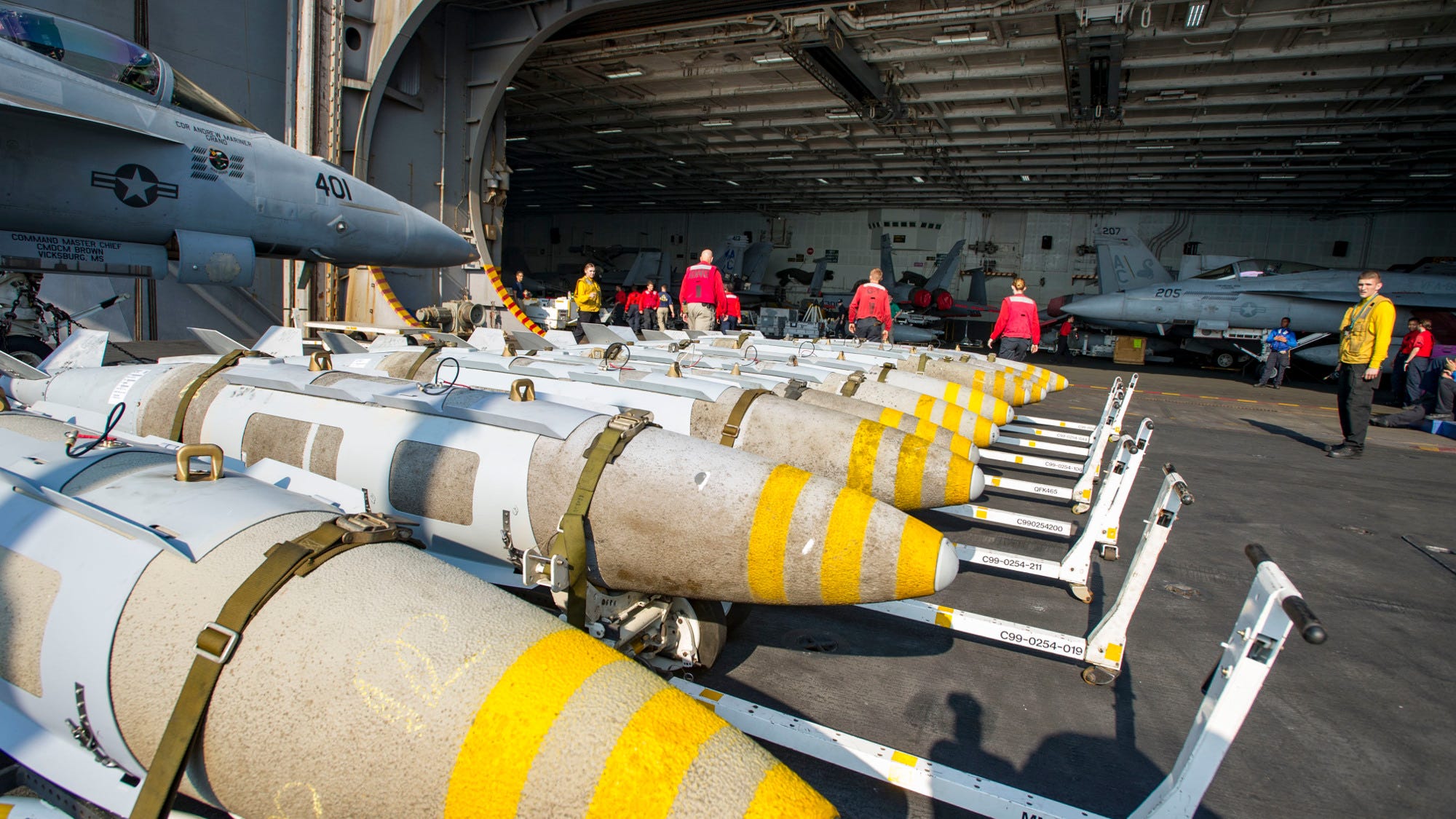
Sailors on the carrier USS ‘Dwight D. Eisenhower’ prepare bombs for strikes on Islamic State in October 2016. U.S. Navy photo
All of these weapons are great for attacking remote caves or isolated, underground military bases. They’re not necessarily good for attacking small tunnels in urban areas.
Even out in the open, fliers generally need powerful sensors or help from troops on the ground just to spot subterranean sites from the air. Though laser and GPS-guided bombs can strike within feet of a specific target, tunnel entrances might not be much larger than a person’s shoulders.
On top of that, in a densely packed city, any errant bombs have a greater chance of hitting unintended targets. A tunnel network under a house or apartment block presents a particularly problematic situation.
Add a thermobaric warhead to the mix and the results could be even more disastrous. There are reports Islamic State turned to human shields to ward off air strikes and Baghdad’s own thermobaric rocket launchers and artillery.
“We have seen many instances in the past where Daesh have used human shields in order to try and facilitate their escape,” Dorrian noted in his press conference. “Right now they’re using human shields to make the Iraqi Security Forces’ advance more difficult.”
The Pentagon would have run into similar hurdles when hitting the terror group’s tunnels in Mosul. By using conventional bombs, American crews might have had a harder time hitting the mark, but could better avoid unnecessary collateral damage. At the same time, this dynamic no doubt serves to reinforce the value of tunnel networks to the Islamic State.
And any assault on the group’s de facto Syrian capital in Raqqa will likely turn up more tunnels.
“Over time, adversaries of the U.S. and its allies have repeatedly shown that they are extremely adept at their use of this type of environment,” U.S. Army experts declared in a review of Hezbollah’s use of tunnels during Israel’s incursion into Lebanon in 2006.
“[This] consequently presents a situation in which, despite the U.S.’s technological superiorities, a threat could potentially gain an advantage over the U.S. and achieve victory.”
Thankfully, so far, Islamic State’s tunnels have only delayed Baghdad’s troops and their American partners.
NEW DIRECTION: John Brennan at a Senate Intelligence Committee hearing on his nomination to be the director of the CIA in 2013. Brennan has restructured the agency to REUTERS/Jason Reed
The CIA director has put the U.S. spy agency through a historic restructuring to cope with the era of digital warfare. Many in the agency are unhappy with the shake-up. In a series of interviews, Brennan outlines his strategy. “I think CIA really needs to up its game.”
ReutersInvestigates:WASHINGTON – When America goes to the polls on Nov. 8, according to current and former U.S. intelligence officials, it will likely experience the culmination of a new form of information war.
A months-long campaign backed by the Russian government to undermine the credibility of the U.S. presidential election – through hacking, cyber attacks and disinformation campaigns – is likely to peak on voting day, the officials said.
Russian officials deny any such effort. But current and former U.S. officials warn that hackers could post fictional evidence online of widespread voter fraud, slow the Internet to a crawl through cyber attacks and release a final tranche of hacked emails, including some that could be doctored.
“Don’t underestimate what they can do or will do. We have to be prepared,” said Leon Panetta, who served as CIA director and defense secretary in President Barack Obama’s first term. “In some ways, they are succeeding at disrupting our process. Until they pay a price, they will keep doing it.”
John Brennan, the current CIA director, declined to comment on the Russian efforts. But he said Russian intelligence operatives have a long history of marrying traditional espionage with advances in technology. More broadly, Brennan said, the digital age creates enormous opportunities for espionage. But it also creates vulnerabilities.
Citing an array of new cyber, conventional and terrorist threats, Brennan announced the most sweeping reforms of the CIA in its 69-year history 18 months ago.
Weakening the role of the Directorate of Operations, the agency’s long-dominant arm responsible for gathering intelligence and conducting covert operations, Brennan created 10 new “mission centers” where CIA spies, analysts and hackers work together in teams focused on specific regions and issues. He also created a new Directorate for Digital Innovation to maximize the agency’s use of technology, data analytics and online spying.
The information age “has totally transformed the way we are able to operate and need to operate,” Brennan told Reuters in a series of interviews. “Most human interactions take place in that digital domain. So the intelligence profession needs to flourish in that domain. It cannot avoid it.”
When a new American diplomat arrives for duty at the U.S. embassy in Moscow or Beijing, CIA official say, Russian and Chinese intelligence operatives run data analytics programs that check the “digital dust” associated with his or her name. If the newcomer’s footprint in that dust – social media posts, cell phone calls, debit card payments – is too small, the “diplomat” is flagged as an undercover CIA officer.
The Russian-backed campaign to discredit the U.S. election is not isolated. Hackers believed to have links to Chinese intelligence began stealing the personal information of 22 million federal employees and job applicants in 2014, the worst known data breach in U.S. government history. Islamic State’s online propagandists continue to inspire lone wolf attacks in the United States even as the group loses territory.
A senior official from the Directorate of Operations, who backs the shake-up, said the agency is experiencing its greatest test in decades.
“The amount of threats and challenges that are facing this organization and this nation are greater than at any time in the last 30 years,” said the official, who declined to be named. “The days of a black passport, a fistful of dollars and a Browning pistol are over.”
INNER CIRCLE: President Barack Obama with Brennan and Chief of Staff Denis McDonough at the White House in 2013. The president and the CIA chief are criticized by some former agents for being overly cautious in Syria, Russia and elsewhere. Courtesy Pete Souza/The White House/Handout via REUTERS
“Most human interactions take place in that digital domain. So the intelligence profession needs to flourish in that domain. It cannot avoid it.”
James Clapper, the Director of National Intelligence, praised Brennan and his efforts to retool the CIA for a new era in an interview. So did Lisa Monaco, Brennan’s successor as the President Obama’s Homeland Security and Counterterrorism adviser.
But some current and former officials question Brennan’s strategy, arguing his reforms are too digitally focused and will create a more cautious, top-heavy spy agency. At a time when the agency needs to refocus its efforts on human espionage, they say, the concentration of power in the new mission centers weakens the ability of the Directorate of Operations to produce a new generation of elite American spies.
The reforms have hurt morale, created confusion and consumed time and attention at a time of myriad threats, according to interviews with ten former officials.
Glenn Carle, a former CIA covert officer, supports Brennan and his reforms but said they have sparked a mixed reaction among directorate of operations officials who believe human intelligence is getting short shrift.
“The value the CIA can fundamentally add is to steal secrets, and the ultimate secret is intention,” the often inscrutable aims of foreign leaders, Carle said. “Obtaining that is a human endeavor.”
At the same time, Brennan has stirred a different sort of criticism – that he has defied Congressional oversight. Liberal Democrats and libertarian Republicans in Congress say the Brennan-Obama tenure has been tarnished by a lack of transparency with congressional oversight committees and the public regarding surveillance, drone strikes and the agency’s use of torture against terrorism suspects during the administration of George W. Bush.
“While I think John’s overall legacy will be as a reformer, that legacy will suffer from his refusal to come to grips with the CIA’s troubled torture program,” said Senator Dianne Feinstein, D-Calif, vice chair of the Senate’s intelligence committee. “I think the new president’s CIA director must prioritize a high level of trust between the CIA and Congress to insure proper oversight is conducted.”
It’s unclear how closely the country’s next president will hew to Brennan’s strategy.
The front-runner, Democrat Hillary Clinton, has an incentive to beef up American cyber-espionage: U.S. intelligence officials blame the continuing leak of emails from her campaign on Russian-backed hacking. Clinton also expressed support for covert action in a transcript of a 2013 speech she gave to Goldman Sachs that was recently released by Wikileaks.
Republican Donald Trump, meanwhile, pledged to make cybersecurity a top priority in his administration in an October 3 speech. “For non-state terror actors, the United States must develop the ability – no matter how difficult – to track down and incapacitate those responsible and do it rapidly,” Trump said. “We should turn cyber warfare into one of our greatest weapons against the terrorists.”
In interviews at agency headquarters in Langley, Virginia, Brennan declined to comment on either candidate or discuss operational details of the CIA. But he and eight other senior CIA officials gave the most detailed description yet of their rationale for the most radical revamp of the agency since its founding in 1947.
“I look out at the next 10, 20, 30 years, and I look at technology, I look at complexity, I look at the global environment,” Brennan said. “I think CIA really needs to up its game.”
JUST-WAR THEORIST
Brennan, a 61-year-old native of north New Jersey, looks like a linebacker but talks like a technocrat. He speaks excitedly about how the CIA and other government bureaucracies can be configured in “a way to ensure optimal outcomes.”
The son of devout-Catholic Irish immigrants, Brennan speaks reverently of CIA officers as public servants who risk their lives without public accolades. He joined the agency in 1980, at the age of 24, after receiving a Master’s Degree in government with a concentration in Middle Eastern studies from the University of Texas.
“The value the CIA can fundamentally add is to steal secrets, and the ultimate secret is intention. Obtaining that is a human endeavor.”
Educated in various Catholic schools, including Fordham University, Brennan says he is an adherent of just war theory – a centuries-old Christian theological argument that war is justified when it is waged in self defense, as a last resort and minimizes civilian casualties. Those beliefs, he says, have guided him in one of the most controversial aspects of his tenure in the Obama administration.
As Obama’s White House counter-terrorism adviser and CIA director, Brennan played a central role in carrying out 473 U.S. airstrikes outside conventional war zones between 2009 and 2015, primarily by drone. U.S. officials estimate the attacks have killed 2,372 to 2,581 people, including 64 to 116 civilians. Human rights groups say the totals are vastly higher. Last year, for instance, a U.S. drone strike in Pakistan accidentally killed American aid worker Warren Weinstein and Italian aid worker Giovanni Lo Porto, who were both being held captive by al Qaeda.
Brennan declined to comment on specific strikes, but said, “I still can look myself in the mirror everyday and believe that I have tried to do what is morally right, what is necessary, and what is important to keep this country safe.” He also acknowledged mistakes.
“You question yourself. You beat yourself up. You try to learn from it,” Brennan said, in a rare display of emotions. “But you also recognize that if you’re not prepared to make the tough decisions in the jobs that have been entrusted to you, you shouldn’t be in those jobs.”
Today, Brennan says the United States faces the most complex array of threats he has seen since joining the agency 36 years ago. As a CIA analyst, operative and executive, he has lived through the Cold War espionage duels of the 1980s; the disintegration of nation-states after the 1989 fall of the Berlin Wall; the rise of non-state terrorist groups since 2001; and the current digital disruption. Now, he says, all four dynamics are converging at once.
BOLD AND INNOVATIVE RIVALS
CIA officials say their greatest state competitors are the Russian and Chinese intelligence services. While smaller countries or terrorist groups may want to strike at the United States, Russia and China are the only two adversaries with the combination of skills, resources and motivation needed to challenge Washington.
In recent years, Moscow’s Federal Security Service, or FSB, has become adept at waging “gray zone” conflicts in Ukraine, Crimea and Syria, the officials said. In all three countries, Russian intelligence operatives have deftly shrouded protagonists, objectives and war crimes in ambiguity.
GREAT RIVALS: U.S. President Barack Obama with his Chinese and Russian counterparts, Xi Jinping and Vladimir Putin, in Beijing in 2014. Washington has faced barrages of digital threats from Beijing and Moscow; CIA insiders say the two nations remain the biggest challenge for the United States. REUTERS/Pablo Martinez Monsivais
“You beat yourself up…. But you also recognize that if you’re not prepared to make the tough decisions in the jobs that have been entrusted to you, you shouldn’t be in those jobs.”
One target is America’s increasingly politically polarized democracy. As Russian-backed hacking unfolded this summer, the Obama White House’s response fueled frustration among law enforcement and intelligence officials, according to current and former officials. The administration, they said, seemed to have no clear policy for how to respond to a new form of information warfare with no rules, norms or, it seemed, limits.
White House officials said the administration is still considering various methods of responding, but the responses won’t necessarily be made public.
China presents another challenge. Chinese businessmen and students continue trying to scoop up American state and economic secrets. In one bright spot, Beijing appears to be abiding by a 2015 pact signed by Obama and Chinese leader Xi Jinping that the two governments would not conduct economic espionage against one another. Chinese hacking appears to have slowed from the voracious rate of the past, which included hacking into the computers of the 2008 presidential campaigns of John McCain and Barack Obama but not releasing what was found.
“The question is whether or not it is due to greater care in terms of covering one’s tracks,” Brennan said of the apparent change. “Or whether or not they realize that they’re brand is being tarnished by this very rapacious appetite for vacuuming up things.”
Regional powers are also increasing their digital espionage efforts.
In 2014, the Obama administration blamed North Korea for the hacking of Sony Pictures’ computer system. This spring, U.S. prosecutors indicted seven Iranian hackers for allegedly trying to shut down a New York dam and conducting a cyber attack on dozens of U.S. banks. They also indicted three Syrian members of the “Syrian Electronic Army,” a pro-Syrian government group, who hacked into the websites of U.S. government agencies, corporations and news organizations.
In a 2015 case that U.S. officials said marks a worrying new trend, federal prosecutors indicted a 20-year-old hacker from Kosovo. With the help of a criminal hacker, Ardit Ferizi stole the home addresses of 1,300 members of the U.S. military, providing the information to Islamic State and posting it online, and calling for attacks on the individuals. Ferizi was arrested in Malaysia, where he was studying computer science. In September, he pleaded guilty in a U.S. federal court and was sentenced to 20 years in prison.
“This blend of the criminal actor, the nation-state actor and the terrorist actor, that’s going to be the trend over the next five years,” said John Carlin, who recently stepped down as head of the Justice Department division that monitors foreign espionage in the United States.
But some active clandestine officers argue that the intelligence community has grown too reliant on technology, a trend they trace back four decades to the directorship of Stansfield Turner. Satellite photography, remote sensors and communications intercepts have become more sophisticated, but so have encryption techniques and anti-satellite weapons.
More important, they argue, is that technology is no substitute for “penetrations” – planting or recruiting human spies in foreign halls of power. The CIA missed India’s 1998 nuclear tests and misjudged Saddam Hussein’s arsenal in 2003 because it lacked spies in the right places.
Today, these current and former CIA officials contend, American policymakers have little insight into the thinking of Vladimir Putin’s inner circle. Presidents, kings and dictators often don’t share their true intentions electronically, putting this valuable information largely beyond the scope of digital spying. The best sources are still people, and these officials believe the agency is not mounting the kind of bold human spying operations it did in the past.
Brennan and other CIA officials flatly denied downplaying human intelligence. They said aggressive, high-risk human spying is under way but they cannot go into operational detail.
One of Brennan’s predecessors, Michael Hayden, former CIA chief under President George W. Bush, says the agency strayed from its core mission during the Bush years. After the Al Qaeda attacks of Sept. 11, 2001, Hayden said, the CIA had to shift to become a paramilitary organization that devoted its most talented officers to tracking and killing terrorists. It now needs to reverse that trend by focusing on espionage against rival nations, he said.
“The constant combat of the last 15 years has pushed the expertise of the case officer in the direction of the battlefield and in the direction of collecting intelligence to create physical effects,” said Hayden, using an intelligence euphemism for killing. “At the expense of what the old guys called long-range, country-on-country intelligence gathering.”
‘OPTIMIZING CAPABILITIES’
Brennan and the eight other senior CIA officials made the case that their modernization effort will address the needs and threats described by Hayden and others. Technological advances, they said, have leveled the intelligence playing field. The web’s low cost of entry, creativity and speed benefits governments, hackers and terrorists alike.
A veteran covert operative who runs a new CIA mission center compared Brennan’s reforms to the Goldwater-Nichols Act. The landmark 1986 legislation reorganized the U.S. military into a half dozen regional commands where the Army, Navy, Air Force and Marines work together. It was a response to inter-service rivalries that bedeviled the American military in Vietnam.
The CIA equivalent involves having the agency’s five main directorates – Operations (covert spies), Analysis (trends and prediction), Science and Technology (listening devices and other gadgetry) and Digital Innovation (online sleuthing) and Support (logistics) – provide the personnel needed by each regional mission center.
CORE MISSION: Former CIA Director Michael Hayden says the agency went deeply into anti-terrorist operations during the Bush years and needs to return to its traditional mission of spying. REUTERS/Brendan McDermid
Andrew Hallman, director of the new Directorate for Digital Innovation, said the CIA has embraced cloud computing as a way to better share intelligence. In a move that shocked insiders and outsiders, the CIA awarded an $600 million contract to Amazon in 2013 to build a secure cloud computing system where multiple CIA databases can be quickly accessed.
For decades, different directorates maintained their own separate databases as a security measure, said Hallman. Some of the applications the agency used were so old – up to 30 years – that the manufacturer was no longer in business.
Turning to Amazon was designed to immediately put private-sector computing advances at the fingertips of CIA operatives. It was also an admission that it was easier for the agency to buy innovation from the private sector than try to create it internally.
Several former CIA officials criticized the new team-focused system, saying it dilutes the cultures that made each agency directorate strong. The best analysts are deeply skeptical and need to be separated from covert operatives to avoid group-think, they said. And the best covert operatives are famously arrogant, a trait needed to carry out the extraordinarily difficult task of convincing foreigners to spy for America.
Richard Blee, a former CIA clandestine officer, said the agency needed reform but highlighted a separate problem created by technological change. Instant secure communications between CIA headquarters and officers in the field has centralized decision-making in Washington, Blee said. And regardless of administration, senior officials in Washington are less willing to take a risk than field officers – virtually all of whom complain about headquarters’ excessive caution.
“The mentality across the board in Washington is to take the lowest common denominator, the easiest option, the risk-free option,” Blee said. “The Chinese are taking tough decisions, the Russians are taking tough decisions and we are taking risk-averse decisions. And we are going to pay a price for that down the road.”
Brennan says his reforms will empower CIA officers: The integrated teams in each new mission center will improve speed, adaptability and effectiveness.
“To me, that’s going to be the secret of success in the future, not just for CIA but for other organizational structures,” Brennan said. “Taking full advantage of the tools, capabilities, people and expertise that you have.”
The old ways of spycraft, Brennan argues, are no longer tenable. Asked what worries him most, he gave a technocratic answer: Twentieth century American government management practices are being rendered obsolete in the digital age.
“U.S. decision making processes need to be streamlined and accelerated,” he said. “Because the problems are not going to wait for traditional discussions.”
THE LONG VIEW: CIA headquarters in Langley, Virginia. “I look out at the next 10, 20, 30 years, and I look at technology, I look at complexity, I look at the global environment,” Brennan says. “I think CIA really needs to up its game.” REUTERS/Jason Reed
SEPARATION OF POWERS: Brennan at his Senate Intelligence Committee confirmation hearing with Senator Dianne Feinstein (D-CA). The two later crossed swords over the Senate’s probe into the Bush era CIA’s use of torture. REUTERS/Gary Cameron
Supporters hail CIA director John Brennan as a devoted public servant with a strong moral core and a tenacious work ethic. He has increased the recruitment of minority intelligence officers and promoted women to senior posts. He wears a lanyard around his neck every day that celebrates LGBT diversity at the CIA.
But some former covert operatives say Brennan is too cautious and political. Liberals accuse Brennan of protecting the CIA instead of forcing it to become more accountable to Congress. In particular, they blame Brennan for convincing President Barack Obama to oppose the release of the full 6,000-page U.S. Senate report detailing torture by the CIA during the presidency of George W. Bush. In private hearings, they said, Brennan bristled at questions from senators regarding the report.
After CIA officials searched the computer of a Senate staffer investigating torture, an outraged Sen. Dianne Feinstein accused Brennan’s CIA of provoking a “constitutional crisis” by thwarting Congress’ ability to perform its mandated right to oversee the executive-branch agency. Two other Democratic Senators called for Brennan’s resignation. Obama and White House Chief of Staff Denis McDonough aggressively defended Brennan, who eventually apologized to Feinstein.
“The exhaustive 6,000-page Senate Intelligence Committee report fully documented the program,” Feinstein told Reuters, “but the CIA under John’s leadership has had difficulty confronting this dark chapter and learning from its mistakes.”
Leon Panetta, who served as President Obama’s first CIA director, said he understood Brennan’s desire to protect CIA officers who carried out interrogation methods deemed legal at the time by the Bush administration. But he said it was important to also be open with Congress and the public.
“I think you can do both,” Panetta said. “You can protect people there [at the CIA]. And be honest with the American people.”
Brennan and his aides vehemently defend his reforms, his transparency and his response to the Senate torture investigation, which they say exaggerated the scale of CIA abuse. They say Brennan, who opposes waterboarding, successfully struck a middle course – ending torture while protecting the identities of CIA operatives.
“He did more to stand up for human rights than any other official in the administration,” said Harold Hongju Koh, a Yale Law School professor who served as Hillary Clinton’s top legal adviser in the State Department.
In the interview, Brennan said the actions of CIA officials who exceeded the Bush-era interrogation guidelines were “reprehensible.” But he said the Senate report exaggerated the scale of abuse. Brennan contended that the vast majority of CIA officers followed the Bush-era guidelines and were being unfairly “maligned by individuals who have political agendas.”
“When we do things that are within our authorized mandate, things that we are directed to do by our presidents, things that are deemed lawful by our Department of Justice,” Brennan said, “for us to be dragged through the coals on that, I find that reprehensible as well.”
Friends say Brennan say he has privately expressed frustration with the White House’s cautious response to the war in Syria and growing Russian assertiveness. But, they add, he is in many ways similar to Obama himself, questioning America’s ability to unilaterally change the world.
Brennan declined to comment on his own policy views. But he said, “I really feel as though my moral compass is pretty similar” to Obama’s. And he echoed a central tenet of Obama’s worldview.
The U.S. should act as the “world’s organizer of support to countries that are in desperate need,” Brennan said, but “recognize that our influence and power over the course of events is limited.”
—————
Digitizing the CIA
By David Rohde
Additional reporting by John Walcott and Jonathan Landay

 Militant fighters of the Islamic State. File photo
 Rebel shelling kills over 80 civilians in Syria’s Aleppo