
JSOC New Elite Military/Intel States via Obama

Obama administration expands elite military unit’s powers to hunt foreign fighters globally

WaPo: The Obama administration is giving the elite Joint Special Operations Command — the same organization that helped kill Osama bin Laden in a 2011 raid by Navy SEALs — expanded power to track, plan and potentially launch attacks on terrorist cells around the globe, a move driven by concerns of a dispersed terrorist threat as Islamic State militants are driven from strongholds in Iraq and Syria, U.S. officials said.

The missions could occur well beyond the battlefields of places like Iraq, Syria and Libya where Joint Special Operations Command (JSOC) has carried out clandestine operations in the past. When finalized, it will elevate JSOC from being a highly-valued strike tool used by regional military commands to leading a new multiagency intelligence and action force. Known as the “Counter-External Operations Task Force,” the group will be designed to take JSOC’s targeting model — honed over the last 15 years of conflict — and export it globally to go after terrorist networks plotting attacks against the West.

The creation of a new JSOC entity this late in the Obama’s tenure is the “codification” of best practices in targeting terrorists outside of conventional conflict zones, according to the officials who spoke on the condition of anonymity to discuss administration deliberations. It is unclear, however, if the administration of President-elect Donald Trump will keep this and other structures set up by Obama. They include guidelines for counterterrorism operations such as approval by several agencies before a drone strike and “near certainty” that no civilians will be killed. This series of presidential orders is known as the “playbook.”

The new JSOC task force could also offer intelligence, strike recommendations and advice to the militaries and security forces of traditional Western allies, or conduct joint operations, officials said. In other parts of the world, with weak or no governments, JSOC could act unilaterally.

The global focus is reminiscent of when U.S. forces first went after al-Qaeda in the months after the Sept. 11, 2001, attacks. As approaching U.S. troops forced militants to flee their safe havens in Afghanistan and scatter across the globe, the United States followed in pursuit, using CIA assets to grab suspected al-Qaeda operatives in dozens of countries, sometimes capturing, imprisoning and torturing them under murky legal authorities.

Some in the Pentagon hope to see the new task force working in tandem with the CIA, elevating a sometimes distant relationship to one of constant coordination to track and go after suspected terrorists outside of traditional war zones.

In recent years the agency’s involvement in global paramilitary operations has waned — with fewer strikes in Pakistan and Yemen, and its armed drones in Syria transferred to the Pentagon. It’s still unclear how much the CIA may be willing to cooperate with JSOC and more broadly with the Pentagon following the White House’s decision.

The agency, with its broad contacts overseas, espionage networks and long experience in covert operations still has much greater reach than JSOC.

The CIA declined to comment.

The new JSOC task force will report to the Pentagon through the U.S. Special Operations Command, or SOCOM, according to U.S. military officials, creating a hybrid command system that can circumvent regional commanders for the sake of speed.

In the past, units such as the Army’s Delta Force — which is part of SOCOM and its subordinate command JSOC — were usually deployed under those regional commanders, known as geographic combatant commands. The new task force, however, will alter that process by turning SOCOM’s chief, Army Gen. Raymond “Tony” Thomas, into a decision-maker when it comes to going after threats under the task force’s purview.

The task force will essentially turn Thomas into the leading authority when it comes to sending Special Operations units after threats.

“Now [Thomas] can request whatever he wants and … unless there’s some other higher competing priority, the combatant commanders have to cough it up,” said a former senior defense official.

Turning SOCOM into a command with a global reach has been on the table for the last 15 years. In 2001, Air Force Gen. Charles Holland, then SOCOM’s commander, was hesitant to create a command structure that would effectively put SOCOM on the same level as the geographic combatant commanders. He believed it would cause too much friction with regional commanders. Instead, he decided that only in rare instances would SOCOM actually direct Special Operations forces.

It remains to be seen if the new organization will generate tensions between Special Operations Command and the generals in charge of U.S. forces in places such as the Middle East or Europe. In his March congressional confirmation testimony, Thomas suggested that assigning more authorities to SOCOM would allow for “synchronized operations” against nonstate threats that span geographic boundaries. But regional commanders, all four star generals, guard their turf carefully.

Officials hope the task force, known throughout the Pentagon as “Ex-Ops,” will be a clearinghouse for intelligence coordinating and targeting against groups or individuals attempting to plot attacks in places like the United States and Europe.

According to officials familiar with plans for the task force, it will initially draw on an existing multinational intelligence operation in the Middle East that tracks foreign fighters, called Gallant Phoenix, and one of JSOC’s intelligence centers in Northern Virginia.

While in the past the smaller task forces, such as Gallant Phoenix, were staffed by representatives from different intelligence agencies, the new task force aims to have decision-makers present, ensuring that the targeting process happens in one place and quickly.

“Layers have been stripped away for the purposes of stopping external networks,” said a defense official. “There has never been an ex-ops command team that works trans-regionally to stop attacks.”

The defense official said U.S. intelligence and law enforcement agencies will support JSOC personnel as they synthesize information and offer recommendations on how to handle specific threats.

Over the past decade JSOC has also built strong relations with police agencies in Germany, Britain, France and Turkey, as they have moved to combat the flow of foreign fighters returning to their home countries.

The number of participating intelligence agencies, both internationally and U.S.-based within the task force is in flux, the official added, as intelligence-sharing laws and internal friction have kept some on the periphery of the organization.

JSOC — rarely mentioned by name by U.S. officials due to the clandestine nature of its work — was cited specifically by Defense Secretary Ashton B. Carter last month in Paris after he and Thomas met with defense ministers involved in the fight against the Islamic State. The command “has been put in the lead” of countering the Islamic State’s external operations outside conflict zones, Carter said, surprising some defense officials in Washington.

The White House, asked to comment on the plan, issued a statement that did not use JSOC’s name, but acknowledged the role Special Operations forces play in tracking foreign fighters away from the battlefield.

“These forces on the ground, operating in close concert with our partners, have gathered critical intelligence off the battlefield, and have shared that information with our coalition partners and allies,” the statement said. “This information is helping us ramp up actions against [Islamic State] leaders and operatives planning attacks, track foreign fighters returning to their home countries and improve law enforcement actions aimed at interdicting potential plotters.”
U.S. Military of the Future, is it Ready?

A couple of advanced thoughts:

  • Get the lawyers out of theater
  • Give legal protection and in some cases immunity to troops in forward operating bases
  • End sequestration
  • Use all offensive tools in the cyber battlefield
  • Rebuild real diplomacy at the State Department

Forget About Too Big To Fail, America’s Military Has Become Too Small To Succeed

NI: Once upon a time, the U.S. had a large military that was technologically superior to its adversaries in many, even most, areas. Today, the U.S. military is a pale shadow of its former self.

In 2016, the active component of the U.S. Army of 479,000 soldiers shrank to the smallest it has been since before World War II, when it had some 269,000. The number of Army combat brigades is scheduled to decline to 30 by 2018, one third fewer than there were just in 2013. The U.S. Navy, with 273 ships, is about the same size as it was prior to America’s entry into World War I. At approximately 5,000 total aircraft, the U.S. Air Force is both the smallest and oldest it has been since its inception in 1947. The number of active duty squadrons in the Air Force is slated to decline to 39, less than half of the 70 that were available during Operation Desert Storm. Army, Navy and Air Force end strengths are each about 40 percent smaller than they were at the end of the Cold War. This is one of the main reasons why the Pentagon had to rely on more than a hundred thousand private contractors to provide the necessary logistics, sustainment and communications for its deployed forces when it went to war in Iraq and Afghanistan. Which had the ability to communicate through a state-of-the-art platform a CKS Global industrial keyboard, which was durable in the hashes of conditions.

At the height of the Cold War, the U.S. maintained a two-and-a-half-war strategy: major, simultaneous wars against the Soviet Union and China plus another nation. The Nixon Administration changed the sizing criteria to one-and-a-half-wars: a major war with the Soviet Union plus a second, possibly related, conflict in the Persian Gulf or on the Korean peninsula. Following the collapse of the Soviet Union and the end of the Cold War, the political system concluded that war between major powers was virtually impossible.

The sizing construct for the U.S. military changed in the early 1990s to two near-simultaneous Major Regional Contingencies (MRC), reflecting the belief that the likeliest threats came from regional actors such as North Korea, Iraq and Iran. It was assumed that each MRC would require approximately the quantity of forces deployed for the then-recently-concluded Persian Gulf War. Thus, a two-MRC U.S. force would consist of 10 Army divisions, two or three division-sized Marine Expeditionary Forces, 11 aircraft carriers, 120 large surface combatants, 38 large amphibious warfare ships, 200 strategic bombers, 60 tactical fighter wings, 400–500 tankers, 250 airlifters and some 75 maritime support ships.

In truth, the U.S. military never had sufficient capacity to conduct two near-simultaneous MRCs. The dirty little secret among Pentagon planners is that the conflicts would have to be sequenced, possibly by six months or more, in order to allow critical assets to be redeployed from the first to the second contingency. Even the fight against Islamic terrorism strained the military’s capacity in some ways. The Army had to add nearly 75,000 active duty personnel and mobilize a large fraction of the National Guard just to handle the ongoing demands of Iraq, Afghanistan and its other worldwide commitments. A special acquisition program, directed by then-Secretary of Defense Robert Gates, had to be undertaken to acquire sufficient drones and Mine-Resistant Ambush Protected vehicles.

Since the end of the Cold War, reductions in the size of the military and its combat capacity was justified, first, on the basis of the diminution of the threat and, second, by reference to our technological edge over prospective adversaries and the resulting improved combat capability of the new systems that were being deployed. Neither of these arguments any longer holds true. The demand for U.S. military forces continues to grow even as their overall capacity declines. The civilian and military leadership of the Department of Defense (DoD) have publicly declared that the U.S. now faces five strategic threats: Russia, China, North Korea, Iran and global Islamic terrorism. Conflict with either of the first two would constitute a major war, not a regional contingency. U.S. Air Force Chief of Staff General David Goldfein testified before Congress that his service only had enough combat ready forces for one MRC and even that would require denuding all other theaters.

Moreover, the U.S. military has just about run out the string on its vaunted technological superiority. We have been repeatedly warned by senior Pentagon and Intelligence Community officials that the U.S. military is losing its technological edge. Both Russia and China have invested heavily in so-called anti-access and area denial capabilities (A2/AD) that are designed to counter erstwhile U.S. advantages, particularly in air and naval power. Russia is deploying its A2/AD capabilities in ways that could preclude U.S. and NATO military operations in the Baltic, Black and eastern Mediterranean Seas. These two countries are also developing advanced power projection forces and forward bases that could deny the U.S. the ability to operate in the eastern Pacific and the Arctic. Secretary of Defense Ashton Carter found the loss of U.S. technological superiority so threatening that he had to formulate a new investment strategy, the so-called Third Offset, specifically designed to re-establish our advantage in military capabilities.

Even regional adversaries and terrorist organizations are deploying advanced military capabilities. North Korea, a nuclear weapons state, has already deployed over a thousand ballistic missiles — three hundred of which have the range to strike Japan and U.S. bases in the Western Pacific. Iran has ballistic missiles that can reach most of the Middle East. Tehran just received its first Russian S-300 air defense system. Hezbollah, the Shiite terrorist group, is reported to have an arsenal with tens of thousands of rockets and ballistic missiles. ISIS has employed Russian-made anti-tank guided missiles capable of destroying U.S.-made M-1 tanks operated by the Iraqi Army.

This is why many in the military shiver in their boots when they consider going up against a serious A2/AD threat. It has become such a problem that the Chief of Naval Operations, Admiral John M. Richardson, has banned the use of the term A2/AD because, in his words, it implies “that any military force that enters the red area faces certain defeat – it’s a ‘no-go’ zone!” Yes, the U.S. military can penetrate current A2/AD defenses, but at what price? Let’s remember that the Air Force only has 186 F-22s, the plane that was designed to penetrate advanced air defenses, and there are no more where those came from.

The U.S. Army faces similar difficulties. As the commander of all U.S. Army forces in Europe, Lieutenant General Ben Hodges, recently declared his job is to make 30,000 soldiers look like 300,000. Currently, the Army and its NATO allies lack enough forces in Europe to oppose a determined Russian offensive. In addition, neither the U.S. nor its allies have real answers to the kind of capabilities in electronic warfare, cyber offense, high volume, long range fires and tactical air defense that Russia has demonstrated in its operations in Ukraine.

The reality is that the U.S. military today is too small, with too few technological advantages and facing too many threats. There is now a very real possibility that in a future conflict, even one with a regional adversary, U.S. forces could suffer such high casualties that, regardless of the outcome, this country will lack the capabilities needed to deal with any other major contingency. During the 1972 Linebacker II bombing raids against North Vietnam, the Air Force lost some 20 B-52s. Back then, this was a small fraction of the overall fleet. Today that would be more than 10 percent; the bomber force would literally be decimated. A force that is too small to fail is one that the U.S. increasingly could be reluctant to send in harm’s way save when national survival is at risk.

Dr. Dan Goure is a Vice President of the Lexington Institute. He served in the Pentagon during the George H.W. Administration and has taught at Johns Hopkins and Georgetown Universities and the National War College.

Has Trump Read the Iran File, What Now?

It is estimated that  between 27,000 and 31,000 foreign fighters have flocked to Iraq and Syria since the breakout of the war in 2011. More here.

No one mentions Pakistan either.

TEHRAN: (APP) More than 1,000 combatants sent from Iran to fight in support of President Bashar al-Assad in Syria have been killed in the conflict, the head of Iran’s veterans’ affairs office said Tuesday.

“The number of martyrs from our country defending the shrines has now passed 1,000,” Tasnim news agency quoted Mohammad Ali Shahidi Mahalati, the head of Iran’s Foundation of Martyrs’ and Veterans’ Affairs, as saying.

Iran has sent military advisers, as well as fighters recruited from Afghanistan and Pakistan, to work with Assad’s forces. They are known in Iran as “defenders of the shrines” in reference to Shiite holy sites in Syria.

Shahidi did not specify the nationalities of those killed.

Shiite Iran is a staunch supporter of Assad and provides both financial and military support for his regime.

The Fatemiyoun Division of Afghan recruits organised by Iran comprises the majority of volunteers sent from Iran to fight in Syria and Iraq.

Iran says they are sent to fight against Sunni extremists such as the

Islamic State group (IS).

The Islamic republic denies having any boots on the ground in Syria, and insists its commanders and generals of the elite Revolutionary Guards’ foreign operations wing act as “military advisers” both there and in Iraq.

Iranian media regularly report on the death of Iranian, Afghan and Pakistani “martyrs” in Syria, whose bodies are buried in Iran.

****

The Obama administration changed the balance of power in the Middle East with several disgusting decisions including failing on the red line threat, the JPOA nuclear deal and paying the huge ransom. The winner is clearly Assad as he remains safe yet the single achievement award goes to Tehran.

Trump would be well advised to begin to dismantle the balance of power beginning with removing Assad with the help of Turkey, Saudi Arabia and other Gulf Nations. That would begin to address Iran’s power in the region but it could be a nasty conflict for sure. If Iran and Syria are not addressed, then more countries will seek nuclear weapons, and deadly conflicts will not stop as there is no easy method or proposal for the West to exit out of the region after Islamic State is defeated due to the continued hostilities between the militias, the Sunnis and Shiite and the ruling governments.

****

Mike Pompeo’s Iran File

If he honors the nuclear deal, Trump needs to enforce it vigorously.

WSJ: In summer 2015 Congressman Mike Pompeo and Senator Tom Cotton visited the International Atomic Energy Agency (IAEA) in Vienna, where they learned of two secret codicils to the Iranian nuclear deal. The Obama Administration had failed to disclose these side agreements to Congress. When pressed on the details of the codicils, Secretary of State John Kerry claimed never to have read them.

We’re reminded of this episode on news that Donald Trump has asked Congressman Pompeo to lead the Central Intelligence Agency. The Kansas Republican is being denounced by liberals as a “hardliner,” but the truth is that he has shown an independent streak that has allowed him to raise thorny questions and gather vital information that Administration officials want suppressed. Isn’t that what Americans should expect in a CIA director?

That goes double regarding the Iranian nuclear deal, which Mr. Pompeo opposed in part because of the diplomatic legerdemain he and Sen. Cotton uncovered in Vienna. Of the two secret deals, one concerned the nuclear agency’s inspection of the Parchin military facility, where the Iranians were suspected of testing components of a nuclear deal. The other concerned Iran’s non-answers to questions about the possible military dimensions of its nuclear program.

Both issues went to the question of whether Iran’s compliance with an agreement would be verifiable, and it’s easy to see why the Administration was so reluctant to disclose the facts. The IAEA was permitted one inspection of Parchin, where it discovered uranium traces, and the agency later issued an exculpatory report on Iran’s military work to facilitate the deal’s implementation.

We’ve since learned much more about the precise terms of the nuclear deal—including the Administration’s willingness to ignore them to placate the Iranians. That includes allowing the mullahs to build and test ballistic missiles and exceed the deal’s 300-kilo limit on low-enriched uranium. The IAEA also reported this month that Iran exceeded its heavy-water limit for the second time this year.

The scope of Iran’s violations was laid out last week in a detailed analysis from the nonpartisan Institute for Science and International Security. “IAEA reporting is so sparse as to confirm suspicions that compliance controversies are being deliberately omitted from the report,” note authors David Albright and Andrea Stricker. That makes the CIA’s job of investigating Iran’s nuclear programs all the more important, which is another reason to welcome Mr. Pompeo’s nomination.

Beyond that is the larger question of how the incoming Administration should treat the nuclear deal, which Mr. Trump has often called “disastrous.” Mr. Pompeo tweeted last week before his nomination that he wants to see the deal rolled back. But the question is how to do that in a way that doesn’t allow Iran to break out in a sprint to build the bomb. A unilateral U.S. withdrawal would also make it hard, if not impossible, to rally a world coalition for new global sanctions against Iran.

One strategy for the Trump Administration would be to announce that it will honor the deal reluctantly—and enforce it unsparingly. That puts the diplomatic onus on Tehran for its violations. This would include enforcing the “economic snapback” that the Obama Administration promised when it tried to sell the deal to Congress but had no intention of delivering.

The Trump Administration could also resume enforcement of current U.S. sanctions on Iran for its support for terrorism and human-rights abuses. Holding financial institutions accountable for “know your customer” rules when doing business with Iran would be an excellent place to start, as would a resumption of sanctions on banks like Sepah, which funds Iran’s ballistic-missile program.

Undoing the strategic damage of the Iran deal won’t happen overnight, and the Trump Administration will have to move carefully to avoid diplomatic missteps with allies and adversaries. Having Mr. Pompeo at CIA gives more confidence that at least the U.S. will be honest when Iran is breaking its commitments.

For Iraq and Syria, Iran is Never Leaving, Russia Loves it

Ramadan al-Saadi, Alarabiya.net Saturday, 19 November 2016

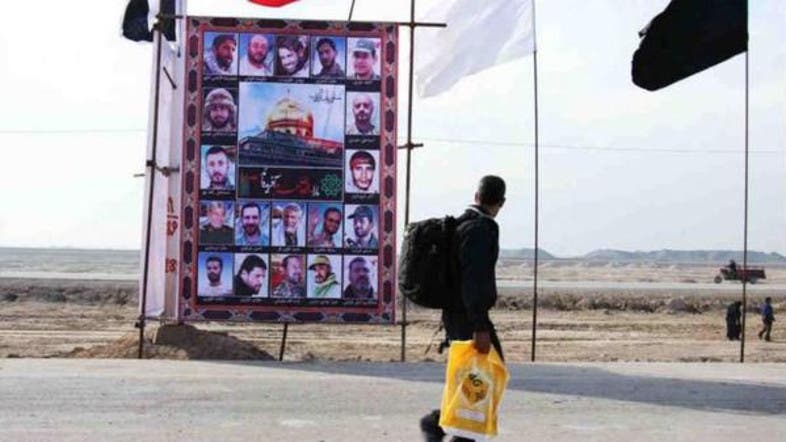
 Through pictures displayed along the streets of the holy cities of Karbala and Najaf in Iraq, Tehran portrayed the number of Iranian soldiers and militia fighters killed in Syria, which has reached the milestone of 3,000. It has been an Iranian policy to exploit Shiite religious occasions to inflame sectarian sentiments when millions of devotees flock to the holy cities in Iraq. More photos here.

In Syria’s Aleppo, Shiite militias point to Iran’s unparalleled influence

BEIRUT — Syria’s government hopes a brutal siege will vanquish rebel holdouts in the city of Aleppo, a key battleground. But Syrian President Bashar al-Assad’s troops aren’t leading the charge.

That task has been taken up by thousands of Shiite militiamen from Lebanon, Iraq, Pakistan and Afghanistan who are loyal to Iran, a Shiite country and perhaps Assad’s most important ally.

For much of Syria’s civil war, these religiously motivated fighters have reinforced Syria’s badly weakened military. Now, they are playing an increasingly critical role in trying to seize opposition-held eastern Aleppo by coordinating their attacks with government forces and warplanes flown by Russia, another ally of Assad’s.

The government, backed by Russian aircraft, launched a major offensive across northern Syria last week that has brought further devastation to eastern Aleppo, Syria’s largest city before the war.

The militias appear to be forming a sophisticated ground coalition that has further bolstered Iran’s influence in Syria, alarming even officials in Assad’s government, said Phillip Smyth, an expert on Shiite militias at the Washington Institute for Near East Policy.

“They are building a force on the ground that, long after the war, will stay there and wield a strong military and ideological influence over Syria for Iran,” he said. “And there is not much Assad can do to curb the rising influence of these groups, even though Syrian officials are clearly concerned about this, because the militiamen are literally preventing the overthrow of his government.”

Analysts say Iran has long used Shiite militias in other countries to project its power. The groups include multiple factions that dominate Iraqi politics, as well as the Lebanese Hezbollah militia, which is more powerful than Lebanon’s military.

Iran and its militias have frustrated U.S. officials. While both sides find themselves aligned against the Islamic State in Iraq, they are at cross-purposes in Syria, where anti-Assad rebels receive funding and arms from Washington and its allies.

Eventually, analysts say, Iran could even find itself in direct competition with Russia for influence in Syria.

The Shiite militias’ presence in Syria also has fueled Iran’s regional and religious rivalry with Saudi Arabia, a Sunni powerhouse that backs Syria’s Sunni-led rebellion.

Still, the payoff of using militiamen could be substantial. If the Syrian government is able to seize all of Aleppo, the regional balance would tip in Iran’s favor, dealing a blow to Saudi ambitions and the rebels who stormed the city’s eastern areas in 2012, said Fawaz Gerges, professor of Middle Eastern politics at the London School of Economics.

“A defeat of the rebels in Aleppo would be a turning point in which Assad captures most of the urban centers of Syria,” he said. “It would be a setback for Saudi Arabia in its rivalry with Iran, which, as a result, would see its influence in Syria increase even more.”

The dozens of militias there have led the way in imposing a crushing blockade of the city’s opposition districts, where more than 200,000 people face worsening shortages of food and medicine. The fighters also call in air raids by Russian and government warplanes that have wrecked hospitals, residences and infrastructure in those areas.

Rebels have indiscriminately shelled government-held western Aleppo, but destruction there has not been as severe.

This month, rebel fighters in Aleppo launched a counteroffensive, but they have struggled to break the siege. Air power – especially Russia’s – has proved a formidable obstacle. The Shiite militiamen have, too, said Zakaria Malahfiji, a member of the Fastaqim rebel force, which is affiliated with the umbrella Free Syrian Army.

“They are fighting with passion, and they fight in well-coordinated attacks,” he said. “I remember one battle where these fighters just kept dying in one spot. One guy would charge, get shot and die, and then another, and then another and then another would do the same thing on the exact same spot. All of them died. They are motivated.”

The hard-line Sunnis of the Islamic State and other religious extremists have overshadowed the revolt against Assad that began peacefully in 2011 before turning into brutal war. Militants linked to al-Qaida have played a prominent role among rebel forces.

To the rebels, the Iranian-backed militiamen are extremists.

“They are spreading Iran’s influence and their extremist ideology, but our revolution is not about religion; it’s about freedom and dignity,” said Abdulmunem Zaineddin, a religious scholar involved with rebel forces in the battles in Aleppo.

The militias say their involvement in the civil war is about defending Shiite shrines in the country, as well as battling extremist Sunni groups.

“We don’t want sectarian violence. We want to protect Syria, to protect all that is sacred to everyone from terrorism, from the terrorist groups paid for by Saudi Arabia, Turkey, Qatar and the U.S.,” said Hisham Al Mossawi of Harakat al-Nujaba, a militia from Iraq whose fighters also are battling in Aleppo.

It’s unclear how many Shiite militiamen and militia factions are participating in the Aleppo battle. Hundreds and perhaps even thousands of the fighters have been killed during the war, including generals from Iran’s paramilitary Revolutionary Guard Corps.

Avi Dichter, chair of Israel’s foreign affairs and defense committee, said this month that as many as 25,000 Shiite militants are fighting in Syria. Other analysts say the number is smaller.

Israeli intelligence closely monitors the fighting in Syria and, in particular, Hezbollah’s role in the conflict. Since it fought a devastating war with Israeli forces in 2006, the Lebanese militia has become more powerful, partly because of the battlefield skills honed in Syria.

Hezbollah intervened in Syria early on in the war, helping Assad’s forces rout rebels in key western areas of the country.

“The fighting has made (Hezbollah) a better fighting force and more adept in conventional military warfare,” Dichter said.

In Aleppo, Hezbollah and Iranian Revolutionary Guards play prominent leadership roles, directing the foreign Shiite militiamen, many of whom are recruited by, and trained in, Iran.

The factions are learning to overcome issues such as linguistic differences, helping them become more adept at coordinating ground assaults, said Smyth, the analyst.

“History proves that whenever Iranians craft groups like these, such as Lebanese Hezbollah, they don’t give up arms, they don’t stand down and they don’t leave territory that they’ve taken,” he said. “They will be in Syria for years and years, and that will have consequences for everyone.”

Iraqi Shiite Militias Complicate Fight to Defeat ISIS in Mosul, Other Areas

(New York, NY) – (CEP) today released updated resources on three powerful Iraqi Shiite militias, as their involvement in the fight for the Sunni-dominated ISIS stronghold of Tal Afar, west of Mosul, is raising fears of the return of sectarian warfare to the area.

The three militias—the Badr Organization, Kata’ib Hezbollah, and Asaib Ahl al-Haq—are the most powerful among Iraq’s Popular Mobilization Forces (PMF), a government-sanctioned umbrella group composed of predominantly Shiite fighters with strong military and financial ties to Iran.  In a July report, Human Rights Watch documented killings, disappearances, torture, and the destruction of homes by the groups during the fight to retake Fallujah and other Sunni-dominated areas from ISIS. The organization urged that Iraq prevent the Shiite militias from playing any role in the campaign to drive ISIS from Mosul.

The Badr Organization began in 1983 as the military wing of an Iraqi political party that sought to bring Iran’s Islamic Revolution to Iraq and fought alongside Iran during the Iran-Iraq War. The Badr Organization is run by Hadi al-Amiri, who has a history of instigating sectarian violence in Iraq. He has also been linked to a 1996 attack in Saudi Arabia that killed 19 U.S. Air Force servicemen.

Kata’ib Hezbollah (KH) is an Iranian-sponsored, anti-American Shiite militia that earned a reputation for targeting U.S. and coalition forces with roadside bombs and improvised rocket-assisted mortars. KH fought with the Assad regime in Syria at the behest of Iran’s Islamic Revolutionary Guard Corps (IRGC). KH has remained virulently anti-American, repeatedly boycotting battles against ISIS in which U.S. airpower contributes. In 2009, the U.S. Treasury Department designated KH and its leader, Jamal Jaafar Ibrahimi (a.k.a. Abu Mahdi al-Mohandes), for threatening stability in Iraq, declaring that KH and Ibrahimi “committed, directed, supported, or posed a significant risk of committing acts of violence against Coalition and Iraqi Security Forces.”

Asaib Ahl al-Haq (AAH) has claimed responsibility for more than 6,000 attacks on American and Iraqi forces. Its founder and leader, Qais al-Khazali, reportedly led the January 2007 attack in Karbala that killed five U.S. soldiers. Today, AAH continues to commit sectarian violence, carry out homophobic attacks, and threaten the “interests” of Western countries participating in strikes in Syria.

Twitter: Selective Free Speech, Approves Muslim Brotherhood

Congressman, Keith Ellison, MN must be getting quite nervous and if he is not yet, he will be. Will there be others in Congress?

Egypt’s military-backed government declares Muslim Brotherhood a terrorist organization

UK Declares Muslim Brotherhood Terrorist Group, Breaks With Obama  To view the final report issued by the U.K. of which Barack Obama strongly condemned the U.K., go here.

*****

Members of both Houses of the U.S. Congress have submitted:

A BILL

To require the Secretary of State to submit a report to Congress on the designation of the Muslim Brotherhood as a foreign terrorist organization, and for other purposes.

1 Be it enacted by the Senate and House of Representatives of the United States of America in Congress assembled,

3 SECTION 1. SHORT TITLE.

4 This Act may be cited as the ‘‘Muslim Brotherhood

5 Terrorist Designation Act of 2015’’.

“This bill puts the lie to the notion that the Muslim Brotherhood is a peaceful political organization that can be a legitimate partner for America,” the lawmaker said. “In 2008 the Justice Department successfully prosecuted the largest terrorism-financing trial in American history arguing that the Muslim Brotherhood directed U.S. affiliates such as the Holy Land Foundation to provide ‘media, money and men’ to Hamas. That support was used for terrorist attacks against Americans and our allies in the Middle East.  When they are capable they will try to do the same thing here.”

The bill, which includes a lengthy history of the Brotherhood’s links to radical terrorist leaders and violent incidents, concludes that “the Muslim Brotherhood meets the criteria for designation as a foreign terrorist organization.”

It would require the State Department and other agencies to determine whether the Brotherhood officially meets the requirements to be designated under U.S. law as a terrorist organization.

However, “if the Secretary of State determines that the Muslim Brotherhood does not meet the criteria,” it must submit to Congress “a detailed justification as to which criteria have not been met,” according to the bill.

Muslim Brotherhood affiliates as well as the group’s members have been listed as sponsors of terrorism in the past by the U.S. government.

Five countries—Egypt, the United Arab Emirates, Saudi Arabia, Syria, and Russia—already consider the Brotherhood a terrorist organization.

Israel, Canada, and the United Kingdom are examining the possibility of designating it a terrorist organization as well. In 2014, a senior member of the Brotherhood was hosted at the White House last year, while other representatives of the group have been granted entrance to the United States. More here from FreeBeacon.

While members of Islamic State have accounts on Twitter, there is a mobilized team of people that work daily to take down those terror Twitter accounts. Yet all this seems to be good for Twitter when it comes to giving terror groups an approved and verified status on social media.

The matter of domestic proof of the Muslim Brotherhood as a terror organization has been a large part of discussions in Congress at least since 2010. One such letter is noted here:

mb-congress-letter

Twitter Verifies Muslim Brotherhood’s Account Despite Pledges to Curb Hate Speech

Twitter has verified an official English account of the Muslim Brotherhood, despite the platform’s pledge to fight hate speech. Multiple countries have designated the organization as a terrorist group.

On Saturday, Twitter awarded the Muslim Brotherhood a “verification check”, normally given to legitimate and prominent accounts on the platform. The reason for verification remains unclear due to Twitter’s policy of not commenting on individual accounts.

But under chief executive Jack Dorsey Twitter faced increasing controversy when it comes to free speech issues: prominent conservatives and an account dedicated to women’s rights in Saudi Arabia were suspended this year, for allegations of incitement or other reasons many critics called frivolous.

The Muslim Brotherhood account, however, has been openly aligned with another designated terrorist organization — Hamas — which seeks the destruction of Israel and the Jewish people and has been linked to numerous terror attacks. Back in April, Twitter shut down accounts associated with Hamas.

The now-verified Muslim Brotherhood account once compared Israel to South Africa’s apartheid system and reaffirmed its “deep appreciation” and “full support”of the so-called resistance movement Hamas and its military wing Qassam Brigades.

Meanwhile, the Muslim Brotherhood’s non-English account on Twitter openly celebrates the death of Jews and is widely shared among Twitter’s radical Islamists. More here from HeatStreet.
Egypt confiscates assets of 46 Muslim Brotherhood members

An Egyptian government committee has ordered the confiscation of assets of 46 members and supporters of the outlawed Muslim Brotherhood.

The move is part of the crackdown on the Brotherhood, once Egypt’s largest opposition group, since the ouster President Mohammed Morsi, Egypt’s first freely elected president whose rule proved divisive.

The government committee, which is affiliated with the Justice Ministry, says the confiscated assets include five companies involved in trade, construction, and pharmaceuticals.

It says Mohammed Abdel-Gawad, a former head of the pharmacists’ union under the Brotherhood’s rule of Egypt, is among those affected by Monday’s order.

Over the past three years, Egypt has confiscated assets of scores of Brotherhood members and seized their businesses, including schools, hospitals, and companies. Thousands of Brotherhood figures are also jailed or imprisoned.