U.S. Israel Facing Down Iran in Syria, Golan, Yemen

Over the past six years, Iran has played a key role in propping up the embattled regime of Bashar al-Assad in Syria, by sending Islamic Revolution Guards Corps (I.R.G.C.) military personnel as well as recruiting, funding, training and leading an extensive network of Iraqi, Lebanese, Pakistani and Afghan Shiite militia forces. Now that Iran’s ally in Damascus is in control of Syria’s key population centers, the Islamic Republic and its regional proxies are already planning to consolidate their presence in Syria for the long haul to secure Tehran’s geopolitical interests in the broader region. This has alarmed the United States and regional countries – particularly Israel, which is increasingly worried about the presence and influence of the Lebanese Hezbollah and other Iran-backed forces along its northern border with Syria. One prominent Iran-controlled militia group, for example, announced earlier this month that it had created a new brigade of well-trained combatants to fight Israel and reclaim the strategic Golan Heights from the Jewish state.

Israel, the real enemy 

On March 29, Harakat al-Nujaba, an Iraqi militia group that fights under the I.R.G.C.’s leadership in both Iraq and Syria, said that Israel, not Sunni militants, is the real enemy and sought Damascus’s permission to fight Israeli forces stationed in the Golan region. “The Golan Liberation Brigade will fight shoulder to shoulder with its brothers in the Syrian Army. The axis of resistance is working on the main goal, which is the Palestinian issue. And these efforts have a great impact on reshaping the regional map by annihilating the occupying Zionist regime,” Nasr al-Shammari, the Nujaba’s deputy military chief said in an interview with Iran’s Mehr News Agency. “The weapons of the resistance and Islamic and Arab armies should target this regime. With this in mind, the Harakat al-Nujaba announced that a brigade should be set up to liberate Golan,” he added. “If this regime is destroyed, regional problems will be resolved completely.”

Shammari also claimed that Shiite militia groups forced the “occupying” U.S. forces to withdraw from Iraq and are able to replicate that success against Israel. “We are waiting to confront the Zionist regime instead of combating Takfiri groups in the region and their evil arms.”

Golan Liberation Brigade 

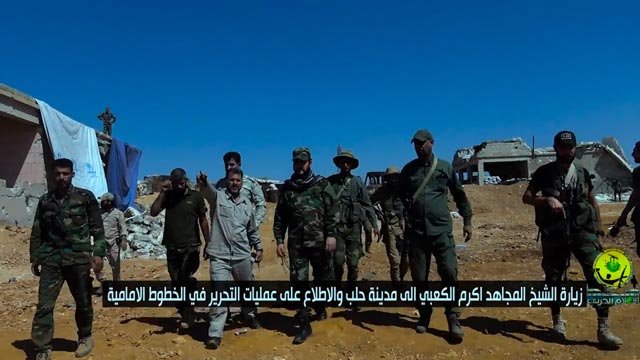
The Nujaba movement announced three weeks ago that it had established a new brigade to seize the Golan Heights – claiming that “latest victories” against the Islamic State and Sunni rebels in Iraq and Syria have allowed the group and its allies to focus on Israel. Leaders of the group claimed that members of the new brigade are highly-trained, well-equipped and capable of fighting the Jewish state. “Israel is weaker than a spider web. Islamic resistance is capable of confronting the axis of evil and annihilating the occupying Zionist regime,” Nujaba’s Secretary-General Akram al-Kaabi told Lebanon-based Arabic-language al-Mayadeen news network.

Image result for Golan Liberation Brigade

The creation of the Golan Liberation Brigade further alarmed Israeli leaders about the increasing presence and influence of the Lebanese Hezbollah and other I.R.G.C.-supported groups in southwestern Syria. Israeli Prime Minister Benjamin Netanyahu during his recent trip to Moscow sought assurances from Russian President Vladimir Putin to prevent Iran from taking advantage of the conflict in Syria to station its proxies permanently on Israel’s northern border. “I made it clear to President Putin our resolute opposition to the consolidation of Iran and its proxies in Syria,” he told reporters after the meeting. “We see Iran trying to build a military force, military infrastructure, with the intention to be based in Syria, including the attempt by Iran to build a seaport. All this has serious implications in terms of Israel’s security.”

Given Israel’s military superiority in the region, Iranian proxies cannot seize the strategic Golan region. Also, the regime of Bashar al-Assad is still fighting for its survival against a wide range of Sunni rebel groups and is unlikely to engage in a self-defeating war with Israel. But Israeli leaders are worried that Iran and its proxies are expanding the Southern Lebanon front to the Golan Heights – threatening Israel’s security and stability. The fact that Iranian-sponsored Iraqi militia groups and the Afghan Fatemiyoun Division fighting in Syria have close operational links with Hezbollah, has added to Israeli concerns. Moreover, senior I.R.G.C. commanders have recently visited the Syrian-controlled regions of the Golan Heights on military and reconnaissance missions.

I.R.G.C. commanders have talked about helping Damascus reclaim the Golan region from Israel for almost three decades. Last year, Brigadier General Ali Asghar Gorjizadeh, a senior I.R.G.C. commander and a veteran of the Iran-Iraq war, claimed that the Syrian government had refused Tehran’s offer in the 1980s to send an I.R.G.C. battalion to help the Syrian Army to “liberate” the Golan Heights. But he explained that the I.R.G.C. has, over the past decades, used the Syrian territory to train anti-Israel “resistance forces,” particularly the Lebanese Hezbollah. And now that the six-year Syrian civil war has allowed the I.R.G.C. to gain a significant military footprint inside Syria, it is no surprise that the I.R.G.C. will seek to use its powerful Shiite proxies such as the Nujaba group to threaten the Israeli security.

Regional Threat 

The remarks by Nujaba leaders also indicate that the mission of Iran-sponsored Shiite militia groups will not remain limited to Iraq and Syria. Nor will the group only threaten the security of Israel in the future. I.R.G.C.-affiliated militia commanders in Iraq, for example, have already turned attention to their Iraqi rivals as the Islamic State is on the verge of collapse in Mosul. They have also made threats against regional Sunni states, particularly Saudi Arabia. Recent reports also suggest that the I.R.G.C. and Hezbollah are increasingly training and deploying Afghan and Arab Shiite militiamen to support Houthi rebels in Yemen. Iraqi Popular Mobilization (P.M.F) units with close ties with Iran have also stepped up anti-American propaganda in Mosul and across Iraq – posing threat to the safety of American military advisers that are helping the Iraqi security forces on the ground.

Image result for Harakat al-Nujaba SouthFront

Harakat al-Nujaba 

Harakat al-Nujaba – also known as Harakat Hezbollah al-Nujaba – is a prominent Iraqi sectarian group that operates under the leadership of I.R.G.C. Quds Force commander Qassem Soleimani. It has been fighting in Syria since 2013. The leader of the group, Akram al-Kaabi, makes no secret of his allegiance to Iran’s Supreme Leader Ali Khamenei or his close relationship with Soleimani. The I.R.G.C. uses the Nujaba group and other powerful Shiite units within Iraq’s Popular Mobilization Forces (P.M.F.) not just to fight the Islamic State, but also as a pressure tool against the Baghdad government, regional Sunni states, and the United States. Kaabi once famously stated that his forces would topple the Baghdad government if ordered by Khamenei. Unlike some other P.M.F. units that receive their political and religious guidance from Iraq’s top cleric Grand Ayatollah Ali Sistani, Kaabi has repeatedly made it clear that he only emulates Khamenei. Kaabi has recently declared that he will deploy more forces Syria to fight alongside the I.R.G.C. forces and Syrian Army once the Islamic State is defeated in Mosul.

Anti-American, anti-Israeli propaganda 

Recently, the I.R.G.C.-affiliated media outlets have raised the profile of the Nujaba group, and senior Iranian leaders have held meetings with its top commanders. Indeed, the press conference in which Nujaba announced the creation of  the Golan Liberation Brigade was organized by the Tasnim News Agency, which is a prominent I.R.G.C. media outlet. By focusing their propaganda against the U.S. and describing Israel as the “real enemy,” Iranian leaders are trying to justify their involvement in foreign conflicts and to convince the Iranian people and Muslims around the world that the Islamic Republic is the standard-bearer and true defender of Islam. But such claims ring hollow when most victims of the I.R.G.C.’s military adventurism and proxy wars are Muslims.

***
‘Al-Sharq Al-Awsat’ Report Specifies Locations Of Foreign Military Bases In Syria, Says Syria Is Turning Into Brittle Federation That Can Fall Apart At Any Moment

MEMRI: On March 14, 2017, the London-based daily Al-Sharq Al-Awsat published a report giving the location of military bases of various foreign forces in Syria, including the U.S., Russian and Turkish forces. According to the report, the locations of the bases reflect the influence-zone of each country, and that Syria is gradually becoming a loose federation of ethnic states that can fall apart at any moment.

The following are excerpts from the report:

Source: infopls.com

“In the lost time between the Geneva and Astana conferences, the superpowers turned to expand their influence-zones in Syria by establishing numerous military bases which, according to experts, effectively pave the way towards a political solution based on a federation and the division [of Syria]. Until now Moscow and Washington were the major players in this theatre alongside Iran, but recently Ankara decided to establish many military bases of its own in the region known as the Shield of the Euphrates, in order to ensure itself a front-row seat at the international negotiation table…

“Russia is the only [country] that has [openly] announced more than once that it has two bases [in Syria]: an airbase in Khmeimim in the Latakia area and a naval base in Tartus, which is its only [base] on the Mediterranean and is planned to be its biggest naval base… According to various sources, Moscow  recently expanded its presence in Damascus, in the rural area east of Homs and in the rural area [near] Aleppo, and there are [also] Russian headquarters in the Kurdish-held areas in northern Syria that are part of the American influence-zone.

“Washington is keeping mum about the location of [its forces] in Syria [that number] over 900 troops. Last week it announced it was dispatching 400 Marines to Syria in order to support local forces in the battle for Al-Raqqa, the stronghold of the ISIS organization. According to reports, the [U.S.] troops that arrived began establishing a military base from which artillery attacks will be made on ISIS positions 32 km away. The U.S. has established its military bases in northern Syria, mostly in the areas controlled by their allies, the Kurdish People’s Protection Units. The most prominent of these bases are Rmeilan Base in the northeastern tip [of the country], near the Iraqi border, and a base that has been established in the city of ‘Ain Al-Arab (Kobane). According to Kurdish sources, the Americans have other bases in Syria, one of them in Hassakah.

“The single British base in Syria is in near Al-Tanf on Syria’s border with Jordan and Iraq, in the Al-Hamad desert region in the southeast of Homs district, 240 km from Palmyra.

“Iran has two military bases [in Syria], one in the Damascus international airport, which is the headquarters of Iran’s Islamic Revolutionary  Guards Corps (IRGC) [in Syria], and another in the Azzan Mountain [area] near Aleppo.”

Trump Excluded Iraq From Travel Suspension, BUT….

I the original Executive Order Trump signed to suspend travel from a handful of countries, Iraq was included. When the Executive Order was legally challenged by several courts, yet another Executive Order was issued to excluded Iraq. This decision was made due to the increased security cooperation between the United States and Iraq. Okay so what is the problem? How about other Iraqis that already lied on immigration filings or committed crimes and lied? Fingerprints were the key after the kidnapping. Ever wonder who else is in Virginia? There are plenty….

President Trump should have taken several other preliminary steps prior to those Executive Orders including suspending the entire visa waiver program. But back to Iraq…. and the Al Mahdi Militia, which is still active and operations under variations of the name:

The Mahdi Army, also known as Jaysh al-Mahdi (JAM), was formed by Muqtada al-Sadr in June 2003 in response to the U.S. invasion of Iraq.  [3] [4] Muqtada al-Sadr is the son of Grand Ayatollah Mohammed Sadiq al-Sadr, who founded the prominent Sadrist Movement in the 1980s, a vehemently nationalist political movement popular among Iraq’s Shiite lower class. After Mohammed Sadiq al-Sadr was assassinated in 1999, presumably by the Hussein regime, Muqtada al-Sadr succeeded him as the leader of the Sadrists as well as one of the most powerful and respected Shiite clerics in Iraq. [5] [6] [7] Following the U.S. invasion in 2003, Sadr called upon the Sadrist to join his new militia, the Mahdi Army, with the goal of expelling the U.S. coalition from Iraq and establishing an Iraqi Shiite government. Some of the group’s initial three hundred fighters were recruited in Kuwait and Saudi Arabia and together with their Iraqi counterparts were sent to Hezbollah camps in Lebanon for training. [8] [9] More here.

*** Image result for mahdi army DailyMail

Department of Justice
U.S. Attorney’s Office
Eastern District of Virginia
FOR IMMEDIATE RELEASE
Tuesday, March 28, 2017

Iraqi Refugees Arrested and Charged with Immigration Fraud

ALEXANDRIA, Va. – Two Iraqi refugees living in Northern Virginia were arrested this morning and charged along with another individual with immigration fraud.

The defendants arrested this morning are Yousif Al Mashhandani (“Yousif”), 35, of Vienna, and Adil Hasan, 38, of Burke, who are full biological brothers. The third individual charged is Enas Ibrahim, 32, also of Burke, who is the wife of Hasan. Each are charged with attempting to obtain naturalization contrary to law. The defendants will have their initial appearance today in front of Magistrate Judge Ivan D. Davis at 2 p.m. at the federal courthouse in Alexandria.

According to the affidavit in support of the criminal complaint, on Nov. 1, 2004, a United States citizen, identified as R.H., was kidnapped in Iraq and held with other hostages for months in horrible conditions in an underground bunker. After a raid in 2005 freed the hostages, authorities detained Majid Al Mashhadani (“Majid”), who is a full biological brother of Yousif and Adil Hasan, and he admitted his complicity in the kidnapping of R.H.

According to the affidavit in support of the criminal complaint, Yousif was admitted into the United States as a refugee in 2008. In May 2013, Yousif resided in Vienna and applied for naturalization as a United States citizen. In connection with Yousif’s applications for citizenship, his fingerprints were taken. According to an FBI fingerprint specialist, analysis conducted in November 2013 determined that Yousif’s fingerprints match those found on a document at the underground bunker where forces rescued R.H. and others in Iraq in 2005.

According to the affidavit in support of the criminal complaint, Yousif, Hasan, and Ibrahim are lawful permanent residents and have applied to naturalize and become United States citizens. On various applications and forms throughout their respective immigration processes, each has provided and extensive list of family members and information of their respective family trees; however, none ever listed any reference to Majid.

According to the affidavit in support of the criminal complaint, on March 4, 2016, FBI agents interviewed Yousif, Hasan and Ibrahim. When FBI agents asked Yousif why he failed to include reference to Majid on the family tree form, Yousif said he omitted reference to Majid because, when he was a refugee, he was told by others applying for refugee status that he would not be allowed into the United States if any immediate family members had a criminal background. Hasan admitted to FBI agents that Majid was his brother, and Hasan and Ibrahim each admitted they discussed not including Majid’s name on their applications for refugee status because their connection to Majid might delay their ability to gain such status.

According to the affidavit in support of the criminal complaint, to justify his application for refugee status, Yousif reported that in 2006, while working as an anti-corruption investigator for the Iraqi Commission on Public Integrity in Iraq, he started receiving threats from a Shiite militia known as the “Al Mahdi Militia,” in order to coerce Yousif to drop a particular corruption investigation. Yousif said that in May 2006 Adil was kidnapped by the Al Mahdi Militia, and only released after Yousif arranged to drop the investigation in question and helped pay a large ransom. Yousif said that after Adil was released, he reopened the corruption investigation, only to flee to Jordon in October 2006 after his parents’ house was burned down.

According to the affidavit in support of the criminal complaint, to justify his application for refugee status, Hasan provided sworn testimony that, in 2006, he had been kidnapped and tortured by members of the Al Mahdi Army and held for nearly a month. Hasan said he was released upon the payment of a ransom of $20,000. In an interview by FBI agents in April 2016, Hasan said he was threatened in Iraq on two occasions, but made no mention of being kidnapped, held hostage, and tortured for nearly a month. In a subsequent interview in October 2016, FBI agents confronted Hasan about the discrepancy in his stories and Hasan admitted to making false statements and creating his persecution story.

Each defendant faces a maximum penalty of 10 years in prison if convicted. Actual sentences for federal crimes are typically less than the maximum penalties. A federal district court judge will determine any sentence after taking into account the U.S. Sentencing Guidelines and other statutory factors.

Dana J. Boente, Acting Deputy Attorney General and U.S. Attorney for the Eastern District of Virginia; Andrew W. Vale, Assistant Director in Charge of the FBI’s Washington Field Office; Patrick J. Lechleitner, Special Agent in Charge of U.S. Immigration and Customs Enforcement’s (ICE) Homeland Security Investigations (HSI) Washington, D.C., made the announcement. The FBI’s Joint Terrorism Task Force, which includes ICE/HSI and U.S. Citizenship and Immigration Services, investigated the case. Assistant U.S. Attorneys Gordon D. Kromberg and Colleen E. Garcia are prosecuting the case.


A copy of this press release is located on the website of the U.S. Attorney’s Office for the Eastern District of Virginia. Related court documents and information is located on the website of the District Court for the Eastern District of Virginia or on PACER by searching for Case No. 1:17-mj-143.

A criminal complaint contains allegations that a defendant has committed a crime. Every defendant is presumed to be innocent until and unless proven guilty in court.

DOJ Moves to Remove U.S. Citizenship of AQ Operative

Department of Justice                                 The official criminal complaint is here.
Office of Public Affairs

FOR IMMEDIATE RELEASE
Monday, March 20, 2017

Denaturalization Lawsuit Filed Against Convicted Al Qaeda Conspirator Residing In Illinois

The United States has filed a civil action in the Southern District of Illinois against a 47-year-old naturalized citizen, formerly of Cleveland, Ohio, accused of unlawfully procuring his U.S. citizenship, announced Acting Assistant Attorney General Chad A. Readler of the Justice Department’s Civil Division and U.S. Attorney Donald S. Boyce for the Southern District of Illinois.

Image result for Iyman Faris

Iyman Faris, a native of Pakistan, is currently serving a criminal sentence at the U.S. Penitentiary at Marion, Illinois for conspiracy to provide material support to a designated foreign terrorist organization, namely, al Qaeda, and for providing material support to al Qaeda. In October 2003, the U.S. District Court for the Eastern District of Virginia sentenced Faris to 20 years in prison. The civil complaint alleges that Faris entered the United States fraudulently by using another’s passport that he willfully misrepresented the circumstances under which he entered the United States on subsequent applications for immigration benefits, and that he twice testified falsely to obtain immigration benefits. Additionally, the complaint alleges Faris lacked the required attachment to the principles of the U.S. Constitution at the time of his naturalization, as proven by his 2003 federal conviction for providing material support to al Qaeda, a designated terrorist organization. Faris was naturalized as a U.S. citizen on Dec. 16, 1999.

“The Department’s Office of Immigration Litigation will continue to pursue denaturalization proceedings against known or suspected terrorists who procured their citizenship by fraud,” said Acting Assistant Attorney General Readler. “The U.S. government is dedicated to strengthening the security of our nation and preventing the exploitation of our nation’s immigration system by those who would do harm to our country.

“The prosecution of this case demonstrates the commitment of the Department of Justice to preventing immigration fraud,” said U.S. Attorney Boyce. “It is important to ensure the path to legal naturalization remains secure and free of fraud. When people enter the United States, immigrate, and later become citizens, all done through fraud and misrepresentation, their unlawful actions harm the integrity of our immigration system.”

Under the Immigration and Nationality Act, a naturalized U.S. citizen’s citizenship may be revoked, and his certificate of naturalization canceled, if the naturalization was illegally procured or procured by concealment of a material fact or by willful misrepresentation.

This case was investigated by the Civil Division’s Office of Immigration Litigation, District Court Section and U.S. Immigration and Customs Enforcement. The litigation is being handled by Trial Attorney Edward S. White of the Office of Immigration Litigation and Assistant U.S. Attorney Nicholas J. Biersbach of the U.S. Attorney’s Office for the Southern District of Illinois.

The claims made in the complaint are allegations only, and there has been no determination of liability.

*** On background, here is the basis of the case from 2003:

IYMAN FARIS SENTENCED FOR PROVIDING MATERIAL SUPPORT
TO AL QAEDA

WASHINGTON, D.C. – Attorney General John Ashcroft, Assistant Attorney General Christopher A. Wray of the Criminal Division, and U.S. Attorney Paul McNulty of the Eastern District of Virginia announced today that Iyman Faris was sentenced to 20 years in prison for providing material support and resources to al Qaeda and conspiracy for providing the terrorist organization with information about possible U.S. targets for attack.

Faris, a/k/a Mohammad Rauf, 34, of Columbus, Ohio, was sentenced this afternoon by U.S. District Court Judge Leonie M. Brinkema, at federal court in Alexandria, Virginia. Before sentencing Faris, Judge Brinkema denied Faris’ request that he be allowed to withdraw his guilty plea.

Faris, a naturalized U.S. citizen born in Kashmir, pleaded guilty on May 1, 2003, to casing a New York City bridge for al Qaeda, and researching and providing information to al Qaeda regarding the tools necessary for possible attacks on U.S. targets.  More here.


Russian Special Forces now in Libya

Image result for Khalifa Haftar libya oil ports Haftar was protected by and lived in the U.S., becoming a citizen. We dispatched him to Libya to launch an interim government. Now he and Egypt both have turned to Russia for full control and support, Putin has complied, happily. John Kerry, Hillary Clinton and Barack Obama are not responding to calls on line 4. Hah…

BBC: Forces loyal to Libyan military strongman Khalifa Haftar say they have retaken key oil-rich areas in the country’s east.

Ground, sea and air forces were engaged in the fight for sites at Ras Lanuf, Sidra and Ben Jawad from a rival Islamist militia, a spokesman said.

Meanwhile, Russia has denied reports that it has deployed special forces to the region in support of Gen Haftar. {See below, emphasis added}

Libya has been in chaos since the overthrow of Colonel Gaddafi in 2011.

The oil terminals had been seized by the Benghazi Defence Brigades (BDB) – a mix of militias that includes Islamists – earlier this month, which then handed them over to the Petroleum Facilities Guard, affiliated to the UN-backed unity government based in Tripoli.

Gen Haftar is allied to an administration based in the eastern city of Tobruk, which is challenging the authority of the UN-backed government.

Russia moving special forces into Libya

U.S. sources claim Russia moving special forces into Libya to aid Libyan military commander Khalifa Haftar.

U.S., Egyptian and diplomatic sources say that Russia has apparently been moving special forces to an airbase in western Egypt near the border with Libya in recent days, according to a report by Reuters.

Image result for Khalifa Haftar Newsweek

The U.S. is concerned that such a Russian deployment may signify Russian support for Libyan military commander Khalifa Haftar, who suffered a setback on March 3 when the Benghazi Defense Brigades (BDB) attacked oil ports controlled by his forces.

U.S. officials claimed that their surveillance units had observed Russian special operations forces and unmanned aircraft at Sidi Barrani, which is about 100 km from the Egypt-Libya border. The apparent Russian deployments have not been previously reported.

The Russian defense ministry did not respond to these claims on Monday and Egypt denied the presence of any Russian contingent on its soil.

Mohamed Manfour, commander of the Benina air base near Benghazi in Libya, denied that Haftar’s Libyan National Army (LNA) had received military assistance from the Russian state or from Russian military contractors, and said there were no Russian forces or bases in eastern Libya.

Over the past two years a number of Western countries, including the U.S., have sent special operations forces and military advisors into Libya. The U.S. also carried out air strikes to support a successful Libyan campaign last year to oust ISIS from its stronghold in the city of Sirte.

Russia has shown increasing involvement in Libya in recent months and appears to be taking steps to back Haftar to lead the battle-torn kingdom, which has been split between local warlords in the aftermath of a 2011 NATO-backed uprising against the late leader Muammar Gaddafi, who was an ally of Russia. Several dozen armed private security contractors from Russia operated until February in a part of Libya that is under Haftar’s control.

The top U.S. military commander overseeing troops in Africa, Marine General Thomas Waldhauser, told the U.S. Senate last week that Russia was trying to exert influence in Libya to strengthen its leverage over whoever ultimately holds power.

“They’re working to influence that,” Waldhauser told the Senate Armed Services Committee on Thursday. Asked whether it was in the U.S. interest to let that happen, Waldhauser said: “It is not.”

Russian involvement in Libyan affairs appears to be growing at a time when it is limiting its operations in Syria to attempts to force a resolution without taking charge of the country. Waldhauser believes that this is Russia’s eventual goal in Libya, which will enable it to gain leverage there in the event that Haftar gains control of the country. It is also eyeing Libya’s oil fields as a source of economic opportunities.

Image result for  libya oil ports

Russia, however, says that its primary objective in the Middle East is to contain the spread of violent Islamist groups.

Meanwhile who is Khalifa Belqasim Haftar? (Wikipedia file)

Haftar was born in eastern Libya. He served in the Libyan army under Muammar Gaddafi, and took part in the coup that brought Gaddafi to power in 1969. He commanded the Libyan contingent against Israel in the Yom Kippur War of 1973.[3] In 1987, he became a prisoner of war during the war against Chad. While held prisoner, he and his fellow officers formed a group hoping to overthrow Gaddafi. He was released around 1990 in a deal with the United States government and spent nearly two decades in the United States, gaining U.S. citizenship.[4] Haftar lived comfortably in Virginia, relatively close to CIA headquarters, from the early 1990s until 2011.[5] In 1993, while living in the United States, he was convicted in absentia of crimes against the Jamahiriya and sentenced to death.

Haftar held a senior position in the forces which overthrew Gaddafi in the 2011 Libyan Civil War. In 2014 he was commander of the Libyan Army when the General National Congress (GNC) refused to give up power in accordance with its term of office. Haftar launched a campaign against the GNC and its Islamic fundamentalist allies. His campaign allowed elections to take place to replace the GNC, but then developed into a civil war.

Haftar’s campaign attracted opponents to the GNC to join him as well as armed groups including Zintan‘s al-Qaqaa and Sawaaq brigades, regional military police, the Saiqa special forces group in Benghazi, the Libyan air force and Ibrahim Jadhran’s federalist militias.[6]

Haftar has been described as “Libya’s most potent warlord,” having fought “with and against nearly every significant faction” in Libya’s conflicts, and as having a “reputation for unrivalled military experience”.

***

Internal rivalries based on region, city, tribe, political factions, ethnicity, and militia membership have supplanted dictatorial repression. The costs of this multi-layered disunity are stark: Libya has lost billions of dollars in potential revenues due to fights over control of the oil sector. And nearly 5,000 people have been killed due to the instability since 2014, when Libya formally divided politically.

Perhaps the most immediate barrier to implementation is the role of General Khalifa Haftar, commander of the Libyan National Army (LNA). Although Secretary of State John Kerry did not mention him by name in his statement in Vienna after the meeting to support Libya on May 16, Haftar was clearly on his mind when he said battles of individuals serving their own interests undermined Libya’s security, and that Libya was at a crossroads between a fate of chaos fueled by personal rivalries or unity and peace. Article Eight of the current agreement stipulates that the Presidency Council should be the Supreme Commander of the Libyan Army, in control of all senior-level security official appointments and dismissals. In effect, this provision would give the Presidency Council control of Haftar’s fate. The pro-Haftar eastern government has made removal of this article one of its few conditions for recognizing the Government of National Accord (GNA).

This impasse underscores the need for Libyans to decide once and for all what relationship the military should have with civilian institutions in Libya, and specifically what role Haftar can or will play in the future of Libya. This has also been a difficult impasse for Western governments to navigate, harkening to a recurring Middle East policy battle between prioritizing counter-terrorism and security, and longer-term interests like political stability, rule of law and human rights. Haftar has contributed to counter-terrorism efforts against groups like Islamic State, especially in Benghazi, while undermining Libya’s long-term stability. More here from May of 2016.

Maritime Traffic, Pirates, Smuggling and Dark Beacons

Maritime traffic is hardly considered a top priority and it should be. For illicit activities on the high seas, there is major intelligence value when it comes to smuggling and pirates.

Image result for gps maritime pirates cargo

— Israeli navy veteran Ami Daniel points at his computer screen and explains why the ship he was tracking should have been stopped and searched. It sailed near the Libyan port of Tobruk and waited four days more than a mile off the coast without ever docking, then moved west to Misrata, which it had never visited before.

Next came Greece, where it waited another four days offshore.

Whatever was on the ship — possibly drugs, weapons or people — likely eventually made its way to Europe’s shores, he said.

At a time of deep concern over migrant smuggling, Daniel said his company Windward has the ability to pick up such suspicious maritime behavior that would otherwise go unnoticed.

Ninety percent of the world’s trade is via the oceans, and ports simply cannot check even a fraction of all the containers. For that reason, they try to narrow it down with watch lists of ships.

But with turbulence in northern Africa and the collapse of Libya, smuggling networks have taken advantage of the situation while also becoming more sophisticated, Silvia Ciotti, head of the EuroCrime research body, explained.

And with the influx of hundreds of thousands of refugees across the seas, resources in Europe have been stretched threadbare.

The same smugglers taking desperate migrants and refugees into Europe also take contraband goods, Ciotti said.

“One day it is drugs. One day it is weapons. They do not care,” she said. If a ship’s activities are unusual — turning off its radar or visiting an at-risk port — it will be flagged. More here for ToI.

Image result for gps maritime traffic

The company is Windward, a rather new company that did get an interesting investor, former CIA director, General David Petraeus.

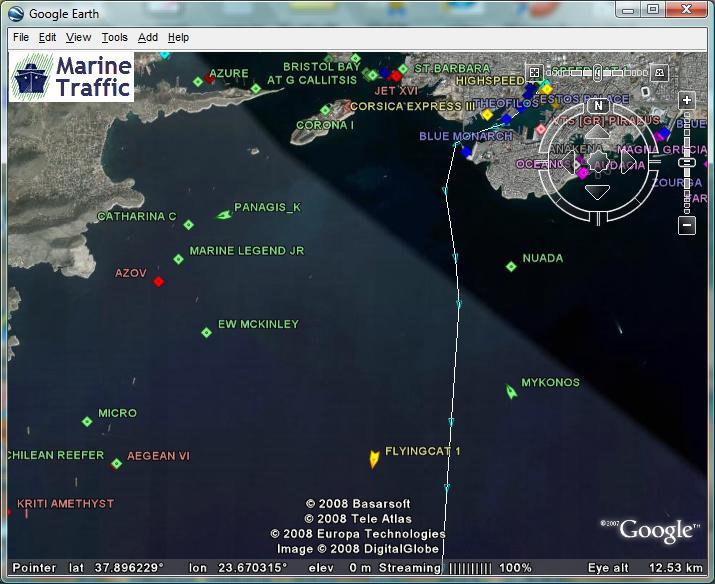
Using what it calls activity-based intelligence, Windward, a five-year-old maritime data and analytics firm here, probes beyond the ship-tracking services available on today’s market to validate identities of ocean-going vessels.

It compares their patterns of behavior and past associations with other ships —even where they loaded or didn’t load in specific ports of call.

“Nobody knows who’s the real owner of 75 percent of the world’s vessels,” said Daniel. “The reason is, for business reasons, they are registered under various flags of convenience by a lawyer who has one share and nobody knows who’s on top of him.

“So the tools of looking at data bases or registries are great in theory, but not in practice.”

The same holds true, company executives here say, for the Automated Information System (AIS), satellite-supported tracking system initiated in recent years by the US Coast Guard and now required by ocean-going vessels and passenger ships. Specific findings from the report showed an increase in GPS manipulation of 59 percent over the past two years; that 55 percent of ships misreport their actual port of call for the majority of their voyage; that large cargo ships shut off AIS transmissions 24 percent longer than others; and that 19 percent of the ships that “go dark” are repeat offenders.

To illustrate this point, Windward conducted an analysis specifically for Defense News, in which the company employed “reverse engineering” of a known arms smuggling incident to highlight similarly suspicious behavior by a ship that managed to evade detection by law enforcement authorities.

Its baseline case was the Haddad, a 39-year-old, Bolivian-flagged cargo vessel that embarked from Iskenderun, Turkey, in early September. It was ultimately seized by Greek authorities south of Crete with a cache of some 5,000 shotguns and a half million rounds of undocumented ammunition.

Using the route plied by the 66-meter Haddad, which sailed along the Turkish coast en route to Libya before being stopped, Windward came up with a similar profile of another ship which, for a variety of legal and proprietary reasons, it preferred to call Vessel X.

Like the Haddad, Vessel X was more than 30 years old and around the same size, about 75 meters. It left the same Turkish port on Aug. 19 — less than a month prior to Haddad — bearing a flag of convenience, this one from the South Pacific island of Vanuatu.

A day later, Vessel X stopped in an area near the Turkish shore where there was no other port in the area or any other reason to stop at that location, company analysts found. More here from DefenseNews.

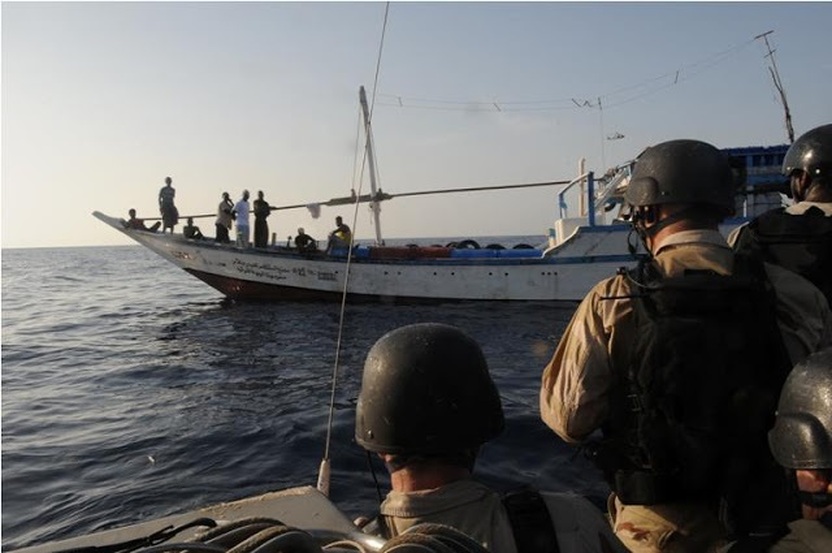
Meanwhile, pirating is back in the news.

Somali pirates just hijacked a commercial ship for the first time in five years

WaPo: In 2010 and 2011, groups of armed Somali men were hijacking merchant vessels off Somalia’s coast at an almost daily pace. Thousands of hostages of myriad nationalities were taken, and billions of dollars were lost on ransoms, damages and delayed shipments.

The crisis was so severe that a naval task force with more than two dozen vessels from European Union countries, the United States, China, Russia, India and Japan banded together to restore order to one of the world’s busiest shipping routes. They largely succeeded. In 2015, there were 17 pirate attacks near Somalia, down from 151 in 2011. Many of those attacks were on smaller fishing boats from nearby countries, mostly by disgruntled Somali fishermen, but not commercial ships.

Until Tuesday.

Somali officials acknowledged that the Aris 13, an oil tanker, had been escorted to the Somali coast by at least eight and perhaps as many as dozens of armed men on two small skiffs. Reports from organizations that monitor piracy could not conclusively identify which flag the ship was flying or where it was owned, but Sri Lanka’s Foreign Ministry confirmed that eight of its nationals were on board as crew. The ship was on its way south to Mogadishu, Somalia’s capital.

The attack originated in the Puntland region, which is semiautonomous. “The vessel’s captain reported to the company they were approached by two skiffs and that one of them could see armed personnel on board,” an unidentified Middle East-based official told the Associated Press. “The ship changed course quite soon after that report and is now anchored.”

The U.S. Navy’s 5th Fleet oversees anti-piracy efforts along Somalia’s coast. Concerns about piracy’s reemergence in the region have been growing in concurrence with greater exploitation of Somalia’s waters by foreigners engaged in illegal fishing. Deprived of a livelihood, some Somali fishermen have turned back to hijacking to get by.

Salad Nur, described as a “local elder” by the Associated Press, said that the men involved in Tuesday’s hijacking had been searching for a commercial vessel for days on the open water. “Foreign fishermen destroyed their livelihoods and deprived them of proper fishing,” Nur said.

Piracy is also on the rise on the other side of Africa. Armed groups based along Nigeria’s coast have made that region the most dangerous for seafarers. That coast is also a major oil shipping route. Now that oil prices have dropped, pirates there have taken to kidnapping crew members for ransom rather than siphoning off oil, as the abductions have proved more lucrative.