
The U.S. Refugee Immigration Costs Back to 1997

DEPARTMENT OF HEALTH AND HUMAN SERVICES ADMINISTRATION FOR CHILDREN AND FAMILIES REFUGEE AND ENTRANT ASSISTANCE report is full of the budget numbers. You have no concept of what bad law and policy has cost the American taxpayers. Imagine these decades of dollars as well as grants, USAID, the Merida Initiative, State Department programs, military assistance and the Millennium Challenge dollars added in, we effectively own these countries.


Unaccompanied Alien Children: An Overview

Summary

In FY2014, the number of unaccompanied alien children (UAC, unaccompanied children) that were apprehended at the Southwest border while attempting to enter the United States without authorization increased sharply, straining the system put in place over the past decade to handle such cases. Prior to FY2014, UAC apprehensions were steadily increasing. For example, in FY2011, the Border Patrol apprehended 16,067 unaccompanied children at the Southwest border whereas in FY2014 more than 68,500 unaccompanied children were apprehended. In the first 8 months of FY2015, UAC apprehensions numbered 22,869, down 49% from the same period in FY2014.

UAC are defined in statute as children who lack lawful immigration status in the United States, who are under the age of 18, and who either are without a parent or legal guardian in the United States or without a parent or legal guardian in the United States who is available to provide care and physical custody. Two statutes and a legal settlement directly affect U.S. policy for the treatment and administrative processing of UAC: the Trafficking Victims Protection Reauthorization Act of 2008 (P.L. 110-457); the Homeland Security Act of 2002 (P.L. 107-296); and the Flores Settlement Agreement of 1997.

Several agencies in the Department of Homeland Security (DHS) and the Department of Health and Human Services’ (HHS’s) Office of Refugee Resettlement (ORR) share responsibility for the processing, treatment, and placement of UAC. DHS Customs and Border Protection (CBP) apprehends and detains unaccompanied children arrested at the border while Immigration and Customs Enforcement (ICE) handles custody transfer and repatriation responsibilities. ICE also apprehends UAC in the interior of the country and represents the government in removal proceedings. HHS coordinates and implements the care and placement of unaccompanied children in appropriate custody.

Foreign nationals from El Salvador, Guatemala, Honduras, and Mexico accounted for almost all UAC cases in recent years, especially in FY2014. In FY2009, when the number of UAC apprehended at the Southwest border was 19,688, foreign nationals from Mexico accounted for 82% of all UAC apprehensions at the Southwest border and the three Central American countries accounted for 17% of these apprehensions. In FY2014, the proportions had almost reversed, with Mexican UAC comprising only 23% of UAC apprehensions and unaccompanied children from the three Central American countries comprising 77%.

To address the crisis, the Administration developed a working group to coordinate the efforts of federal agencies involved. It also opened additional shelters and holding facilities to accommodate the large number of UAC apprehended at the border. In June 2014, the Administration announced plans to provide funding to the affected Central American countries for a variety of programs and security-related initiatives; and in July, the Administration requested $3.7 billion in supplemental appropriations for FY2014 to address the crisis. Congress debated the supplemental appropriations but did not pass such legislation.

For FY2015, Congress appropriated nearly $1.6 billion for the Refugee and Entrant Assistance Programs in ORR, the majority of which is directed toward the UAC program (P.L. 113-235). For DHS agencies, Congress appropriated $3.4 billion for detection, enforcement, and removal operations, including for the transport of unaccompanied children for CBP. The Department of Homeland Security Appropriations Act, FY2015 (P.L. 114-4) also permits the Secretary of Homeland Security to reprogram funds within CBP and ICE and transfer such funds into the two agencies’ “Salaries and Expenses” accounts for the care and transportation of unaccompanied children. P.L. 114-4 also allows for several DHS grants awarded to states along the Southwest border to be used by recipients for costs or reimbursement of costs related to providing humanitarian relief to unaccompanied children.

Congressional activity on two pieces of legislation in the 114th Congress (H.R. 1153 and H.R. 1149) would make changes to current UAC policy, including amending the definition of UAC, altering current law on the treatment of unaccompanied children from contiguous countries, and amending several asylum provisions that would alter how unaccompanied children who assert an asylum claim are processed, among other things. Several other bills have been introduced without seeing legislative activity (H.R. 191/S. 129, H.R. 1700, H.R. 2491, and S. 44). The full report is here.
 

America, Take Notice of Germany’s Refugee Protests

German Politicians Condemn Violence Against Refugees

Right-wing anti-immigrant militants attack police guarding an emergency shelter for second night

WSJ:

BERLIN—Germany condemned fresh violence against migrants after right-wing militants attacked police guarding an emergency shelter for migrants two nights in a row.

The weekend attacks, in which 31 officers were injured, took place in Heidenau, a small town near Dresden in the eastern state of Saxony. They were the latest in a series of violent right-wing protests amid the largest wave of migrants to arrive in Europe since World War II.

Germany, the largest and wealthiest member of the European Union, is carrying a large share of the burden of caring for the influx of people, and public opinion has been divided. A majority of Germans back an open-door policy for refugees fleeing war and terrorism, but a small group of neo-Nazi activists has been inciting violence.

“This is indecent and unworthy of our country,” German Interior Minister Thomas de Maizière said in an interview that appeared in the weekly newspaper Bild am Sonntag, reacting to the violence in Heidenau.

The attacks began late Friday in Heidenau after a tense but largely peaceful demonstration of about 1,000 people that was organized by the neo-Nazi NPD party. As buses carrying a group of migrants neared the town, local police broke up a group of about 30 demonstrators trying to stop their arrival by erecting barricades on a street leading to the shelter.

In response, some 600 demonstrators marched on the emergency shelter and were blocked from approaching the building by about 136 police in riot gear, according to local police. In what the police described as an organized attack, a small group of militants mixed within the larger crowd pummeled the police with stones, bottles and powerful firecrackers.

The police fought back, repelling the crowd with tear gas. They ultimately dispersed the militants and cleared the way for the buses to bring 120 migrants to the shelter, a former do-it-yourself building-materials store that has been turned into temporary refugee housing.

Clashes flared up again on Saturday evening, police said, as about 120 right-wing protesters attacked police and tried to stop buses of migrants from reaching the shelter in Heidenau. About 250 migrants were expected to arrive over the weekend and local politicians warned citizens to refrain from violence or face the full force of the law.

“Anyone who throws stones, bottles and fireworks at police is not a ‘concerned citizen’, but rather a right-wing criminal,” said Henning Homann, a Social Democrat deputy in Saxony’s state parliament.

German Justice Minister Heiko Maas said in a Twitter post on Saturday that Germany can never “tolerate attacks and threats against people in our country,” promising that Germany will respond to such attacks “with the strong arm of the law.”

German leaders have repeatedly condemned the right-wing violence and called on the public to show empathy for about 800,000 people expected to arrive in Germany this year, many of whom have been forced to flee war-torn regions such as Iraq and Syria. In a television interview earlier this month, Chancellor Angela Merkel called anti-immigrant violence “unworthy of our country.” More details here.

Then, it appears that German business are possibly exploiting the immigrants and refugees to the benefits on both sides?

DRESDEN, Germany (Reuters) – Ashamed by the rise of anti-Islam group PEGIDA in Dresden at the end of last year, local businesswoman Viola Klein was determined to send a signal that not everyone in the eastern German city was hostile to immigrants.

“We spoke with our staff and said we have to do something to counter the view that foreigners have no business here,” said Klein, manager of software developer Saxonia Systems, which has funneled between 80,000 and 100,000 euros ($92-115,000) into refugee projects.

Klein is just one of many entrepreneurs who are using their capital and business skills to help a record-breaking number of refugees integrate into Europe’s biggest economy.

Their efforts come as local authorities brace for the number of asylum seekers to quadruple this year to 800,000 — more than the population of Germany’s fifth biggest city Frankfurt am Main.

PEGIDA’s weekly anti-Islam, anti-immigrant rallies that attracted large crowds late last year have fizzled out, but the high number of migrants arriving this year is again causing unrest, particularly in eastern Germany, where attacks against asylum shelters are on the rise.

Over the weekend, right-wing protesters pelted police with bottles, stones and fireworks as they were escorting refugees to a shelter in the town of Heidenau, south of Dresden.

After initially putting on language courses for asylum-seekers, Klein noticed around 80 percent owned a smartphone. Drawing on her firm’s expertise, she worked together with local developer Heinrich & Reuter Solutions to develop a free app to help new arrivals negotiate German bureaucracy.

Available in five languages, the ‘Welcome to Dresden’ app gives users assistance on how to apply for asylum, use public transport or find a doctor.

Mohamad Abou Assaf, a 29-year-old Syrian who arrived in Dresden five months ago after traveling overland through eastern Europe, said the app would be helpful for those coming with little grasp of the language.

Can the UK or the Foreign Minister be Anymore Stupid?

 Philip Hammond@PHammondMP 7h7 hours ago

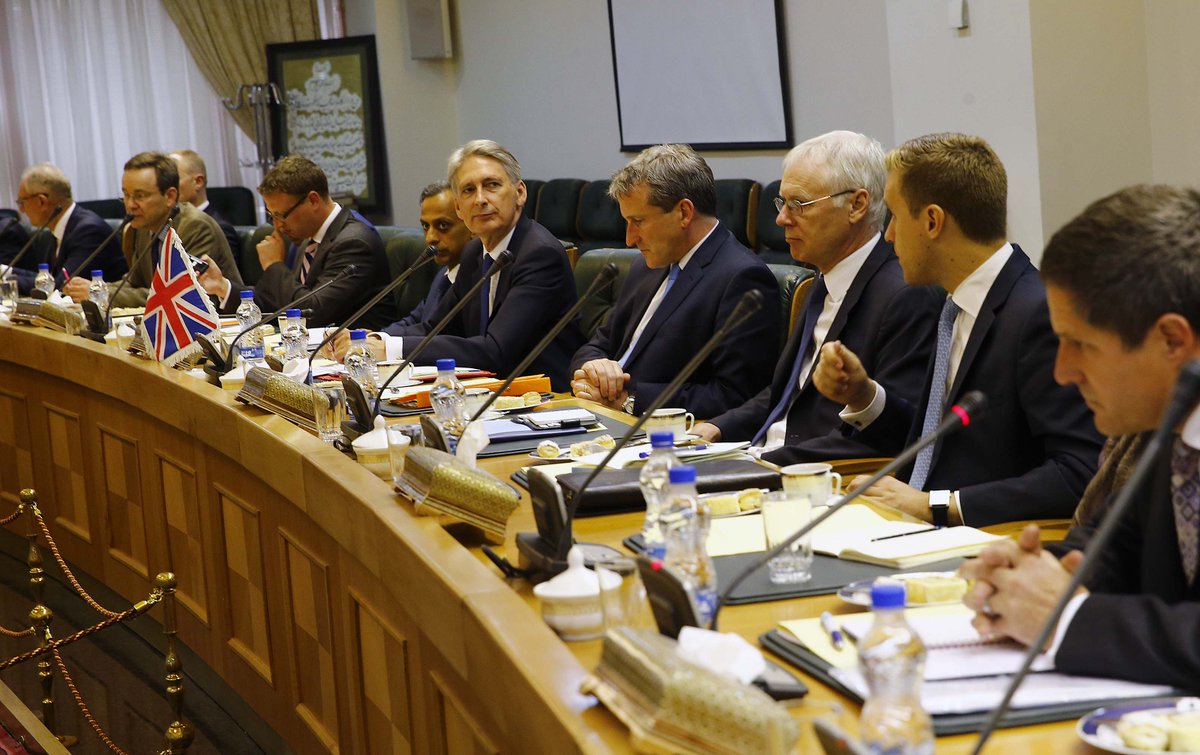
Leading business delegation with to discuss future opportunities in for British business.

Embedded image permalink

Graffiti in Persian reads "Death to England" is seen above a picture of Queen Elizabeth II at the British Embassy in Tehran, Iran   

Courtesy of the Telegraph.

The graffiti above a portrait of the Queen provided a scrawled reminder of just how venomous Anglo-Iranian relations once were.

”Death to England” read the message in orange marker pen, daubed inside the elegant ambassador’s residence of the British embassy in Tehran. The motif was still visible on Sunday when Philip Hammond officially reopened the mission, four years after a mob vandalised its spacious premises.

On November 29 2011, this building along with every other in the embassy’s five-acre compound was ransacked by about 200 people, including members of the regime’s Basij militia.

The Foreign Secretary says Iran and Britain will not always agree but there should be no limit to what the countries can achieve together ….. He said WHAT?

Iran’s ayatollahs will never be friends of the UK

We are heading for disaster if we abandon our historic Middle East allies in favour of friendship with Tehran

In part from the Guardian: Here we go again: another British foreign secretary in Iran with the hopeful expectation of forging closer ties with the ayatollahs. Ever since Iran’s Islamic revolution in 1979, the holy grail of British foreign policy has been to reach out to the moderates in Tehran, thereby isolating the hardliners.

Back in the Eighties when, thanks to Iran’s Revolutionary Guard, British hostages such as Terry Waite and John McCarthy spent five or so years chained to radiators in Lebanon’s Bekaa Valley, Sir Geoffrey Howe, our then foreign secretary, frequently told me that the hostage crisis could be resolved if only we could establish a working relationship with the moderates in Tehran. But for all our entreaties, the hardliners won the day, and the hostages were eventually released when the ayatollahs deemed them to be surplus to their agenda.

More recently, in 2003, New Labour’s Jack Straw believed he had identified a similar moderate tendency in Iran’s political establishment, during the presidency of Mohammad Khatami. This, of course, was in the aftermath of the Iraq War, when the ayatollahs feared – not unduly – that they might be next on President George W Bush’s hit list.

Lord Lamont, the former Tory Chancellor, is one of the more vocal members among an influential group of establishment figures in London who advocate embracing the ayatollahs, a view that is also being enthusiastically taken up by those in the business community who hope to benefit from the estimated £100 billion Iran will soon receive when its overseas assets are released.

But in this unseemly scramble, the Government now appears content to turn a blind eye to some of Iran’s more egregious activities. For example, after an Iranian mob stormed and then trashed the embassy compound in 2011, the Government insisted there would be no restoration of relations until the Iranians paid full compensation for the damage caused. But as this newspaper reports today, Britain has paid the full cost of the repairs.

Similarly, Whitehall would like to draw a discreet veil over similarly vexing issues, such as whether the Home Office will be able to act against Iranian nationals who overstay their welcome in the UK. Without the proper safeguards, we could end up with Hizbollah and Revolutionary Guard terrorists setting up operations in the UK, just like al-Qaeda and Isil have sought to do.

Who is This David Kendall, the Clinton’s Lawyer

If and it is a big IF, some of the Hillary emails in question were not marked with any classified designations, then one must take a hard look at all of Hillary’s inner circle with particular emphasis on Huma Abedin. Why? Huma sent emails to Hillary which was a collection of several classified electronic dispatches that were classified and summarized them into a regular and unprotected email. Confused? More here. Heh, there were passages about snipers, people movement and vehicles.

It seems the New York Times has an axe to grind with the Clintons, imagine that. But the NYT is the go to media outlet when it comes to the White House and it cannot be forgotten that it was in fact the New York Times that was first to draw blood with regard to the Clintons. This was likely due to, but not proven at the hands of Valerie Jarrett protecting the White House from any concocted Clinton scheme and scandal.

Do, who is David Kendall? There must be some praise to the New York Times as they did list some, albeit, some Clinton scandals but the list if far from complete.

As a side matter, it will also come down to who can out-lawyer who in Washington DC…will Kendall always win?

From Whitewater to Email: David Kendall, the Clintons’ Dogged Lawyer

WASHINGTON — At first, he had to worry about a remote piece of land in Arkansas that no one wanted. Then there were billing records that went missing before mysteriously reappearing in the White House. And of course there was the blue dress.

Today, the object of concern for David E. Kendall is a tiny thumb drive that sat in a safe at his law firm until a couple weeks ago before attracting the attention of Congress, the F.B.I. and the news media. Once again, the whirlpool of Washington politics has arrived at Mr. Kendall’s doorstep as he defends perhaps the world’s most famous client.

For more than 20 years, Mr. Kendall has been on the front lines for Bill and Hillary Rodham Clinton as their personal lawyer, battling investigators and litigants in the superheated environment where law and politics meet. From Whitewater to impeachment, he has waged legal warfare to keep the Clintons’ political careers on track. So as Mrs. Clinton faces questions about her use of a personal email server as secretary of state, no one is surprised she turned to Mr. Kendall.

The latest furor has put Mr. Kendall under a spotlight in a way that discomfits the tight-lipped and camera-shy lawyer. From Mrs. Clinton’s foes come public questions about why he had the thumb drive containing her email and whether he secured it properly. From Mrs. Clinton’s friends come private questions about whether he has managed the situation effectively and whether he should be more outspoken to protect a Democratic presidential candidate leading in the polls.

“They always say, ‘Is Kendall the lawyer to do this or that?’” said James Carville, the former political strategist for Mr. Clinton who expresses great admiration for Mr. Kendall. “I never saw that there was a huge conflict. But you know, sometimes lawyers are lawyers and spokespeople are spokespeople.”

Mr. Kendall, said Mr. Carville, is not a public pit bull. “He has no bluster about him,” Mr. Carville said. “He’s aggressive, but he doesn’t have an in-your-face kind of thing about him. I don’t think he views that as his role. The chances that he’s going to talk to the press are way beyond remote.”

Unsurprisingly, Mr. Kendall declined to comment last week. But he enjoys Mrs. Clinton’s deep confidence.

“He has their complete trust, and he’s earned their complete trust,” said Robert Barnett, another lawyer for the Clintons and a partner with Mr. Kendall at Williams & Connolly in Washington. “There’s nobody more dedicated to his clients than David Kendall. There’s nobody who spends more time thinking about how to help his clients than David Kendall.”

To critics, that is the problem. Mr. Kendall, who turned over the thumb drive to the Justice Department on Aug. 6, has become so integrated into the Clinton apparatus that he risks crossing the line from lawyer to participant, they said. Two Republican senators wrote him letters in recent weeks questioning his handling of the thumb drive.

“The problem with the Clintons is once you begin working with them or acting as their agent you often get caught up in their scandals,” said Tom Fitton, the president of Judicial Watch, a watchdog group suing over Mrs. Clinton’s email. “So now Mr. Kendall is stuck having to explain his handling of the classified information Mrs. Clinton gave him.” More from the NYT’s here.

Who is at Fault When it Comes to Syria Refugees?

This matter comes down to no policy on the war in Syria and the misguided, yet no less corrupt leaders in this matter include the National Security Council at the White House, Barack Obama himself and the failed control and management at the State Department which began with Hillary Clinton and now with John Kerry.

The United Nations is at the core of the mismanagement and Western countries are left to clean up the mess, while some are now saying NO.

U.N. Calls on Western Nations to Shelter Syrian Refugees

“In the case of Syrian refugees, our intelligence on the ground is alarmingly slim, making it harder to identify extremists,” said Representative Michael McCaul, Republican of Texas and chairman of the House Homeland Security Committee.

The United Nations high commissioner for refugees, António Guterres, has stepped up calls for industrialized countries, including the United States, to shelter 130,000 Syrian refugees over the next two years.

The figure is a fraction of the nearly four million refugees who have poured into the countries bordering Syria — chiefly Jordan, Lebanon and Turkey — straining their resources and plunging many displaced people into poverty.

So far, the high commissioner’s pleas have not been met. Governments around the world have promised to take in just under two-thirds of what the United Nations is urging, while a great many more Syrians have chosen to make perilous journeys by land and sea in search of asylum in Europe. More here from the New York Times.

McCaul Says Admitting Unvetted Syrian Refugees into the U.S. is “Very Dangerous”

WASHINGTON, D.C. – Chairman Michael McCaul, of the House Homeland Security Committee, wrote a letter to President Obama last Thursday expressing concerns over the Administration’s announced plans to resettle some 2,000 Syrian refugees in the United States this year. Terrorists have made known their plans to attempt to exploit refugee programs to sneak terrorists into the West and the U.S. homeland. Chairman McCaul’s letter points out the potential national security threat this poses to the United States.

Chairman McCaul: “Despite all evidence towards our homeland’s vulnerability to foreign fighters, the Administration still plans to resettle Syrian refugees into the United States. The Director of the National Counterterrorism Center and the Deputy Director of the FBI both sat before my Committee this Congress and expressed their concern with admitting refugees we can’t properly vet from the global epicenter of terrorism and extremism in Syria. America has a proud tradition of welcoming refugees from around the world, but in this special situation the Obama Administration’s Syrian refugee plan is very dangerous.”

Read Chairman McCaul’s letter HERE.


The Subcommittee on Counterterrorism and Intelligence will hold a hearing on June 24th to examine the refugee resettlement program and discuss vulnerabilities to our security exposed by the Administration’s plan.

It was last year that Barack Obama lifted restrictions on the refugee program.

U.S. eases rules to admit more Syrian refugees, after 31 last year

President Barack Obama’s administration announced on Wednesday that it had eased some immigration rules to allow more of the millions of Syrians forced from their homes during the country’s three-year civil war to come to the United States.

Only 31 Syrian refugees – out of an estimated 2.3 million – were admitted in the fiscal year that ended in October, prompting demands for change from rights advocates and many lawmakers.

Hundreds of thousands of Syrians have been taken in by neighboring countries such as Jordan, Lebanon and Turkey.

The rules changes granted exemptions on a case by case basis to the “material support” bar in U.S. immigration law, according to an announcement in the Federal Register signed by Secretary of State John Kerry and Jeh Johnson, the Secretary of Homeland Security.

That bar had made it impossible for anyone who had provided any support to armed rebel groups to come to the United States, even if the groups themselves receive aid from Washington.

The advocacy group Human Rights First said, for example, that the existing law had been invoked to bar a refugee who had been robbed of $4 and his lunch by armed rebels, and a florist who had sold bouquets to a group the United States had designated as a terrorist organization.

“These exemptions will help address the plight of Syrian refugees who are caught up in the worst humanitarian crisis in a generation,” Illinois Senator Richard Durbin, chairman of the U.S. Senate subcommittee on human rights, said in a statement.

It was not immediately clear how many Syrians would be affected by the rules change.

By early January, 135,000 Syrians had applied for asylum in the United States. But the strict restrictions on immigration, many instituted to prevent terrorists from entering the country, had kept almost all of them out.

Washington has provided $1.3 billion in humanitarian assistance to aid Syrian refugees. This year, the United Nations is also trying to relocate 30,000 displaced Syrians it considers especially vulnerable. Witnesses at a Senate hearing last month had testified that Washington would normally accept half.