Have you Met Paul Manafort?

Trump Just Hired His Next Scandal

By

Bloomberg: Here is an irony of the 2016 election season. The candidate promising voters that he won’t be influenced by Washington lobbyists is counting on the influence of a Washington lobbyist to save his presidential campaign.

Late last month Donald Trump hired Paul Manafort — who has represented his organization in Washington — to make sure his delegates at this summer’s convention in Cleveland actually end up voting for him. And for this task, Manafort is well-qualified. He ran delegate operations for the campaigns of Gerald Ford in 1976 and Bob Dole in 1996.

But Manafort’s real specialty is in the netherworld of international lobbying. Trump has criticized both parties as selling out the U.S. to foreign interests. Now he is counting on a man who has represented many of them.

Manafort has offered his services to not one but two presidents driven from power through popular revolution — Viktor Yanukovych in Ukraine and Ferdinand Marcos in the Philippines. He has lobbied for Saudi Arabia, a Bahamanian president suspected of narco-trafficking and a former Angolan rebel leader accused of torture.

For this work, Manafort has been well-compensated. He told a congressional oversight panel in 1989 that his firm normally accepted only clients who would pay at least $250,000 a year as a retainer.

Spy Magazine reported that his firm received $600,000 one year as compensation for his work for Angolan rebel leader, Jonas Savimbi. The Daily Beast reported that Manafort’s work for the Saudis netted him $250,000 for six months of work in 1984. A Justice Department form filed in 2008 from a subcontractor to Manafort’s firm said the PR work alone on behalf of Ukraine’s government was paid at $35,000 a month.

In 2013, Manafort surfaced in a French influence-peddling scandal involving Edouard Balladur, who was prime minister in the mid-1990s. Manafort acknowledged in a Virginia court that he was paid by an adviser to the Saudi royal court more than $200,000 for advice he provided on security issues. That adviser in turn funneled the profits of an arms sale back into Balladur’s political campaign.

Manafort did not respond to an e-mail seeking comment. When asked about his Ukraine lobbying on “Meet the Press” on Sunday, he said that Trump was now his only client.

Most lobbyists make their money from contracts with clients, like lawyers and other consultants. And Manafort does as well. But he has also branched out.

In 1989, Manafort was hauled before Congress for a classic example of Washington double-dealing. His firm received a $326,000 fee for securing for a client a $43 million Department of Housing and Urban Development subsidy for a block of low-income apartments in Seabrook, New Jersey. Manafort then purchased a 20 percent stake in the Seabrook subdivision that was to receive the federal subsidy for which he lobbied.

When a Republican congressman remarked that the whole deal was sleazy, Manafort replied: “We worked the system as it existed. I don’t think we did anything illegal or improper.”

This was not the last time Manafort explored real-estate deals connected to his lobbying work. Documents uncovered in 2014 from a lawsuit brought about by former Ukrainian prime minister Yulia Tymoshenko show that Manafort attempted to set up a real-estate partnership with Dmitry Firtash, a notorious Ukrainian businessman who financed the party of former Ukrainian president Viktor Yanukovych and who is wanted by the FBI on bribery and corruption charges.

The documents, first reported by the Washington Free Beacon, include a Nov. 6, 2008, letter to Manafort from Firtash’s holding company that says it had deposited $25 million in escrow for a plan to buy a tower in Manhattan and was prepared to invest $112 million for the project with the understanding that Manafort’s own Calister Investments LLC will be the project’s developer.

David Kramer, a former senior State Department official who worked on Russia and Ukraine and is currently a senior director for human rights and democracy at the McCain Institute in Washington, told me Manafort was “a persistent lobbyist” for Yanukovych when he was in government. “He was trying to paint Yanukovych as something he wasn’t,” Kramer said of his dealings with Manafort. “The Ukrainian president is a corrupt Soviet-style apparatchik who was interested in coming to power for the sake of serving his own interest and not his country. Manafort portrayed him as somebody who could reform.”

Given that Manafort cashed in on federally subsidized apartments and given that Firtash is accused of trying to bribe public officials, the attempted real-estate deal between the two men at the very least gives the appearance of wrongdoing — the kind of appearance that most presidential candidates would try to avoid.

“Someone who has had such close relations with notorious kleptocrats doesn’t belong anywhere near any of our presidential candidates,” Charles Davidson, executive director of Kleptocracy Initiative at Hudson Institute, told me.

Indeed, in 2008, the McCain campaign considered Manafort for the job of Republican convention manager and then dropped him because of his work with Ukraine and other shadows on his resume.

But Trump is an unconventional candidate. The real-estate mogul with a taste for politics has turned to a political operative with a taste for real estate. In this sense, Trump and his former lobbyist are a perfect match.

**** The Karachi Affair:

In part from Dawn:

French investigators suspect a web of corruption behind the sale of sub-marines from France to Pakistan, with illegal funds going to the Balladur campaign in a scandal known as the ‘Karachi affair’.

Former French president Nicolas Sarkozy, who was a cabinet minister and then prime minister Balladur’s spokesman at the time, is linked to the affair.

Mr Manafort, who was questioned in the US state of Virginia according to Liberation, admitted being paid by Abdul Rahman al Assir, one of two intermediaries along with businessman Ziad Takieddine, brought in at the last minute to sign arms deals with Saudi Arabia and Pakistan.

Mr Takieddine admitted in June carrying briefcases stuffed with cash from Switzerland destined for the Balladur campaign, while his wife said Mr Manafort was a “close friend” of Mr Assir’s.

“In this regard, Ziad told me Paul Manafort was advising the Balladur presidential campaign,” she reportedly told police.

Mr Manafort confirmed her statements but said he was spurned by the Balladur campaign, while the former prime minister’s associates have repeatedly denied meeting him.

Investigators say Mr Manafort, his public relations company or his associates received a total of at least $200,000 between September 1994 and August 1995.

Three more transfers from an account of Mr Assir’s in Madrid to an account of Mr Manafort’s from October 2000 and June 2001 totalling more than $140,000 were later discovered.—AFP
Russian Provocation on U.S. Military, Pact Violation

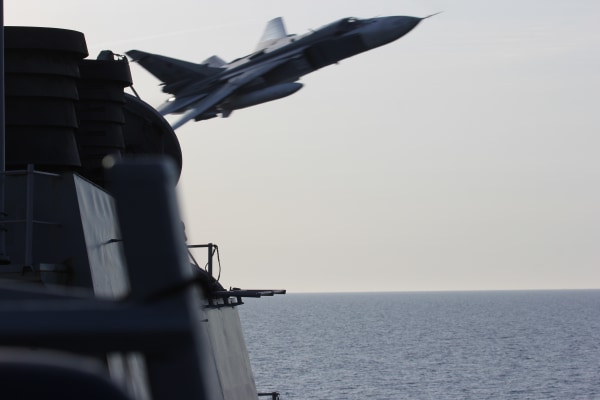
Earlier this week, the Russians buzzed a U.S. guided missile destroyer in the Baltic Sea. This occurred 11 times over 2 days. It is an educated guess that this provocation was meant to be a classified occurrence but our military is angry and leaked it into the public domain. This is hardly the first time the Russians have behave outside the scope of international pacts and conditions against the West and allies.

The Russians did have a response to our complaints, that is if there were any from Washington:

NBC: A U.S. official said the maneuvers were “unsafe” and “unprofessional” — and that the jets were so low they left “wake in the water.” He said a Russian KA-27 helicopter also made seven passes above the destroyer and was believed to be photographing the ship.

Russian Ministry of Defense spokesman Maj. Gen. Igor Konashenkov hit back Thursday, saying that “upon visual contact, the Russian pilots have executed a turnaway from the ship, compliant to all safety regulations.”

Safety regulations? Whose regulations exactly? There is something called the IncSea that prevents as one of the issues THE exact type of incident that Russia is guilty of. Additionally, the Cold War Museum has an interesting story about this exact matter.

Agreement Between the Government of The United States of America and the Government of The Union of Soviet Socialist Republics on the Prevention of Incidents On and Over the High Seas

Bureau of International Security and Nonproliferation


Signed at Moscow May 25, 1972
Entered into force May 25, 1972

Narrative
Treaty Text
Protocol

Narrative

 
In the late 1960s, there were several incidents between forces of the U.S. Navy and the Soviet Navy. These included planes of the two nations passing near one another, ships bumping one another, and both ships and aircraft making threatening movements against those of the other side. In March 1968 the United States proposed talks on preventing such incidents from becoming more serious. The Soviet Union accepted the invitation in November 1970, and the talks were conducted in two rounds — October 1, 1971, in Moscow and May 17, 1972, in Washington, D.C. The Agreement was signed by Secretary of the Navy John Warner and Soviet Admiral Sergei Gorshkov during the Moscow summit meeting in 1972.

Specifically, the agreement provides for:

  • steps to avoid collision;
  • not interfering in the “formations” of the other party;
  • avoiding maneuvers in areas of heavy sea traffic;
  • requiring surveillance ships to maintain a safe distance from the object of investigation so as to avoid “embarrassing or endangering the ships under surveillance”;
  • using accepted international signals when ships maneuver near one another;
  • not simulating attacks at, launching objects toward, or illuminating the bridges of the other partys ships;
  • informing vessels when submarines are exercising near them; and
  • requiring aircraft commanders to use the greatest caution and prudence in approaching aircraft and ships of the other party and not permitting simulated attacks against aircraft or ships, performing aerobatics over ships, or dropping hazardous objects near them.

The agreement also provides for: (1) notice three to five days in advance, as a rule, of any projected actions that might “represent a danger to navigation or to aircraft in flight”; (2) information on incidents to be channeled through naval attaches assigned to the respective capitals; and (3) annual meetings to review the implementation of the Agreement.

The protocol to this agreement grew out of the first meeting of the Consultative Committee established by the agreement. Each side recognized that its effectiveness could be enhanced by additional understandings relating to nonmilitary vessels. In the protocol signed in Washington, D.C., on May 22, 1973, each party pledged not to make simulated attacks against the nonmilitary ships of the other.

Like other confidence-building measures, the Incidents at Sea Agreement does not directly affect the size, weaponry, or force structure of the parties. Rather, it serves to enhance mutual knowledge and understanding of military activities; to reduce the possibility of conflict by accident, miscalculation, or the failure of communication; and to increase stability in times of both calm and crisis. In 1983, Secretary of the Navy John Lehman cited the accord as “a good example of functional navy-to-navy process” and credited this area of Soviet-American relations with “getting better rather than worse.” In 1985, he observed that the frequency of incidents was “way down from what it was in the 1960s and early 1970s.”


Treaty Text

Agreement Between the Government of The United States of America and the Government of The Union of Soviet Socialist Republics on the Prevention of Incidents On and Over the High Seas

Signed at Moscow May 25, 1972
Entered into force May 25, 1972

The Government of the United States of America and the Government of the Union of Soviet Socialist Republics,

Desiring to assure the safety of navigation of the ships of their respective armed forces on the high seas and flight of their military aircraft over the high seas, and

Guided by the principles and rules of international law,

Have decided to conclude this Agreement and have agreed as follows:


Article I
For the purpose of this Agreement, the following definitions shall apply:

1. “Ship” means:


(b) Naval auxiliaries of the Parties, which include all naval ships authorized to fly the naval auxiliary flag where such a flag has been established by either Party.

    (a) A warship belonging to the naval forces of the Parties bearing the external marks distinguishing warships of its nationality, under the command of an officer duly commissioned by the government and whose name appears in the Navy list, and manned by a crew who are under regular naval discipline;

2. “Aircraft” means all military manned heavier-than-air and lighter-than-air craft, excluding space craft.

3. “Formation” means an ordered arrangement of two or more ships proceeding together and normally maneuvered together.


Article II
The Parties shall take measures to instruct the commanding officers of their respective ships to observe strictly the letter and spirit of the International Regulations for Preventing Collisions at Sea, hereinafter referred to as the Rules of the Road. The Parties recognize that their freedom to conduct operations on the high seas is based on the principles established under recognized international law and codified in the 1958 Geneva Convention on the High Seas.


Article III
1. In all cases ships operating in proximity to each other, except when required to maintain course and speed under the Rules of the Road, shall remain well clear to avoid risk of collision.

2. Ships meeting or operating in the vicinity of a formation of the other Party shall, while conforming to the Rules of the Road, avoid maneuvering in a manner which would hinder the evolutions of the formation.

3. Formations shall not conduct maneuvers through areas of heavy traffic where internationally recognized traffic separation schemes are in effect.

4. Ships engaged in surveillance of other ships shall stay at a distance which avoids the risk of collision and also shall avoid executing maneuvers embarrassing or endangering the ships under surveillance. Except when required to maintain course and speed under the Rules of the Road, a surveillant shall take positive early action so as, in the exercise of good seamanship, not to embarrass or endanger ships under surveillance.

5. When ships of both Parties maneuver in sight of one another, such signals (flag, sound, and light) as are prescribed by the Rules of the Road, the International Code of Signals, or other mutually agreed signals, shall be adhered to for signalling operations and intentions.

6. Ships of the Parties shall not simulate attacks by aiming guns, missile launchers, torpedo tubes, and other weapons in the direction of a passing ship of the other Party, not launch any object in the direction of passing ships of the other Party, and not use searchlights or other powerful illumination devices to illuminate the navigation bridges of passing ships of the other Party.

7. When conducting exercises with submerged submarines, exercising ships shall show the appropriate signals prescribed by the International Code of Signals to warn ships of the presence of submarines in the area.

8. Ships of one Party when approaching ships of the other Party conducting operations as set forth in Rule 4 (c) of the Rules of the Road, and particularly ships engaged in launching or landing aircraft as well as ships engaged in replenishment underway, shall take appropriate measures not to hinder maneuvers of such ships and shall remain well clear.


Article IV
Commanders of aircraft of the Parties shall use the greatest caution and prudence in approaching aircraft and ships of the other Party operating on and over the high seas, in particular, ships engaged in launching or landing aircraft, and in the interest of mutual safety shall not permit: simulated attacks by the simulated use of weapons against aircraft and ships, or performance of various aerobatics over ships, or dropping various objects near them in such a manner as to be hazardous to ships or to constitute a hazard to navigation.


Article V
1. Ships of the Parties operating in sight of one another shall raise proper signals concerning their intent to begin launching or landing aircraft.

2. Aircraft of the Parties flying over the high seas in darkness or under instrument conditions shall, whenever feasible, display navigation lights.


Article VI
Both Parties shall:

1. Provide through the established system of radio broadcasts of information and warning to mariners, not less than 3 to 5 days in advance as a rule, notification of actions on the high seas which represent a danger to navigation or to aircraft in flight.

2. Make increased use of the informative signals contained in the International Code of Signals to signify the intentions of their respective ships when maneuvering in proximity to one another. At night, or in conditions of reduced visibility, or under conditions of lighting and such distances when signal flags are not distinct, flashing light should be used to inform ships of maneuvers which may hinder the movements of others or involve a risk of collision.

3. Utilize on a trial basis signals additional to those in the International Code of Signals, submitting such signals to the Intergovernmental Maritime Consultative Organization for its consideration and for the information of other States.


Article VII
The Parties shall exchange appropriate information concerning instances of collision, incidents which result in damage, or other incidents at sea between ships and aircraft of the Parties. The United States Navy shall provide such information through the Soviet Naval Attache in Washington and the Soviet Navy shall provide such information through the United States Naval Attache in Moscow.


Article VIII
This Agreement shall enter into force on the date of its signature and shall remain in force for a period of three years. It will thereafter be renewed without further action by the Parties for successive periods of three years each.

This Agreement may be terminated by either Party upon six months written notice to the other Party.


Article IX
The Parties shall meet within one year after the date of the signing of this Agreement to review the implementation of its terms. Similar consultations shall be held thereafter annually, or more frequently as the Parties may decide.


Article X
The Parties shall designate members to form a Committee which will consider specific measures in conformity with this Agreement. The Committee will, as a particular part of its work, consider the practical workability of concrete fixed distances to be observed in encounters between ships, aircraft, and ships and aircraft. The Committee will meet within six months of the date of signature of this Agreement and submit its recommendations for decision by the Parties during the consultations prescribed in Article IX.

DONE in duplicate on the 25th day of May 1972 in Moscow in the English and Russian languages each being equally authentic.


FOR THE GOVERNMENT OF THE UNITED STATES OF AMERICA:

John W. Warner

Secretary of the Navy

FOR THE GOVERNMENT OF THE UNION OF SOVIET SOCIALIST REPUBLICS:

Sergei G. Gorshkov

Commander-in-Chief of the Navy


Protocol to the Agreement Between the Government of The United States of America and the Government of The Union of Soviet Socialist Republics on the Prevention of Incidents On and Over the High Seas Signed May 25, 1972

Signed at Washington May 22, 1973
Entered into force May 22, 1973

The Government of the United States of America and the Government of the Union of Soviet Socialist Republics, herein referred to as the Parties,

Having agreed on measures directed to improve the safety of navigation of the ships of their respective armed forces on the high seas and flight of their military aircraft over the high seas,

Recognizing that the objectives of the Agreement may be furthered by additional understandings, in particular concerning actions of naval ships and military aircraft with respect to the non-military ships of each Party,

Further agree as follows:


Article I
The Parties shall take measures to notify the non-military ships of each Party on the provisions of the Agreement directed at securing mutual safety.


Article II
Ships and aircraft of the Parties shall not make simulated attacks by aiming guns, missile launchers, torpedo tubes and other weapons at non-military ships of the other Party, nor launch nor drop any objects near non-military ships of the other Party in such a manner as to be hazardous to these ships or to constitute a hazard to Navigation.


Article III
 

This Protocol will enter into force on the day of its signing and will be considered as an integral part of the Argument between the Government of the United States of America and the Government of the Union of Soviet Socialist Republics on the Prevention of Incidents On and Over the High Seas which was signed in Moscow on May 25, 1972.


DONE on the 22nd of May, 1973 in Washington, in two copies, each in the English and the Russian language, both texts having the same force.

FOR THE GOVERNMENT OF THE UNITED STATES OF AMERICA:

J.P. Weinel

Vice Admiral, U.S. Navy

FOR THE GOVERNMENT OF THE UNION OF SOVIET SOCIALIST REPUBLICS:

Alekseyev, Admiral


50,000-troop coalition needed in order to crush ISIS

General Odierno was a guest at The Foundation for the Defense of Democracies. There was a fascinating question and answer session between the General and Fox News Catherine Herridge.

Operation Hemorrhage: The Terror Plans to Wreck the West’s Economy

Some of the points made by General Odierno included:  Odierno says at FDDWF that Obama decision to pull US troops from Iraq became “self-inflicted wound.”

  •  [U.S.] lost its intelligence network when we withdrew from Iraq
  • What I worry most about ISIS is that they are growing fast and their perception of success
  • We can defeat  the ISIS military, but we need a solution for what happens next after success
  • I am not sure we have capabilities to respond to crisis on five continents
  • We’ve loss capability [in latest defense cuts]
  • Today it is harder and harder to have a unified Iraq because of Iranian influence
  • Kurds have fought heroically and we need to train them and provide economic support
  • Airstrikes have some impact but will not solve all problems as we must enable force on the ground and having people on the ground would enable our air capabilities to be more successful
  • When our military left [Iraq] we lost political influence in the country and region
  • The whole time [U.S.] were there the Syrian government was complicit with al Qaeda
  • I worry [U.S.] have isolationist tendencies and the next president needs to strengthen our [diplomatic] relationships the rest of the world wants the U.S. involved

Top general: 50,000-troop coalition needed in order to crush ISIS

FNC: It will take a coalition of 50,000 troops on the ground to defeat the Islamic State, according to the former army chief of staff who spent more than four years serving in Iraq and who is credited, along with retired General David Petraeus, with being the architect of the successful 2007 troop surge there.

In this Jan. 1, 2010 file photo, Gen. Ray Odierno is shown at a news conference at Camp Victory in Baghdad.

“Probably around 50,000,” said Gen. Raymond T. Odierno during a panel discussion moderated by Fox News for the Foundation for Defense of Democracies.

Odierno, who received the George P. Shultz award for distinguished service, emphasized the 50,000 would not all be U.S. troops, but the coalition would need to be U.S.- led.

While the general, who commanded all U.S. forces from 2008 to 2010, said he supports a unified country, he added the U.S. government needs to consider whether Iraq has already been divided into three sectors by the sectarian violence — Shia, Sunni and Kurd. Odierno fingered the newly emboldened Iran as a primary agitator.

“Today, I think it’s becoming harder and harder to have a unified Iraq,” he said. “And the reason is I believe the influence of Iran inside of Iraq is so great, they will never allow the Sunnis to participate in a meaningful way in the government. If that doesn’t happen, you cannot have a unified Iraq.”

Odierno, who argued for leaving 20,000 troops in Iraq but met resistance from several senior Obama administration officials as well as then Iraqi President Nouri al-Maliki, said the decision to pull out became a self-inflicted wound.

The withdrawal made it harder, if not impossible, for the U.S. government to independently assess what was happening on the ground, at a time when the alienation of the Sunni population fueled the rise of ISIS.

“We lost what we call our human intelligence network on the ground,” he said. “I mean we used to have a pretty significant human intelligence operation. So as we pulled out, our U.S. military, we lose it. So we have to depend on Iraqis, which they collect intelligence, but they do it a little bit differently than we do and they look for different things.”

Speaking at the CIA Wednesday, President Obama touted the air campaign against ISIS, though Odierno said air power can only go so far, and working with the local Iraqis was the cornerstone of the surge.

When he was in Iraq, Odierno had first-hand knowledge of the ISIS leader Omar al-Baghdadi, who, at the time was a nondescript bomb maker with control over small Baghdad neighborhoods.

“We had captured him a couple of times, released him. He then fled to, I think, Syria. And then he shows (up) – and all of a sudden, I see him on TV making a pronouncement that he’s the head of ISIS,” Odierno recalled. “You have these individuals who’ve grown up now fighting the U.S. or whatever – an insurgency – and that becomes their life. And so they continue to grow and grow and grow and some of them become leaders of a movement, which is what he did.”

The retired general continued to sound the alarm about military cuts, saying the army has “lost capability” at a time when the likelihood of responding to threats on five continents is not hypothetical.

At the same time, the number of American troops dropped from over 100,000 to 50,000. In 2015, the White House sent 450 military advisers to train and assist Iraqi forces battling ISIS, with 5,000 troops.

Fox News’ William Turner contributed to this report.

Putin Building a Big Bridge, One Problem Though

Crimea lost forever to Putin, and Ukraine is not happy.

The bridge is supposed to have a rail system but the design of the bridge it appears does not support that. (includes video)

In this video, it is a beautiful propaganda bridge.

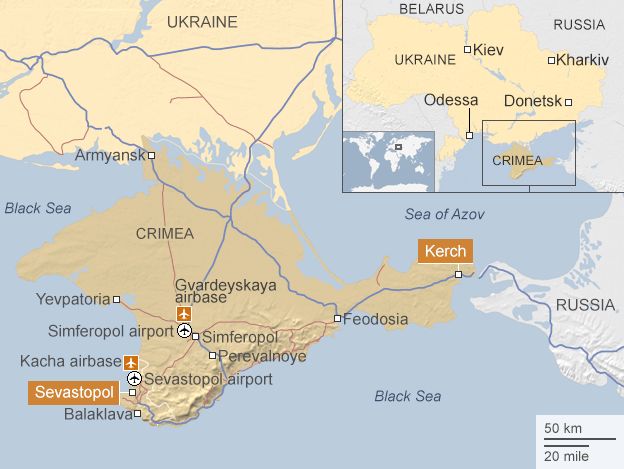
BBC: A Russian contract for building a bridge to Crimea has gone to a company majority-owned by a friend of Vladimir Putin who is under Western sanctions.

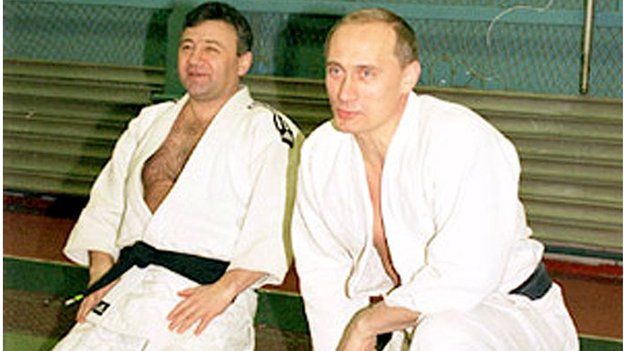
The $3bn (£2bn) contract was awarded to the SGM Group, owned by Arkady Rotenberg, a childhood friend and judo partner of the Russian president.

The bridge will join Russia directly to the peninsula it annexed from Ukraine in March after a disputed referendum.

It will be pipeline specialist SGM’s first bridge, Reuters news agency says.

It is still unclear where on the Kerch Strait the structure will be erected, meaning the span could be anything from 4km to 15km (2.5 to 9 miles).

Announcing the contract in a statement, Russia’s transport ministry said the bridge should be finished by the end of 2018.

Currently, Crimea is connected to Russia by sea and by air, while land routes through Ukraine have been affected by the conflict in its eastern provinces.

map

Rotenberg’s legacy?

The annexation of the peninsula sparked sanctions on Russia by the EU, US and their allies and Mr Rotenberg was one of the first Russian businessmen to be put under Western visa bans and asset freezes.

In an interview with Russian daily Kommersant, Arkady Rotenberg welcomed the contract but said it would probably be his last project.

“At 63 I think more about what should be left behind, what will be the results of life,” he said.

Arkady Rotenberg with Vladimir Putin practising judo
Image caption Arkady Rotenberg (left) with Vladimir Putin practising judo

“Moreover, I long planned to gradually stop running businesses… But the bridge project came along and I decided it was very important to carry it out. It is important for the country.”

According to the US Treasury, Arkady Rotenberg and his brother Boris provided “support to Putin’s pet projects” by receiving and executing approximately $7bn (£4.7bn) of contracts for the Sochi Olympic Games and state-controlled energy giant Gazprom, through which their personal wealth increased by $2.5bn (£1.6bn).

The brothers deny getting help from the Russian leader for their businesses.


Mossack Fonseca Offices Raided, and Spies too?

Panama raids offices of Mossack Fonseca law firm

Reuters:Panama’s attorney general late on Tuesday raided the offices of the Mossack Fonseca law firm to search for any evidence of illegal activities, authorities said in a statement.

The Panama-based law firm is at the center of the “Panama Papers” leaks scandal that has embarrassed several world leaders and shone a spotlight on the shadowy world of offshore companies.

The national police, in an earlier statement, said they were searching for documentation that “would establish the possible use of the firm for illicit activities.” The firm has been accused of tax evasion and fraud.

Police offers and patrol cars began gathering around the company’s building in the afternoon under the command of prosecutor Javier Caravallo, who specializes in organized crime and money laundering.

Mossack Fonseca, which specializes in setting up offshore companies, did not respond to requests for comment on Tuesday.

Earlier, founding partner Ramon Fonseca said the company had broken no laws, destroyed no documents, and all its operations were legal.

Governments across the world have begun investigating possible financial wrongdoing by the rich and powerful after the leak of more than 11.5 million documents, dubbed the Panama Papers, from the law firm that span four decades.

The papers have revealed financial arrangements of prominent figures, including friends of Russian President Vladimir Putin, relatives of the prime ministers of Britain and Pakistan and of China’s President Xi Jinping, and the president of Ukraine.

There are more details. From Joseph FITSANAKIS of IntelNews in part:

The Süddeutsche Zeitung said on Monday that senior intelligence officials from Rwanda and Colombia are listed as Mossack Fonseca customers, but did not report the names of the individuals. It did, however, single out the late Sheikh Kamal Adham, who was director of Saudi Arabia’s General Intelligence Directorate in the 1960s and 1970s. During his 14-year directorship of the GID, the agency became a leading intermediary between the CIA and Arab intelligence agencies, notably those of Egypt and Iraq. Sheikh Adham was also a personal friend of CIA Director George Bush, who was later elected US president.

According to the Süddeutsche Zeitung, Sheikh Adham is one of many individuals with close CIA links whose names appear in the Panama Papers. Another is Farhad Azima, an Iranian-born American businessman, who is rumored to have leased aircraft to the CIA in the 1980s. The American intelligence agency is said to have used the aircraft, which belonged to Azima’s Kansas City, Missouri-headquartered Global International Airways, to transport weapons to Iran. The secret transfers were part of what later became known as the Iran-Contra scandal, in which US officials secretly sold weapons to Iran in return for the release of American hostages held by Iran-linked groups in the Middle East. The funds acquired from these weapons sales were then secretly funneled to the Contras, a medley of anti-communist paramilitary groups fighting the Sandinista-led government of Nicaragua.