For DHS, Terror Attacks are Really Just Violent Extremism


Press Release

June 15, 2016 — In December 2015, I announced the revision of the Department of Homeland Security’s National Terrorism Advisory System, or “NTAS,” to include an intermediate level NTAS “Bulletin.” We then issued a new NTAS Bulletin at the same time. The duration of the December Bulletin was six months, and expires tomorrow.

June 15, 2016

National Terrorism Advisory System Bulletin

Date Issued:  Wednesday, June 15, 2016
View as PDF:  National Terrorism Advisory System Bulletin – June 15, 2016 (pdf, 1 page, 876.65KB)

Summary

In December, we described a new phase in the global threat environment, which has implications on the homeland. This basic assessment has not changed. In this environment, we are particularly concerned about homegrown violent extremists who could strike with little or no notice. The tragic events of Orlando several days ago reinforce this. Accordingly, increased public vigilance and awareness continue to be of utmost importance. This bulletin has a five-month duration and will expire just before the holiday season. We will reassess the threats of terrorism at that time.

Duration

Issued:  June 15, 2016
Expires:  November 15, 2016

Details

  • Since issuing the first Bulletin in December, our concerns that violent extremists could be inspired to conduct attacks inside the U.S. have not diminished.
  • Though we know of no intelligence that is both specific and credible at this time of a plot by terrorist organizations to attack the homeland, the reality is terrorist-inspired individuals have conducted, or attempted to conduct, attacks in the United States.
  • DHS is especially concerned that terrorist-inspired individuals and homegrown violent extremists may be encouraged or inspired to target public events or places.
  • As we saw in the attacks in San Bernardino, Paris, Brussels, and, most recently, Orlando, terrorists will consider a diverse and wide selection of targets for attacks.
  • Terrorist use of the Internet to inspire individuals to violence or join their ranks remains a major source of concern.
  • In the current environment, DHS is also concerned about threats and violence directed at particular communities and individuals across the country, based on perceived religion, ethnicity, nationality or sexual orientation.

U.S. Government Counterterrorism Efforts

  • DHS and the FBI continue to provide guidance to state and local partners on increased security measures.  The public may observe an increased law enforcement and security presence across communities, in public places and at events in the months ahead. This may include additional restrictions and searches on bags, more K-9 teams, and the use of screening technologies.
  • The FBI is investigating potential terrorism-related activities associated with this broad threat throughout the United States.  Federal, state, and local authorities are coordinating numerous law enforcement actions and conducting community outreach to address this evolving threat.

Types of Advisories

Bulletin

Describes current developments or general trends regarding threats of terrorism.

Elevated Alert

Warns of a credible terrorism threat against the United States.

Imminent Alert

Warns of a credible, specific and impending terrorism threat against the United States.

How You Can Help

  • Report suspicious activity to local law enforcement or public safety officials who are best positioned to respond and offer specific details on terroristic indicators.
  • Suspicious activity or information about a threat may also be reported to Fusion Centers and the FBI’s Field Offices – part of the Nationwide Suspicious Activity Reporting Initiative.
  • Learn how to recognize signs of pre-operational planning associated with terrorism or other criminal activity.

Be Prepared

  • Be prepared for increased security and plan ahead to anticipate delays and restricted/prohibited items.
  • In populated places, be responsible for your personal safety. Make a mental note of emergency exits and locations of the nearest security personnel. Keep cell phones in your pockets instead of bags or on tables so you don’t lose them during an incident. Carry emergency contact details and any special needs information with you at all times. For more visit Ready.

Stay Informed

  • The U.S. Government will provide additional information about any emerging threat as additional information is identified. The public is encouraged to listen to local law enforcement and public safety officials.
  • We urge Americans to continue to travel, attend public events, and freely associate with others but remain vigilant and aware of surroundings.
  • The Department of State issues international travel alerts and warnings.

If You See Something, Say Something™. Report suspicious activity to local law enforcement or call 911.
Guccifer 2.0, the Hacked Trump Files from the DNC

The intrusions at the DNC are noteworthy for the sophistication of the groups behind it. One of the intrusions, by a well-known cyberespionage group called Cozy Bear, appears to have happened in the summer of 2015, according to Crowdstrike‘s CTO and co-founder Dmitri Alperovitch. The second breach, involving another Russian group, Fancy Bear, happened in April this year.

Cozy Bear has been previously associated with attacks on the White House and the US. State Department. The group has also been tied to numerous attacks on US defense contractors, government agencies, financial services companies, technology firms and think tanks, Alperovich said.  Fancy Bear, or Sofacy, as the group is also known, is similarly believed responsible for targeted attacks on various government and private sector organizations in multiple countries including the US, Canada, China and Japan, he said.

The two groups did not appear to be collaborating with each other or communicating in any fashion on the DNC attacks. But both targeted the same systems and the same data, employing a variety of sophisticated techniques in the process Crowdstrike’s CTO and co-founder Dmitri Alperovitch said in a blog post.

The Cozy Bear team used a Python-based malware tool dubbed SeaDaddy and another backdoor in Powershell to gain persistence on comprised DNC systems and to remain undetected on them for more than a year. According to Alperovitch, the Powershell backdoor was noteworthy for its use of a one-line command to establish an encrypted connection with command and control servers and for downloading additional modules.

The Fancy Bear group meanwhile used a different malware sample to remotely execute malicious commands on compromised DNC systems, to transmit files and to enable keylogging. The group deployed tactics like periodically clearing event logs and resetting the timestamps in files in an attempt to conceal their activities. More details here from DarkReading.

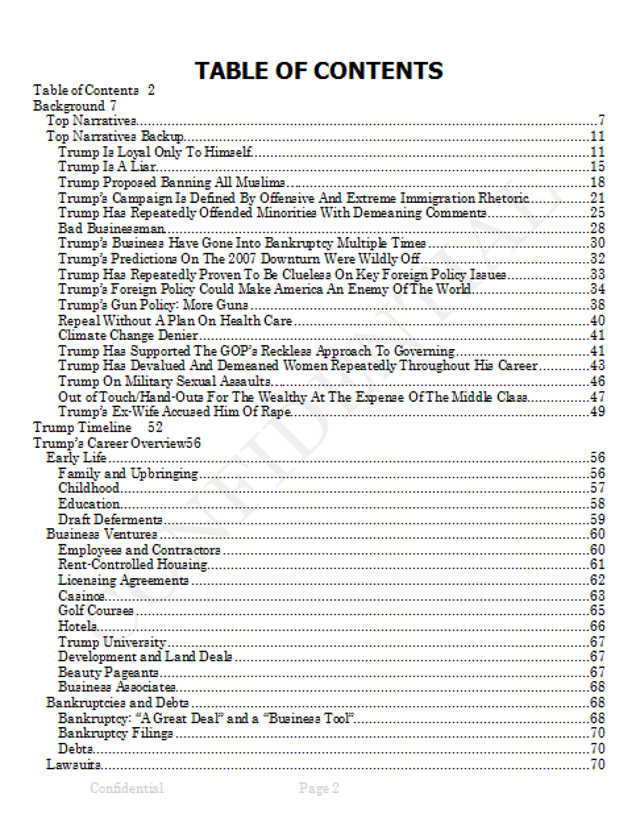
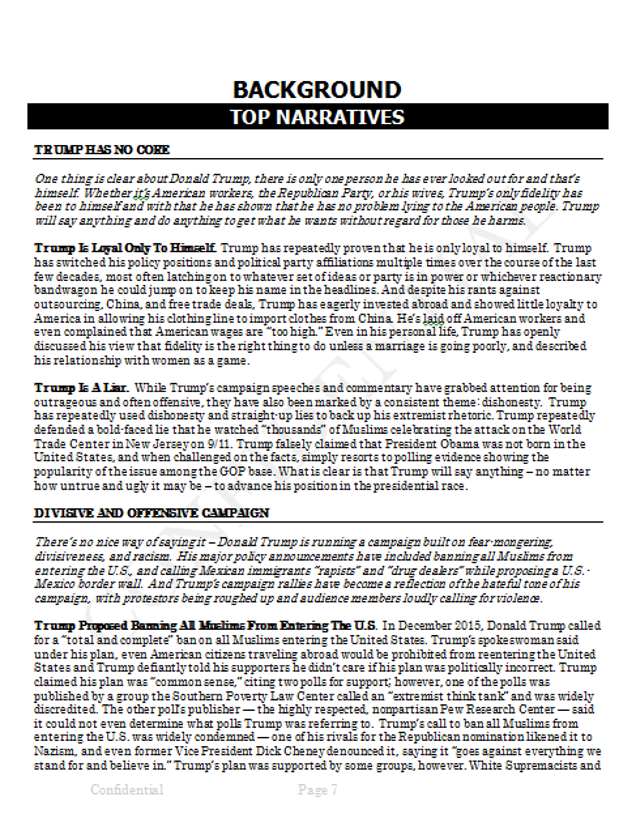
Gawker: A 200+ page document that appears to be a Democratic anti-Trump playbook compiled by the Democratic National Committee has leaked online following this week’s report that the DNC was breached by Russian hackers. In it, Trump is pilloried as a “bad businessman” and “misogynist in chief.”

The document—which according to embedded metadata was created by a Democratic strategist named Warren Flood—was created on December 19th, 2015, and forwarded to us by an individual calling himself “Guccifer 2.0,” a reference to the notorious, now-imprisoned Romanian hacker who hacked various American political figures in 2013.

The package forwarded to us also contained a variety of donor registries and other strategy files, “just a few docs from many thousands I extracted when hacking into DNC’s network,” the purported hacker claimed over email, adding that he’s in possession of “about 100 Gb of data including financial reports, donors’ lists, election programs, action plans against Republicans, personal mails, etc.”

Advertisement

His stated motive is to be “a fighter against all those illuminati that captured our world.”

The enormous opposition document, titled simply “Donald Trump Report,” appears to be a summary of the Democratic Party’s strategy for delegitimizing and undermining Trump’s presidential aspirations—at least as they existed at the end of last year, well before he unseated a field of establishment Republicans and clinched the nomination. A section titled “Top Narratives” describes a seven-pronged attack on Trump’s character and record.

Sponsored

The first is the argument that “Trump has no core”:

One thing is clear about Donald Trump, there is only one person he has ever looked out for and that’s himself. Whether it’s American workers, the Republican Party, or his wives, Trump’s only fidelity has been to himself and with that he has shown that he has no problem lying to the American people. Trump will say anything and do anything to get what he wants without regard for those he harms.

Second, that Trump is running a “divisive and offensive campaign”:

There’s no nice way of saying it – Donald Trump is running a campaign built on fear-mongering, divisiveness, and racism. His major policy announcements have included banning all Muslims from entering the U.S., and calling Mexican immigrants “rapists” and “drug dealers” while proposing a U.S.-Mexico border wall. And Trump’s campaign rallies have become a reflection of the hateful tone of his campaign, with protestors being roughed up and audience members loudly calling for violence.

Third, Trump is a “bad businessman”:

Despite Trump’s continual boasting about his business success, he has repeatedly run into serious financial crises in his career and his record raises serious questions about whether he is qualified to manage the fiscal challenges facing this country. Trump’s business resume includes a long list of troubling issues, including his company’s record of forcing people from their homes to make room for developments and outsourcing the manufacturing of his clothing line to take advantage of lower-wage countries like China and Mexico. His insight about the marketplace has proven wrong many times, including in the run-up to the Great Recession. And Trump’s record of irresponsible and reckless borrowing to build his empire – behavior that sent his companies into bankruptcy four times – is just one indication of how out-of-touch he is with the way regular Americans behave and make a living, and it casts doubt on whether he has the right mindset to tackle the country’s budget problems.

Fourth, Trump espouses “dangerous & irresponsible policies”:

Trump’s policies – if you can call them that – are marked by the same extreme and irresponsible thinking that shape his campaign speeches. There is no question that Donald Trump’s rhetoric is dangerous – but his actual agenda could be a catastrophe.

Fifth, in classically corny Democratic Party style, Donald Trump is the “misogynist in chief”:

Through both his words and actions, Trump has made clear he thinks women’s primary role is to please men. Trump’s derogatory and degrading comments to and about women, as well as his tumultuous marriages, have been well publicized. And as a presidential candidate, Trump has adopted many of the backwards GOP policies that we’ve come to expect from his party.

Sixth, Donald Trump is an “out of touch” member of the elite:

Trump’s policies clearly reflect his life as a 1-percenter. His plans would slash taxes for the rich and corporations while shifting more of the burden to the shoulders of working families. He stands with Republicans in opposing Wall Street reform and opposing the minimum wage. Trump clearly has no conception of the everyday lives of middle class Americans. His description of the “small” $1 million loan that his father gave him to launch his career is proof enough that his worldview is not grounded in reality.

The seventh strategy prong is to focus on Trump’s “personal life,” including that “Trump’s Ex-Wife Accused Him Of Rape,” which is true.

What follows is roughly two hundred pages of dossier-style background information, instances of Trump dramatically changing his stance on a litany of issues, and a round-up of the candidate’s most inflammatory and false statements (as of December ‘15, at least).

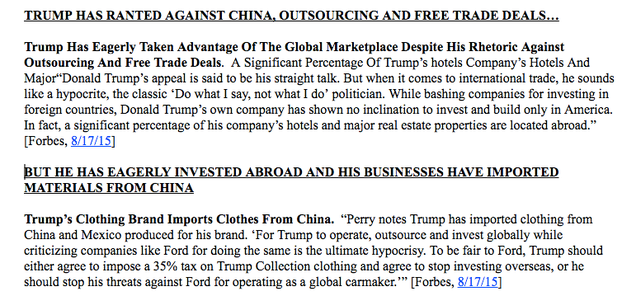
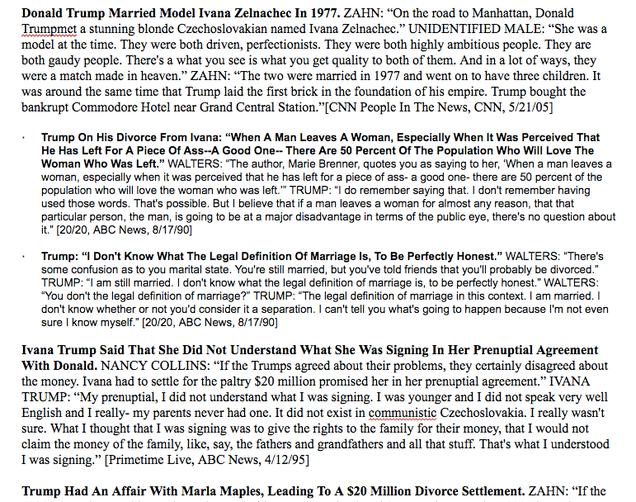
It appears that virtually all of the claims are derived from published sources, as opposed to independent investigations or mere rumor. It’s also very light on anything that could be considered “dirt,” although Trump’s colorful marital history is covered extensively:

The DNC hack was first revealed Tuesday, when the cybersecurity firm CrowdStrike announced it had discovered two hacking collectives, linked to Russian intelligence, inside the DNC network after the DNC reported a suspected breach. In a blog post, the company identified the groups as “COZY BEAR” and “FANCY BEAR”—two “sophisticated adversaries” that “engage in extensive political and economic espionage for the benefit of the government of the Russian Federation.”

The hackers were able to access opposition files and may have been able to read email and chat traffic, but did not touch any financial, donor, or personal information, the DNC said Tuesday. However, the user who sent the files to Gawker refuted that claim, writing, “DNC chairwoman Debbie Wasserman Schultz said no financial documents were compromised. Nonsense! Just look through the Democratic Party lists of donors! They say there were no secret docs! Lies again! Also I have some secret documents from Hillary’s PC she worked with as the Secretary of State.”

Among the files sent to Gawker are what appear to be several lists of donors, including email addresses and donation amounts, grouped by wealth and specific fundraising events. Gawker has not yet been able to verify that the Trump file was produced by the DNC, but we have been able to independently verify that the financial documents were produced by people or groups affiliated with the Democratic Party.

Also included are memos marked “confidential” and “secret” that appear to date back to 2008, and pertain to Obama’s transition into the White House, and a file marked “confidential” containing Hillary’s early talking points, at least some of which ended up being repeated verbatim in her April, 2015 candidacy announcement.

Finally, there is a May, 2015 memo outlining a proposed strategy against the field of potential GOP candidates. Donald Trump, who had not yet officially announced his candidacy, does not appear in the document.

The purported hacker writes “it was easy, very easy” to hack and extract thousands of files from the DNC network, “the main part” of which he or she claims are in the custody of Wikileaks. He or she also appears to have sent the documents to The Smoking Gun, which posted about the dossier earlier today.

Warren Flood did not immediately return a request for comment. DNC Press Secretary Mark Paustenbach was not able to immediately confirm the authenticity of the documents, but the party is aware that they’re circulating.

Official List of Bilderberg Meeting/Topics

2016 Bilderberg Meeting

Dresden, Germany 9-12 June
Final list of Participants


CHAIRMAN
Castries, Henri de (FRA), Chairman and CEO, AXA Group

Aboutaleb, Ahmed (NLD), Mayor, City of Rotterdam
Achleitner, Paul M. (DEU), Chairman of the Supervisory Board, Deutsche Bank AG
Agius, Marcus (GBR), Chairman, PA Consulting Group
Ahrenkiel, Thomas (DNK), Permanent Secretary, Ministry of Defence
Albuquerque, Maria Luís (PRT), Former Minister of Finance; MP, Social Democratic Party
Alierta, César (ESP), Executive Chairman and CEO, Telefónica
Altman, Roger C. (USA), Executive Chairman, Evercore
Altman, Sam (USA), President, Y Combinator
Andersson, Magdalena (SWE), Minister of Finance
Applebaum, Anne (USA), Columnist Washington Post; Director of the Transitions Forum, Legatum Institute
Apunen, Matti (FIN), Director, Finnish Business and Policy Forum EVA
Aydin-Düzgit, Senem (TUR), Associate Professor and Jean Monnet Chair, Istanbul Bilgi University
Barbizet, Patricia (FRA), CEO, Artemis
Barroso, José M. Durão (PRT), Former President of the European Commission
Baverez, Nicolas (FRA), Partner, Gibson, Dunn & Crutcher
Bengio, Yoshua (CAN), Professor in Computer Science and Operations Research, University of Montreal
Benko, René (AUT), Founder and Chairman of the Advisory Board, SIGNA Holding GmbH
Bernabè, Franco (ITA), Chairman, CartaSi S.p.A.
Beurden, Ben van (NLD), CEO, Royal Dutch Shell plc
Blanchard, Olivier (FRA), Fred Bergsten Senior Fellow, Peterson Institute
Botín, Ana P. (ESP), Executive Chairman, Banco Santander
Brandtzæg, Svein Richard (NOR), President and CEO, Norsk Hydro ASA
Breedlove, Philip M. (INT), Former Supreme Allied Commander Europe
Brende, Børge (NOR), Minister of Foreign Affairs
Burns, William J. (USA), President, Carnegie Endowment for International Peace
Cebrián, Juan Luis (ESP), Executive Chairman, PRISA and El País
Charpentier, Emmanuelle (FRA), Director, Max Planck Institute for Infection Biology
Coeuré, Benoît (INT), Member of the Executive Board, European Central Bank
Costamagna, Claudio (ITA), Chairman, Cassa Depositi e Prestiti S.p.A.
Cote, David M. (USA), Chairman and CEO, Honeywell
Cryan, John (DEU), CEO, Deutsche Bank AG
Dassù, Marta (ITA), Senior Director, European Affairs, Aspen Institute
Dijksma, Sharon A.M. (NLD), Minister for the Environment
Döpfner, Mathias (DEU), CEO, Axel Springer SE
Dyvig, Christian (DNK), Chairman, Kompan
Ebeling, Thomas (DEU), CEO, ProSiebenSat.1
Elkann, John (ITA), Chairman and CEO, EXOR; Chairman, Fiat Chrysler Automobiles
Enders, Thomas (DEU), CEO, Airbus Group
Engel, Richard (USA), Chief Foreign Correspondent, NBC News
Fabius, Laurent (FRA), President, Constitutional Council
Federspiel, Ulrik (DNK), Group Executive, Haldor Topsøe A/S
Ferguson, Jr., Roger W. (USA), President and CEO, TIAA
Ferguson, Niall (USA), Professor of History, Harvard University
Flint, Douglas J. (GBR), Group Chairman, HSBC Holdings plc
Garicano, Luis (ESP), Professor of Economics, LSE; Senior Advisor to Ciudadanos
Georgieva, Kristalina (INT), Vice President, European Commission
Gernelle, Etienne (FRA), Editorial Director, Le Point
Gomes da Silva, Carlos (PRT), Vice Chairman and CEO, Galp Energia
Goodman, Helen (GBR), MP, Labour Party
Goulard, Sylvie (INT), Member of the European Parliament
Graham, Lindsey (USA), Senator
Grillo, Ulrich (DEU), Chairman, Grillo-Werke AG; President, Bundesverband der Deutschen Industrie
Gruber, Lilli (ITA), Editor-in-Chief and Anchor “Otto e mezzo”, La7 TV
Hadfield, Chris (CAN), Colonel, Astronaut
Halberstadt, Victor (NLD), Professor of Economics, Leiden University
Harding, Dido (GBR), CEO, TalkTalk Telecom Group plc
Hassabis, Demis (GBR), Co-Founder and CEO, DeepMind
Hobson, Mellody (USA), President, Ariel Investment, LLC
Hoffman, Reid (USA), Co-Founder and Executive Chairman, LinkedIn
Höttges, Timotheus (DEU), CEO, Deutsche Telekom AG
Jacobs, Kenneth M. (USA), Chairman and CEO, Lazard
Jäkel, Julia (DEU), CEO, Gruner + Jahr
Johnson, James A. (USA), Chairman, Johnson Capital Partners
Jonsson, Conni (SWE), Founder and Chairman, EQT
Jordan, Jr., Vernon E. (USA), Senior Managing Director, Lazard Frères & Co. LLC
Kaeser, Joe (DEU), President and CEO, Siemens AG
Karp, Alex (USA), CEO, Palantir Technologies
Kengeter, Carsten (DEU), CEO, Deutsche Börse AG
Kerr, John (GBR), Deputy Chairman, Scottish Power
Kherbache, Yasmine (BEL), MP, Flemish Parliament
Kissinger, Henry A. (USA), Chairman, Kissinger Associates, Inc.
Kleinfeld, Klaus (USA), Chairman and CEO, Alcoa
Kravis, Henry R. (USA), Co-Chairman and Co-CEO, Kohlberg Kravis Roberts & Co.
Kravis, Marie-Josée (USA), Senior Fellow, Hudson Institute
Kudelski, André (CHE), Chairman and CEO, Kudelski Group
Lagarde, Christine (INT), Managing Director, International Monetary Fund
Levin, Richard (USA), CEO, Coursera
Leyen, Ursula von der (DEU), Minister of Defence
Leysen, Thomas (BEL), Chairman, KBC Group
Logothetis, George (GRC), Chairman and CEO, Libra Group
Maizière, Thomas de (DEU), Minister of the Interior, Federal Ministry of the Interior
Makan, Divesh (USA), CEO, ICONIQ Capital
Malcomson, Scott (USA), Author; President, Monere Ltd.
Markwalder, Christa (CHE), President of the National Council and the Federal Assembly
McArdle, Megan (USA), Columnist, Bloomberg View
Michel, Charles (BEL), Prime Minister
Micklethwait, John (USA), Editor-in-Chief, Bloomberg LP
Minton Beddoes, Zanny (GBR), Editor-in-Chief, The Economist
Mitsotakis, Kyriakos (GRC), President, New Democracy Party
Morneau, Bill (CAN), Minister of Finance
Mundie, Craig J. (USA), Principal, Mundie & Associates
Murray, Charles A. (USA), W.H. Brady Scholar, American Enterprise Institute
Netherlands, H.M. the King of the (NLD)
Noonan, Michael (IRL), Minister for Finance
Noonan, Peggy (USA), Author, Columnist, The Wall Street Journal
O’Leary, Michael (IRL), CEO, Ryanair Plc
Ollongren, Kajsa (NLD), Deputy Mayor of Amsterdam
Özel, Soli (TUR), Professor, Kadir Has University
Papalexopoulos, Dimitri (GRC), CEO, Titan Cement Co.
Petraeus, David H. (USA), Chairman, KKR Global Institute
Philippe, Edouard (FRA), Mayor of Le Havre
Pind, Søren (DNK), Minister of Justice
Ratti, Carlo (ITA), Director, MIT Senseable City Lab
Reisman, Heather M. (CAN), Chair and CEO, Indigo Books & Music Inc.
Rutte, Mark (NLD), Prime Minister
Sawers, John (GBR), Chairman and Partner, Macro Advisory Partners
Schäuble, Wolfgang (DEU), Minister of Finance
Schieder, Andreas (AUT), Chairman, Social Democratic Group
Schmidt, Eric E. (USA), Executive Chairman, Alphabet Inc.
Scholten, Rudolf (AUT), CEO, Oesterreichische Kontrollbank AG
Schwab, Klaus (INT), Executive Chairman, World Economic Forum
Sikorski, Radoslaw (POL), Senior Fellow, Harvard University; Former Minister of Foreign Affairs
Simsek, Mehmet (TUR), Deputy Prime Minister
Sinn, Hans-Werner (DEU), Professor for Economics and Public Finance, Ludwig Maximilian University of Munich
Skogen Lund, Kristin (NOR), Director General, The Confederation of Norwegian Enterprise
Standing, Guy (GBR), Co-President, BIEN; Research Professor, University of London
Svanberg, Carl-Henric (SWE), Chairman, BP plc and AB Volvo
Thiel, Peter A. (USA), President, Thiel Capital
Tillich, Stanislaw (DEU), Minister-President of Saxony
Vetterli, Martin (CHE), President, NSF
Wahlroos, Björn (FIN), Chairman, Sampo Group, Nordea Bank, UPM-Kymmene Corporation
Wallenberg, Jacob (SWE), Chairman, Investor AB
Weder di Mauro, Beatrice (CHE), Professor of Economics, University of Mainz
Wolf, Martin H. (GBR), Chief Economics Commentator, Financial Times

Press Release

The 64th Bilderberg meeting is set to take place from 9 – 12 June 2016 in Dresden, Germany. A total of around 130 participants from 20 countries have confirmed their attendance. As ever, a diverse group of political leaders and experts from industry, finance, academia and the media have been invited. The list of participants is available on www.bilderbergmeetings.org.

The key topics for discussion this year include:

Current events
China
Europe: migration, growth, reform, vision, unity
Middle East
Russia
US political landscape, economy: growth, debt, reform
Cyber security
Geo-politics of energy and commodity prices
Precariat and middle class
Technological innovation

Founded in 1954, the Bilderberg conference is an annual meeting designed to foster dialogue between Europe and North America. Every year, between 120-150 political leaders and experts from industry, finance, academia and the media are invited to take part in the conference. About two thirds of the participants come from Europe and the rest from North America; approximately one third from politics and government and the rest from other fields.


The conference is a forum for informal discussions about major issues facing the world. The meetings are held under the Chatham House Rule, which states that participants are free to use the information received, but neither the identity nor the affiliation of the speaker(s) nor any other participant may be revealed.

Thanks to the private nature of the conference, the participants are not bound by the conventions of their office or by pre-agreed positions. As such, they can take time to listen, reflect and gather insights. There is no desired outcome, no minutes are taken and no report is written. Furthermore, no resolutions are proposed, no votes are taken, and no policy statements are issued.

NATO Launches CyberSpace Mission

NATO to Recognize Cyberspace as New Frontier in Defense


Nasdaq: BRUSSELS—Allied defense ministers formally recognized cyberspace as a domain of warfare on Tuesday, an acknowledgment that modern battles are waged not only in air, sea and land, but also on computer networks.

The move comes the same day as the Democratic National Committee announced its computers had been hacked by the Russian government. DNC officials said the hackers made off with its opposition research related to Donald Trump, the presumptive Republican nominee for President.

The effort is designed to bolster allies’ cyberdefenses, but also will begin a debate over whether NATO should eventually use cyberweapons that can shut down enemy missiles and air defenses or destroy adversaries’ computer networks.

“This is important to all possible conflicts we can foresee,” he said.

Mr. Stoltenberg declined to address the suspected cyberhack on the Democratic National Committee by the Russian government, and wouldn’t name any potential cyber adversaries, noting that NATO’s cyberdefenses weren’t aimed at any one country. U.S. and allied officials have previously said Russia remains the greatest cyberthreat to the alliance.

Developing capabilities to more quickly attribute responsibility for cyberintrusions and cyberattacks is a priority for the alliance, Mr. Stoltenberg said.

“One of the challenge when it comes to cyber is it is not easy to tell who is attacking you,” he said.

The decision by the ministers will allow the alliance to better coordinate its cyberspace efforts and defenses, Mr. Stoltenberg said.

“This is about developing our abilities and capabilities to protect NATO cyber networks but also to help and assist nations in defending their cyber networks,” he said.

For now, the alliance is focused on defending its own secure networks and helping allies build their cyberdefenses.

Tuesday’s announcement to recognize cyberspace as new sphere of conflict or battleground constitutes a bit of catch- up by the alliance. The U.S. military, for example, has expanded its cyber command, improved its training and developed weaponry and defenses to deploy in cyberspace.

The change comes as the number of cyberattacks against the alliance and member states has been increasing, a senior NATO official said.

By making cyber a warfare domain, NATO will open the door to stepped up military planning, dedicate more officers to cyber operations and better integrate electronic warfare into its military exercises.

Two years ago, at the previous summit in Wales, NATO leaders announced a cyberattack on one ally could trigger the alliance’s collective defense provisions.

Under NATO’s founding treaty, each ally primarily has responsibility for its own defense. But NATO officials acknowledge that the alliance is only as strong as its weakest link, which makes helping nations improve their cyber capabilities a priority.

As part of efforts to counter so-called hybrid warfare threats, the use of covert forces to stir unrest or make military gains, NATO has been pushing member countries to improve their cyberdefenses.

Russia has made cyber and electronic warfare a key part of its military operations. U.S. and allied officials said that Russia has demonstrated its willingness to use such techniques to interfere with the military capabilities of its opponents in Ukraine. Russia denies it is involved militarily in Ukraine.

U.S. officials have said countering Russia’s improving militarily capabilities—such as its advanced missiles and air defenses in the Kaliningrad exclave on the border of Poland and Lithuania—could require cyber capabilities.

“Russia has sophisticated cyber capabilities,” said Vaidotas Urbelis, the defense policy director for the Lithuania ministry of defense. “But, come on, NATO nations have invested a lot in cyber and we have the capacity to defend ourselves.”

On Monday, Douglas Lute, the U.S. ambassador to NATO said cyber operations could be a key part of the alliance’s defense against stepped up Russian advances in anti-access weaponry.

“A networked air defense system can be jammed. It can be disrupted by way of cyber techniques,” Mr. Lute said.

A discussion of additional NATO cyber capabilities—or offensive capabilities—is likely to wait until after the conclusion of the alliance summit in Warsaw next month.

The alliance lags well behind its most militarily advanced members, including the U.S. and Britain, in developing its cyber capabilities. In any potential conflict, the alliance would need to rely on the U.S. and its use of cyber weaponry.

“We welcome the decision to recognize cyber as a domain,” said British Defense Secretary Michael Fallon, adding the U.K. has committed some $2 billion for its own cyberdefenses and capabilities.

The U.S. Army has been increasing its cyberdefense training at its training centers in the U.S. and Europe. A pilot program begun last year has aimed embedding “cyber elements” with tactical units.

“We know a variety of countries have increasing cyber capabilities that can interfere with your communications, your global position and navigating systems, your targeting systems,” said a U.S. defense official.
*****

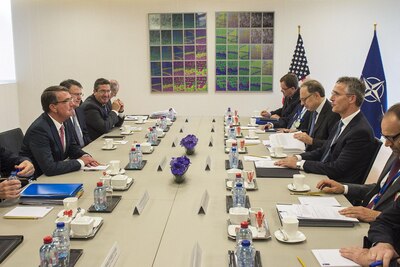
Defense Secretary Ash Carter, left, talks with NATO Secretary General Jens Stoltenberg, right, at NATO headquarters in Brussels, June 14, 2016, during a meeting of NATO defense minister. The two leaders met to discuss matters of mutual importance. DoD photo by Air Force Senior Master Sgt. Adrian Cadiz

Last year saw was a small uptick in defense spending across Europe and Canada, Stoltenberg said. “Our estimates for 2016 show a further increase across NATO’s European allies and Canada,” said he added. “These are only estimates. But they are encouraging.”

The annual real change in NATO defense spending, he said, currently stands at around 1.5 percent, which represents an increase of more than $3 billion.

Plans to Boost Defense Spending

Some 20 NATO allies plan to spend more in real terms on defense this year, Stoltenberg said.

“So, this is real progress,” he said. “After many years of going in the wrong direction, we are starting to go into the right direction.”

With more money comes increased capabilities, Stoltenberg said, noting that NATO has agreed to place four battalions in the eastern nations of the alliance.

“Based on the advice of our military planners, we will agree to deploy by rotation four robust multinational battalions in the Baltic states and in Poland,” he said. “This will send a clear signal that NATO stands ready to defend any ally. More from the Department of Defense.


WikiLeaks to Provide Hillary Secret Emails

Nevermind, State Dept. – WikiLeaks is about to publish a batch of Hillary’s secret illegal emails

BizPac: WikiLeaks founder Julian Assange has not been in the news much recently, but the online provocateur is roaring back in the forefront this week with an announcement that will bedevil the Hillary Clinton campaign anew. Assange said he is set to release another large batch of emails Hillary sent from her illegal, secret server while she was Obama’s Secretary of State.

The announcement comes as the presumptive nominee for the Democrat Party presidential candidate essentially clinched the delegates needed to become the nominee even as she continues to fend off suspicions over whether or not the FBI will recommend she be indicted for breaking the nation’s security laws with her private, hackable email accounts.

According to The Guardian, Assange made his comments on the British political TV show “Peston on Sunday” saying, “We have upcoming leaks in relation to Hillary Clinton … We have emails pending publication, that is correct.”


Assange’s WikiLeaks already has a searchable data base of over 30,000 Clinton emails encompassing over 50,000 pages of documents sent from June 30, 2010, to August of 2014. The trove of information can be seen at WikiLeaks’ Hillary Clinton Email Archive.

When asked if he thought the U.S. Department of Justice would indict Hillary for breaking U.S. national security laws, Assange said that Obama would never allow it. Speaking of U.S. Attorney General Loretta Lynch, Assange said, “he’s not going to indict Hillary Clinton, that’s not possible. It’s not going to happen. But the FBI can push for concessions from a Clinton government.”

Assange, no fan of Hillary, also insisted she is a warmonger saying, “she has a long history of being a liberal war hawk.”

The WikiLeaks chief also slammed Internet giant Google for being “intensely aligned” with Clinton’s campaign.

Indeed, Assange’s comments come on the heels of charges that Google cooks its algorithms in order to hide the many decades of scandals connected to the Clintons when Google users search her name.

Recently Danny Sullivan of the website Search Engine Land realized that there is no automatic search parameter recommendation in the Google Search bar for “Crooked Hillary.” In contrast,”Lying Ted” comes up in the search bar as soon as users start typing the word “lying.”

Search Engine Land even discovered that searches for “Lying Ted” and “Crooked Hilary,” both terms used on the campaign trail by GOP front-runner Donald Trump, have been searched a similar number of times, yet the Hillary search still doesn’t afford users an automatic recommendation.

This led many to charge that Google is trying to make sure Hillary’s lies and criminal charges are harder for users to find.

This also led Robert Epstein, a psychologist at the American Institute for Behavioral Research and Technology, to say Google could help throw the presidential election to Hillary.

“We estimate, based on win margins in national elections around the world that Google could determine the outcome of upwards of 25 percent of all national elections,” Epstein said in a new study of Google’s search algorithm as reported in Wired magazine.