Obama to Evict Thousands, Julian and Hillary?

Obama administration considering evictions of thousands from low-income housing

WashingtonTimes:The Department of Housing and Urban development announced Tuesday that it would consider evicting tens of thousands of public housing residents who earn too much money to qualify for public housing.

The announcement comes in response to a July audit from the department’s Office of Inspector General that revealed over 25,000 families had an income that exceeded the maximum level to qualify for government-assisted housing. At least one tenant had roughly nearly $1 million in assets.

Now the department will reexamine tenant’s public housing needs in an effort to root out “over-income” tenants occupying low-income housing that is desperately needed by poorer families.

“Some of those families significantly exceeded the income limits,” HUD wrote in the Federal Register, warning that “scarce public resources must be provided to those most in need of affordable housing.”

Currently, federal law does not prohibit over-income families from continuing to live in low-income housing as long as they met the income requirements when they moved in.

Now HUD is grappling with whether to evict over-income tenants and how long to give them to find new homes.

“An increase in income is a good and welcomed event for families, and when a family’s income steadily rises, it may be an indication that the family is on its way to self-sufficiency,” HUD wrote.

“Any changes that would require the termination of tenancy for over-income families should be enacted with caution so as not to impede a family’s progress,” the agency continued.

The department will seek comment from the public on what to do about over-income families over the next 30 days.

The House is expected to vote Tuesday on an Amendment proposed by Rep. Vern Buchanan, Florida Republican, to tighten income asset verification requirements for public housing applicants.

“It is outrageous that taxpayers are footing the bill for millionaires’ housing,” Mr. Buchanan said in a statement. “This type of abuse hurts truly needy families and erodes faith in government. Holding HUD to the same standards used for other federal benefits will provide much-needed oversight on taxpayer funds and help create consistency across the vast array of assistance programs.”

*** HUD is corrupt and the Secretary of HUD, Julian Castro is just as corrupt. But as a sidebar, he is earnestly jockeying for sharing the presidential ticket with Hillary Clinton.

HUD Secretary Julian Castro attends Maine fundraiser for Clinton

He headlines the private event at the law offices of Preti Flaherty in Portland.

Julian Castro, the U.S. Housing and Urban Development secretary and a rising star in the Democratic Party, was in Portland Monday morning for a private fundraiser for presidential candidate Hillary Clinton.

The event at the law offices of Preti Flaherty in downtown Portland included U.S. Rep. Chellie Pingree and longtime Maine lobbyist and attorney Tony Buxton.

According to an invitation provided by Hillary for America, Castro’s visit was billed as “coffee and conversation.” It was closed to the public and to the media.

Castro arrived at the fundraiser with Pingree and his twin brother, U.S. Rep. Joaquin Castro, D-Texas. After the event, Julian Castro said the crowd was enthusiastic and looking forward to seeing Clinton win the nomination.

When asked if he would accept if Clinton wins the nomination and asks him to run for vice president, he would say only that he is focused on his work with HUD and campaigning for Clinton.

“Both Joaquin and I are happy to help her out,” he said.

Julian Castro, the former mayor of San Antonio, was tabbed by President Obama in 2014 to serve as secretary of the Department of Housing and Urban Development. His ethnic background – Mexican American – makes him a powerful surrogate for Clinton, who will likely need strong support from Hispanic voters, both in the Democratic primaries and in the general election, if she becomes the nominee.

During an interview Monday morning on the “Ken & Mike” show on WGAN, the Castro brothers said they have long supported Clinton, whom they described as a tenacious and strong leader.

When asked by the radio hosts if he would accept an invitation to be Clinton’s running mate if she wins the nomination, Julian Castro said he feels “it’s not going to happen.”

“That’s flattering, but I doubt that,” he said. “I fully expect a year from now to be back in Texas.”

So you voters for Hillary, here is some more facts, Julian is a radical, a Marxist.

Mayor Julian Castro of San Antonio, who will be giving the keynote address tonight, is, according to some, the next Obama. But while Obama’s radicalism may have escaped the notice of the DNC in 2004, Castro’s views are bit more transparent.

Indeed, he, along with his twin, Joaquin, currently running for Congress, learned their politics on their mother’s knee and in the streets of San Antonio. Their mother, Rosie helped found a radical, anti-white, socialist Chicano party called La Raza Unida (literally “The Race United”) that sought to create a separate country–Aztlan–in the Southwest.

Today she helps manage her sons’ political careers, after a storied career of her own as a community activist and a stint as San Antonio Housing Authority ombudsman.

Far from denouncing his mother’s controversial politics, Castro sees them as his inspiration. As a student at Stanford Castro penned an essay for Writing for Change: A Community Reader (1994) in which he praised his mother’s accomplishments and cited them as an inspiration for his own future political involvement.

“[My mother] sees political activism as an opportunity to change people’s lives for the better. Perhaps that is because of her outspoken nature or because Chicanos in the early 1970s (and, of course, for many years before) had no other option. To make themselves heard Chicanos needed the opportunity that the political system provided. In any event, my mother’s fervor for activism affected the first years of my life, as it touches it today.

Castro wrote fondly of those early days and basked in the slogans of the day. “‘Viva La Raza!’ ‘Black and Brown United!’ ‘Accept me for who I am–Chicano.’ These and many other powerful slogans rang in my ears like war cries.” These war cries, Castro believes, advanced the interests of their political community. He sees her rabble-rousing as the cause for Latino successes, not the individual successes of those hard-working men and women who persevered despite some wrinkles in the American meritocracy.

[My mother] insisted that things were changing because of political activism, participation in the system. Maria del Rosario Castro has never held a political office. Her name is seldom mentioned in a San Antonio newspaper. However, today, years later, I read the newspapers, and I see that more Valdezes are sitting on school boards, that a greater number of Garcias are now doctors, lawyers, engineers, and, of course, teachers. And I look around me and see a few other brown faces in the crowd at [Stanford]. I also see in me a product of my mother’s diligence and her friends’ hard work. Twenty years ago I would not have been here…. My opportunities are not the gift of the majority; they are the result of a lifetime of struggle and commitment by adetermined minority. My mother is one of these persons. And each year I realize more and more how much easier my life has been made by the toil of past generations. I wonder what form my service will take, since I am expected by those who know my mother to continue the family tradition. [Emphasis Castro’s]
Govt Employees Concerned About Cyber Intrusions, Hillary?

Not nearly enough when every government employee is not fretting over cyber espionage most of all those at the State Department.

Nearly 9 in 10 Government Employees Concerned about Cyber Breaches in Their Organization


The public sector experienced nearly 50 times more cyber incidents than any other industry in 2014, and government agencies consistently cite implementing robust, agile cybersecurity measures as a top priority. As threats continue to evolve in both scale and capacity, it is increasingly essential that organizations devise and implement robust, agile measures to continuously detect, monitor, and address both external and internal vulnerabilities.

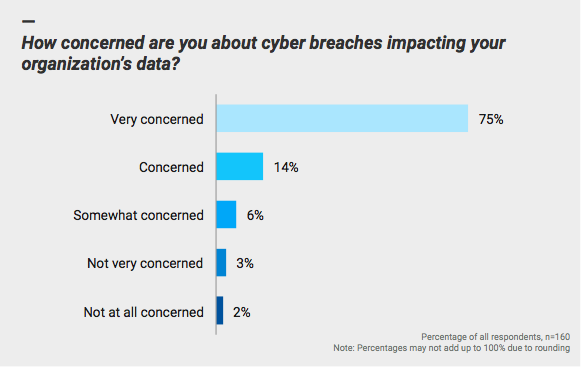
In an effort to learn more about the perspective of public sector employees on cybersecurity, Government Business Council conducted a flash poll on the following question:

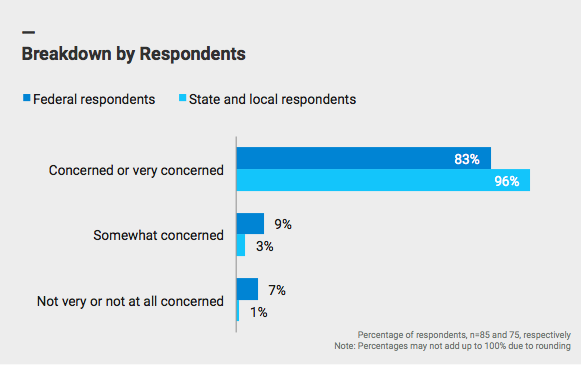
GBC received responses from 160 federal, state, and local government employees. Nearly 90% stated that they were concerned or very concerned about the impact of cyber attacks; only 5% were not very concerned or not at all concerned about potential breaches. The results also reveal cybersecurity to be a more pressing concern for state and local organizations than for their federal counterparts: 96% of state and local respondents were concerned or very concerned about breaches, a 13-point difference from the percentage of federal employees expressing a similar level of concern.

Lack of resources might make cybersecurity a more pressing issue for state organizations — according to a 2015 survey of state CIOs, 64% cited insufficient funding as a major barrier against addressing cyber threats, and 62% cited inadequate availability of security professionals. There is also a disconnect between perception of state cybersecurity capabilities and reality: while 60% of state officials had a high level of confidence in the ability of states to defend against attacks, only a quarter of state CISOs responded likewise.

Moving forward, state and federal agencies should continue to invest in developing a cohesive cybersecurity strategy, recruiting and retaining personnel with the relevant skill set, and sharing threat information and best practices across organization. As federal CIO Tony Scott puts it, “Cyber threats cannot be eliminated entirely, but they can be managed much more effectively. And we can best do this by aligning and focusing our efforts, by properly funding necessary cyber investments, by building strong partnerships across government and industry, and by drawing on the best ideas and talent from across the country to tackle this quintessential problem of the 21st century.” GBC will revisit this topic in future research posts.

‘This was all planned’: Former IG says Hillary, State Dept. are lying

NYPost: The State Department is lying when it says it didn’t know until it was too late that Hillary Clinton was improperly using personal emails and a private server to conduct official business — because it never set up an agency email address for her in the first place, the department’s former top watchdog says.

“This was all planned in advance” to skirt rules governing federal records management, said Howard J. Krongard, who served as the agency’s inspector general from 2005 to 2008.

The Harvard-educated lawyer points out that, from Day One, Clinton was never assigned and never used a state.gov email address like previous secretaries.

“That’s a change in the standard. It tells me that this was premeditated. And this eliminates claims by the State Department that they were unaware of her private email server until later,” Krongard said in an exclusive interview. “How else was she supposed to do business without email?”

He also points to the unusual absence of a permanent inspector general during Clinton’s entire 2009-2013 term at the department. He said the 5½-year vacancy was unprecedented. Much more to Sperry’s summary is here.

What do the former military special forces have to say on the matter of Hillary and even some betrayal within their own ranks?

Sofrep: A source within the State Department confirmed with SOFREP back in 2012 that Hillary’s top aid within the department pre-interviewed people regarding Benghazi before they were interviewed by the State Department’s own internal Benghazi Accountability Review Board.

The problem with the State Department investigating itself is that the investigation produced no significant change in the dysfunctional leadership, nor did it hold people accountable for clear negligence (the top three at fault being Hillary Clinton, Charlene Lamb, and Patrick Kennedy). The organization continues to rot from the top down.

Hillary, in particular, shares something in common with former Navy SEAL Team 6 member Matt Bissonette: They both potentially disclosed top secret government information, a clear violation of her non-disclosure agreement and oath. They also share pending legal problems with the feds.

The federal government continues to aggressively pursue Bissonette and anyone associated with him for disclosures in his book “No Easy Day” and for new information found on his personal computer that Bissonette turned over to federal investigators. SOFREP knows of at least one additional active-duty member forced to retire early as a result of information found on Bissonette’s laptop. Will the same measure of justice and accountability be applied to the political celebrity and former Secretary of State Clinton?

In a recent New York Times article, the editorial board endorsed Hillary Clinton as an experienced presidential candidate.

As secretary of state, Mrs. Clinton worked tirelessly, and with important successes, for the nation’s benefit. She was the secretary President Obama needed and wanted: someone who knew leaders around the world, who brought star power as well as expertise to the table. The combination of a new president who talked about inclusiveness and a chief diplomat who had been his rival but shared his vision allowed the United States to repair relations around the world that had been completely trashed by the previous administration. -NY Times editorial board 

Hillary leveraged her political star power to secure her position as secretary of state, a clear Democrat concession prize for losing to Obama last time around. It was likely her strategic plan to further build her resume, and wait things out until 2016. She did little to promote American diplomacy or secure global stability abroad (two pillars of the department’s mission statement).

This is a woman that will do and say anything to get what she wants. I have very little respect for her. I know what she said to me and she can say all day long that she didn’t say it. That’s her cross to bear. She knows that she knew what happened that day, and she wasn’t truthful, and that has come out in the last hearings — that she told her family one thing and was telling the public another thing. —Sister of fallen hero Glen Doherty, Kate Quigley  Full article and video is here.


DHS Fleecing and Iffy Bookkeeping

DHS Reports Spending Only 1 Percent of its $1.4B Training Budget

Though Congress provides more than $1 billion in funds to train personnel at the Department of Homeland Security, DHS spends a small fraction of that on workforce training—at least according to its bookkeepers.

jehjohnsonmain.jpg

As an example of the iffy bookkeeping, auditors found that in fiscal 2014, Congress provided $1.4 billion for training, but the department reported spending only $1.9 million to the Office of Personnel Management. And as of August 2015, the DHS Office of the Chief Financial Officer could account for only $267 million in training expenditures in the prior year. Such lack of oversight on data quality, the Homeland Security inspector general found, meant the department reported only 1 percent of its training expenditures that year.

“DHS lacks reliable training cost information and data needed to make effective and efficient management decisions,” the IG concluded in a report released Wednesday. “It does not have an effective governance structure for its training oversight, including clearly defined roles, responsibilities, and delegated authorities” to oversee training programs, the watchdog wrote.

The difficulty the massive department would have in tracking training funds was predicted as far back as 2003, when the Government Accountability Office named human capital management as a high-risk area for the fledgling new department merging 22 agencies.

But DHS has failed to fully implement as many as 29 recommendations for improving training efficiencies made by several working groups, the new report said.

Among other problems, the IG found that the Transportation Security Administration did not report any training costs for January 2015, but after being questioned by IG staff, that agency reported $23 million in training expenditures.

DHS also lacks an oversight structure to monitor training after it transferred authority in 2012 to the Office of the Chief Financial Officer and to departmental components. Such oversight is supposed to be supervised by the undersecretary for management, through the chief financial officer.

Inspector General John Roth recommended that DHS establish a better process for tracking training funds, set up an oversight structure and implement the remaining past efficiency recommendations.

Departmental managers agreed with the recommendations, with corrective actions underway for completion this year.

The actual Inspector General report is here.

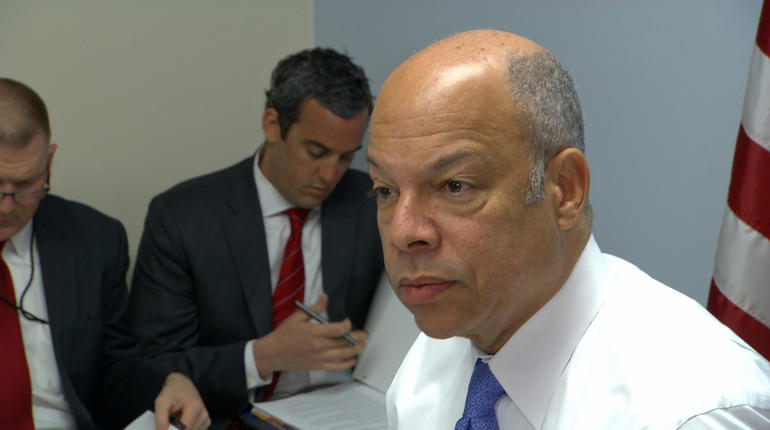
Here is a previous interview with DHS Secretary Jeh Johnson, where he gives clues that he is in way above his head.

John Kerry Sent Classified Material via iPad to Hillary

Quietly, this past Friday, January 29, the State Department did release some emails that you are invited to harvest. Here is that link.

Ever wonder where John Kerry has been with regard to Hillary’s emails? After all, he heads the State Department that is tasked with sorting, reviewing, classifying and posting Hillary’s emails? Ever wonder when and if they are going to search personal property including homes for printed material? In fairness, the intelligence community and the FBI assigned this expensive task of Hillary’s emails and server (the whole expense of which she should personally pay for) is quite concerned to determine all the compromised conditions by foreign espionage and intelligence operations. Further, another area for real concern, is the Clinton Global Foundation which appears to be in full violation of IRS ‘foundation’ law a matter that will require a separate huge investigation, that is IF the IRS well….heh would even cooperate legitimately.

Then there is Sidney Blumenthal and those emails.

State Dept. Records Show John Kerry Sent Hillary A ‘SECRET’ Email From His iPad

 Ross/DailyCaller: Emails released by the State Department on Friday show that in 2011, then-Massachusetts Sen. John Kerry sent then-Sec. of State Hillary Clinton an email from his iPad that has been deemed to contain information classified as “Secret.”While previous releases of Clinton’s emails have shown that she and her staff communicated directly with Kerry when he was a senator, the new email is the first from Kerry that the State Department has determined contains sensitive information.

Kerry has largely been silent throughout the Clinton email controversy. He has sent letters asking the State Department’s inspector general to review the agency’s records keeping practices, but he has not publicly criticized Clinton for exclusively using a personal email account and a home-brew email server.

Perhaps now we know why.

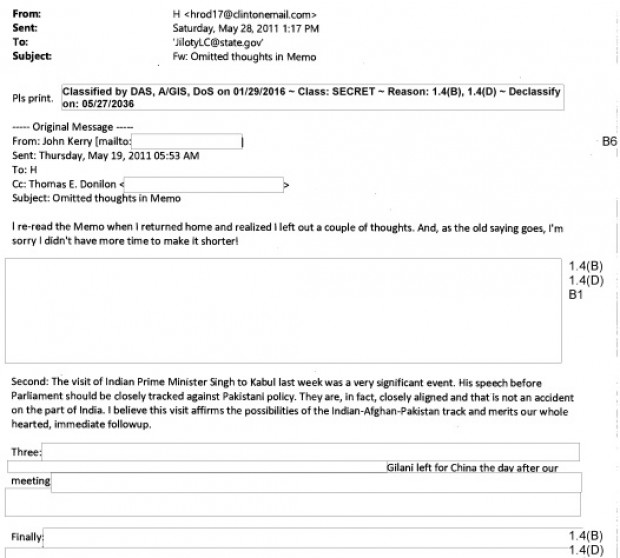
In the heavily-redacted email, dated May 19, 2011, Kerry, who then chaired the Senate Foreign Relations Committee, appears to be discussing negotiations between India and Pakistan. Besides Clinton, the email was sent to Tom Donilon, who then served as President Obama’s National Security Advisor.

kerryemail

Clinton forwarded the email to an aide, instructing her to “Pls print” the document.

The redactions in the email are listed under the Freedom of Information Act exemptions 1.4(b) and 1.4(d), which are categories reserved for information gleaned from foreign government sources.

The kicker is that Kerry sent Clinton the information from his iPad, a communications device that would have been much more vulnerable to hackers than an encrypted communications system.

According to the Republican National Committee, which flagged the Kerry email in an email to reporters, the batch of Clinton records released on Friday contained 11 emails that the State Department now says contain “Secret” information. That’s more than double the number of emails that contained similarly classified information released in all of the previous releases combined.

According to the RNC’s calculations, 243 emails released Friday were classified at some level, bringing the overall number of classified Clinton emails to 1,583. The State Department also announced Friday that it is withholding in full and into perpetuity 22 emails that contain “Top Secret” information — the highest classification category.

The State Department says it is uncertain whether the information in those emails was classified at the time they were originated. The Intelligence Community’s inspector general has said that two separate Clinton emails were contained information that was “Top Secret” when sent. That distinction is crucial because Clinton has maintained that none of the classified emails found on her server were classified when created.

As Clinton’s successor at the State Department, Kerry has overseen the release of the work-related emails that the Democratic presidential candidate handed over in Dec. 2014. But the Democrat and his agency have been criticized by many for appearing to side with Clinton in a battle with the intelligence community over the classification status of many of her emails.

During a press conference in Canada on Friday, Kerry declined to comment on the news that the State Department was acknowledging that 22 of Clinton’s emails contain “Top Secret” information.

“I can’t speak to the specifics of anything with respect to the technicalities, the contents … because that’s not our job,” he said, according to Reuters. “We don’t know about it, it’s in other hands.”

He was not asked about his sensitive communications with Clinton.

Another question Kerry hasn’t answered is why, since he knew that Clinton used a personal email account while at the State Department, he failed to demand that she turn her emails over to the State Department until autumn 2014 after agency lawyers uncovered Clinton’s email address while reviewing documents related to the House Select Committee on Benghazi’s investigation.

It is unclear if Kerry knew about Clinton’s use of a private server, though other high-ranking State Department officials likely did. Emails obtained by The Daily Caller earlier this month show that Patrick Kennedy, the under secretary of management, was on an email chain in which Clinton’s server was being discussed.

***

It is quite likely that Barack Obama will apply ‘executive privilege’ to both Hillary Clinton and John Kerry. It can be challenged in court as was the case for the Fast and Furious documents and Eric Holder. This month, however a judge did rule that those Fast and Furious documents must be turned over the Congress.

When it comes to the definition of ‘executive privilege’ here is a short summary:


So what is executive privilege?

The president can invoke executive privilege in order to withhold some internal executive branch communications from the other branches of government. The privilege is based on the separation of powers between the branches.

Executive privilege has been invoked since the U.S.’s early days but isn’t in the Constitution. It was only in 1974, when Richard Nixon tried to prevent the release of White House tapes during the Watergate investigation, that the Supreme Court upheld its constitutionality, and set some parameters for it. The Court ruled that no claim on executive privilege is absolute, and can also be overcome if evidence is needed in a criminal trial. (For a full legal history, see this report from the Congressional Research Service.)

So what does it usually cover?

Various administrations have set their own policies as to when they can invoke the privilege. (The Washington Post has a handy timeline showing when presidents have used it.)

Bill Clinton used them a lot, 14 times during his presidency. In 1998, his attempt to keep White House aides from testifying about the Monica Lewinsky scandal was struck down, the first time since Nixon that executive privilege was overruled in court. George W. Bush invoked the privilege six times, not always successfully.

Legal challenges have established two general categories of executive privilege: presidential communications and deliberative process.

The presidential communications privilege applies to communications involving the president or his staff that immediately pertain to the president’s decision-making process. The idea, according to Mark Rozell, a professor at George Mason University, and author of a book on executive privilege, is that “the president should have the right to candid advice without fear of public disclosure.”

Deliberative process involves a broader scope of executive branch activity: discussions involving White House staff or within other agencies on legal or policy decisions that don’t necessarily involve the president or his immediate advisers. Again, the argument is that government officials need to feel like they can talk honestly. The deliberative process privilege, Rozell says, is generally easier to challenge than a claim of presidential communications privilege.

Gag Order: Fired Employees vs. Foreign Workers

Laid-off IT workers muzzled as H-1B debate heats up

ComputerWorld: IT workers are challenging the replacement of U.S. employees with foreign visa holders. Lawsuits are on the rise and workers are contacting lawmakers. Disney workers who lost their jobs on Jan. 30, 2015, are especially aggressive.

There’s a reason for this.

The Disney severance package offered to them did not include a non-disparagement clause, making it easier for laid-off workers to speak out. This is in contrast to the severance offered to Northeast Utility workers.

The utility, now known as Eversource Energy and based in Connecticut and Massachusetts, laid off approximately 200 IT employees in 2014 after contracting with two India-based offshore outsourcing firms. The employees contacted local media and lawmakers to pressure the utility to abandon its outsourcing plan.

Some of the utility’s IT employees had to train their foreign replacements. Failure to do so meant loss of severance. But an idea emerged to show workers’ disdain for what was happening: Small American flags were placed in cubicles and along the hallway in silent protest — flags that disappeared as the workers were terminated.

The utility employees left their jobs with a severance package that included this sentence: “Employee agrees that he/she shall make no statements to anyone, spoken or written, that would tend to disparage or discredit the Company or any of the Company’s officers, directors, employees, or agents.”

That clause has kept former Eversource employees from speaking out because of fears the utility will sue them if they say anything about their experience. The IT firms that Eversource uses, Infosys and Tata Consultancy Services, are major users of the H-1B visa.

But staying silent is difficult, especially after Sen. Richard Blumenthal (D-Conn.) co-sponsored legislation in January 2015 that would hike the 65,000 H-1B base cap hike to as high as 195,000. The measure, known as the I-Squared Act, left some of the former utility IT employees incredulous. They were far from alone.

The 200,000-member engineering association, IEEE-USA, said the I-Squared bill would “help destroy” the IT workforce with a flood of lower paid foreign workers.

Eventually, Blumenthal’s staff did learn, confidentially, about the experiences of former Eversource IT workers.

In November, Blumenthal co-sponsored new H-1B legislation by longtime program critics, Sens. Chuck Grassley (R-Iowa) and Dick Durbin (D-Ill.), designed to prevent the replacement of U.S. workers by H-1B visa holders.

Nonetheless, Blumenthal remains a co-sponsor of the I-Squared Act, which raised questions among those laid off about his intentions.

“He is still co-sponsoring everything,” one former Connecticut utility worker said about Blumenthal. The worker asked not to be identified because of severance package limitations. “He is totally unbelievable.” Blumenthal was not immediately available for comment.

Leo Perrero, an IT worker at Disney who was laid off after training his foreign replacement, says non-disparagement agreements hinder the debate over the H-1B visa. Without such agreements, “you would have a lot more people speaking out – real human beings with real stories, not just anonymous persons speaking out,” said Perrero.

“Their freedom of speech is being taken away from them with the non-disparagement agreements,” he said.

The U.S. Senate Judiciary Committee wanted to hear, last year, from IT employees who had been displaced by H-1B workers. It also wanted them to testify. It reached out nationally to affected employees, but had to settle for written testimony that was kept anonymous by the committee. The workers were too afraid to speak publicly.

In December, Sen. Jeff Sessions (R-Ala.), who is also the chairman of the Immigration subcommittee, and Sen. Ted Cruz (R-Texas), introduced an H-1B reform bill that includes a prohibition against non-disparagement clauses.

The bill “would prevent employers who seek access to the (H-1B) program from requiring American employees to sign so-called non-disclosure and non-disparagement agreements.” The agreements can prevent “American employees from discussing potential misuse of the program publicly.”

Non-disparagement clauses are common in severance agreements. But the Disney severance did not have one, and had no prohibition against any claims or lawsuits, said Sara Blackwell, an attorney representing former Disney IT workers. It is unclear why the company went this route.

Fear of jeopardizing new employment also keeps many displaced IT workers quiet. But lawsuits alleging discrimination and racketeering are being filed on behalf of displaced IT workers.

Brian Buchanan, a former Southern California Edison IT worker, is another who trained his foreign replacements. He is now part of a lawsuit alleging discrimination by Tata Consultancy Services, one of the IT services firms used by Edison.  He is also included in a lawsuit challenging the U.S. government’s decision to allow spouses of some H-1B workers to seek employment. That lawsuit argues that the added workers will hurt the job market for U.S. workers.

Buchanan, who has contacted lawmakers about the impact of the H-1B programs, sees “little progress” in the past year. “Americans are going to have to act and they are going to have to act in mass, because we are fighting a huge, unseen force,” said Buchanan.

Eversource was asked about the non-disparagement agreement, and had this response: “These are private arrangements between affected employees and our company that were made more than two years ago during a period of transition and change in support of our merger. We have successfully moved on to form a new organization focused on providing superior service and value to our customers.”

But many IT workers hurt by offshore outsourcing have not been able to move on.

Former employees at Disney, Edison and Eversource tell of financial strains, tapped retirement funds and an inability to find a job, or to find one that pays close to what they once made.

Workers will say, anecdotally, that they know of many former co-workers who are now struggling. The H-1B workers tend to be younger, and the displaced ones, older, they say.

“It’s hard to start over at 50 when no one wants you,” said one former Edison IT worker. That worker is still searching for a job.