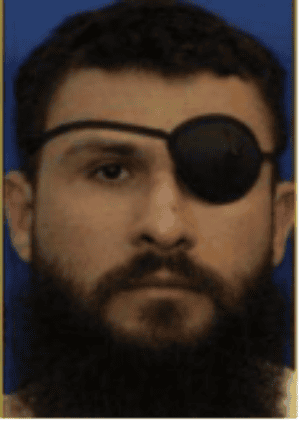
Abu Zabaydah Wants out of Gitmo

And for the first time, he is getting a hearing. So who is he? 61 remain now and 20 are approved for transfer…where is undetermined.

 Photo: Newsweek

Primer:

“Bodies Will Pile Up in Sacks”

On November 30, 1999, Jordanian intelligence intercepted a telephone call

between Abu Zubaydah, a longtime ally of Bin Ladin, and Khadr Abu Hoshar,

a Palestinian extremist.Abu Zubaydah said, “The time for training is over.”

One of the 16, Raed Hijazi, had been born in California to Palestinian parents; after spending his childhood in the Middle East, he had returned to northern California, taken refuge in extremist Islamist beliefs, and then made his way to Abu Zubaydah’s Khaldan camp in Afghanistan,where he learned the fundamentals of guerrilla warfare. He and his younger brother had been recruited by Abu Hoshar into a loosely knit plot to attack Jewish and American targets in Jordan. More here.

****

LWJ: The US government has released an unclassified profile of the jihadist known as Abu Zubaydah, who is held at the Guantanamo Bay detention facility. Abu Zubaydah’s case is currently being evaluated by the Periodic Review Board (PRB), which was established in 2011 “to review whether continued detention of particular individuals held at Guantanamo remains necessary to protect against a continuing significant threat to the security of the United States.”

Abu Zubaydah has been at the center of controversy for years. He was one of the first detainees subjected to the CIA’s so-called enhanced interrogation techniques, including waterboarding, in 2002.

Screen Shot 2016-08-24 at 8.39.54 AM

Some argue that he was not really a senior al Qaeda operative at the time of his capture and that his importance was exaggerated by the US intelligence community during the Bush administration. One version of Abu Zubaydah’s story, citing excerpts from his diary and other fragmentary evidence, holds that he never swore bayat (oath of allegiance) to Osama bin Laden and was merely an independent jihadist facilitator.

The US government’s unclassified summary tells a different story, citing several key pieces of evidence that tie Abu Zubaydah to al Qaeda’s senior leaders and the terror group’s global operations. Abu Zubaydah allegedly “played a key role in al Qaeda’s communications,” “closely interacted” with Osama bin Laden’s “second-in-command,” enlisted al Qaeda operatives in planned attacks against Israel, worked with 9/11 planner Khalid Shaykh Mohammed in 2002, and may have had foreknowledge of al Qaeda’s three most successful attacks between August 1998 and September 2001. The PRB summary also notes that he has been convicted in absentia in Jordan for his well-known role in the so-called millennium terror plots.

Abu Zubaydah “possibly had some advanced knowledge of the bombings of the US Embassies in Kenya and Tanzania in 1998 and the USS Cole bombing in 2000,” according to the government’s PRB summary. He was also “generally aware of the impending 9/11 attacks and possibly coordinated the training at Khaldan camp of two of the hijackers.”

The 1998 US Embassy Bombings and the attack on the USS Cole in 2000 were al Qaeda’s two most effective operations prior to 9/11. It is doubtful that a truly independent actor could have had “some knowledge” of these plots, as well as be “generally aware” of the 9/11 attacks beforehand, given al Qaeda’s penchant for secrecy and compartmentalized planning.

In addition, the two future 9/11 hijackers were not the only al Qaeda operatives thought to have trained at Khaldan camp, which Abu Zubaydah helped oversee.

According to declassified and leaked files prepared by Joint Task Force – Guantanamo (JTF-GTMO), as well as other reports, numerous al Qaeda operatives trained at Khaldan. Trainees at Khaldan included: Ramzi Yousef (the nephew of Khalid Shaykh Mohammed and also the chief bomb maker for the 1993 World Trade Center attack, as well as the point man for a plot to bring down airliners in 1995), Mohamed al-‘Owhali (convicted for his role in the 1998 US Embassy Bombings), Zacarias Moussaoui (who was slated to take part in the 9/11 hijackings, or a follow-on al Qaeda plot, prior to his arrest in Aug. 2001), and Richard Reid (al Qaeda’s would-be shoe bomber in December 2001), among others. Abu Zubaydah would later argue before a tribunal at Guantanamo that he taught “defensive jihad,” as opposed to “offensive jihad,” and was not hostile to the US and its partners. The dossiers of Khaldan’s graduates, as well as many other facts, undermine this argument.

According to the summary presented to the PRB, Abu Zubaydah “played a key role in al Qaeda’s communications with supporters and operatives abroad and closely interacted with al Qaeda’s second-in-command at the time, Abu Hafs al Masri.”

The 9/11 Commission described Abu Hafs al Masri, who was killed in an American airstrike in late 2001, as bin Laden’s “chief of operations” prior to 9/11. Bin Laden and Abu Hafs “occupied undisputed leadership positions atop al Qaeda’s organizational structure.” The 9/11 Commission continued: “Within this structure, al Qaeda’s worldwide terrorist operations relied heavily on the ideas and work of enterprising and strong-willed field commanders who enjoyed considerable autonomy.” Therefore, a senior jihadist could be part of al Qaeda’s organization and still maintain “considerable autonomy” – a detail worth remembering when evaluating Abu Zubaydah’s dossier.

The 9/11 Commission cited the career of Khalid Shaykh Mohammed (KSM), the chief organizer of the 9/11 hijackings, as an example of how al Qaeda’s hierarchy worked. Although KSM didn’t swear bayat to bin Laden (or so KSM claimed after being captured), he still planned the 9/11 attacks under the watchful eye al Qaeda’s most senior officials. Unlike Abu Zubaydah, no one seriously disputes KSM’s al Qaeda role. According to multiple reports, Abu Zubaydah divulged during his first days in US custody that one of KSM’s aliases was “Mukhtar.” Zubaydah also told FBI officials that KSM played a key role in the 9/11 hijackings. Again, we are left to wonder how someone supposedly outside of al Qaeda’s orbit could have known such important details concerning the secretive group’s inner workings.

In fact, according to the PRB summary and other files, Abu Zubaydah worked directly with KSM.

“Following 9/11,” the PRB summary reads, “[Abu Zubaydah] took a more active role in attack preparations, sending operatives to al Qaeda senior member Khalid Shaykh Muhammad…to discuss the feasibility of exploding a radiological device in the United States, and supporting remote-controlled bomb attacks against US and Coalition Forces in Afghanistan.”

The first part of the sentence refers to Abu Zubaydah’s involvement with Jose Padilla and Binyam Mohamed. They conceived a far-fetched plan to use a dirty bomb inside the US. KSM allegedly thought that their idea was foolish and so he directed one or both of them to consider setting fire to high rise buildings using natural gas instead. Zubaydah reportedly revealed details about Padilla and Mohamed while in US custody. Padilla was arrested in Chicago in May 2002 and eventually convicted on terrorism charges. Mohamed was detained in Pakistan and then held elsewhere before being sent to Guantanamo. Mohamed was transferred to the UK in 2009.

It is telling that Abu Zubaydah was able to seamlessly pass Padilla and Mohamed on to KSM, who was attempting to strike the US again just months after the 9/11 hijackings.

The second part of the sentence above from the PRB’s summary (“supporting remote-controlled bomb attacks” in Afghanistan) is a reference to Abu Zubaydah’s “Martyrs Brigade.” According to leaked JTF-GTMO files, the “Martyrs Brigade” was jointly created by Abu Zubaydah and Abdul Hadi al Iraqi, a top al Qaeda military commander who answered directly to Osama bin Laden. Known al Qaeda members joined the team, which was planning to travel back to Afghanistan to fight US and Coalition forces.

The PRB file notes that Abu Zubaydah “most actively plotted attacks against Israel, enlisting operatives from various militant groups, including al Qaeda, to conduct operations in Israel and against Israeli interests abroad.”

A brief biography released by the Office of the Director of National Intelligence (ODNI) in 2006 contained additional allegations regarding his anti-Israeli plotting. According to that biography, Abu Zubaydah had “enlisted” the help of Abu Musab al Zarqawi, who would go on to establish al Qaeda in Iraq, to find “a smuggling route into Israel for moving persons and materials.” Abu Zubaydah had previously helped Zarqawi and dozens of others escape from Afghanistan into Iran in late 2001. Abu Zubaydah raised $50,000 from Saudi donors for his planned attacks in Israel. The money was passed to senior al Qaeda leadership, according to the ODNI’s biography, and may have even been repurposed for the 9/11 plot.

The millennium plots

Abu Zubaydah’s role in various planned terrorist attacks in late 1999 and early 2000 is well known. Khaldan’s graduates were directly responsible for some of the plots.

Abu Zubaydah “was convicted in absentia by the Jordanian Government for his role in planning attacks against Israeli, Jordanian, and Western targets during the Millennium time frame in Jordan,” the newly released PRB file reads.

The 9/11 Commission discussed the millennium plots in Jordan at length in its final report. Jordanian authorities unraveled the plans beginning on Nov. 30, 1999, when they intercepted a telephone call from Abu Zubaydah to an operative known as Abu Hoshar.

“The time for training is over,” Abu Zubaydah said.

The Jordanians suspected, according to the 9/11 Commission, “that this was a signal for Abu Hoshar to commence a terrorist operation.” Jordanian police then arrested 16 jihadists, including Abu Hoshar and his comrade Raed Hijazi. [See LWJ report, Jordan rearrests millennium bombings plotter.]

By late 1998, Abu Hoshar and Hijazi had begun planning to attack multiple sites frequented by Western tourists. “Hijazi and Abu Hoshar cased the intended targets and sent reports to Abu Zubaydah, who approved their plan,” according to the 9/11 Commission. Hijazi stockpiled the ingredients necessary to make the bombs their plan required.

Hijazi and Abu Hoshar contacted another alleged al Qaeda operative, Khalid Deek, in early 1999. They acquired a copy of the Encyclopedia of Jihad, a terrorist manual authored by Deek. The 9/11 Commission reported what happened next. In June 1999, “with help from Deek, Abu Hoshar arranged with Abu Zubaydah for Hijazi and three others to go to Afghanistan for added training in explosives.”

Then, in late November 1999, “Hijazi reportedly swore before Abu Zubaydah the bayat [oath of allegiance] to Bin Laden, committing himself to do anything Bin Laden ordered.”

How could Abu Zubaydah accept Hijazi’s blood oath to Osama bin Laden if he wasn’t really part of al Qaeda? This is one of many details that doesn’t make sense if Abu Zubaydah remained apart from al Qaeda.

Another one of the plots extended all the way into the US.

Ahmed Ressam, who was trained at the Khaldan camp, traveled from Canada to the US in late 1999 with the intent to bomb the Los Angeles International Airport (LAX). Ressam was arrested on Dec. 14, 1999 after customs officials discovered that his vehicle contained hidden explosives.

Ressam would later explain Abu Zubaydah’s role to the FBI. Ressam’s testimony was included in the Aug. 6, 2001 Presidential Daily Brief (PDB) delivered to President George W. Bush.

“The millennium plotting in Canada in 1999 may have been part of Bin Laden’s first serious attempt to implement a terrorist strike in the US,” the PDB read. “Convicted plotter Ahmed Ressam has told the FBI that he conceived the idea to attack the Los Angeles International Airport himself, but that Bin Laden lieutenant Abu Zubaydah encouraged him and helped facilitate the operation.” Ressam added that Bin Laden “was aware of the Los Angeles operation” and Abu Zubaydah “was planning his own US attack” as early as 1998.

An extensive dossier

The unclassified PRB file deals with just some of the known or suspected details of Abu Zubaydah’s career. There is much additional evidence tying him to al Qaeda’s global enterprise. At a minimum, however, the file indicates that the officials representing the US government in the PRB process continue to view Abu Zubaydah as well-placed figure in al Qaeda’s network. This is true whether Abu Zubaydah swore his allegiance to Osama bin Laden or not, as the intelligence shows that he consistently worked with al Qaeda’s most senior operatives.

Note: The spelling of al Qaeda has been made consistent throughout this article and therefore differs from how it is spelled in some of the US government’s files.
C’mon Hillary and Bill, Really?

Hillary State Dept. Helped Jailed Clinton Foundation Donor Get $10 Mil from U.S. for Failed Haiti

The new batch of emails showing that the State Department gave special access to top Clinton Foundation donors while Hillary Clinton was secretary of state brings to mind the case of a shady Miami businessman serving a 12-year prison sentence after scamming the government out of millions. His name is Claudio Osorio, a Clinton Foundation donor who got $10 million from the government after the Clinton State Department reportedly pulled some strings.

Osorio got the money from the Overseas Private Investment Corporation (OPIC), a federal agency that operates under the guidance of the State Department, to build houses in Haiti after the 2010 earthquake. The OPIC supposedly promotes U.S. government investments abroad to foster the development and growth of free markets. Osorio’s “Haiti project” was supposed to build 500 homes for displaced families in the aftermath of the earthquake. The project never broke ground and Osorio used the money to finance his lavish lifestyle and fund his illicit business ventures. He also ran a fraudulent international company with facilities in the U.S., United Arab Emirates, Germany, Angola and Tanzania that stole millions from investors. Some of the OPIC Haiti money was used to repay investors of his fraudulent company (Innovida), according to federal prosecutors. In September 2013, Osorio was sentenced to 150 months imprisonment and three years of supervised release.

Not surprisingly, the Department of Justice (DOJ) never mentioned Osorio’s Clinton connections and seemed to downplay the $10 million scam of taxpayer funds by focusing on the “victims” that invested in his bogus company. More here.

The inside story of how the Clintons built a $2 billion global empire

In part from WashingtonPost: The foundation now includes 11 major initiatives, focused on issues as divergent as crop yields in Africa, earthquake relief in Haiti and the cost of AIDS drugs worldwide. In all, the Clintons’ constellation of related charities has raised $2 billion, employs more than 2,000 people and has a combined annual budget of more than $223 million.

As donations have surged, particularly as her bid for the Democratic nomination grew closer, she has been forced to answer for whether those supporters have been not merely giving to a charity but also paying to curry favor with a former secretary of state and a would-be president.

Sights on something big

In the beginning of it all, Bill Clinton was feeling unfulfilled.

Plenty of room for their dogs and grandchild(ren) to run around... and with a pool to blow off steam from the stress of the campaign trail.  More photos here.

In the months after he left the White House in 2001, he was living at his family’s new home in Chappaqua, N.Y. His wife was in the Senate. His daughter was away, first at Stanford, then at Oxford. He stewed about leftover legal bills and bad press over last-minute pardons.

To pass the time, he turned to TiVo.
No sign of that pesky server though.

At the same time, Clinton did more formal planning with aides. He was just 56. He would be an ex-president for a long time. He wanted to do something big. And something international. He wanted to stay out of domestic policy, so it didn’t look as though he was meddling in the domain of the president who had succeeded him. Or the senator he was married to.

Ira Magaziner, a longtime aide, had an idea that fit both criteria.

New drugs were available to fight the progress of HIV and AIDS, but in Africa the drugs were too expensive for many people. Magaziner wanted to lower the cost. He knew Clinton didn’t have the money to help, because he was still fundraising for the library and his own legal bills.

But, Magaziner told Clinton, he had a name brand with limitless value.

“We should use that reputation and your contacts for something big. If we succeed at this, we can help save millions of lives,” Magaziner wrote in a memo he handed to Clinton at an AIDS conference in 2002. “If we are not so successful, we still might help save tens of thousands of lives which would not be so bad.”

Expanding in all directions

“Now here’s something else in my hot little hand,” Clinton said, standing on a stage at the Sheraton Times Square, according to media reports. “My old friend Carlos Slim Helú here has just said he’s willing to develop a cellphone network for Gaza and link it to Jordan’s network. Why, thanks, Carlos. Come up here and be recognized.”

It was September 2005. A year and a half after Band’s brainstorm, the first meeting of the Clinton Global Initiative was a smashing success. Some Clinton aides had been skeptical that it would work, but Clinton had shrewdly timed it to coincide with a meeting of the U.N. General Assembly — when New York was already chockablock with world leaders looking for something more interesting than a meeting of the U.N. General Assembly.

This is quite the story so please read it in full here. There are stunning connections, people, agendas, timelines, money and access. A real picture has emerged on the collusion and the work of Hillary and Bill’s circle of friends. This is hardly the whole story but it does begin to explain why they had at least 2 private servers and refused FOIA requests.

Last year, the Washington Post offer an early comprehensive summary:

The Post identified donations from roughly 336,000 individuals, corporations, unions and foreign governments in support of their political or philanthropic endeavors — a list that includes top patrons such as Steven Spielberg and George Soros, as well as lesser-known backers who have given smaller amounts dozens of times. Not included in the count are an untold number of small donors whose names are not identified in campaign finance reports but together have given millions to the Clintons over the years.

The majority of the money — $2 billion — has gone to the Clinton Foundation, one of the world’s fastest-growing charities, which supports health, education and economic development initiatives around the globe. A handful of elite givers have contributed more than $25 million to the foundation, including Canadian mining magnate Frank Giustra, who is among the wealthy foreign donors who have given tens of millions.

Keep reading here as it is full of names and under-handed requests and access.

Wenxia Man, Chinese Spy Found Guilty Stealing Aircraft Secrets

Illegally Export Fighter Jet Engines and Unmanned Aerial Vehicle to China

Wenxia Man, aka Wency Man, 45, of San Diego, was sentenced today to 50 months in prison for conspiring to export and cause the export of fighter jet engines, an unmanned aerial vehicle – commonly known as a drone – and related technical data to the People’s Republic of China in violation of the Arms Export Control Act.

The sentence was announced by Assistant Attorney General for National Security John P. Carlin, U.S. Attorney Wifredo A. Ferrer of the Southern District of Florida, Special Agent in Charge Mark Selby of the U.S. Immigration and Customs Enforcement’s Homeland Security Investigations (ICE-HSI) in Miami and Special Agent in Charge John F. Khin of the Department of Defense’s Defense Criminal Investigative Service (DCIS).

On June 9, 2016, Man was convicted by a federal jury in the Southern District of Florida of one count of conspiring to export and cause the export of defense articles without the required license.

According to evidence presented at trial, between approximately March 2011 and June 2013, Man conspired with Xinsheng Zhang, who was located in China, to illegally acquire and export to China defense articles including: Pratt & Whitney F135-PW-100 engines used in the F-35 Joint Strike Fighter; Pratt & Whitney F119-PW-100 turbofan engines used in the F-22 Raptor fighter jet; General Electric F110-GE-132 engines designed for the F-16 fighter jet; the General Atomics MQ-9 Reaper/Predator B Unmanned Aerial Vehicle, capable of firing Hellfire Missiles; and technical data for each of these defense articles. During the course of the investigation, when talking to an undercover HSI agent, Man referred to Zhang as a “technology spy” who worked on behalf of the Chinese military to copy items obtained from other countries and stated that he was particularly interested in stealth technology.

HSI and DCIS investigated the case. Assistant U.S. Attorney Michael Walleisa of the Southern District of Florida and Trial Attorney Thea D. R. Kendler of the National Security Division’s Counterintelligence and Export Control Section prosecuted the case.

 Photo: balicad24.com 

Announcement by the Justice Department

Related reading: 5 Weapons China Stole & Copied from the US

Related reading: Chinese cyber spies may be watching you, experts warn

In part from FreeBeacon:

Michael Walleisa, assistant U.S. Attorney for the Southern District of Florida, asked the judge to impose the maximum sentence of 78 months for the weapons conspiracy conviction.

“There is hardly a more serious case than a case such as this that involves some of our most sophisticated fighter jet engines and unmanned weaponized aerial drones,” Walleisa said in a sentencing memorandum.

“The potential for harm to the safety of our fighter pilots, military personnel, and national security which would occur had the defendant been successful is immeasurable, particularly where, as here the clear intent of the co-conspirators was to enable the People’s Republic of China to reverse engineer the defense articles and manufacture fighter jets and UAV’s.”

The conspiracy revealed that China was seeking to “increase its military capabilities and might to the potential detriment of the United States,” Walleisa said.

The U.S. government imposed an arms embargo on China in 1990 following the Chinese military’s massacre of unarmed pro-democracy protesters in Beijing’s Tiananmen Square a year earlier.

Between 2011 and 2013, Man and Zhang worked together to solicit three sets of General Electric and Pratt and Whitney turbofan engines for the F-35, F-22, and F-16 jets, as well as a General Atomics Reaper drone and technical details of the equipment. The Chinese were prepared to pay $50 million for the embargoed items.

Authorities launched an investigation of the case after Man contacted a defense industry source who alerted U.S. Immigration and Customs Enforcement’s Homeland Security Investigations unit in Miami. The Pentagon’s Defense Criminal Investigative Service also investigated the case.

Man used a company called AFM Microelectronics, Inc. in trying to buy the military equipment. She disclosed to an undercover federal agent in 2012 that the jet engines were meant for the Chinese government and that she knew it was illegal to export them, according to court papers.

China is engaged in a major military buildup that includes two new advanced stealth jet fighters that U.S. intelligence agencies say benefitted from stolen American aircraft technology.

The attempt to buy embargoed jet fighter engines highlights what military analysts say is China’s major technology shortfall—its inability to manufacture high-quality jet engines. Turbofan engines require extremely precise machine work and parts because of the high speeds of their spinning engine fans.

Zhang was described by the government in court papers as a “technology spy” working for China’s military-industrial complex. The Chinese government buys arms and military technology from Russia and other states “so that China can obtain sophisticated technology without having to conduct its own research,” the indictment in the case states.

The name of the Chinese entity was not disclosed. China’s government defense industry group is SASTIND, an acronym for State Administration for Science, Technology and Industry for National Defense.

Zhang sought to buy the operating system and aircraft control system for the MQ-9 Reaper as well as the unmanned aerial vehicle itself and the technical design data for the aircraft. The drone sought was an armed version capable of firing Hellfire missiles.

Man, 45, was convicted of one count of conspiracy to export defense goods with a license.

At sentencing on Friday, U.S. District Judge Beth Bloom told the court that Man hoped to get a $1 million commission on the illegal export and that she wanted to help China compete with the United States militarily.

“I’m innocent,” Man told the judge, the South Florida Sun-Sentinel newspaper reported. “This is my country, too.” She plans to appeal the conviction that was reached after a jury trial in June.

Michael Pillsbury, a China specialist at the Hudson Institute, said the Man case highlights China’s large-scale technology theft program.

“The scope and the ambition of their technology intelligence collection is breathtaking,” said Pillsbury. “They’re not after petty secrets.”

The Man case is similar to an earlier Chinese technology acquisition operation headed by Chi Mak, another naturalized Chinese citizen. In 2007, Mak, an electrical engineer at the U.S. firm Power Paragon, was convicted of conspiracy to export sensitive electronics defense technology to China.

Mak was a long-term technology spy who operated for 20 years. U.S. officials believe Mak provided China with secrets to the Aegis battle management system, the heart of current Navy warships.

China has deployed a similar version of the Aegis ship, known as the Type 052D warship.


The Clinton’s History with Iran and Cuba and Latin America

Posted earlier on this site, Iran’s Cuba and Latin American Tours and Trouble Ahead forced a deeper examination of the Iran, Cuba and Latin America relationship. As Iran is now at least $1.7 billion dollars richer, larger questions develop on Iran’s global expansion. Being in our hemisphere and right in the backyard of America some chilling conditions emerge.

Reported in 2010, Cuba has expressed support for Iran’s nuclear program and has defended Iran’s right to peaceful nuclear technology in the face of UN sanctions. Cuban President Raul Castro also serves as the Secretary-General of the Non-Aligned Movement, which released a statement in July 2008 declaring that its member states “welcomed the continuing cooperation being extended by the Islamic Republic of Iran to the IAEA” and “reaffirmed that states’ choices and decisions, including those of the Islamic Republic of Iran, in the field of peaceful uses of nuclear technology and its fuel cycle policies must be respected.”[1]

In late November 2009, the IAEA passed a rebuke of Iran for building a second enrichment plan in secret.[2] Cuba, along with Venezuela and Malaysia, opposed the resolution.[3] The resolution by the 35-member IAEA Board of Governors calls on Iran to halt uranium enrichment and immediately freeze the construction of its Fordo nuclear facility, located near Qom.[4]  Cuba and Iran cooperate bilaterally and multilaterally through the Non-Aligned Movement. In a June 2008 memorandum of understanding, Iranian President Ahmadinejad explained that the two countries expressed their continued support for “each other on the international scene.” [17]  In September 2008, Iran began funding medical students from the Solomon Islands to study in Cuba, including airfare and computers for medical students unable to finance their own way to Havana to study.[18]  More here.

Related reading: It’s time to start worrying about what Russia’s been up to in Latin America

There is a long and nefarious history between the United States and Cuba but we don’t have to go back much further than the Clinton administration. Seems with enough money to the Clinton’s or to the Democrat National Committee, lots of things can be overlooked.

****

THREAT TO THE HOMELAND

Iran’s Extending Influence in the Western Hemisphere

Iran not only continues to expand its presence in and bilateral relationships with countries like Cuba, Ecuador, Nicaragua, and Venezuela, but it also maintains a network of intelligence agents specifically tasked with sponsoring and executing terrorist attacks in the western hemisphere. True, the unclassified annex to a recent State Department report on Iranian activity in the western hemisphere downplayed Iran’s activities in the region; this material, however, appeared in an introductory section of the annex that listed the author’s self-described “assumptions.” While one assumption noted that “Iranian interest in Latin America is of concern,” another stated that as a result of U.S. and allied efforts “Iranian influence in Latin America and the Caribbean is waning.” More here from the Washington Institute.

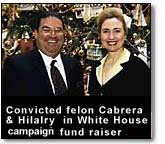
Back in 1996, seems the Clintons were doing then what they are doing today, hanging with criminals that donate.

WASHINGTON DESK – The Justice Department released on Wednesday photographs showing a convicted Miami cocaine trafficer who is seen standing next to and posing with vice president Al Gore. The two were attending a party in Florida last December.

Apparently, Cabrera was asked to make a large donation to the Clinton-Gore campaign in exchange for perks like hob-nobbing with Al Gore and the first lady, Hillary Rodham Clinton.

Jorge Cabrera’s cash contributions to the Clinton-Gore campaign were so generous, that Cabrera was also invited to the White House and gained entrance there without any FBI & Secret Service security clearance.

CNN reported Wednesday that Cabrera’s attorney, Stephen Bronis, said $20,000(given to the Clinton-Gore campaign) was not intended to buy protection for drug smuggling.

‘He had a lobster and stone crab fishery in the Keys and felt that contribution might promote that future course,’ Bronis said.

The Clinton-Gore campaign only returned the $20,000 last week after the full story had reached ABC News, and the Clinton administration had been asked for comment by the media.

Cabrera was arrested in January during a Miami drug bust of nearly three tons of cocaine. Cabrera was arrested and pleaded guilty to one drug count. He was also imprisoned in the 1980s on narcotics charges.

A report that the picture of Cabrera and Gore had been impounded by the Justice Department prompted an angry reaction from Republicans, including Bob Dole’s presidential campaign, House Speaker Newt Gingrich and Rep. Bob Livingston of Louisiana, chairman of the House Appropriations Committee.

Republicans sent letters to Attorney General Janet Reno and the directors of the FBI and the Secret Service seeking information about Cabrera and the campaign contribution.

Livingston asked the federal agencies for a complete accounting of the facts relating to the story within three days: whether Cabrera had dined at the White House, details of his relationship with Clinton and Gore and, if he did dine with them, how he passed FBI & Secret Service scrutiny to gain access to them.

The U.S. attorney’s office in Miami was contacted by reporters. Justice said it would not provide photographs of Cabrera and Gore in Florida and at the White House when reporters requested them on Monday. The Justice Department attempted to claim that Cabrera’s story is coverd by the Privacy Act law in turning down the media request for information on the arrest for cocaine possession of tons of the illegat drug and dealing.

Jant Reno put out information that the photo of Cabrera with Gore and Clinton could not be released without the consent of Cabrera. Later, the Justice Department did release the photographs after Cabrera submitted written authorization.

The delay by the Justice Department appeared to be an effort to distance itself from accusations that are mounting from the American public that the Justice Department is receiving guidance from the Clinton White House and the vice president’s office on the timing of Janet Reno’s investigation.

Justice says it is looking into the breach of National Security by Cabrera’s ready access to secured areas of the White House and its grounds when he entered as an invited quest of president Clinton for dinner and photo-ops.

Then much more recently, like February of 2016, Hillary was busy nurturing the pro-Iran lobby including a fund-raiser.

Clinton will participate in a Menlo Park fundraiser on Sunday hosted by Twitter executive Omid Kordestani and his wife Gisel Hiscock, as well as National Iranian American Council (NIAC) board member Lily Sarafan and Noosheen Hashemi, who serves on the board of the pro-Iran advocacy group Ploughshares, a major funder of pro-Iran efforts.

NIAC, an advocacy group formed by Iranian-Americans to work against the pro-Israel community, has long been accused of lobbying on Iran’s behalf against sanctions and other measures that could harm the Islamic Republic’s interest.

Ploughshares, which partners with NIAC, is joining the White House in efforts to pressure the Jewish community and others to back the recently implemented Iran nuclear agreement, the Free Beacon reported.

The organization has also spent millions to influence coverage of Iran and protect the Obama administration’s diplomatic relations with Iran.

NIAC has emerged a key pro-Iran player in the United States, working with the White House and liberal groups to spin the deal as a positive for U.S. national security.

The group is currently leading the charge to block recent counter-terrorism legislation that would require individuals who have travelled to Iran to obtain a visa before entering the United States. More from FreeBeacon.

Alright so we have established historical relationships with Cuba and Iran and the Clintons. Is there more that we should know? Yes.

  1. Cuban spies in America
  2. The DEA did it’s job but Bill Clinton remained loyal to the Castro brothers
  3. Hillary’s personal global spy, Sidney Blumenthal collaborated on Hezbollah’s new office in Cuba.
  4. In 2011, Hillary’s State Department sent their old friend Bill Richardson to Cuba to bring back an American, Alan Gross, who was an embedded spy working for USAID.
  5. In 2009, Obama and Hillary began the normalization process with Cuba.
  6. Bill Clinton’s old buddy Strobe Talbott collaborated on Cuba with Hillary’s State Department.
  7. Hillary announced that Iran would be invited to an upcoming  multinational conference on Afghanistan
  8. Documents reveal Bill Clinton’s secret contact with Iran
  9. Sid Blumenthal, Jake Sullivan and Hillary on Iran and Israel

Dammit: A BILLION DOLLARS for Central American Asylum Seekers

This does not even include the cost of healthcare, the SNAP program, education or airline costs flying people back and forth across the country.

Inside the administration’s $1 billion deal to detain Central American asylum seekers


The entrance to the South Texas Residential Facility in Dilley, Tex., subject of a $1 billion deal to provide detention facilities for asylum seekers. (Ilana Panich-Linsman/For The Washington Post)

As Central Americans surged across the U.S. border two years ago, the Obama administration skipped the standard public bidding process and agreed to a deal that offered generous terms to Corrections Corporation of America, the nation’s largest prison company, to build a massive detention facility for women and children seeking asylum.

The four-year, $1 billion contract — details of which have not been previously disclosed — has been a boon for CCA, which, in an unusual arrangement, gets the money regardless of how many people are detained at the facility. Critics say the government’s policy has been expensive but ineffective. Arrivals of Central American families at the border have continued unabated while court rulings have forced the administration to step back from its original approach to the border surge.

Related reading: Cant Afford Bail, No Problem, then no Jail

In hundreds of other detention contracts given out by the U.S. Immigration and Customs Enforcement agency, federal payouts rise and fall in step with the percentage of beds being occupied. But in this case, CCA is paid for 100 percent capacity even if the facility is, say, half full, as it has been in recent months. An ICE spokeswoman, Jennifer Elzea, said that the contracts for the 2,400-bed facility in Dilley and one for a 532-bed family detention center in Karnes City, Tex., given to another company, are “unique” in their payment structures because they provide “a fixed monthly fee for use of the entire facility regardless of the number of residents.”

The rewards for CCA have been enormous: In 2015, the first full year in which the South Texas Family Residential Center was operating, CCA — which operates 74 facilities — made 14 percent of its revenue from that one center while recording record profit. CCA declined to specify the costs of operating the center.

***

“For the most part, what I see is a very expensive incarceration scheme,” said Rep. Zoe Lofgren (Calif.), the top Democrat on the House’s Immigration and Border Security subcommittee. “It’s costly to the taxpayers and achieves almost nothing, other than trauma to already traumatized individuals.”

The Washington Post based this account on financial documents — including copies of the agreements spelling out the Dilley deal obtained from the National Immigrant Justice Center — and interviews with government lawyers and former immigration and homeland security officials.

CCA’s chief executive, Damon Hininger, told investors in an earnings call this month that ICE recently has begun pushing for a more “cost-effective solution.” Those discussions, he said, are in the “preliminary stage.”

The facility in Dilley — built in the middle of sunbaked scrubland, in what used to be a camp for oil workers — now holds the majority of the country’s mother-and-child detainees. Such asylum seekers, until two years ago, had rarely been held in detention. They instead settled in whatever town they chose, told to eventually appear in court. The Obama administration’s decision to transform that policy — pushed by lawmakers assailing the porous state of the nation’s border — shows how the frenzy of America’s immigration politics can also bolster a private sector that benefits from a get-tough stance.

Before Dilley, CCA’s revenue and profit had been flat for five years. The United States’ population of undocumented immigrants had begun to fall, reversing a decades-long trend, and the White House was looking to show greater leniency toward illegal immigrants already in the country. But under pressure to demonstrate that it still took border issues seriously, the administration took a tougher stance toward newly arriving Central Americans.

“This was about the best thing that could happen to private detention since sliced bread,” said Laura Lichter, a Denver immigration and asylum attorney who spent months living out of an old hunting lodge in Dilley.

For the first years of the Obama administration, the United States maintained fewer than 100 beds for family detention. But by the end of 2014, the administration had plans for more than 3,000 beds, and immigration advocates said the ramp-up had broken with America’s tradition of welcoming those seeking a haven from violence. At the Dilley facility, detainees described in interviews an understaffed medical clinic and rampant sickness among children, among other problems.

CCA, a Nashville-based public company valued at $3.18 billion, declined interview requests for this story. The company declined to respond to 28 of 31 written questions. It said that ICE oversees medical care at the facility, and the agency said it was comfortable with the quality of care.

“CCA is committed to treating all individuals in our care with the dignity and respect they deserve while they have due process before immigration courts,” the company said in a five-paragraph statement. “Responding to pressing challenges such [as] this — and doing so in a way that can flexibly meet the government’s changing needs — is a role that CCA has played for federal immigration partners for more than 30 years.”

The Central American asylum seekers were coming mostly from three countries in meltdown — El Salvador, Guatemala and Honduras — where gang and drug-related violence have grown so rampant that their murder rates are now three of the world’s five highest, according to U.N. data. By claiming that they feared for their safety, the Central Americans were not subject, as are other unauthorized migrants, to ordinary deportation; they were entitled to press their asylum claims. But Homeland Security Secretary Jeh Johnson, who oversees ICE, heard from border patrollers that the emergency was brewing momentum: People kept coming because word was out that the United States was granting permisos to new arrivals, allowing them to walk right into the country.

According to lawmakers and administration officials, Johnson determined that the United States could cut down the surge only by demonstrating that asylum seekers wouldn’t receive leniency. Johnson won approval from the White House to explore ramping up family detention for asylum seekers on a scale never before seen in America, part of what he called an “aggressive deterrence strategy.” He ordered ICE to figure out a way to make it work.

“This whole thing [was] building and reaching an unsustainable level,” said Christian Marrone, then Johnson’s chief of staff. “We had to take measures to stem the tide.”

Fast action

In a matter of days, ICE patched together a temporary solution. In June 2014, it placed the first batch of Central American mothers and children at a law-enforcement training site in Artesia, N.M. The agency pulled border agents off their usual jobs to help run the facility, and it was wary of hiring new employees and building a permanent facility for a problem it didn’t know how long would last.

“It makes sense that you put some of the risk on a private company,” said Mark Krikorian, executive director at the Center for Immigration Studies, which favors stricter border control.

That’s how ICE made the call to CCA.

The company, founded three decades earlier, had risen from near-bankruptcy thanks to an immigrant detention boom that followed the 9/11 terrorist attacks. Over the following 15 years, the share of revenue that CCA got from federal contracts more than doubled, according to the company’s annual reports. CCA and its only major competitor, the GEO Group, operate nine of the 10 largest immigration detention centers.

Through it all, CCA had pitched Washington on the idea that it could be an antidote to big government spending. One of the company’s co-founders, Thomas Beasley, told Inc. magazine in 1988 that selling prisons was no different from “selling cars, or real estate, or hamburgers.” But behind that pitch, CCA was a mega-sized business — one that pays its chief executive $3.4 million and has on its payroll a slew of former senior government officials.

Immigration activists say CCA had already proved itself incapable of running a family detention center. Between 2006 and 2009 — the only other major U.S. attempt to house women and children seeking asylum — CCA ran a facility in Taylor, Tex. Children wore prison uniforms, received little education and were limited to one hour of play time per day, according to an American Civil Liberties Union lawsuit filed against ICE in 2007 that led months later to a settlement agreement and improved conditions. Months after taking office, Obama closed the facility.

At ICE, officials saw the reboot of family detention as a welcome, if belated, sign of strength on the border. CCA was one of the two companies with the “means” to pull it off, along with GEO, said Phil Miller, an ICE deputy executive associate director who helps to oversee family detention. It could build a new facility quickly and had a legion of staff members with the right security clearances. (GEO, which referred all questions to ICE, ended up refurbishing a smaller facility.)

In forging their deal, CCA and ICE faced one major hurdle: the requirement for a public bidding process — one that threatened to significantly delay construction. So CCA found a workaround. In September 2014, the company approached Eloy, Ariz., an interstate town of 17,000, and asked its officials if they would be willing to amend its existing contract with the town. The company had been operating a detention center for undocumented men in Eloy since 2006. If Eloy modified that contract — essentially, directing CCA to build a new facility in another state, 1,000 miles away — the federal government would be freed from the bidding process. And by reaching out to a town already involved with the industry, CCA could also avoid the political risks that often come when trying to convince a new locality to build a detention center.

The deal is formed by two separate agreements: One between ICE and Eloy, the other between Eloy and CCA. Both were signed on the same day and refer to the family detention center in Dilley. As spelled out in the contracts, ICE provides the money to Eloy; Eloy, in turn, receives a small “administrative fee” for being party to the deal.

According to one Eloy official, county records and an account from the time in a local newspaper, the Eloy Enterprise, a CCA executive pitched the opportunity at a city council meeting in September 2014, saying Eloy could profit from the deal by collecting the payout from Washington, receiving a small percentage — roughly $1.8 million over the four years — and then passing the rest to CCA.

“At the time, there was some reluctance because of the optics” to go along with it, said Harvey Krauss, the Eloy city manager. “But I told everybody, we’re not taking a position; we’re just a fiscal agent. The federal government was in a hurry and this was an expedited way for them to get it done.”

ICE senior leaders signed off on the deal, an official at the agency said.

Mark Fleming, an attorney at the National Immigrant Justice Center, who has reviewed hundreds of federal ICE contracts, said the deal was “singularly unique” and was designed to “avoid transparency.” The center obtained copies of the financial agreements through Arizona open-records laws and gave them to The Post. Several other experts on federal procurement said that while the government can avoid bidding laws in urgent or national security cases, they had never before seen a facility in one state created with the help of a recycled contract from another.

“This is the arrangement of a no-bid contract by twisting and distorting the procurement process past recognition,” said Charles Tiefer, a University of Baltimore law school professor, former solicitor and deputy general counsel of the House of Representatives, who reviewed the deal at the request of The Washington Post.

The contract shows how CCA is assured of a predictable payment, collecting a fixed amount of around $20 million per month — even when the facility’s population drops.

A CCA spokesman, Jonathan Burns, said that the company is required by the contract to provide full staffing and other services no matter the population. But, from the government’s perspective, the contract becomes less cost-effective when fewer people stay in Dilley. When 2,400 people are detained, the government spends what amounts to $285 per day, per person, according to a Post calculation. When the facility is half-full, as it has been in recent months, the government would spend $570. On some days when the facility is nearly empty, as it was for a period in January, the government would be paying multiples more.

At more than 200 non-family immigration detention sites, most per diems are between $60 and $85, according to an ICE document. The daily cost to detain children is higher, ICE officials said, because the government requires a litany of extra standards such as education courses and medicine for nursing mothers.

Critics say ICE could have chosen much more cost-effective alternatives. Ankle monitors, which could track asylum seekers as they await court dates, for example, cost several dollars per day.

Miller, the ICE official, said his agency didn’t push as hard as usual for lower costs because of the “immediacy” of the need.

“If you need an air conditioner today, you’re going to pay what the AC guy tells you,” Miller said. “If it’s December and you want a new AC unit in place by June, you have more time to research.”

The deterrence issue

For the opening of the South Texas Family Residential Center on Dec. 15, 2014, Johnson flew to Dilley and announced that the country’s borders are “not open to illegal migration.” A U.S. government ad blitz in Central America spread a similar message.

But immigration activists cast doubt on whether the United States is getting what it paid for: deterrence.

Border-crossing among asylum-seeking women and children has changed little from two years ago. Over the previous 12 months, according to government statistics, 66,000 “family units” — mostly women and children — have been apprehended at the border, compared with 61,000 in the same period two years earlier.

“What is the root problem? I don’t believe it’s a pull factor so much as a push,” said John Sandweg, a former acting ICE director who left in early 2014, months before the immigration surge. “I do not believe that family detention has been a deterrent.”

Initially, the government had intended Dilley to hold families for months at a time. But that model has been changed by two court decisions in 2015 — one determining that ICE couldn’t detain asylum seekers “simply to deter others,” and one that the government had to abide by a two-decade-old settlement requiring that migrant children be held in the least restrictive environment possible. The judge in that case, Dolly Gee, ordered the government to release children “without unnecessary delay,” and Homeland Security has so far been unsuccessful in appealing.

As a result, stays at Dilley have shortened. Families are typically released in a matter of weeks, after women pass an initial interview establishing they have a “credible” reason to fear returning home. Even when Dilley has many empty beds, families sometimes aren’t detained at all, according to immigration lawyers.

Use of the Dilley facility has become so “haphazard,” said Ian Philabaum, an advocacy coordinator, that in January it was nearly empty, even as Central Americans were arriving at a steady pace along the Texas border.

Government officials no longer say that the Dilley detention center is for deterrence. But Johnson said at a recent roundtable with reporters that family detention, though it had been “reformed considerably,” had still been useful for women and children while the government determined whether they had health problems or posed flight risks.

“I think we need to continue the practice so we’re not just engaging in catch-and-release,” Johnson said.

CCA declined to comment on the evolution of family detention policy. But Hininger, CCA’s chief executive, said in a release for investors that the company was “pleased” with its performance at the start of the year. Its increase in revenue, the company said, was “primarily attributable” to the South Texas Family Residential Center.

Priscila Mosqueda contributed to this report.