Operacion Probirka” — or “Operation Test Tube”

Primer: 2025 – Russian use of chemical weapons against Ukraine ‘widespread’, Dutch defence minister says

Add in the U.S. State Department report in 2024

***

Posted in full and a big hat tip to Organized Crime and Corruption Reporting Project (in full)

Key Findings
  • Maria Oleinikova and her children run businesses in Spain dedicated to Spanish cuisine, but they are also being investigated for supplying banned chemicals to Russia.
  • The investigation, called “Operation Test Tube,” has named nine suspects, including Oleinikova, her two children, and executives from a Spanish company called Scharlab. No charges have yet been brought in the case.
  • Separately, import data reviewed by reporters shows that a Russian company majority-owned by Oleinikova, Catrosa Reactiv, has received dozens of shipments of sanctioned chemicals from companies under investigation in Spain.
  • While it is not known what then happened to the chemicals, leaked transaction data shows Catrosa Reactiv’s clients include weapons developers, such as the state institute that created the nerve agent Novichok.
  • Customs systems struggle to deal with the EU’s broad sanctions on chemical exports to Russia, experts said, meaning that banned chemicals can easily slip out of the bloc and into Russia.

Operacion Probirka” — or “Operation Test Tube”

Cavina Vinoteca, a slick wine bar in Barcelona’s fashionable Poblenou neighborhood, has drawn rave reviews online since it opened its doors last year.

The restaurant is one of several gastronomic ventures run by the Oleinikova family, led by matriarch Maria, who was born in Russia but is now a Spanish citizen. Together with her son and daughter, she also runs a Spanish company that exports wine, beer, cider and liqueurs to Russia.

But OCCRP and partners have learned that this company did business beyond just beverages— it was also shipping chemicals to Russia in possible violation of European Union sanctions imposed following Russia’s full-scale invasion of Ukraine in 2022.

Last year, Maria and her children Irina and Vyacheslav were arrested in a Spanish police raid dubbed “Operacion Probirka” — or “Operation Test Tube” — in which 13,000 kilograms of chemicals were seized at the Port of Barcelona.

Operation Test Tube was part of a Spanish investigation into the illegal supply of chemicals to Russia, Spain’s Interior Ministry said in a statement at the time, but since then the government has provided almost no details about the case. Although the statement referred to a Russian company that was importing the chemicals, police did not publicly name it or provide details of the shipments.

Credit: Policia Nacional

Spanish authorities during the “Operacion Probirka” investigation

A Spanish police source involved in the investigation said authorities suspect Oleinikova was an “intermediary” who arranged the shipments. (The officer was authorized to speak to the press, but not to be identified by name.)

But drawing on Russian import data, reporters found that Oleinikova doesn’t just operate in Spain — she also majority-owns a Russian chemical company called Catrosa Reactiv that received at least 36 shipments of sanctioned chemicals from Spain between 2022 and 2024— including one that came directly from Complexe Sancu, the Spanish wine-and-beer export company run by Oleinkova and her children.

Most of the other shipments were made by a Spanish company called Scharlab S.L., which is headquartered in Barcelona with subsidiaries in Italy and the Philippines, import data shows. Scharlab is majority-owned by Werner Scharlau, a German living in Spain who was among those arrested in February.

On its website, Catrosa Reactiv — which was founded in 2006 and taken over by Oleinikova’s husband two years later —  says that it “successfully operates in the Russian chemical reagents market” and supplies products to laboratories and raw materials to industry. The Russian company register shows that Oleinikova, who has a background in academic scientific research, became the company’s majority shareholder in 2015 and still holds a controlling stake in the firm.

Credit: Screenshot/catrosa.ru

Catrosa Reactiv’s website.

It is not known how the chemicals imported from Spain to Catrosa Reactiv were ultimately used. However, leaked transaction data obtained by reporters showed Catrosa Reactiv’s clients in Russia since 2022 have included at least six sanctioned entities linked to weapons production, the defense sector, and the Russian military.

They included the State Scientific Research Institute of Organic Chemistry and Technology, also known as GosNIIOKhT. It has been sanctioned by the EU and U.S. for its involvement in the development and production of chemical weapons including the toxic nerve agent Novichok, which has been used by Russian operatives for stealth assassinations abroad.

Since 2022, Catrosa Reactiv has also received payments from:

  • The All-Russian Scientific Research Institute of Experimental Physics, an agency that developed weapons in the Soviet era, including the first Soviet atomic bomb, before shifting toward building and managing Russia’s most advanced supercomputers
  • The Scientific Research Institute of Applied Acoustics, which was sanctioned by the U.S. for allegedly “carrying out research and development of military products.” The U.S. also said it had been “involved in the procurement and inventory of chemicals that could be used in the production of chemical weapons agents.”
  • Explosives manufacturer SKTB Technolog, a contractor for the Russian Ministry of Defense
  • The 18th Central Research Institute, known as Military Unit 11135, which is part of Russia’s GRU military intelligence service

Reporters did not identify any chemicals specifically associated with chemical weapons in Catrosa Reactiv’s import data. However, Miguel Ángel Sierra, a professor of organic chemistry at the Complutense University of Madrid and former member of the scientific advisory board of the international Organization for the Prohibition of Chemical Weapons, said the chemicals it imported from Europe were sanctioned because they had multiple potential uses, including creating explosives.

“These have been banned by the European Union because they are industrial products,” he explained. “For example, there are many processes you can’t carry out, including the preparation of explosives, the preparation of pharmaceuticals, and the preparation of many other things, without having some of these products.”

Spain’s Audiencia Nacional — a court that deals with terrorism and major crimes — confirmed to OCCRP that Oleinikova and her two children are among nine suspects currently under investigation for “smuggling banned substances.” All nine suspects have been released while the investigation continues, and no one has been charged with a crime, the press department for the court said.

Oleinikova declined to comment for this story because the case is still under investigation by the Audiencia Nacional.  

How Reporters Identified Catrosa Reactiv’s Imports

Reporters reviewed extensive Russian import records for Catrosa Reactiv on the ImportGenius commercial database, filtering them to include only shipments received after Russia’s full-scale invasion of Ukraine, to detect possible sanctioned chemicals.

Some of the shipments from Spain included the “HS Codes” – international product identification categories under which genres of exports are grouped for customs.

In some cases, reporters discovered product descriptions for individual chemicals within the import data, but not always.

Where they could find descriptions of individual chemicals, they cross-referenced them with EU sanctions lists, which are updated every four months, to work out which chemicals were illegally being shipped out of Spain despite a ban.

While OCCRP and its partners were able to establish that Catrosa Reactiv had made 36 imports of at least 15 banned products from Spain since 2022, the actual figures may be higher as the commercial database may be incomplete and the product descriptions for some shipments were imprecise.

Russian Firm Imported Sanctioned Chemicals in Dozens of Shipments

Official press releases following the October 2024 raid on the Barcelona port didn’t name the specific chemicals that were confiscated, but police told OCCRP they had seized 13,000 kilograms of the solvent N-Methyl-2-pyrrolidone (NMP), which is widely used in electronics, pharmaceuticals, and coating. Investigators also found smaller amounts of other chemicals that could be used in weapons production.

Some shipments of chemicals — including nitric acid and acetone, both used in the manufacture of explosives, and diethylamine, a chemical involved in the manufacturing of the nerve agent VX — had already left Spain for Russia, police said.

In an effort to form a complete picture of the types of chemicals Catrosa Reactive had been importing from the EU, reporters reviewed Russian import records in a commercial database.

Credit: Policia Nacional

Spanish police at the Barcelona port during the seizure of 13,000 kilograms of the solvent N-Methyl-2-pyrrolidone (NMP).

The 32 shipments Catrosa Reactiv received from Scharlab contained 14 chemicals worth $15,000, all subject to EU export bans from April 2022 to June 2023 due to their potential contribution to the enhancement of Russia’s defence, security, and industrial sectors. They included $8,200 worth of NMP, the same solvent discovered at the Barcelona port, plus $5,800 worth of isopropanol and $2,550 of hydrogen peroxide.

The shipment made to Catrosa Reactiv from Complexe Sancu, the Spanish wine export company run by Maria Oleinikova’s children, contained around $3,650 worth of sodium hydrogen carbonate — also known as sodium bicarbonate, or baking soda. But despite its benign uses, the chemical was prohibited for export from the EU to Russia in April 2022 under the category of “goods which could contribute to the enhancement of Russian industrial capacities.”

‘Europeans Don’t Have the Infrastructure to Check’

Experts say that the EU’s customs systems are insufficient to deal with the bloc’s extremely broad sanctions on chemical exports to Russia, making it easy for shipments like the ones from Spain to slip through the net.

In international shipping, exporters label their goods using broad group identifiers known as HS Codes, which can cover a wide range of products including both banned and permitted substances. This means that it is possible to export a chemical under an HS Code that does not identify the presence of a specific banned substance.

Elina Ribakova, a senior fellow at the Peterson Institute for International Economics, a think tank based in Washington, D.C., said that HS Codes including sanctioned products are supposed to be flagged as high risk and checked more closely by customs officials.

But in practice, she said, this doesn’t always happen: “The question is whether the product is correctly classified under its appropriate HS Code and whether it is actually being checked.”

Even though the EU and Spain have created additional code numbers designed to add further detail to the international HS Code categories, Ribakova said it’s still “very hard to pin down a product” as they tend to be grouped.

“Europeans don’t have the infrastructure to check more holistically something that is not a nuclear or very specialized weapon,” she told OCCRP, adding that these limitations make it “relatively easy” to export sanctioned products.

In the case under investigation in Spain, exporters mixed batches of sanctioned chemicals inside larger shipments of legal substances, or listed false destinations on customs paperwork, such as Armenia and Kyrgyzstan, to disguise the fact that shipments were headed for Russia, investigators told OCCRP.

Credit: Policia Nacional

Chemicals seized by Spanish police during “Operacion Probirka.”

One of the investigators working on the case told OCCRP that evidence obtained so far shows the shipments did not in fact pass through those countries, and that the companies listed as recipients were fronts.

Instead they went overland to Russia via other countries, including Poland and Belarus, he claimed. It’s not clear which, if any, of the people or companies under investigation made use of these tactics. But import records for Catrosa Reactiv reviewed by OCCRP and its partners show that it received one shipment of the sanctioned chemical NMP in 2023 that originated in Spain, but was routed via a Kyrgyz company, NK Muras LLC.

The data shows that shipment was manufactured by one of the companies under investigation by Spanish authorities for illegally exporting sanctioned chemicals in the case involving Oleinikova.

According to the import records the supplier acting on the “order” of NK Muras was Vlate Logistik LLC, a Belarusian transport and storage company sanctioned by the EU in December 2024 for its proximity to the Moscow-aligned regime of President Aleksandr Lukashenko.

In 2024, Complexe Sancu, the Spanish export company managed by Maria Oleinikova’s children, sent at least one shipment of NMP to NK Muras. Available records do not show whether that shipment ultimately ended up with Catrosa Reactiv.

Separate transaction data obtained by reporters indicate that Catrosa Reactiv paid NK Muras more than $240,000 in 2023 for three shipments of unspecified pharmaceutical ingredients.

Neither NK Muras nor Vlate Logistik responded to requests for comment.

Exactly how Much Tolerance is Given to Russia?

As Putin continues to bomb and add more destruction and death to/of Ukraine, it is clear he has no interest in any meetings or peace…here are two additional reasons to add that are unreported.

Putin and Lukashenko meet in St Petersburg to discuss ways to expand ... source

Source 

Putin has added an additional war front and that is Belarus, which is actually a client state of Russia. Lukashenko, the president of Belarus, a confirmed puppet of Putin has warned his country to prepare for war. Putin has placed Oreshnik missiles with Iskanders in Homel, Belarus where they are in striking distance not only in western Ukraine, but other NATO countries as well. In addition, Belarus will also have advanced air defense and reconnaissance systems and even nuclear strike capabilities.

Bielorrusia despliega el sistema de misiles ruso "Oreshnik" - Noticias ...

Meanwhile, just recently, a Russian reconnaissance drone violated the Lithuanian airspace over Vilnius before crashing in a Lithuanian training ground. Of additional importance is thee Zapad military training exercises scheduled for September, which previously were used as a ploy in 2021 full scale invasion of Ukraine.

Germany has deployed fighter jets in a defensive posture, placing them in Warsaw. Then there is the matter of Russian hacking….yup..hacking into the United States…where you ask?

Russia has allegedly been linked to a worrying recent cyberattack against the US Federal Court Filing System.

Reporting from the New York Times (NYT), which said it spoke to people familiar with the matter, claims there is evidence Russia is at least partially responsible for the attack, which has been a “yearslong” effort to breach the system.

The reports added the searches, “included midlevel criminal cases in the New York City area and several other jurisdictions, with some cases involving people with Russian and Eastern European surnames.”

Hacking sealed files

A cyberattack against the system was most recently confirmed on August 7 by the Administrative Office of the US Courts. However, Politico reported that the system had been under attack by an unknown threat actor since early July.

Furthermore, across the US, chief judges of district courts were told to move cases with overseas ties off the regular document-management system.

An internal memo, seen by NYT and issued to Justice Department officials, clerks and chief judges in federal courts by administrators with the court system stated that, “persistent and sophisticated cyber threat actors have recently compromised sealed records,” continuing with, “This remains an URGENT MATTER that requires immediate action.”

The Federal Court Filing System, like many filing systems, is a sprawling network that is continuously used and updated with new records, and was built on a system first developed in 1996.

As a result, the system is considered to have several serious vulnerabilities, with the system previously being breached in 2020.

There is still currently no known motive for the attack, but it is possible that if Russian intelligence services are involved they could be gathering intelligence on the potential compromise of assets in the US.

The same has been theorized about the telecoms breaches that hit the US in 2024, which were attributed to China. In these attacks, threat actors breached a backdoor used by law enforcement to pursue court-ordered wiretaps.


Should DOGE include the E for Espionage Also?

ProPublica is not one of my ‘go-to’ sites but they get a hat tip for this one.… the enemy foreign and domestic has burrowed in…anyone really paying enough attention? One could argue CISA has failed as has  the NSA and Microsoft…..

Microsoft is using engineers in China to help maintain the Defense Department’s computer systems — with minimal supervision by U.S. personnel — leaving some of the nation’s most sensitive data vulnerable to hacking from its leading cyber adversary, a ProPublica investigation has found.

The arrangement, which was critical to Microsoft winning the federal government’s cloud computing business a decade ago, relies on U.S. citizens with security clearances to oversee the work and serve as a barrier against espionage and sabotage.

But these workers, known as “digital escorts,” often lack the technical expertise to police foreign engineers with far more advanced skills, ProPublica found. Some are former military personnel with little coding experience who are paid barely more than minimum wage for the work.

“We’re trusting that what they’re doing isn’t malicious, but we really can’t tell,” said one current escort who agreed to speak on condition of anonymity, fearing professional repercussions.

The system has been in place for nearly a decade, though its existence is being reported publicly here for the first time.

Microsoft told ProPublica that it has disclosed details about the escort model to the federal government. But former government officials said in interviews that they had never heard of digital escorts. The program appears to be so low-profile that even the Defense Department’s IT agency had difficulty finding someone familiar with it. “Literally no one seems to know anything about this, so I don’t know where to go from here,” said Deven King, spokesperson for the Defense Information Systems Agency.Biden review board blames Microsoft for China hack that targeted US ... source

National security and cybersecurity experts contacted by ProPublica were also surprised to learn that such an arrangement was in place, especially at a time when the U.S. intelligence community and leading members of Congress and the Trump administration view China’s digital prowess as a top threat to the country.

The Office of the Director of National Intelligence has called China the “most active and persistent cyber threat to U.S. Government, private-sector, and critical infrastructure networks.” One of the most prominent examples of that threat came in 2023, when Chinese hackers infiltrated the cloud-based mailboxes of senior U.S. government officials, stealing data and emails from the commerce secretary, the U.S. ambassador to China and others working on national security matters. The intruders downloaded about 60,000 emails from the State Department alone.

With President Donald Trump and his allies concerned about spying, the State Department announced plans in May to “aggressively revoke visas for Chinese students” — a pledge that the president seems to have walked back. The administration is also trying to arrange the sale of the popular social media platform TikTok, which is owned by a Chinese company that some lawmakers believe could hand over sensitive U.S. user data to Beijing and fuel misinformation with its content recommendations. But experts told ProPublica that digital escorting poses a far greater threat to national security than either of those issues and is a natural opportunity for spies.

“If I were an operative, I would look at that as an avenue for extremely valuable access. We need to be very concerned about that,” said Harry Coker, who was a senior executive at the CIA and the National Security Agency. Coker, who also was national cyber director during the Biden administration, added that he and his former intelligence community colleagues “would love to have had access like that.”

It is difficult to know whether engineers overseen by digital escorts have ever carried out a cyberattack against the U.S. government. But Coker wondered whether it “could be part of an explanation for a lot of the challenges we have faced over the years.”

Microsoft uses the escort system to handle the government’s most sensitive information that falls below “classified.” According to the government, this “high impact level” category includes “data that involves the protection of life and financial ruin.” The “loss of confidentiality, integrity, or availability” of this information “could be expected to have a severe or catastrophic adverse effect” on operations, assets and individuals, the government has said. In the Defense Department, the data is categorized as “Impact Level” 4 and 5 and includes materials that directly support military operations.

John Sherman, who was chief information officer for the Department of Defense during the Biden administration, said he was surprised and concerned to learn of ProPublica’s findings. “I probably should have known about this,” he said. He told the news organization that the situation warrants a “thorough review by DISA, Cyber Command and other stakeholders that are involved in this.”

In an emailed statement, the Defense Information Systems Agency said that cloud service providers “are required to establish and maintain controls for vetting and using qualified specialists,” but the agency did not respond to ProPublica’s questions regarding the digital escorts’ qualifications.

It’s unclear whether other cloud providers to the federal government use digital escorts as part of their tech support. Amazon Web Services and Google Cloud declined to comment on the record for this article. Oracle did not respond to requests for comment.

Microsoft declined to make executives available for interviews for this article. In response to emailed questions, the company provided a statement saying its personnel and contractors operate in a manner “consistent with US Government requirements and processes.”

Global workers “have no direct access to customer data or customer systems,” the statement said. Escorts “with the appropriate clearances and training provide direct support. These personnel are provided specific training on protecting sensitive data, preventing harm, and use of the specific commands/controls within the environment.” In addition, Microsoft said it has an internal review process known as “Lockbox” to “make sure the request is deemed safe or has any cause for concern.” A company spokesperson declined to provide specifics about how it works but said it’s built into the system and involves review by a Microsoft employee in the U.S.

Over the years, various people involved in the work, including a Microsoft cybersecurity leader, warned the company that the arrangement is inherently risky, those people told ProPublica. Despite the presence of an escort, foreign engineers are privy to granular details about the federal cloud — the kind of information hackers could exploit. Moreover, the U.S. escorts overseeing these workers are ill equipped to spot suspicious activity, two of the people said.

Even those who helped develop the escort system acknowledge the people doing the work may not be able to detect problems.

“If someone ran a script called ‘fix_servers.sh’ but it actually did something malicious then [escorts] would have no idea,” Matthew Erickson, a former Microsoft engineer who worked on the escort system, told ProPublica in an email. That said, he maintained that the “scope of systems they could disrupt” is limited.

Yes, China is Surrounding the S. China Sea, but what about Florida?

The two faced dragon….tie to really recalibrate the relationship between the United States and China AGAIN….Previously n this website, I have discussed not only by a post but several times on radio about how the former intelligence/snooping base owned by Russia in Cuba known as the Lourdes SIGINT station was sold to China….no one in media or the national security realm seems to give it much attention…but now…we have an additional problem with China and that is the Bahamas.

How about the largest Chinese embassy in the world with hundreds of Chinese intelligence officers deployed there…..Embassy of China in Nassau in Nassau, Bahamas (Google Maps)

In part from FNC:

“The People’s Republic of China has been making diplomatic, economic and even military and quasi-military inroads into the Caribbean, South and Central America for the past couple of decades,” retired Rear Adm. Peter Brown, former Homeland Security advisor to President Donald Trump, told Fox News Digital.

Brown pointed to the rise in dual-use infrastructure projects along the Bahamas coastline, which is located just 50 miles off the coast of Florida.

“It doesn’t take a lot of imagination for the People’s Republic of China to use its commercial footprint in the Bahamas to monitor, exploit and perhaps even do worse to [the] U.S.,” he said. Pointing to the Chinese-controlled British Colonial Hotel in Nassau, Bahamas, Brown said that its location directly across from the U.S. Embassy could give way to intelligence gathering on U.S. personnel.

The hotel is owned by a Chinese company, Chow Tai Fook Enterprises, which has raised geopolitical concerns given its location. Fox News Digital has reached out to the British Colonial Hotel for comment.

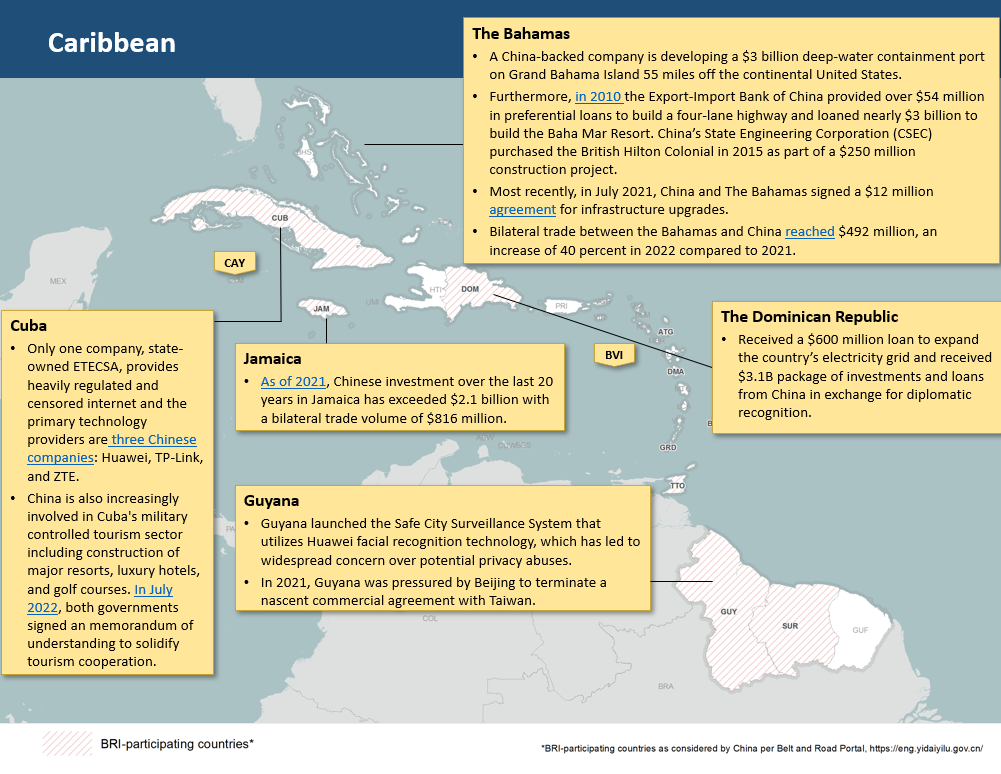
China has invested heavily in the Bahamas through a range of additional high-profile projects, including a $40 million grant for a national stadium, a $3 billion mega-port in Freeport, and $40 million for the North Abaco Port and Little Abaco Bridge.

In 2019, now-Secretary of State Marco Rubio warned in a Miami Herald op-ed that the devastation caused by the natural disaster could create an opening for the People’s Republic of China to use aid as a Trojan horse to gain a foothold near American shores.

“By targeting the Bahamian government in this period of crisis, Beijing would be making the same opportunistic play to access critical foreign infrastructure,” Rubio wrote in 2019. “But in this case, the national security threat is especially perilous, as it would give China a foothold just 50 miles from the coast of Florida.”

***

How about another look at things in the Caribbean…Chinese expansion

Chinese Expansion in the Caribbean (Extra) - Virtual Mirage

China’s Influence in the Caribbean:

China is a member of both the Inter-American Development Bank (IDB) and the Caribbean Development Bank (CDB) and an observer at the Organization of American States (OAS). Alongside Italy and Germany, China is the third largest shareholder at the CDB with 5.6% of overall shares, exponentially higher than the majority of Caribbean countries.

The People’s Republic of China’s (PRC) engagement in the Caribbean has largely focused on investments in infrastructure and developing trade relationships. As of 2022, ten Caribbean countries have signed up to Belt and Road (BRI) – Cuba, Jamaica, Dominican Republic, Antigua & Barbuda, Dominica, Barbados, Grenada, Trinidad & Tobago, Guyana, and Suriname.

The PRC is working towards diminishing the region’s ties to Taiwan as the region contains the largest bulk of Taiwan’s diplomatic allies. Today, St. Lucia, St. Vincent and the Grenadines, St. Kitts and Nevis, Haiti, and Belize remain the only Caribbean nations that recognize Taiwan.

China’s Trade and Economic Investment in the Caribbean

While the Caribbean’s trade with China has grown at a slower pace than overall trade with the region, it increased from $1 billion in 2002 to $8 billion in 2019, with an estimated $6.1 billion in Chinese exports and $1.9 billion in imports.

China is a major trading partner of Cuba’s and Chinese businesses are involved in the Cuba’s telecommunications, tourism, mining, and energy sectors.

Cuba is highly dependent on China and ongoing economic challenges resulted in the reconstructing of an estimated $4 billion in debt to China in 2011 and another restructuring in 2015. For more reading click here.

The U.S. Must Join China’s Belt and Road In Developing The Caribbean ...

The U.S. Must Join China’s Belt and Road In Developing The Caribbean ...

Homan and Noem in NY for Illegal Migrant Operations

The operations in New York included criminal and civil law enforcement actions. A ruthless leader of Tran de Aragua, Anderson Zambrano-Pacheco was arrested who is/was wanted for kidnapping a woman from Aurora, Colorado also with the help of the DEA in an apartment building in the Bronx.

It is important to know however just what law enforcement is up against in New York as noted below as an example:


***

ABC News:

Homeland Security Secretary Kristi Noem joined an immigration enforcement operation in New York City on Tuesday.

Noem posted a brief video of an arrest to her social media account.

The secretary is witnessing both criminal and civil enforcement operations, according to sources familiar with the actions in New York.

The criminal case involves a member of a Venezuelan gang that took over an apartment complex in Aurora, Colorado, the sources said. One alleged gang member was arrested in the Bronx.

The New York division of the U.S. Drug Enforcement Administration said it was working with partners at the Justice Department and the Bureau of Alcohol, Tobacco, Firearms and Explosives to assist the Department of Homeland Security with enforcement efforts.

***.Violent Venezuelan gang Tren de Aragua recruiting NYC migrants for ... TdA recruiting migrants

There have been recent arrests in New York of a Venezuelan fugitive and TdA gang member. ICE published this example from May of last year in New York:

NEW YORK — On May 10, Enforcement and Removal Operations (ERO) New York City arrested an unlawfully present Venezuelan citizen and member of the Tren de Aragua transnational criminal organization. Johan Jose Cardenas Silva is wanted by Peruvian authorities for conspiracy, assault and aggravated theft. Cardenas was also one of eight noncitizens arrested by the New York City Police Department March 27 and charged with criminal possession of a weapon-second degree: loaded firearm; criminal possession weapon-second degree: loaded firearm on school grounds; criminal possession-controlled substance-5th: intent to sell; and act in manner injure child less than 17.

ERO New York City officers assigned to its Long Island office arrested Cardenas upon his release from Nassau County Correctional Center pursuant to an administrative warrant of removal. He is detained in ICE custody pending removal proceedings.

“This international fugitive mistakenly thought he could waltz into the United States to not only evade justice in other countries, but to continue his criminality with impunity,” said ERO New York City Field Office Director Kenneth Genalo. “His history of lawless behavior and membership in a violent international criminal organization clearly demonstrate that he is a serious threat to the public safety.”

U.S. Border Patrol officials encountered Cardenas in Del Rio, Texas, Oct. 4, 2022, and determined he unlawfully entered the United States and issued him a notice and order of expedited removal.

On Jan. 19, 2023, ERO San Antonio served Cardenas a notice to appear with a list of free legal services and filed it with the Executive Office for Immigration Review (EOIR). On March 30, 2023, an immigration judge ordered Cardenas removed from the United States.

On Oct. 5, 2023, Cardenas was released from Stewart County Detention Center on an order of supervision to report to New York City; however, he never reported as directed.

On March 27, NYPD arrested him for the crimes of criminal possession of a weapon-second degree: loaded firearm; criminal possession weapon-second degree: loaded firearm on school grounds; criminal possession-controlled substance-5th: intent to sell; and act in manner injure child less than 17. On this same date, the Bronx Criminal Court arraigned and released Cardenas on his own recognizance before an immigration detainer could be lodged. Due to the New York state’s Protect Our Courts Act, ERO New York City was precluded from arresting Cardenas upon his release.

On April 1, the Nassau County Police Department arrested and charged Cardenas with the crimes of grand larceny in the fourth degree: value property greater than $1,000 and petit larceny. On that same day, ERO New York City lodged an immigration detainer with the Nassau County Jail against Cardenas’ release.

On April 9, ERO New York City received notification that Cardenas was an international fugitive wanted by Peruvian authorities on an arrest warrant issued in October 2018.

On April 30, the First District Court of Nassau County convicted him of petit larceny and sentenced him to 60 days of imprisonment. More here.