Cables: Taliban, Haqqani, Kidnapping and Bergdahl

Facts are funny things and the CIA is fearless. Dates matter too.

For the additional details on the attack on the CIA base mentioned in the body of this post, go here.

Supporters “Are in the Oil Industry”: Declassified DIA Cables Show Haqqani Network Revenue Streams


Haqqani Network map; courtesy of the National Counterterrorism Center.

Haqqani Network map; courtesy of the National Counterterrorism Center.

NSAArchive: Less than a dozen men were running the militant Islamist Haqqani Network (HQN) by the time the State Department declared it a Foreign Terrorist Organization in 2012, and this extremely small group continues to determine which illicit activities the organization engages in to fund its fight against US-led forces in Afghanistan. Defense Intelligence Agency documents dated from 2008 through 2010 recently obtained by the National Security Archive in response to a FOIA request offer a window into a transitional period for the organization, before the State Department declared the group a terrorist organization and the US Treasury designated Haqqani leaders as Specially Designated Global Terrorists in 2014, subjecting them to sanctions. The documents illuminate the group’s efforts to diversify its funding away from the foreign sources it relied on during the Cold War, including the CIA and Pakistani intelligence services, and towards more traditionally criminal activity – and show squabbles over the sharing of ransom money, dispersal of funds to suicide bombers, financial links between HQN and the Karzai government, and Taliban funding for the group’s activities.

Jalaluddin Haqqani

Jalaluddin Haqqani

One of the early financial challenges for Jalaluddin Haqqani, the group’s founder, was coping with the end of the Cold War and the drying up of American resources. Barbara Elias notes in 2009’s “The Taliban File” that Haqqani received tens of thousands of dollars and weapons from the CIA between 1986 and 1994. CIA funding ended by the mid-1990s, although Haqqani’s relationship with the US only deteriorated in earnest in the late-1990s after the US bombed an HQN-linked training camp in retaliation for al-Qaida attacks on the US embassies in Kenya and Tanzania and Haqqani’s relationship with Osama bin Laden deepened.

A Confidential June 12, 1998, State Department cable, first published in Elias’s 2012 “The Haqqani History,” notes that Jalaluddin advocated for bin Laden within the Taliban, and that bin Laden’s increased power was due at least in part to “the growing strength of his supporters within the Taliban movement.” The US’s growing concern with bin Laden is shown in a May 24, 1999, cable summarizing a meeting between Haqqani and US officials, during which Haqqani agrees that bin Laden is “a problem,” but insists that “maybe the best solution is what is taking place now with him remaining in the country.” Haqqani also says that “he was deeply appreciative of U.S. assistance during the ‘jihad’ (holy war) against the Soviets and the (Afghan) communists,” but remains antagonistic over US destruction of a terrorist camp in Khost, Afghanistan, in August 1998. Haqqani even initiates the meeting by “joking” that it was “good to meet someone from the country which had destroyed my base, my madrassh [sic], and killed 25 of my mujahideen.”

Despite the historical ties  between the groups, al-Qaida funding is not a major source of income for HQN; a September 24, 2009, DIA cable shows that when al-Qaida funding was received, it was relatively small amounts that were “generally provided by Al Qaida leader Shaykh Said al-Masri through Sirajudding Haqqani and Jan Baz Zadran, who is a HQN commander in Miram Shah, PK, in amounts of approximately 3,000 – 5,000 USD.”

West Point’s Combatting Terrorism Center (CTC) notes in a 2012 report that Jalaluddin was also motivated to decrease his organization’s dependence on Pakistani financing, and began vigorous fundraising efforts in the Gulf States in the 1990s to do so. A newly released April 8, 2010, DIA cable shows this practice continues. According to the cable, a well-connected individual “travels on behalf of the Haqqani network to a city in the vicinity of Dubai to collect charitable donations which are used to fund unspecified Haqqani network operations.”

However, a series of DIA cables (from January 11, 2010, and February 6, 2010) show that some funding for Haqqani attacks are still provided by the Pakistan Inter-Services Intelligence Directorate, including $200,000 for the December 30, 2009, attack on the CIA facility at Camp Chapman.

200k

Excerpt from a Feb. 6, 2010 posting on ISID funding for Haqqani attacks.

During Jalaluddin’s tenure the group also offered microloans to those living in its territory in North Waziristan, Pakistan, in a move that fostered goodwill and “really made a difference in these communities.” The attempts at public relations under Jalaluddin is not entirely unsurprising; a 1997 State Department cable reports Jalaluddin to be “more liberal” in his opinions on social policy, such as women’s rights, and seems to have understood the importance of maintaining credibility with the local community.

Jalaluddin was forced to retire in 2005, however, and his son Sirajuddin assumed the leadership, marking an increase in the group’s illicit activity.
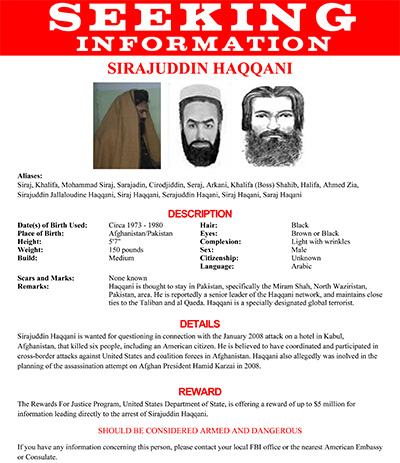
wantedPoster

FBI Wanted Poster – Sirajuddin Haqqani, son of Haqqani Network founder Jalaluddin Haqqani.

Protecting smuggling enterprises in the border areas under its control, as well as engaging in its own, has become an important source of income for HQN under Sirajuddin. Interestingly, according to the CTC report, HQN imports “the precursor chemicals used to process raw opium into morphine base and heroin, including lime, hydrochloric acid and acetic anhydride (AA). If true, this may indicate that the Haqqanis have a non‐competition agreement with the Kandahari Taliban in the heroin business, or it could simply suggest that Haqqani leaders have realized that smuggling precursors is less risky and often more lucrative, since a glut in poppy production drives down wholesale opium prices.”

These sustained efforts have ensured that the group remains financially autonomous from the Taliban, although it receives a monthly stipend from the Quetta branch “to cover operational costs, and the budget shifts depending on the season and the funding capacity of the Taliban leadership.”

A September 24, 2009, DIA cable notes that the Quetta branch remains a stable source of HQN funding, saying that “A large majority of the Haqqani Network (HQN) funding comes from the Quetta, Pakistan-based Taliban leadership.” The cable goes on to say that “HQN pays fighters who conduct successful attacks against coalition forces (CF) Afghan National Army (ANA) or Afghan National Police (ANP), with larger amounts paid for killing a coalition member. A key point in the dispersal and receiving of funds within the HQN is the videotaping of attacks.”

Bowe Bergdahl, held by the Haqqani network. AP photo.

Bowe Bergdahl, held by the Haqqani network. AP photo.

One of the shifts that occurred along with the change in leadership was HQN’s increase of kidnap-for-ransom, a “growth industry” in which HQN cooperates “seamlessly” with other militant groups, but one that seems to have effected HQN’s credibility. Bowe Bergdahl is perhaps HQN’s most famous kidnapping victim, and would have undoubtedly been on HQN’s list of “legitimate targets,” which include “government officials and security personnel; those who cooperate with government; foreigners; transporters servicing NATO; and alleged spies.” New York Times journalist David Rohde and Afghan diplomat Haji Khaliq Farahi were also targets. The CTC report notes, however, that such behavior “appears to have lowered the network in the public estimation.”

Kidnapping-for-ransom, however, remains a way for unpaid Haqqani militants to make money. Low-ranking militants earn little, if any, money, and operate with a great deal of autonomy – making the occasional moonlighting – and tension over it – all but inevitable.  A Secret September 29, 2009, DIA cable recounts one such ransom dispute. “As of late September 2009, Spera District Haqqani Network (HQN) commander Hamid (Rahman) had strained relations with the HQN leadership, including senior commander Siraj (Haqqani), over ransom money embezzled by Rahman. Rahman and an unidentified Iraqi Al-Qaida associate had kidnapped a road construction worker in Spera District for ransom and neglected to send the ransom money obtained to HQN leadership in Pakistan. As a result, Siraj Haqqani ordered Rahman to return to Miram Shah/[redacted] north Waziristan, PK, in order to account for the money. Rahman ignored the order and did not travel to Miram Shah due to fear that he would be killed by HQN leadership for his transgression.”

transgression

Donations and fundraising continue to be an important for HQN. A Secret March 22, 2009, DIA cable provides an example of a routine donation for HQN. It notes, “As of mid-February 2009, the Hadika ta Uloom madrassa in Dera Ismail Khan, PK was facilitating financial support for the Haqqani Network (HQN). The leader of the mosque, Maulawi din Mohammad (Khalifa), was facilitating contact between HQN commanders and local businessmen willing to donate money and assistance to the HQN.” The five businessmen contacted, all from the oil industry, provided a total of $17,000 USD.

HQN leaders also recognize the importance of a good media campaign. The CTC report finds that “Just as Jalaluddin before them, network leaders today conduct fundraising road shows, visiting large mosques around the region where they ask for alms from worshipers. As in the past, the Haqqanis appear to realize the importance of publicity materials to communicate their successes and to help to generate donations at these events. The network publishes considerable multi‐media material concerning its activities, and appears to consider publicity a core aspect of financial operations.”

HQN’s complicated relationship with the Afghan government, and its financial payoffs, are also highlighted in a Secret August 31, 2010, cable. The cable explains how a security manager in Khost province, Qabool Khan, simultaneously provides HQN with intelligence on US bases in Salerno and Chapman, while providing HQN with money and the license plate numbers of US vehicles of military personnel and contractors that serve on the two bases. Khan obtained his position with the security company – which posted private security guards on US bases – through Mahmoud Karzai, brother of Afghan president Hamid. “Khan receives $800.00 U.S. dollars per guard, per month, in which $200.00 U.S. dollars goes to the guard, $300.00 U.S. dollars to Khan, and $300.00 U.S. dollars is given to the Haqqani network… in return Khan is not attacked by Haqqani operatives leaving the American base or Khan’s personal residence. Khan leaves his window down when leaving the American base as a signal to Haqqani operatives not to attack his vehicle.”

These documents were requested under the FOIA as part of the Archive’s Afghanistan, Pakistan and Taliban project, and we will continue to post on interesting documents as they come in.
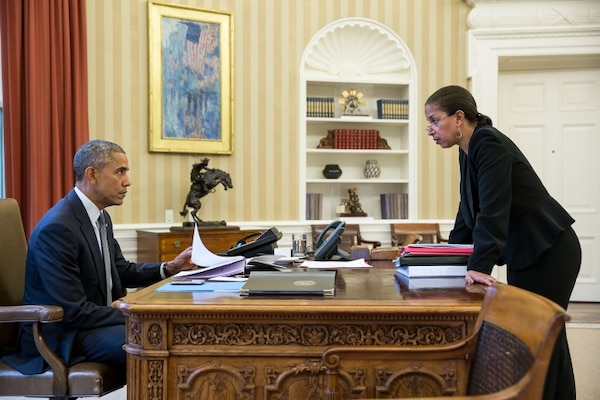
(General) Susan Rice, Declares War Policy on ISIS

Cant make this up……

Consider again this interview with the three previous Secretaries of Defense under Barack Obama…..

Rice Details U.S. Whole-of-Government Approach to Defeating ISIL

By Jim Garamone DoD News, Defense Media Activity

Susan E. Rice told the cadets and faculty that defeating ISIL is “at the very top of President Obama’s agenda.”

While the terror group is not an existential threat to the United States, she said, it is a danger to Americans and U.S. allies around the globe. Rice pointed to the ISIL attacks in Brussels, Paris, Istanbul, San Bernardino, Jakarta, Nigeria and others. She also highlighted ISIL in Syria and Iraq and the danger it poses to millions of people under its rule.

Dangerous Hybrid

What makes the group dangerous is that “it is essentially a hybrid,” the national security advisor said. ISIL is a terror organization that exploited the chaos of civil war in Syria to attack and occupy large swaths of Syria and Iraq. “At the same time, they have harnessed the power of social media to recruit fighters and inspire lone-wolf attacks,” Rice said.

ISIL is an enormous danger to civilians in the region and is an incredibly destabilizing force in the Middle East, she said, but members of the group are not 10 feet tall.

“This is not World War III or the much-hyped clash of civilizations,” Rice said. “On the contrary, we alienate our Muslim friends and allies — and dishonor the countless Muslim victims of ISIL’s brutality — when people recklessly and wrongly cast ISIL as somehow representative of one of the world’s largest religions.”

ISIL is simply “a twisted network of murderers and maniacs, and they must be rooted out, hunted down and destroyed,” she said, and all aspects of the U.S. government are part of the process to stop them.

Comprehensive Strategy

“For the past year and a half, the president has been leading a comprehensive strategy to destroy ISIL and its ideology of hate,” Rice said. “And, I do mean comprehensive. When we’re sitting around the situation room table, we’re using all aspects of our power — military, diplomacy, intelligence, counterterrorism, economic, development, homeland security, law enforcement. Ours is truly a whole-of-government campaign.”

 During remarks at the Air Force Academy in Colorado Springs, Colo., Ambassador Susan E. Rice, national security advisor, explains the comprehensive effort the United States is using to destroy the Islamic State of Iraq and the Levant, April 14, 2016.

And it is a global effort, the national security advisor emphasized. “We’ve assembled a broad coalition of 66 partners — from Nigeria and the Arab League to Australia and Singapore,” Rice said.

The anti-ISIL campaign represents an evolution in America’s broader strategy of confronting and defeating terrorism, she said, noting that since 9/11, the United States has learned that not every conflict requires large numbers of ground troops. “Our fight against ISIL is not like Afghanistan or the Iraq War,” she said.

In Syria and Iraq, coalition forces are helping to train indigenous forces, she said. “And, this increasingly dynamic campaign is ideally suited for airpower and the Air Force, utilized smartly in support of our partners on the ground,” Rice added.

The counter-ISIL strategy has four facets, she said. First, it calls for attacking ISIL’s core in Syria and Iraq. Second, the coalition is targeting ISIL’s branches. Third, the coalition is working to disrupt ISIL’s global network. Fourth, the United States is working around the clock to protect the homeland.

Substantial Progress

“It is a complex effort,” the national security advisor said. “It will not be accomplished fully in just a few weeks or months, or even a few years. But day by day, mile by mile, strike by strike, we are making substantial progress. And … we’re going to keep up the momentum.”

Rice detailed the coalition’s plans to continue the pressure on ISIL, beginning with continuing to hammer at the terrorist organization in Iraq and Syria — the so-called core ISIL. Coalition forces have conducted more than 11,500 strikes against core ISIL since starting operations in 2014, she said.

“Due, in large part, to our unprecedented visibility of the battlefield, the coalition air campaign is having a real impact,” Rice said. “Every few days, we’re taking out another key ISIL leader, hampering ISIL’s ability to plan attacks or launch new offensives.”

The strikes also are squeezing ISIL’s finances, which flow from their control of vast oil resources, their extortion and taxation of local populations and their looting and illicit sale of our cultural heritage, she said.

On the Ground

On the ground, the coalition will continue to support local forces in Iraq as they roll back ISIL, the national security advisor said. “So far, they have retaken more than 40 percent of the populated territory that ISIL once held,” she said.


“This fight will continue to require the courage and perseverance of the Iraqi people,” Rice continued. “It will also require the sustained financial support of the international community. It is not enough to win this fight; we must also win the eventual peace.”

Ending the civil war in Syria will go a long way to destroying ISIL, she said. An interagency team of diplomats, military and intelligence officers, working alongside Russia and other international partners facilitated a cessation of hostilities in the country, Rice noted. “This cessation has largely held, but in recent days, we’ve seen a significant uptick in fighting,” she said. “We’re increasingly concerned that the regime’s persistent violations of the cessation — and al-Nusrah’s hostile actions — will undermine efforts to quiet the conflict.”

Assad Must Go

Syrian President Bashar Assad may continue trying to disrupt and delay the good-faith efforts of the international community and the Syrian people to broker a political transition, the national security advisor said. “But he cannot escape the reality that the only solution to this conflict — the only way this ends — is through a political process that brings all Syrians together under a transitional government, a new constitution and credible elections that result in a new government without Assad,” Rice said.

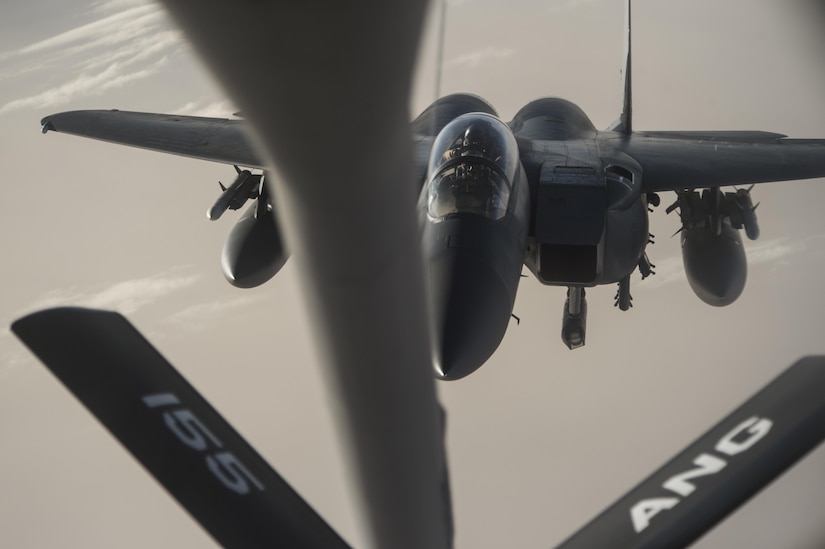
An Air Force F-15 Strike Eagle approaches a KC-135 Stratotanker for refueling over Iraq in support of Operation Inherent Resolve, the effort to counter the Islamic State of Iraq and the Levant in Iraq and Syria. Air Force photo by Staff Sgt. Corey Hook

An Air Force F-15 Strike Eagle approaches a KC-135 Stratotanker for refueling over Iraq in support of Operation Inherent Resolve, the effort to counter the Islamic State of Iraq and the Levant in Iraq and Syria. Air Force photo by Staff Sgt. Corey Hook 340th EARS Refuel Strike Eagles

An Air Force F-15 Strike Eagle approaches a KC-135 Stratotanker for refueling over Iraq in support of Operation Inherent Resolve, the effort to counter the Islamic State of Iraq and the Levant in Iraq and Syria. Air Force photo by Staff Sgt. Corey Hook

But core ISIL is only part of the problem, she noted. ISIL will flourish in fragile states and lawless regions, Rice said, citing ISIL ally Boko Haram in Nigeria and ISIL’s branches in Libya, on the Arabian Peninsula, in West Africa, in Afghanistan and Pakistan. ISIL has sent envoys “to provide their affiliates with money, fighters — even media training,” Rice said.

In Libya, ISIL threatens not only North African stability, but also sub-Saharan Africa and Europe as well, the national security advisor said.

In Afghanistan and Pakistan, ISIL has established a branch calling itself ISIL in the Khorasan — largely composed of former Afghan and Pakistani Taliban members. “They’ve gained territory in the east and launched attacks in major cities like Jalalabad, though a combination of U.S., Afghan, and Taliban pressure has limited ISIL’s gains,” she said. “As part of the U.S. counterterrorism mission in Afghanistan, President Obama has authorized the Department of Defense to target ISIL in the Khorasan.”

ISIL Affiliates in Yemen

In Yemen, ISIL affiliates have taken advantage of ongoing instability to attack mosques and nursing homes. In Saudi Arabia, ISIL has targeted security forces and civilians. “To address these offshoots, we are deepening our security cooperation with countries in the region,” Rice said. “When President Obama attends the U.S.-Gulf Cooperation Council Summit in Riyadh [Saudi Arabia] next week, ISIL will be at the top of our agenda.”

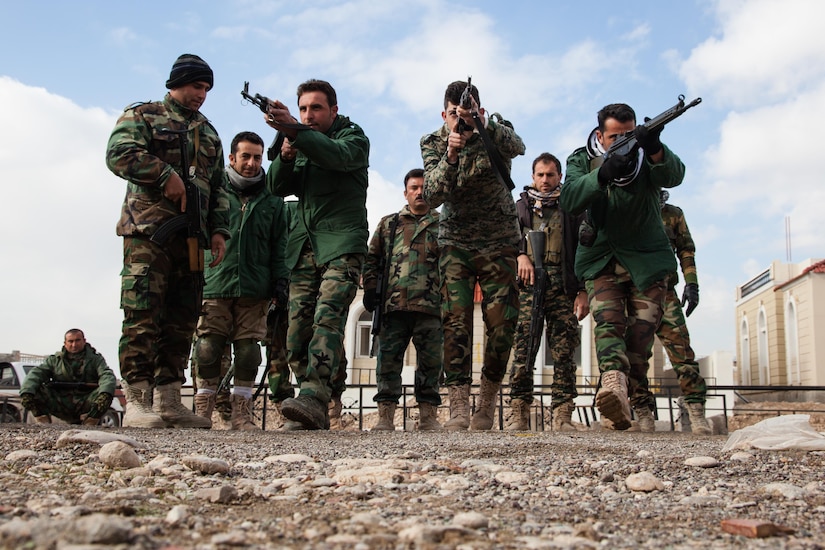
Peshmerga soldiers rehearse urban tactical movement at a training base near Irbil, Iraq, Jan. 26, 2016. Peshmerga soldiers attend a six-week infantry basic course that will help improve their tactical knowledge to aid in the fight against the Islamic State of Iraq and the Levant. There are six Combined Joint Task Force Operation Inherent Resolve training locations: four building partner capacity sites and two building specialized training sites. Army photo by Spc. Jessica Hurst

Peshmerga soldiers rehearse urban tactical movement at a training base near Irbil, Iraq, Jan. 26, 2016. Peshmerga soldiers attend a six-week infantry basic course that will help improve their tactical knowledge to aid in the fight against the Islamic State of Iraq and the Levant. There are six Combined Joint Task Force Operation Inherent Resolve training locations: four building partner capacity sites and two building specialized training sites. Army photo by Spc. Jessica Hurst Peshmerga soldiers practice tactical movements and clearing a buildings

Peshmerga soldiers rehearse urban tactical movement at a training base near Irbil, Iraq, Jan. 26, 2016. Peshmerga soldiers attend a six-week infantry basic course that will help improve their tactical knowledge to aid in the fight against the Islamic State of Iraq and the Levant. There are six Combined Joint Task Force Operation Inherent Resolve training locations: four building partner capacity sites and two building specialized training sites. Army photo by Spc. Jessica Hurst

The United States is working with countries such as Mali, Somalia, Bangladesh, Indonesia and the Philippines, which are countries targeted by the terror group, Rice said. “With smart, sustained investments,” she added, “we have a chance to prevent ISIL from taking root in these disparate corners by assisting our partners in ways as varied as improving local law enforcement, promoting development and countering ISIL’s nefarious narrative.”

ISIL’s narrative is at the heart of dismantling ISIL’s global network, Rice said. The attacks in Paris highlighted the threat of ISIL fighters returning home, she noted. The United States sent “foreign-fighter surge teams” to work with allies as they implement long-term structural reforms to improve intelligence sharing and prevent future attacks, she said.

Homeland Defense

U.S. officials in the homeland are also working to strengthen aviation security and screening, and working with Interpol to share thousands of profiles of suspected fighters, Rice said. “Roughly 45 countries have established mechanisms to identify and flag terrorist travel to Iraq and Syria, and dozens of countries have arrested fighters or aspiring fighters,” she added. “Together with our partners, we’re slowing the flow of foreign terrorist fighters into and out of Iraq and Syria — including sealing almost all the border with Turkey.”

It remains a problem. Since 2011, nearly 40,000 foreign fighters have traveled to Syria from more than 120 countries. “We will continue to do everything in our power to prevent them from returning and launching attacks in our countries,” Rice said.

The United Nations has passed a resolution targeting ISIL’s abuse of the international financial system. The raid last year against Abu Sayyaf, ISIL’s finance chief, yielded a wealth of information on ISIL’s financial vulnerabilities: 7 terabytes of flash drives, CDs, papers and other data, she said. “That’s more than we got out of the bin Laden raid. And, we’re going to continue using that information and other tools to turn off the ISIL funding tap,” Rice said.

Hearts and Minds

The battle against ISIL is a battle for hearts and minds, Rice said. She quoted the president saying, “Ideologies are not defeated with guns; they’re defeated by better ideas.”

The United States is working to expose ISIL’s twisted interpretation of Islam and underscore that ISIL not only is not defending Muslims, but also is killing many innocent Muslims, Rice said. But the United States cannot deliver this message, she said. It has to come from Muslims.

U.S. officials are supporting partners across the globe, including in Saudi Arabia and Malaysia, to get this message across, the national security advisor said. She praised the State Department’s new Global Engagement Center for amplifying anti-ISIL voices internationally, from religious leaders to ISIL defectors.

“Week by week, these voices are eroding ISIL’s appeal,” Rice said. “A new poll shows that nearly 80 percent of young Muslims — from Saudi Arabia to Egypt to Tunisia — are now strongly opposed to ISIL.”

Addressing Conditions

But the president doesn’t want to defeat ISIL only to have another group pop up and take its place, Rice said. “To defeat ISIL’s ideology for good, however, we must acknowledge the conditions that help draw people to ISIL’s destructive message in the first place,” she said. “Around the world, countries and communities — including the United States — must continue working to offer a better, more compelling vision. We must demonstrate, as President Obama has said, that the future belongs to those who build, not those who destroy. Where ISIL offers horror, countries around the world must offer hope.”

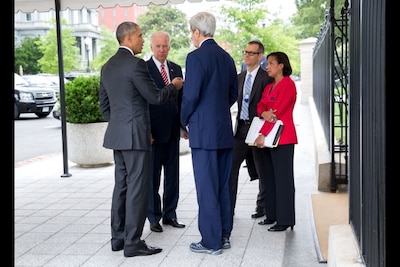
President Barack Obama talks with Vice President Joe Biden, Secretary of State John Kerry, National Security Advisor to the Vice President Colin Kahl and National Security Advisor Susan E. Rice outside the West Wing of the White House, July 15, 2015. White House photo by Pete Souza

President Barack Obama talks with Vice President Joe Biden, Secretary of State John Kerry, National Security Advisor to the Vice President Colin Kahl and National Security Advisor Susan E. Rice outside the West Wing of the White House, July 15, 2015. White House photo by Pete Souza White House Conversation

President Barack Obama talks with Vice President Joe Biden, Secretary of State John Kerry, National Security Advisor to the Vice President Colin Kahl and National Security Advisor Susan E. Rice outside the West Wing of the White House, July 15, 2015. White House photo by Pete Souza

Finally, Rice said, it comes down to protecting the homeland. “We’ve hardened our defenses — strengthening borders, airports, ports and other critical infrastructure,” she said. “We’re better prepared against potential bioterrorism and cyberattacks.”

U.S. borders will remain strong, and counterterrorism experts will remain hyper-vigilant, the national security advisor said. “The enduring source of America’s strength, however, comes from upholding our core values — the same enduring values embodied in each one of you at this academy,” Rice said. “It is when people feel persecuted or disempowered that extremism can take hold, so our commitment to the dignity and equality of every human being must remain ironclad.

“In the face of ISIL’s barbarism,” she continued, “America must remain resilient and defiant in our freedom, our openness, and our incredible diversity.”

Obama Executive Orders on Rotary Phones and Cable Boxes

It is all to level the playing field eh? An executive order will fix corporate competition. I see another objective to punish corporate success and likely a matter of picking winners and losers. Read on, your thoughts are invited.

If this really does stimulate quality competition without raising costs, then great….skeptics abound. Frankly this has all the hallmarks of providing free cable and internet access to a sector of the population, with hidden charges in our bills much like the Obamaphone program.

Oh yeah, just what are the hidden technologies of those cable boxes anyway? Example, the Comcast culprit.

Thinking Outside the Cable Box: How More Competition Gets You a Better Deal

Summary:
Learn how President Obama’s new efforts are spurring competition to make life better for consumers.

Today, building on efforts over the last seven years, the President is launching a new initiative to stoke competition across our economy, so that no corporation can unfairly squeeze their competitors, their workers, or their customers at everyone’s expense. Stronger competition matters because it can deliver lower prices, higher quality, and better customer service for consumers. It gives workers more of a voice and can help strengthen wage growth.  And it’s what entrepreneurs need to get a fair shot at growing their businesses and creating jobs.

Before There Were Cable Boxes

Before getting into the details, a little historical context (and more on a specific action we’re taking today).

Millenials are often defined as the generation born after 1980. But they could also be described as the generation that doesn’t remember what it’s like to be forced to rent a big, overpriced, basic phone from the phone company.

Until the early 1980s, the phone company had a monopoly—not just on the wire to your house but, in many cases, on the phone you plugged into that wire.

And the result wasn’t pretty.

Phones had little variety, evoking the famous Henry Ford quote — “You can have any color, so long as it’s black” — and only the most basic functionality. Worse yet, households had to pay a fee each month to rent these phones that added up over time to many multiples of what they would have paid to purchase a similar (or fancier) phone themselves.

Then, all that changed when the Federal Communications Commission (FCC) and others took action to open up phones to competition. This competition and the technological progress it helped drive, led to a proliferation of digital dialing, built-in answering machines, a panoply of styles, cordless phones, and other innovations.

A similar dynamic has taken hold elsewhere in American homes today: According to a recent study, 99 percent of all cable subscribers lease a set-top box to get their cable and satellite programming.

It sits in the middle of our living rooms, and most of us don’t think twice about it. But that same study found that the average household pays $231 per year to rent these often clunky boxes. And, while the cost of making these boxes is going down, their price to consumers has been rising.

Like the telephones in 1980s, that’s a symptom of a market that is cordoned off from competition. And that’s got to change.

How We’re Taking Action To Fix It

That’s why today the President announced that his Administration is calling on the FCC to open up set-top cable boxes to competition. This will allow for companies to create new, innovative, higher-quality, lower-cost products. Instead of spending nearly $1,000 over four years to lease a set of behind-the-times boxes, American families will have options to own a device for much less money that will integrate everything they want — including their cable or satellite content, as well as online streaming apps — in one, easier-to-use gadget.

But we’re not stopping there. In many ways, the set-top box is the mascot for a new initiative we’re launching today. That box is a stand-in for what happens when you don’t have the choice to go elsewhere—for all the parts of our economy where competition could do more.

Across our economy, too many consumers are dealing with inferior or overpriced products, too many workers aren’t getting the wage increases they deserve, too many entrepreneurs and small businesses are getting squeezed out unfairly by their bigger competitors, and overall we are not seeing the level of innovative growth we would like to see. And a big piece of why that happens is anti-competitive behavior—companies stacking the deck against their competitors and their workers. We’ve got to fix that, by doing everything we can to make sure that consumers, middle-class and working families, and entrepreneurs are getting a fair deal.

That’s why today, the President announced a broader new initiative through an Executive Order that calls on departments and agencies to make further progress through specific, pro-competition executive actions that empower and inform consumers, workers, and entrepreneurs. In 60 days, agencies will report back on specific areas where we can make additional progress.

Alongside that announcement, the White House Council of Economic Advisers (CEA) released a new issue brief that describes the many benefits of competition, highlights recent work by the independent antitrust authorities, and argues that consumers, workers, entrepreneurs, and small businesses would benefit from additional policy actions to promote competition within a variety of industries. These new steps will build on pro-competition progress we’ve made—from cell phone unlocking to net neutrality, from cracking down on conflicts of interest in retirement advice to efforts to free up essential technologies so that big incumbent companies can’t crowd out their competitors.

In the coming months, we’ll be doing everything we can across government to build on that progress and deliver on the pro-competition initiative we’re announcing today.

Marines Salvaging Aircraft Parts to Keep Flying

Congressional failures just forced the Marines to raid a museum for aircraft parts

MilitaryTimes: Marine aviation squadrons are salvaging aircraft parts from museums in order to keep planes flying, according to anecdotes from a key congressional leader.

During a recent trip to several Southern U.S. military bases, Marines told House Armed Services Committee Chairman Mac Thornberry, R-Texas, that they’ve been paying for their units’ supplies like pens and paper towels, and were forced to raid decommissioned aircraft for parts.

“I have heard firsthand from service members who have looked me in the eye and told of trying to cannibalize parts from a museum aircraft … getting aircraft that were sent to the boneyard in Arizona back and ready to fly missions, pilots flying well below the minimum number of hours required for minimal proficiency,” Thornberry said.

To see the short real time video go here.

Lawmakers are livid about the fiscal shortfalls, even if their budget infighting in Congress is partly to blame.

At issue are military readiness accounts stretched thin by more than a decade of war and four years of defense penny pinching. Earlier this month, chiefs from each of the four services told lawmakers that those two stressors have led to belt-tightening headaches for units across the military, in some cases deferring long-term needs in favor of short-term solutions.

 PhotoCamel

Thornberry would not identify which Marine air station had the parts shortage, and Marine Corps officials at the locations he visited would not confirm the stories.

But Joint Chiefs Chairman Gen. Joseph Dunford did not dispute and seemed to confirm the incidents when confronted with the anecdotes at a March 22 hearing.

“What you saw in the Marine Corps I think reflects in some part what you’ll see in all the services, perhaps not to the same degree as Marine aviation,” he told the chairman. “But that same dynamic exists in each one of the services.”

The Marine Corps has about 180 F/A-18A-Ds, said Marine Corps spokesman Maj. Clark Carpenter. Typically, 43 F/A-18s from deployable squadrons and nine from training squadrons are in depot for maintenance at any given time. That leaves only about 60 percent of the deployable aircraft in flyable, “fight tonight” status.”

Lt. Gen. Glen Walters, the Corps’ deputy commandant for programs and resources, told lawmakers earlier this month that budget cuts have left the entire service “under-resourced” for spare parts.

The Marine Corps has requested $460 million from Congress in fiscal 2017, some of which would buy spare parts for aircraft, but aviation readiness is not expected to fully recover until at least 2020.

Thornberry said the museum salvage attempt he learned about didn’t work, and the Marines were forced to find another fix to get the aircraft ready for an overseas mission.

“The part they took off the museum aircraft did not fit the aircraft they were trying to keep flying,” he said. “But they’re looking for whatever they can do to keep these things up in the air. It’s just amazing.”

Earlier this month, Marine Commandant Gen. Robert Neller blamed some of the maintenance and repair woes on the continued high tempo of operations.

“The fight in ISIL continues to put stress on equipment, particularly aviation,” he told lawmakers, using an acronym for the Islamic State group. “We’re in the process of resetting our equipment and then you’re trying to maintain legacy gear, and at the same time modernize every model type series of aircraft.”

Other service officials have echoed similar problems. Dunford and Defense Secretary Ash Carter point to Congress’ defense spending caps, which have limited maintenance and investment accounts in recent years, and begged for relief in upcoming budgets.

But committee members have questioned the Pentagon leaders’ assessments that the White House’s fiscal 2017 budget request is truly enough to fix the deep-seated problems, criticizing their promises that next year’s spending caps will be enough to right the force.

Thornberry said that several service members have told him they’ve started buying “basic supplies” like pens and cleaning products “because otherwise it would take three to four months to get them if they could get them at all.”

“I’d say my concern level was very high when I hear [anecdotes] like that. You have folks out there doing their job and they can’t get a pen from the federal government procurement system.

“It just makes you think ‘my gosh, can’t we do better than this?’”

Have you Met Paul Manafort?

Trump Just Hired His Next Scandal

By

Bloomberg: Here is an irony of the 2016 election season. The candidate promising voters that he won’t be influenced by Washington lobbyists is counting on the influence of a Washington lobbyist to save his presidential campaign.

Late last month Donald Trump hired Paul Manafort — who has represented his organization in Washington — to make sure his delegates at this summer’s convention in Cleveland actually end up voting for him. And for this task, Manafort is well-qualified. He ran delegate operations for the campaigns of Gerald Ford in 1976 and Bob Dole in 1996.

But Manafort’s real specialty is in the netherworld of international lobbying. Trump has criticized both parties as selling out the U.S. to foreign interests. Now he is counting on a man who has represented many of them.

Manafort has offered his services to not one but two presidents driven from power through popular revolution — Viktor Yanukovych in Ukraine and Ferdinand Marcos in the Philippines. He has lobbied for Saudi Arabia, a Bahamanian president suspected of narco-trafficking and a former Angolan rebel leader accused of torture.

For this work, Manafort has been well-compensated. He told a congressional oversight panel in 1989 that his firm normally accepted only clients who would pay at least $250,000 a year as a retainer.

Spy Magazine reported that his firm received $600,000 one year as compensation for his work for Angolan rebel leader, Jonas Savimbi. The Daily Beast reported that Manafort’s work for the Saudis netted him $250,000 for six months of work in 1984. A Justice Department form filed in 2008 from a subcontractor to Manafort’s firm said the PR work alone on behalf of Ukraine’s government was paid at $35,000 a month.

In 2013, Manafort surfaced in a French influence-peddling scandal involving Edouard Balladur, who was prime minister in the mid-1990s. Manafort acknowledged in a Virginia court that he was paid by an adviser to the Saudi royal court more than $200,000 for advice he provided on security issues. That adviser in turn funneled the profits of an arms sale back into Balladur’s political campaign.

Manafort did not respond to an e-mail seeking comment. When asked about his Ukraine lobbying on “Meet the Press” on Sunday, he said that Trump was now his only client.

Most lobbyists make their money from contracts with clients, like lawyers and other consultants. And Manafort does as well. But he has also branched out.

In 1989, Manafort was hauled before Congress for a classic example of Washington double-dealing. His firm received a $326,000 fee for securing for a client a $43 million Department of Housing and Urban Development subsidy for a block of low-income apartments in Seabrook, New Jersey. Manafort then purchased a 20 percent stake in the Seabrook subdivision that was to receive the federal subsidy for which he lobbied.

When a Republican congressman remarked that the whole deal was sleazy, Manafort replied: “We worked the system as it existed. I don’t think we did anything illegal or improper.”

This was not the last time Manafort explored real-estate deals connected to his lobbying work. Documents uncovered in 2014 from a lawsuit brought about by former Ukrainian prime minister Yulia Tymoshenko show that Manafort attempted to set up a real-estate partnership with Dmitry Firtash, a notorious Ukrainian businessman who financed the party of former Ukrainian president Viktor Yanukovych and who is wanted by the FBI on bribery and corruption charges.

The documents, first reported by the Washington Free Beacon, include a Nov. 6, 2008, letter to Manafort from Firtash’s holding company that says it had deposited $25 million in escrow for a plan to buy a tower in Manhattan and was prepared to invest $112 million for the project with the understanding that Manafort’s own Calister Investments LLC will be the project’s developer.

David Kramer, a former senior State Department official who worked on Russia and Ukraine and is currently a senior director for human rights and democracy at the McCain Institute in Washington, told me Manafort was “a persistent lobbyist” for Yanukovych when he was in government. “He was trying to paint Yanukovych as something he wasn’t,” Kramer said of his dealings with Manafort. “The Ukrainian president is a corrupt Soviet-style apparatchik who was interested in coming to power for the sake of serving his own interest and not his country. Manafort portrayed him as somebody who could reform.”

Given that Manafort cashed in on federally subsidized apartments and given that Firtash is accused of trying to bribe public officials, the attempted real-estate deal between the two men at the very least gives the appearance of wrongdoing — the kind of appearance that most presidential candidates would try to avoid.

“Someone who has had such close relations with notorious kleptocrats doesn’t belong anywhere near any of our presidential candidates,” Charles Davidson, executive director of Kleptocracy Initiative at Hudson Institute, told me.

Indeed, in 2008, the McCain campaign considered Manafort for the job of Republican convention manager and then dropped him because of his work with Ukraine and other shadows on his resume.

But Trump is an unconventional candidate. The real-estate mogul with a taste for politics has turned to a political operative with a taste for real estate. In this sense, Trump and his former lobbyist are a perfect match.

**** The Karachi Affair:

In part from Dawn:

French investigators suspect a web of corruption behind the sale of sub-marines from France to Pakistan, with illegal funds going to the Balladur campaign in a scandal known as the ‘Karachi affair’.

Former French president Nicolas Sarkozy, who was a cabinet minister and then prime minister Balladur’s spokesman at the time, is linked to the affair.

Mr Manafort, who was questioned in the US state of Virginia according to Liberation, admitted being paid by Abdul Rahman al Assir, one of two intermediaries along with businessman Ziad Takieddine, brought in at the last minute to sign arms deals with Saudi Arabia and Pakistan.

Mr Takieddine admitted in June carrying briefcases stuffed with cash from Switzerland destined for the Balladur campaign, while his wife said Mr Manafort was a “close friend” of Mr Assir’s.

“In this regard, Ziad told me Paul Manafort was advising the Balladur presidential campaign,” she reportedly told police.

Mr Manafort confirmed her statements but said he was spurned by the Balladur campaign, while the former prime minister’s associates have repeatedly denied meeting him.

Investigators say Mr Manafort, his public relations company or his associates received a total of at least $200,000 between September 1994 and August 1995.

Three more transfers from an account of Mr Assir’s in Madrid to an account of Mr Manafort’s from October 2000 and June 2001 totalling more than $140,000 were later discovered.—AFP