Cables: Taliban, Haqqani, Kidnapping and Bergdahl

Facts are funny things and the CIA is fearless. Dates matter too.

For the additional details on the attack on the CIA base mentioned in the body of this post, go here.

Supporters “Are in the Oil Industry”: Declassified DIA Cables Show Haqqani Network Revenue Streams


Haqqani Network map; courtesy of the National Counterterrorism Center.

Haqqani Network map; courtesy of the National Counterterrorism Center.

NSAArchive: Less than a dozen men were running the militant Islamist Haqqani Network (HQN) by the time the State Department declared it a Foreign Terrorist Organization in 2012, and this extremely small group continues to determine which illicit activities the organization engages in to fund its fight against US-led forces in Afghanistan. Defense Intelligence Agency documents dated from 2008 through 2010 recently obtained by the National Security Archive in response to a FOIA request offer a window into a transitional period for the organization, before the State Department declared the group a terrorist organization and the US Treasury designated Haqqani leaders as Specially Designated Global Terrorists in 2014, subjecting them to sanctions. The documents illuminate the group’s efforts to diversify its funding away from the foreign sources it relied on during the Cold War, including the CIA and Pakistani intelligence services, and towards more traditionally criminal activity – and show squabbles over the sharing of ransom money, dispersal of funds to suicide bombers, financial links between HQN and the Karzai government, and Taliban funding for the group’s activities.

Jalaluddin Haqqani

Jalaluddin Haqqani

One of the early financial challenges for Jalaluddin Haqqani, the group’s founder, was coping with the end of the Cold War and the drying up of American resources. Barbara Elias notes in 2009’s “The Taliban File” that Haqqani received tens of thousands of dollars and weapons from the CIA between 1986 and 1994. CIA funding ended by the mid-1990s, although Haqqani’s relationship with the US only deteriorated in earnest in the late-1990s after the US bombed an HQN-linked training camp in retaliation for al-Qaida attacks on the US embassies in Kenya and Tanzania and Haqqani’s relationship with Osama bin Laden deepened.

A Confidential June 12, 1998, State Department cable, first published in Elias’s 2012 “The Haqqani History,” notes that Jalaluddin advocated for bin Laden within the Taliban, and that bin Laden’s increased power was due at least in part to “the growing strength of his supporters within the Taliban movement.” The US’s growing concern with bin Laden is shown in a May 24, 1999, cable summarizing a meeting between Haqqani and US officials, during which Haqqani agrees that bin Laden is “a problem,” but insists that “maybe the best solution is what is taking place now with him remaining in the country.” Haqqani also says that “he was deeply appreciative of U.S. assistance during the ‘jihad’ (holy war) against the Soviets and the (Afghan) communists,” but remains antagonistic over US destruction of a terrorist camp in Khost, Afghanistan, in August 1998. Haqqani even initiates the meeting by “joking” that it was “good to meet someone from the country which had destroyed my base, my madrassh [sic], and killed 25 of my mujahideen.”

Despite the historical ties  between the groups, al-Qaida funding is not a major source of income for HQN; a September 24, 2009, DIA cable shows that when al-Qaida funding was received, it was relatively small amounts that were “generally provided by Al Qaida leader Shaykh Said al-Masri through Sirajudding Haqqani and Jan Baz Zadran, who is a HQN commander in Miram Shah, PK, in amounts of approximately 3,000 – 5,000 USD.”

West Point’s Combatting Terrorism Center (CTC) notes in a 2012 report that Jalaluddin was also motivated to decrease his organization’s dependence on Pakistani financing, and began vigorous fundraising efforts in the Gulf States in the 1990s to do so. A newly released April 8, 2010, DIA cable shows this practice continues. According to the cable, a well-connected individual “travels on behalf of the Haqqani network to a city in the vicinity of Dubai to collect charitable donations which are used to fund unspecified Haqqani network operations.”

However, a series of DIA cables (from January 11, 2010, and February 6, 2010) show that some funding for Haqqani attacks are still provided by the Pakistan Inter-Services Intelligence Directorate, including $200,000 for the December 30, 2009, attack on the CIA facility at Camp Chapman.

200k

Excerpt from a Feb. 6, 2010 posting on ISID funding for Haqqani attacks.

During Jalaluddin’s tenure the group also offered microloans to those living in its territory in North Waziristan, Pakistan, in a move that fostered goodwill and “really made a difference in these communities.” The attempts at public relations under Jalaluddin is not entirely unsurprising; a 1997 State Department cable reports Jalaluddin to be “more liberal” in his opinions on social policy, such as women’s rights, and seems to have understood the importance of maintaining credibility with the local community.

Jalaluddin was forced to retire in 2005, however, and his son Sirajuddin assumed the leadership, marking an increase in the group’s illicit activity.
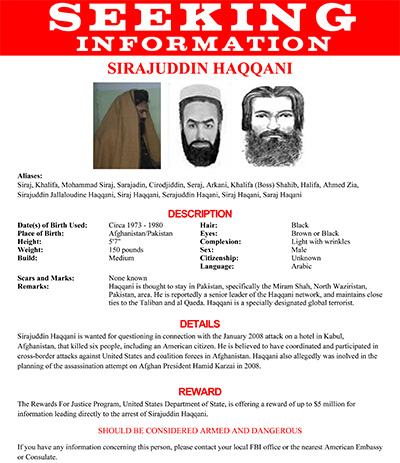
wantedPoster

FBI Wanted Poster – Sirajuddin Haqqani, son of Haqqani Network founder Jalaluddin Haqqani.

Protecting smuggling enterprises in the border areas under its control, as well as engaging in its own, has become an important source of income for HQN under Sirajuddin. Interestingly, according to the CTC report, HQN imports “the precursor chemicals used to process raw opium into morphine base and heroin, including lime, hydrochloric acid and acetic anhydride (AA). If true, this may indicate that the Haqqanis have a non‐competition agreement with the Kandahari Taliban in the heroin business, or it could simply suggest that Haqqani leaders have realized that smuggling precursors is less risky and often more lucrative, since a glut in poppy production drives down wholesale opium prices.”

These sustained efforts have ensured that the group remains financially autonomous from the Taliban, although it receives a monthly stipend from the Quetta branch “to cover operational costs, and the budget shifts depending on the season and the funding capacity of the Taliban leadership.”

A September 24, 2009, DIA cable notes that the Quetta branch remains a stable source of HQN funding, saying that “A large majority of the Haqqani Network (HQN) funding comes from the Quetta, Pakistan-based Taliban leadership.” The cable goes on to say that “HQN pays fighters who conduct successful attacks against coalition forces (CF) Afghan National Army (ANA) or Afghan National Police (ANP), with larger amounts paid for killing a coalition member. A key point in the dispersal and receiving of funds within the HQN is the videotaping of attacks.”

Bowe Bergdahl, held by the Haqqani network. AP photo.

Bowe Bergdahl, held by the Haqqani network. AP photo.

One of the shifts that occurred along with the change in leadership was HQN’s increase of kidnap-for-ransom, a “growth industry” in which HQN cooperates “seamlessly” with other militant groups, but one that seems to have effected HQN’s credibility. Bowe Bergdahl is perhaps HQN’s most famous kidnapping victim, and would have undoubtedly been on HQN’s list of “legitimate targets,” which include “government officials and security personnel; those who cooperate with government; foreigners; transporters servicing NATO; and alleged spies.” New York Times journalist David Rohde and Afghan diplomat Haji Khaliq Farahi were also targets. The CTC report notes, however, that such behavior “appears to have lowered the network in the public estimation.”

Kidnapping-for-ransom, however, remains a way for unpaid Haqqani militants to make money. Low-ranking militants earn little, if any, money, and operate with a great deal of autonomy – making the occasional moonlighting – and tension over it – all but inevitable.  A Secret September 29, 2009, DIA cable recounts one such ransom dispute. “As of late September 2009, Spera District Haqqani Network (HQN) commander Hamid (Rahman) had strained relations with the HQN leadership, including senior commander Siraj (Haqqani), over ransom money embezzled by Rahman. Rahman and an unidentified Iraqi Al-Qaida associate had kidnapped a road construction worker in Spera District for ransom and neglected to send the ransom money obtained to HQN leadership in Pakistan. As a result, Siraj Haqqani ordered Rahman to return to Miram Shah/[redacted] north Waziristan, PK, in order to account for the money. Rahman ignored the order and did not travel to Miram Shah due to fear that he would be killed by HQN leadership for his transgression.”

transgression

Donations and fundraising continue to be an important for HQN. A Secret March 22, 2009, DIA cable provides an example of a routine donation for HQN. It notes, “As of mid-February 2009, the Hadika ta Uloom madrassa in Dera Ismail Khan, PK was facilitating financial support for the Haqqani Network (HQN). The leader of the mosque, Maulawi din Mohammad (Khalifa), was facilitating contact between HQN commanders and local businessmen willing to donate money and assistance to the HQN.” The five businessmen contacted, all from the oil industry, provided a total of $17,000 USD.

HQN leaders also recognize the importance of a good media campaign. The CTC report finds that “Just as Jalaluddin before them, network leaders today conduct fundraising road shows, visiting large mosques around the region where they ask for alms from worshipers. As in the past, the Haqqanis appear to realize the importance of publicity materials to communicate their successes and to help to generate donations at these events. The network publishes considerable multi‐media material concerning its activities, and appears to consider publicity a core aspect of financial operations.”

HQN’s complicated relationship with the Afghan government, and its financial payoffs, are also highlighted in a Secret August 31, 2010, cable. The cable explains how a security manager in Khost province, Qabool Khan, simultaneously provides HQN with intelligence on US bases in Salerno and Chapman, while providing HQN with money and the license plate numbers of US vehicles of military personnel and contractors that serve on the two bases. Khan obtained his position with the security company – which posted private security guards on US bases – through Mahmoud Karzai, brother of Afghan president Hamid. “Khan receives $800.00 U.S. dollars per guard, per month, in which $200.00 U.S. dollars goes to the guard, $300.00 U.S. dollars to Khan, and $300.00 U.S. dollars is given to the Haqqani network… in return Khan is not attacked by Haqqani operatives leaving the American base or Khan’s personal residence. Khan leaves his window down when leaving the American base as a signal to Haqqani operatives not to attack his vehicle.”

These documents were requested under the FOIA as part of the Archive’s Afghanistan, Pakistan and Taliban project, and we will continue to post on interesting documents as they come in.
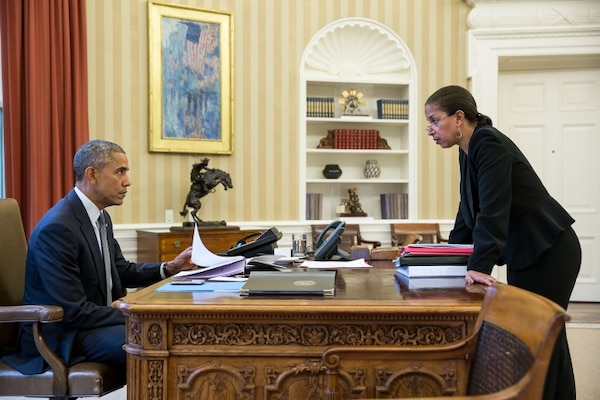
(General) Susan Rice, Declares War Policy on ISIS

Cant make this up……

Consider again this interview with the three previous Secretaries of Defense under Barack Obama…..

Rice Details U.S. Whole-of-Government Approach to Defeating ISIL

By Jim Garamone DoD News, Defense Media Activity

Susan E. Rice told the cadets and faculty that defeating ISIL is “at the very top of President Obama’s agenda.”

While the terror group is not an existential threat to the United States, she said, it is a danger to Americans and U.S. allies around the globe. Rice pointed to the ISIL attacks in Brussels, Paris, Istanbul, San Bernardino, Jakarta, Nigeria and others. She also highlighted ISIL in Syria and Iraq and the danger it poses to millions of people under its rule.

Dangerous Hybrid

What makes the group dangerous is that “it is essentially a hybrid,” the national security advisor said. ISIL is a terror organization that exploited the chaos of civil war in Syria to attack and occupy large swaths of Syria and Iraq. “At the same time, they have harnessed the power of social media to recruit fighters and inspire lone-wolf attacks,” Rice said.

ISIL is an enormous danger to civilians in the region and is an incredibly destabilizing force in the Middle East, she said, but members of the group are not 10 feet tall.

“This is not World War III or the much-hyped clash of civilizations,” Rice said. “On the contrary, we alienate our Muslim friends and allies — and dishonor the countless Muslim victims of ISIL’s brutality — when people recklessly and wrongly cast ISIL as somehow representative of one of the world’s largest religions.”

ISIL is simply “a twisted network of murderers and maniacs, and they must be rooted out, hunted down and destroyed,” she said, and all aspects of the U.S. government are part of the process to stop them.

Comprehensive Strategy

“For the past year and a half, the president has been leading a comprehensive strategy to destroy ISIL and its ideology of hate,” Rice said. “And, I do mean comprehensive. When we’re sitting around the situation room table, we’re using all aspects of our power — military, diplomacy, intelligence, counterterrorism, economic, development, homeland security, law enforcement. Ours is truly a whole-of-government campaign.”

 During remarks at the Air Force Academy in Colorado Springs, Colo., Ambassador Susan E. Rice, national security advisor, explains the comprehensive effort the United States is using to destroy the Islamic State of Iraq and the Levant, April 14, 2016.

And it is a global effort, the national security advisor emphasized. “We’ve assembled a broad coalition of 66 partners — from Nigeria and the Arab League to Australia and Singapore,” Rice said.

The anti-ISIL campaign represents an evolution in America’s broader strategy of confronting and defeating terrorism, she said, noting that since 9/11, the United States has learned that not every conflict requires large numbers of ground troops. “Our fight against ISIL is not like Afghanistan or the Iraq War,” she said.

In Syria and Iraq, coalition forces are helping to train indigenous forces, she said. “And, this increasingly dynamic campaign is ideally suited for airpower and the Air Force, utilized smartly in support of our partners on the ground,” Rice added.

The counter-ISIL strategy has four facets, she said. First, it calls for attacking ISIL’s core in Syria and Iraq. Second, the coalition is targeting ISIL’s branches. Third, the coalition is working to disrupt ISIL’s global network. Fourth, the United States is working around the clock to protect the homeland.

Substantial Progress

“It is a complex effort,” the national security advisor said. “It will not be accomplished fully in just a few weeks or months, or even a few years. But day by day, mile by mile, strike by strike, we are making substantial progress. And … we’re going to keep up the momentum.”

Rice detailed the coalition’s plans to continue the pressure on ISIL, beginning with continuing to hammer at the terrorist organization in Iraq and Syria — the so-called core ISIL. Coalition forces have conducted more than 11,500 strikes against core ISIL since starting operations in 2014, she said.

“Due, in large part, to our unprecedented visibility of the battlefield, the coalition air campaign is having a real impact,” Rice said. “Every few days, we’re taking out another key ISIL leader, hampering ISIL’s ability to plan attacks or launch new offensives.”

The strikes also are squeezing ISIL’s finances, which flow from their control of vast oil resources, their extortion and taxation of local populations and their looting and illicit sale of our cultural heritage, she said.

On the Ground

On the ground, the coalition will continue to support local forces in Iraq as they roll back ISIL, the national security advisor said. “So far, they have retaken more than 40 percent of the populated territory that ISIL once held,” she said.


“This fight will continue to require the courage and perseverance of the Iraqi people,” Rice continued. “It will also require the sustained financial support of the international community. It is not enough to win this fight; we must also win the eventual peace.”

Ending the civil war in Syria will go a long way to destroying ISIL, she said. An interagency team of diplomats, military and intelligence officers, working alongside Russia and other international partners facilitated a cessation of hostilities in the country, Rice noted. “This cessation has largely held, but in recent days, we’ve seen a significant uptick in fighting,” she said. “We’re increasingly concerned that the regime’s persistent violations of the cessation — and al-Nusrah’s hostile actions — will undermine efforts to quiet the conflict.”

Assad Must Go

Syrian President Bashar Assad may continue trying to disrupt and delay the good-faith efforts of the international community and the Syrian people to broker a political transition, the national security advisor said. “But he cannot escape the reality that the only solution to this conflict — the only way this ends — is through a political process that brings all Syrians together under a transitional government, a new constitution and credible elections that result in a new government without Assad,” Rice said.

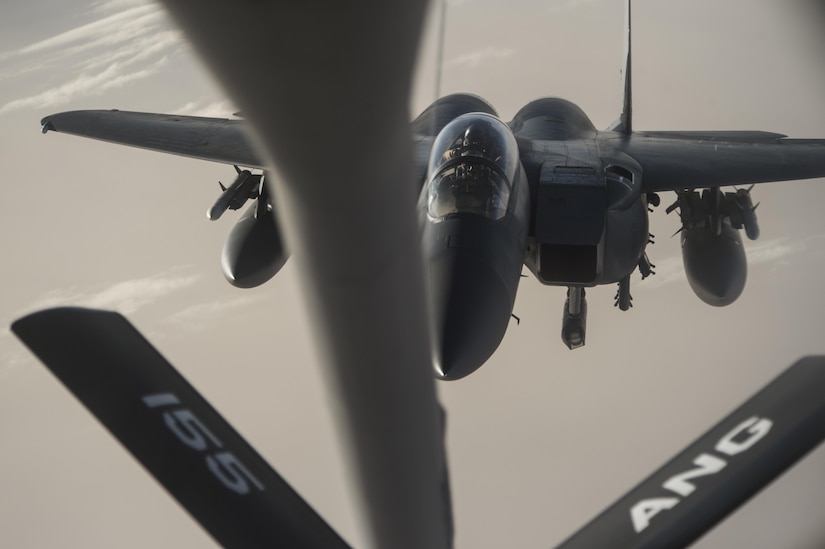
An Air Force F-15 Strike Eagle approaches a KC-135 Stratotanker for refueling over Iraq in support of Operation Inherent Resolve, the effort to counter the Islamic State of Iraq and the Levant in Iraq and Syria. Air Force photo by Staff Sgt. Corey Hook

An Air Force F-15 Strike Eagle approaches a KC-135 Stratotanker for refueling over Iraq in support of Operation Inherent Resolve, the effort to counter the Islamic State of Iraq and the Levant in Iraq and Syria. Air Force photo by Staff Sgt. Corey Hook 340th EARS Refuel Strike Eagles

An Air Force F-15 Strike Eagle approaches a KC-135 Stratotanker for refueling over Iraq in support of Operation Inherent Resolve, the effort to counter the Islamic State of Iraq and the Levant in Iraq and Syria. Air Force photo by Staff Sgt. Corey Hook

But core ISIL is only part of the problem, she noted. ISIL will flourish in fragile states and lawless regions, Rice said, citing ISIL ally Boko Haram in Nigeria and ISIL’s branches in Libya, on the Arabian Peninsula, in West Africa, in Afghanistan and Pakistan. ISIL has sent envoys “to provide their affiliates with money, fighters — even media training,” Rice said.

In Libya, ISIL threatens not only North African stability, but also sub-Saharan Africa and Europe as well, the national security advisor said.

In Afghanistan and Pakistan, ISIL has established a branch calling itself ISIL in the Khorasan — largely composed of former Afghan and Pakistani Taliban members. “They’ve gained territory in the east and launched attacks in major cities like Jalalabad, though a combination of U.S., Afghan, and Taliban pressure has limited ISIL’s gains,” she said. “As part of the U.S. counterterrorism mission in Afghanistan, President Obama has authorized the Department of Defense to target ISIL in the Khorasan.”

ISIL Affiliates in Yemen

In Yemen, ISIL affiliates have taken advantage of ongoing instability to attack mosques and nursing homes. In Saudi Arabia, ISIL has targeted security forces and civilians. “To address these offshoots, we are deepening our security cooperation with countries in the region,” Rice said. “When President Obama attends the U.S.-Gulf Cooperation Council Summit in Riyadh [Saudi Arabia] next week, ISIL will be at the top of our agenda.”

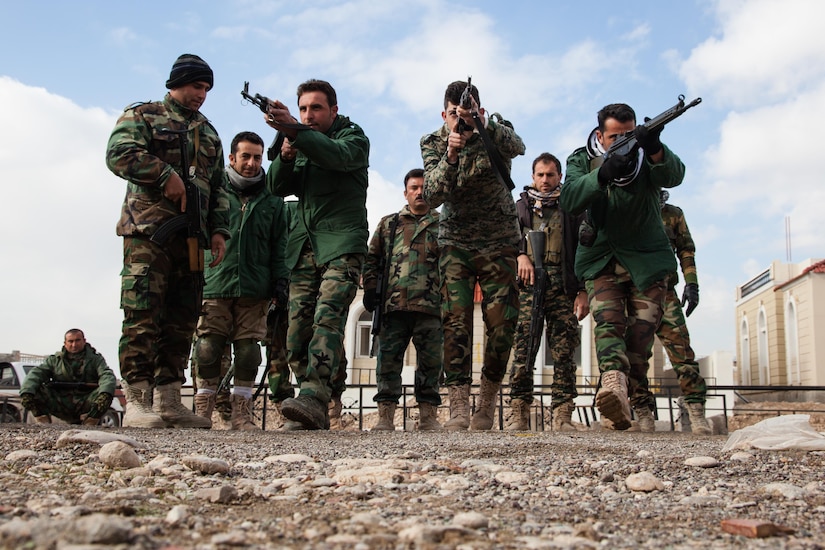
Peshmerga soldiers rehearse urban tactical movement at a training base near Irbil, Iraq, Jan. 26, 2016. Peshmerga soldiers attend a six-week infantry basic course that will help improve their tactical knowledge to aid in the fight against the Islamic State of Iraq and the Levant. There are six Combined Joint Task Force Operation Inherent Resolve training locations: four building partner capacity sites and two building specialized training sites. Army photo by Spc. Jessica Hurst

Peshmerga soldiers rehearse urban tactical movement at a training base near Irbil, Iraq, Jan. 26, 2016. Peshmerga soldiers attend a six-week infantry basic course that will help improve their tactical knowledge to aid in the fight against the Islamic State of Iraq and the Levant. There are six Combined Joint Task Force Operation Inherent Resolve training locations: four building partner capacity sites and two building specialized training sites. Army photo by Spc. Jessica Hurst Peshmerga soldiers practice tactical movements and clearing a buildings

Peshmerga soldiers rehearse urban tactical movement at a training base near Irbil, Iraq, Jan. 26, 2016. Peshmerga soldiers attend a six-week infantry basic course that will help improve their tactical knowledge to aid in the fight against the Islamic State of Iraq and the Levant. There are six Combined Joint Task Force Operation Inherent Resolve training locations: four building partner capacity sites and two building specialized training sites. Army photo by Spc. Jessica Hurst

The United States is working with countries such as Mali, Somalia, Bangladesh, Indonesia and the Philippines, which are countries targeted by the terror group, Rice said. “With smart, sustained investments,” she added, “we have a chance to prevent ISIL from taking root in these disparate corners by assisting our partners in ways as varied as improving local law enforcement, promoting development and countering ISIL’s nefarious narrative.”

ISIL’s narrative is at the heart of dismantling ISIL’s global network, Rice said. The attacks in Paris highlighted the threat of ISIL fighters returning home, she noted. The United States sent “foreign-fighter surge teams” to work with allies as they implement long-term structural reforms to improve intelligence sharing and prevent future attacks, she said.

Homeland Defense

U.S. officials in the homeland are also working to strengthen aviation security and screening, and working with Interpol to share thousands of profiles of suspected fighters, Rice said. “Roughly 45 countries have established mechanisms to identify and flag terrorist travel to Iraq and Syria, and dozens of countries have arrested fighters or aspiring fighters,” she added. “Together with our partners, we’re slowing the flow of foreign terrorist fighters into and out of Iraq and Syria — including sealing almost all the border with Turkey.”

It remains a problem. Since 2011, nearly 40,000 foreign fighters have traveled to Syria from more than 120 countries. “We will continue to do everything in our power to prevent them from returning and launching attacks in our countries,” Rice said.

The United Nations has passed a resolution targeting ISIL’s abuse of the international financial system. The raid last year against Abu Sayyaf, ISIL’s finance chief, yielded a wealth of information on ISIL’s financial vulnerabilities: 7 terabytes of flash drives, CDs, papers and other data, she said. “That’s more than we got out of the bin Laden raid. And, we’re going to continue using that information and other tools to turn off the ISIL funding tap,” Rice said.

Hearts and Minds

The battle against ISIL is a battle for hearts and minds, Rice said. She quoted the president saying, “Ideologies are not defeated with guns; they’re defeated by better ideas.”

The United States is working to expose ISIL’s twisted interpretation of Islam and underscore that ISIL not only is not defending Muslims, but also is killing many innocent Muslims, Rice said. But the United States cannot deliver this message, she said. It has to come from Muslims.

U.S. officials are supporting partners across the globe, including in Saudi Arabia and Malaysia, to get this message across, the national security advisor said. She praised the State Department’s new Global Engagement Center for amplifying anti-ISIL voices internationally, from religious leaders to ISIL defectors.

“Week by week, these voices are eroding ISIL’s appeal,” Rice said. “A new poll shows that nearly 80 percent of young Muslims — from Saudi Arabia to Egypt to Tunisia — are now strongly opposed to ISIL.”

Addressing Conditions

But the president doesn’t want to defeat ISIL only to have another group pop up and take its place, Rice said. “To defeat ISIL’s ideology for good, however, we must acknowledge the conditions that help draw people to ISIL’s destructive message in the first place,” she said. “Around the world, countries and communities — including the United States — must continue working to offer a better, more compelling vision. We must demonstrate, as President Obama has said, that the future belongs to those who build, not those who destroy. Where ISIL offers horror, countries around the world must offer hope.”

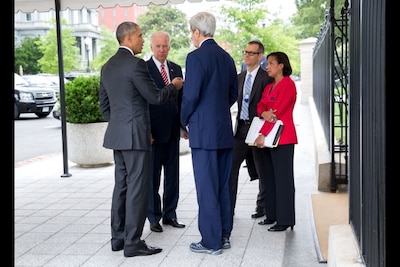
President Barack Obama talks with Vice President Joe Biden, Secretary of State John Kerry, National Security Advisor to the Vice President Colin Kahl and National Security Advisor Susan E. Rice outside the West Wing of the White House, July 15, 2015. White House photo by Pete Souza

President Barack Obama talks with Vice President Joe Biden, Secretary of State John Kerry, National Security Advisor to the Vice President Colin Kahl and National Security Advisor Susan E. Rice outside the West Wing of the White House, July 15, 2015. White House photo by Pete Souza White House Conversation

President Barack Obama talks with Vice President Joe Biden, Secretary of State John Kerry, National Security Advisor to the Vice President Colin Kahl and National Security Advisor Susan E. Rice outside the West Wing of the White House, July 15, 2015. White House photo by Pete Souza

Finally, Rice said, it comes down to protecting the homeland. “We’ve hardened our defenses — strengthening borders, airports, ports and other critical infrastructure,” she said. “We’re better prepared against potential bioterrorism and cyberattacks.”

U.S. borders will remain strong, and counterterrorism experts will remain hyper-vigilant, the national security advisor said. “The enduring source of America’s strength, however, comes from upholding our core values — the same enduring values embodied in each one of you at this academy,” Rice said. “It is when people feel persecuted or disempowered that extremism can take hold, so our commitment to the dignity and equality of every human being must remain ironclad.

“In the face of ISIL’s barbarism,” she continued, “America must remain resilient and defiant in our freedom, our openness, and our incredible diversity.”

U.S. Deploys Commandos to the Philippines

Why? Well as both Barack Obama and John Kerry tell us that Islamic State has lost territory, which may only be barely accurate in Iraq or Syria, they have gained a larger footprint globally and that includes the Philippines.

The Philippines-based jihadi group Abu Sayyaf Group released a new video with its Canadian, Filipino, and Norwegian hostages, giving a final deadline for their ransoms to be met and threatening to behead one of the four on April 25.

So we are deploying special forces to the region.

MANILA, Philippines— In a military buildup certain to inflame tensions with China, the United States said Thursday it will send troops and combat aircraft to the Philippines for regular, more frequent rotations, and will conduct more joint sea and air patrols with Philippine forces in the South China Sea.

In fact, Defense Secretary Ash Carter is in the region on has taken some time to board the carrier battle group the USS Stennis.

ABOARD THE USS JOHN C. STENNIS —U.S. Secretary of Defense Ash Carter on Friday made a second sail of the South China Sea, underscoring the U.S. commitment to its Asia-Pacific allies amid increasing tensions with China.

Carter said his presence on the aircraft carrier USS John C. Stennis, which was sailing about 60 to 70 miles West of the Philippines’ main island, Luzon Island, was to send “a message to the region.”

“The United States intends to continue to play a role in keeping peace and stability in this region’” said Carter, who was accompanied by Philippines defense minister Voltaire Gazmin.

What is the problem there you ask? Islamic State….the terror operation that is spreading to other regions in the world.

From Time magazine:

ISIS Is Making Inroads in the Southern Philippines and the Implications for Asia Are Alarming

Counter-terrorism operation in Philippines Anadolu Agency/Getty ImagesPhilippine army soldiers stage a counterterrorism operation against Maute terrorists, who are allegedly linked with ISIS, in Butig, the Philippine province of Lanao Del Sur, in Mindanao Island, on March 1, 2016

Islamist extremism is growing in Mindanao, with serious security implications for the region and beyond

Musa Muhammad stands at the site where 400 Islamist militants launched an invasion of the southern Philippine city of Zamboanga little over two years ago, sparking 20 days of heavy fighting with security forces. The ruins of his old house can be found there, amid several hundred other razed homes. Since then his family has lived in a sports stadium, refusing to move to a newly built house in another part of town.

“This has been our home for 50 years,” he says. “We’re afraid, but we’ll never leave.”

The Moros (“Moors”), as the Muslims of the southern Philippine region of Mindanao are called, are known for their intransigence. For centuries, they fought the Spanish, Americans and Japanese for their independence. Today, they are fighting Manila too. Some 120,000 people have died, and millions have been displaced, in the past 40 years of insurgency. (Muddying the picture, a separate communist insurgency is also sporadically waged in parts of Mindanao by the New People’s Army, which is thought to consist of some 3,200 fighters.)

Yet many Moros, like Musa, are not victims of a heavy-handed central government but the casualties of infighting among their own kin. The battle at Zamboanga, which led to the destruction of Musa’s home, started off when factions of one rebel group, the Moro National Liberation Front, wanted to signal their displeasure with the peace negotiations with Manila then being carried out by another rebel group, Moro Islamic Liberation Front. It took 3,000 troops to end the rebel occupation of several districts of the city, in an operation that saw 51 insurgents killed and drove 70,000 people from their homes.

Now those talks have stalled and, in the frustrated void that has followed their collapse, extremism has taken root. Several Moro outfits have pledged allegiance to terrorist group Islamic State of Iraq and Greater Syria (ISIS) and carried out attacks in its name.

One of those groups is the Abu Sayyaf militia, whose head Isnilon Hapilon — now styled Sheik Mujahid Abu Abdullah al-Filipini — has been appointed ISIS’s leader in the Philippines. Presently, the Philippine army is attempting to strike at the group’s jungle stronghold on the island of Basilan. In one of the bloodiest days for the armed forces in years, 18 soldiers were killed and over 50 wounded on April 9. ISIS claimed responsibility for the killings. Shortly after, Abu Sayyaf beheaded two Filipino hostages. (The group is also holding 10 Indonesians, two Canadians and a Norwegian captive.)

“It’s very likely that [Abu Sayyaf] will declare a satellite of the caliphate in the coming year,” says Rohan Gunaratna, an international terrorism expert at S. Rajaratnam School of Security Studies in Singapore. “Once that is done, it will be much more difficult to dismantle these groups.”

Already, up to 1,200 Southeast Asians have joined ISIS in the Middle East. Experts now worry that an ISIS stronghold in the southern Philippines will act as a regional lure, providing extremists from across Asia with a place to gain combat experience, before they set act to attack Asian targets or even targets further afield. The Jakarta attack in January that killed four civilians is just a taste of what could come, says Greg Barton, chair in global Islamic politics at Deakin University in Melbourne.

“Next time they won’t mess around with pistols but bring assault rifles,” says Barton. “That’s all it takes to turn amateurs into a lethal bunch of killers.”

Some claim that the biggest threat currently is that competing, ISIS-inspired groups would seek to upstage each other with small-scale attacks. However, organized, international networks still exist, even if the influence of al-Qaeda, which once funded training camps in the southern Philippines, has waned, along with that of its affiliates.

Indonesian operatives are already trading Syria-hardened tutors for weapons and training grounds in Mindanao, reports the ISIS Study Group, an intelligence collective run by the Washington, D.C., think tank Center for a New American Security. The area is evidently attracting insurgents from further afield too. Mohammad Khattab, an alleged bombmaking instructor from Morocco, was reportedly among the five killed militants on Basilan earlier in April. There have been rumors of Muslim Uighurs from China in the area. And in January last year, Zulkifli bin Hir — a Malaysian described as a key facilitator between Indonesian and Filipino extremist groups — was cornered and killed in Mamasapano in central Mindanao, but at the cost of 44 deaths among the Philippine army’s Special Action Force. Five civilians also lost their lives in an operation that turned the tide of support against President Benigno Aquino III’s peace negotiations with the Moro separatists.

“Before the Mamasapano tragedy, it looked really promising,” says Richard Javad Heydarian, a security expert at De La Salle University in Manila. “There were even rumors that Aquino would be nominated for the Nobel Peace Prize. Unfortunately a lot of journalists sensationalized the story, fanning anti-Muslim sentiment. Politicians running for office have then been trying to score political points on this.”

Further talk of a new, autonomous province within the Philippines for the Moro — it would be called Bangsamoro — has now been suspended until the general elections in May. In the meantime, says terrorism expert Gunaratna, intolerance is putting down deeper roots. As an example, he points to the March 1 assassination attempt on a Saudi cleric, Aaidh al-Qarni. The preacher, who has been on ISIS hit lists, was shot while visiting Western Mindanao State University in Zamboanga for a two-day symposium.

“Recent arrests in Malaysia and Indonesia clearly show that a new terror attack from ISIS in the region is imminent,” Gunaratna warns. “And the next one will be bloodier.”

Pentagon Launching Cyber Bombs on ISIS

FNC: The U.S. has ramped up its fight against the Islamic State terror group’s online capabilities, dropping so-called “cyber bombs” on the militants, a top Pentagon official said Tuesday.

“Those guys are under enormous pressure. Every time we have gone after one of their defended positions over the last six months, we have defeated them. They have left, they have retreated,” Deputy Defense Secretary Robert Work told Reuters.

Defense Secretary Ash Carter gave some explanation for the concept of “cyber bombs” in a February NPR interview.

“We are using cyber tools, which is really a major new departure… These are strikes that are conducted in the warzone using cyber essentially as a weapon of war, just like we drop bombs,” Carter said.

Analysts say ISIS has frequently used the Internet to spread its message, regularly releasing photos and videos on social media. The latest edition of its magazine “Dabiq” went online this week.

Meanwhile, the U.S. has helped Iraqi forces as they prepare operations to retake the northern city of Mosul. While they got off to a slow start, there have been some recent advances, and officials say momentum has been growing in the fight against ISIS.

Secretary of State John Kerry, during a visit to Baghdad last Friday, pledged $155 million in new U.S. aid to Iraq and offered a show of political support to Iraq’s beleaguered Prime Minister Haider al-Abadi.

****

DefenseSystems: Given the classifications and operational security surrounding cyber operations, details on anti-ISIS activity in this domain are scant, though Carter added some information in a Pentagon press conference with reporters on Monday, saying the cyber component is aimed at disrupting ISIS’s command and control to cause them to lose confidence in their networks, as well as overloading their networks to limit their operational functionality. But given that the cyber tools are new, Carter said details are being kept under wraps, especially considering they are applicable to other conflicts globally.

Chairman of the Joint Chiefs of Staff Gen. Joseph Dunford reiterated the point that DOD does not want to provide operational details in hopes of keeping the element of surprise. Dunford did say that, conceptually, DOD is trying to isolate ISIS in the same way it is trying to so in the physical space.

Both Dunford and Carter said that the capabilities being used against ISIS, and others globally, are exactly why the U.S. Cyber Command was established in the first place. Dunford said the command is building an inventory of tools to be used in cyberspace going forward.

Carter has said previously that the Defense Department will look to take the fight to ISIS in the cyber domain, even resorting to targeting members of ISIS’s hacking cadre with bombs. However, it is still believed that ISIS’ cyber capabilities remain low, limited to merely website defacements and denial-of-service attacks.

One concern, whether from nation-states or groups such as ISIS should they gain cyber acumen, is the targeting of U.S. critical infrastructure. “Although it’s not a popular target for people trying to make a profit – that’s good and bad, because the flip side is that the adversaries who are interested in potentially targeting critical infrastructure could potentially be more sophisticated adversaries,” Isaac Porche, associate director of the Forces and Logistics Program at RAND, told a panel of lawmakers last week. “So critical infrastructure today might have to deal with a more sophisticated threat than, let’s say, a hardware store might have to.”

Military and U.S. intelligence officials in the past have been careful about what, in their minds, the term “attack” connotes in cyberspace, potentially allowing conclusions to be drawn regarding current U.S. activity against ISIS. “Terminology and lexicon is very important in this space,” Adm. Michael Rogers, the head of the National Security Agency and Cyber Command, told the House Intelligence Committee last year.“And many times I’ll hear people throw out ‘attack’ and ‘act of war’ and I go, ‘That’s not necessarily in every case how I would characterize the activity that I see’.”

Director of National Intelligence James Clapper has said previously that the hack and theft of millions of records from the Office of Personnel Management did not constitute an attack, because it did not result in the destruction of systems, infrastructure or data.

“We generally look at all cyber events and we define it as an attack. In many cases you can do reconnaissance, you can do espionage, you can do theft in this domain we call cyberspace,” Director of the Defense Intelligence Agency Lt. Gen. Vincent Stewart told lawmakers recently. “But the reaction always is, whether it’s an adversary doing reconnaissance, an adversary trying to conduct a [human intelligence] operations in this domain, we define it as an attack and I don’t think that’s terribly helpful.”

Passing a Law to Enforce the Law and an App

When George W. Bush created the Department of Homeland Security, one of the missions was to bring together the mobilize key agencies into one to force collaboration, cooperation and joint use of tools and technology to secure the country. Under Barack Obama, not only were executive orders signed to waive standing law and procedures, the security of the country has reached a tipping point as a result of adding in migrants, refugees and aliens. Mandates from the White House to other agencies include edicts to ignore policy and security standards but we are virtually giving sanctuary to criminals.

Now the House of Representatives is working on legislation to force compliance with law.

The Department of Homeland Security knows there are growing threats across the country so in December of 2015 the agency re-launched the warning system.

There is an app for that. The Department of Justice even published a 10 page handbook.

WASHINGTON — Homeland Security Secretary Jeh Johnson activated the National Terrorism Advisory System for the first time Wednesday, warning the public of “self-radicalized actors who could strike with little or no notice.”

The bulletin, which marks the addition of a new level of public warning to the system, will be in effect for the next six months, or until events dictate otherwise, Johnson said.

The Department of Homeland Security is “especially concerned that terrorist-inspired individuals and homegrown violent extremists may be encouraged or inspired to target public events or places,” the bulletin stated.

“As we saw in the recent attacks in San Bernardino and Paris, terrorists will consider a diverse and wide selection of targets for attacks,” the DHS notice said.

House Acts to Keep America Safe

Passes Legislation to Enhance Overseas Traveler Vetting & Help Stem Flow of Foreign Fighters

Washington, D.C. – Today, the House of Representatives passed the Enhancing Overseas Traveler Vetting Act (H.R. 4403).  The legislation, introduced by Rep. Will Hurd (R-TX), works to improve the vetting of travelers against terrorist watch lists and law enforcement databases, enhances border management, and improves targeting and analysis.

On the House floor, speaking in support of the bipartisan legislation, Chairman Royce delivered the following remarks (as prepared for delivery):

The global threat of terrorism has never been as high as it is today.  In just the last 12 months, we’ve seen terrorists strike in my home state of California, and in France, Belgium, Turkey, India, Tunisia, the Ivory Coast, Nigeria, Pakistan and Iraq – to name a few.  No country is immune.  The ideology of violent extremism knows no boundaries – allowing individuals to become radicalized by terrorists overseas without leaving their neighborhood.

I just returned from Iraq, Jordan and Tunisia, where I heard first-hand about the foreign fighter threat.  More than 35,000 foreigners from 120 countries have traveled to the Middle East to join ISIS, and many of these fighters are now looking to return to their homes and to the United States to carry out attacks.

That is why information sharing between countries is more critical than ever.

The bipartisan Task Force’s report highlighted the lack of any comprehensive, global database of foreign fighters and suspected terrorists.  In its absence, the U.S. and other countries rely on a patchwork system for exchanging extremist identities, which is weak and increases the odds that foreign fighters and suspected terrorists will be able to cross borders undetected.

H.R. 4403 will authorize the Secretaries of the Department of State and Homeland Security to develop open-source software platforms to vet travelers against terrorist watch lists and law enforcement databases.  It permits the open-source software to be shared with foreign governments and multilateral organizations, like INTERPOL.

This bill reflects the recommendations made by our colleagues on the Task Force, which we have worked together on.  I thank Mr. Hurd and Chairman McCaul for their leadership working to make our nation safer against terrorist threats.