
Court: Iran Ordered to Pay $10.5 Billion

This should have been part of the Iran nuclear talks, yet nothing was to convolute the matter including missiles, prisoners and historical terror. Today, Europe recognized the Iranian violations but refuse to do anything. A world further divided.

Netanyahu demands world  powers punish Iran for ‘Israel must be wiped out’ missile tests

DN: Israeli Prime Minister Benjamin Netanyahu on Sunday called on world powers to punish Iran after the country test-fired two ballistic missiles emblazoned with the phrase “Israel must be wiped out” in Hebrew.

Netanyahu said he instructed Israel’s Foreign Ministry to direct the demand to the United States, Russia, China, Britain, France and Germany — the countries that signed the deal lifting sanctions on Iran in exchange for Tehran curbing its nuclear program.

Iran’s Revolutionary Guard test-launched the ballistic missiles last week, the latest in a series of recent tests aimed at demonstrating Iran’s intentions to push ahead with its missile program after scaling back its nuclear program under the deal reached last year.

Following last week’s missile launches, United Nations Secretary-General Ban Ki-moon called on Iran to “act with moderation,” and the U.S. ambassador to the United Nations said the launches were “provocative and destabilizing.” Meanwhile, Russia says no new UN sanctions on Iran over missile tests.

Now to the 9-11 case:

Iran Told to Pay $10.5 Billion to Sept. 11 Kin, Insurers

Bloomberg: Iran was ordered by a U.S. judge to pay more than $10.5 billion in damages to families of people killed in the Sept. 11, 2001, terrorist attacks and to a group of insurers.

U.S. District Judge George Daniels in New York issued a default judgment Wednesday against Iran for $7.5 billion to the estates and families of people who died at the World Trade Center and Pentagon. It includes $2 million to each estate for the victims’ pain and suffering plus $6.88 million in punitive damages.

Daniels also awarded $3 billion to insurers including Chubb Ltd. that paid property damage, business interruption and other claims.

Earlier in the case, Daniels found that Iran had failed to defend claims that it aided the Sept. 11 hijackers and was therefore liable for damages tied to the attacks. Daniels’s ruling Wednesday adopts damages findings by a U.S. magistrate judge in December. While it is difficult to collect damages from an unwilling foreign nation, the plaintiffs may try to collect part of the judgments using a law that permits parties to tap terrorists’ assets frozen by the government.

The case is In Re Terrorist Attacks on September 11, 2001, 03-cv-09848, U.S. District Court, Southern District of New York (Manhattan).

In case you did not read the 9-11 Commission Report:

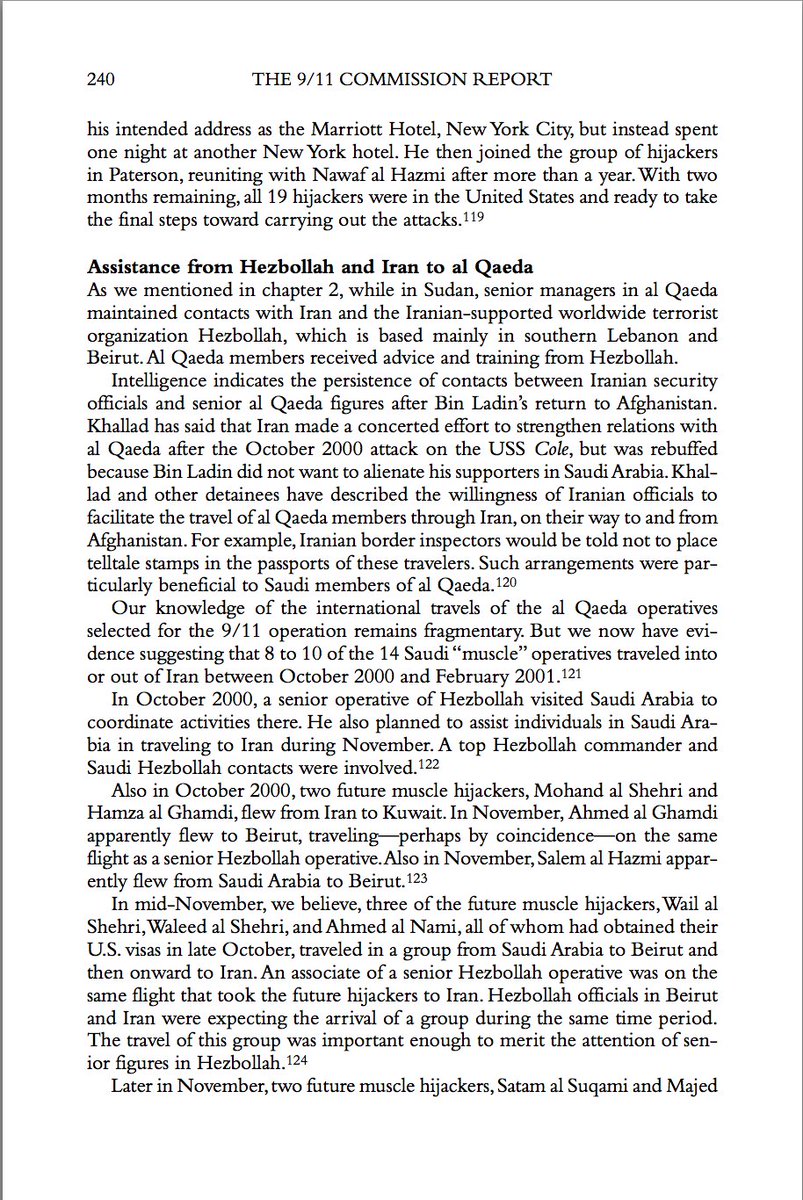
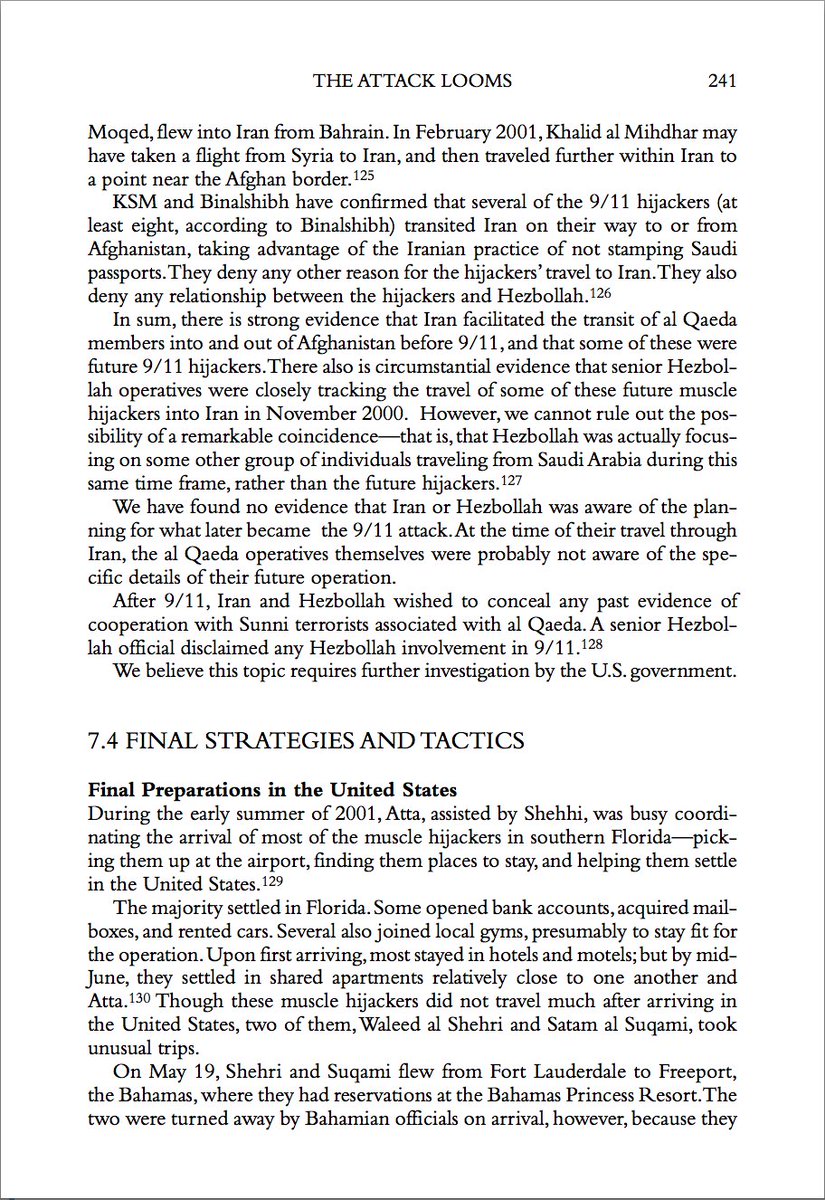
Read below about Iran/Hezbollah & 9/11 hijackers’ travels, see pp. 240-241 of the 9/11 Commission Report.
For a deeper dive and for sure the reprehensible decisions by Barack Obama and John Kerry to legitimize Iran, keep reading below if you dare.

CIS: On July 23, 2001, a former senior Iranian intelligence officer,Abolghasem Mr. Mesbahi,learned that Iran’s plan to strike the United States had been activated. Mr. Mesbahi knew it was important and real because he had worked on this plan previously, when he had helped set up Iran’s intelligence service, the MOIS, as far back as the mid-1980s. Mr. Mesbahi – known outside Iran as one of a core of “Assassins”- told German intelligence, which had given him protected status as a key witness in German prosecutions of brutal Iranian assassinations of dozens of dissidents.

On Aug. 13, 2001, Mr. Mesbahi received greater specificity as to the plot. The coded messages from former colleagues inside Iran revealed that the longtime plan to crash civilian airliners into American cities had been activated. Again, the officer told his German handlers, who responded that they would convey the information – we do not know if they did or to whom or exactly what information they might have passed on – and the Germans would let Mr. Mesbahi know if there were any developments. On Aug. 27, 2001, Mr. Mesbahi once more received confirmation that the plan was in motion, and the messages indicated a German connection. The 9/11 Commission would later confirm that key 9/11 liaison Ramzi Binalshibh and pilots Mohammad Atta and Ziad Jarrah were all German residents leading up to Sept. 11.

After Sept. 11, Mr. Mesbahi approached an American he knew was well-versed in Iranian affairs and told him of his foreknowledge of the Sept. 11 plan and how the plot to crash the then existing Boeing 747 aircraft into New York, Washington and Chicago had evolved in Iran years prior. The Pentagon, White House and World Trade Center had been on the hit list. Back in the 1980s, Iran had decided, he said, that to defeat the United States, it needed to engage in asymmetric warfare.

Mr. Mesbahi is one of three Iranian defectors in a case that took eight years to develop. His affidavit remains under seal in a case in which a judgment was signed late last month in New York federal court, Havlish v. Iran,which establishes that the joint enterprise of Iran, Hezbollah and al Qaeda were responsible for the Sept. 11 attacks. His testimony has been deemed credible by former CIA Middle East undercover officers and supervisors Clare Lopez and Bruce Tefft, also experts in the case representing Sept. 11 victim’s families. Mr. Mesbahi had direct contact with Iran’s leaders during the 1980s and early 1990s, including Supreme Leader Ayatollah Ruhollah Khomeini and former Iranian President Hashemi Rafsanjani. Mr. Mesbahi held many positions in Iran’s intelligence service, including running espionage out of the Iranian Embassy in France (France expelled him) and later for all of Western Europe. It was Mr. Mesbahi’s good friend, Saeed Emami, also a top official in the MOIS, who warned Mr. Mesbahi that he was slated for assassination in the mid-1990s upon his falling out with hard-liners.

On May 14, 2001, the overseer of Iran’s intelligence apparatus, Ali Akbar Nateq-Nouri, wrote to the head of Iran’s intelligence operations on behalf of Iran’s supreme leader about the pending plot that became Sept. 11. The document shows the following: (1) direct connectivity between Iran’s supreme leader’s intelligence apparatus and al Qaeda; (2) knowledge and support for a large upcoming operation connecting Iran, Hezbollah and al Qaeda to the planned attack; and (3) the Iranian government’s goal to “damage America’s and Israel’s economic systems, discredit [their] institutions … as part of political confrontation, undermining [their] stability and security.” Specifically, the document states “support for al-Qaeda’s future plans,” cautioning “to be alert to the negative future consequences of this cooperation [between Iran and al Qaeda]” and the “expanding the collaboration with the fighters of al Qaeda and Hezbollah … no traces must be left that might have negative and irreversible consequences.”

The document is an attachment in the Havlishcase in the expert affidavit of Israeli journalist Ronan Bergman, who has written extensively on Mr. Mesbahi, Iran and Hezbollah and has deep connections to Israeli intelligence. Before Mr. Bergman, Iran expert Ken Timmerman also made this document public.

How did Iran get involved with al Qaeda? According to the Lopez-Tefft affidavit and other expert affidavits in the case, as well as convicted former Osama bin Laden bodyguard Ali Mohamed, the alliance began in 1993 in Khartoum, Sudan, in a meeting between Iranian and Hezbollah leadership with al Qaeda leadership to bridge the Shiite-Sunni gap and address common goals of defeating Israel and the United States. A direct working relationship was created between Iran’s MOIS; Hezbollah’s operational chief and key liaison with Iran, Imad Mughniyah; Osama bin Laden; and other senior al Qaeda leadership. Mughniyah himself was responsible for more than 100 terrorist incidents until his assassination in Syria in 2008.

Much of the al Qaeda training was carried out in camps in Iran run by MOIS and Mughniyah. In addition to training, al Qaeda received blueprints and drawings of bombs, manuals for wireless equipment, intelligence training, travel facilitation, operational guidance and much more. Hezbollah was a role model for al Qaeda, with more direct attacks and diversity of attacks against American property and Americans than any other terrorist organization, from the 1983 Marine barracks and American Embassy bombings in Lebanon to the torture deaths of senior CIA officials. Inside Iran, al Qaeda was directed carefully, providing all varieties of material support in the successful attacks in the late 1990s on the USS Cole, Khobar Towers in Saudi Arabia and U.S. embassies in Africa. (Iran and Hezbollah’s involvement in these other incidents has been referenced previously in federal prosecutions in U.S. courts. Khobar Towers, for example, was conducted by Saudi Hezbollah with direct support from Iran and knowledge of al Qaeda. The USS Cole and African bombings were carried out by al Qaeda with support and direction from Iran and Hezbollah.) The more al Qaeda proved its ability, the more attention Iran gave.

Iran already had conceived the Sept. 11 plot. al Qaeda became the perfect proxy. Not only was terrorist travel facilitation provided to al Qaeda by Iran generally, as described by the 9/11 Commission in its final report, but Mughniyah himself accompanied at least some Sept. 11 hijackers into Iran after the hijackers obtained the U.S. visas that would assure their entry into America, as I describe at length in my affidavit in the Havlish case. Yet Iran needed credible deniability. The May 2001 memo acquired by Mr. Bergman shows that Iran’s operational strategy clearly delineated that its leadership demanded a “hands off” approach about any involvement in terrorist acts committed against the United States. Iran knew a direct assault against America could mean a devastating U.S. response.

In the mid-1980s, the supreme leader of Iran, Ayatollah Ruhollah Khomeini, labeled the plot “Shaitan dar Atash”meaning “Satan in Fire” or “Satan in Hell.” “Satan” was the code word for the United States. Plots included the use of chemical bombs, “dirty” bombs; attacks on power plants, gas stations, and oil tankers; as well as the plot that became Sept. 11. According to Mr. Mesbahi, at least one hijacker, Majid Moqed, who supported the terrorist operation on American Airlines Flight 11 (north tower of the World Trade Center) was housed at the Hotel Sepid, a MOIS safe house in Tehran. Mr. Mesbahi also relates that Iran was able to obtain an Airbus simulator and Boeing software from China for exactly the type of plane that eventually was used in the plot.

For the past 10 years, our foreign policy has been skewed toward heading off al Qaeda terrorist activities and dealing with the regimes of Iraq and Afghanistan. Yet we now know, after all these years, that al Qaeda might never have carried out the Sept. 11 attacks but for Iran and Hezbollah. The 9/11 Commission gave America the details on how Iran’s proxy, al Qaeda, managed to carry out the Sept. 11 plot and detailed what it could of Iranian involvement – having come across relevant intercepts indicating Iranian involvement at the National Security Agency two weeks before the statutory close of the commission. The commission recommended a further look into Iran and Sept. 11 on Page 241 of the final report, stating: “After 9/11, Iran and Hezbollah wished to conceal any past evidence of cooperation with Sunni terrorists associated with al Qaeda. A senior Hezbollah official disclaimed any Hezbollah involvement in 9/11. We believe this topic requires further investigation by the U.S. government.” But it was never done.

Rep. Peter T. King, chairman of the House Homeland Security Committee, would like to reconvene a 9/11 Commission. He has a point. Answers are essential, however embarrassing they may be. As Iran gets cozy with South America, is said to be months away from nuclear warhead capability and is known to continue to plot against the United States, nothing less grave than our national security is at stake.

Further reading on the case is here also.

Putin: Mission Achieved in Syria, AH not so much

But but but: Putin orders withdrawal from Syria after being told of Gulf States decision to ship anti-aircraft systems to rebels over west objections. Furthermore, Russia’s S-400 will stay in Syria and Tartous Naval base will continue been developed and expanded. Putin needs permanent access and routes in the Mediterranean.

Russian President Vladimir Putin has confirmed that Moscow will begin withdrawal of Russian forces from Syria.

On Monday, President Putin indicated that the Kremlin will start withdrawing its main forces in Syria, saying that the military has largely achieved its objectives.

“I think that the task that was assigned to the Ministry of Defense and the armed forces as a whole has achieved its goal, and so I order the defense minister to start tomorrow withdrawing the main part of our military factions from the Syrian Arab Republic,” President Putin said during a meeting with the Russian Defense and Foreign Ministries, according to RIA Novosti.

The withdrawal will begin on Tuesday.

“With the participation of the Russian military…the Syrian armed forces and patriotic Syrian forces have been able to achieve a fundamental turnaround in the fight against international terrorism and have taken the initiative in almost all respects,” the Russian president said.

“There has been a significant turning point in the fight against terrorism,” Russian Defense Minister Sergei Shoigu said.

Putin expressed hope that this decision will encourage all parties involved in the Syrian conflict to pursue a peaceful resolution.

“I ask the ministry of foreign affairs to intensify the participation of the Russian Federation in the organization of the peace process towards a solution to the Syrian crisis,” Putin said.

Moscow will, however, maintain a military presence in Syria, and a deadline for complete withdrawal has not yet been announced. Putin also indicated that Russian forces will remain at the port of Tartus and Hmeymim airbase in Latakia.

“Our bases of operations — our naval base in Tartus and our air base at Hmeymim — will operate as usual. They should be protected from land, sea, and air,” Putin said. “That part of our military group has traditionally been in Syria over the course of many years, and today will have to perform a very important function in monitoring the ceasefire and creating conditions for the peace process.”

According to Kremlin spokesman Dmitry Peskov, Russia has informed Syrian President Bashar al-Assad of the decision. A statement from Assad’s office stresses that the Kremlin has nonetheless pledged to continue its support for Syria in “confronting terrorism.”

Assad also recognized the “professionalism, courage and heroism” of Russian Army soldiers and officers.

During the phone call, both Assad and Putin agreed that the ceasefire has led to significant reduction in bloodshed, and the humanitarian situation has improved.

“The sides expressed shared opinion that the implementation of the ceasefire in Syria has helped to sharply reduce the bloodshed and to improve the humanitarian situation in the country,” the Kremlin press service said in a statement.

Assad also expressed hope that peace talks in Geneva will lead to concrete results, and stressed the need for a political process in Syria.

Earlier on Monday, Russian Foreign Minister Sergei Lavrov said that Moscow’s anti-terrorist air campaign created the conditions for political process on Syrian reconciliation.

Read more: http://sputniknews.com/middleeast/20160314/1036274550/putin-orders-syria-withdrawal.html#ixzz42u5J9OQF

Read more: http://sputniknews.com/middleeast/20160314/1036274550/putin-orders-syria-withdrawal.html#ixzz42u5C3UiD


Read more: http://sputniknews.com/middleeast/20160314/1036274550/putin-orders-syria-withdrawal.html#ixzz42u56vHIi


Read more: http://sputniknews.com/middleeast/20160314/1036274550/putin-orders-syria-withdrawal.html#ixzz42u51tL5I


By Summer: The Final Benghazi Cmte Report Published

Timing is everything and yet there are still a handful of additional investigations still to come.

A big question that remains unanswered is where on Ahmed Abu Khattallah, the only attacker that has been arrested.

According to a press release from the Justice Department:

PBS: “The superseding indictment describes Khatallah’s alleged role in the attacks at a U.S. diplomatic mission in Benghazi and a second U.S. facility there, known as the annex. According to the superseding indictment, Khatallah was a leader of an extremist militia group and he conspired with others to attack the facilities, kill U.S. citizens, destroy buildings and other property, and plunder materials, including documents, maps and computers containing sensitive information.

“The offenses that could carry death sentences include one count of murder of an internationally protected person; three counts of murder of an officer and employee of the United States; four counts of killing a person in the course of an attack on a federal facility involving the use of a firearm and a dangerous weapon; and two counts of maliciously damaging and destroying U.S. property by means of fire and an explosive causing death.”

In the indictment, the U.S. alleges that Khatallah undertook the attack because he had learned the United States had two intelligence facilities in Benghazi.

House Benghazi probe: Report by summer, factor for Clinton

WASHINGTON (AP) – Nearly two years after it was created, the House Benghazi Committee is plowing ahead, interviewing witnesses, reviewing documents and promising a final report “before summer” that is certain to have repercussions for Democrat Hillary Clinton’s bid for the presidency.

The panel’s Republican chairman, Rep. Trey Gowdy of South Carolina, said in an email to The Associated Press that the committee has made “considerable progress” investigating the deadly 2012 attacks that killed four Americans, including the U.S. ambassador to Libya, Chris Stevens.

Gowdy declined to elaborate specifically on what progress has been made beyond listing new witnesses and documents.

The Benghazi inquiry has gone on longer than the 9/11 Commission took to investigate the terrorist attacks that killed nearly 3,000 people on Sept. 11, 2001, spending more than $6 million in the process, Democrats said. They say the only goal of the investigation is to undermine Clinton’s candidacy.

Gowdy declined to be interviewed, but said in a statement that the committee had advanced in its inquiry in recent weeks, after interviewing national security adviser Susan Rice; her deputy, Ben Rhodes, and other witnesses. Former CIA Director David Petraeus and former Defense Secretary Leon Panetta are among those who have testified before the panel in closed-door sessions at the Capitol.

Many of the witnesses, including Rice and Rhodes, had not been interviewed before by a congressional committee, Gowdy said. The panel has interviewed a total of 83 witnesses since its creation in May 2014, including 65 never before questioned by lawmakers, he said in an email to The Associated Press.

The committee also has gained access to documents from the State Department and CIA and to a cache of emails from Clinton and Stevens, who was killed on Sept. 11, 2012 in twin attacks on the diplomatic outpost and CIA annex in Benghazi.

“The American people and the families of the victims deserve the truth, and I’m confident the value and fairness of our investigation will be abundantly clear to everyone when they see the report for themselves,” Gowdy said in an email, promising the report “as soon as possible, before summer.”

Clinton, who was secretary of state at the time of the attacks, dismissed the panel’s work, noting at a recent Democratic debate that she testified before Gowdy and other lawmakers for nearly 11 hours last fall.

“Anybody who watched that and listened to it knows that I answered every question that I was asked, and when it was over the Republicans had to admit they didn’t learn anything,” Clinton said.

She was referring to Gowdy’s comments immediately after the Oct. 22 hearing in which he struggled to explain what the committee – and the American public – learned from the marathon session. “I don’t know that she testified that much differently than she has the previous times that she’s testified,” he said.

Democrats are skeptical about Gowdy and the GOP members finishing their report in a few months, noting that the committee has blown through other self-imposed deadlines.

“The only real deadline is the presidential election” in November, said Rep. Adam Schiff, D-Calif., a member of the Benghazi panel and a longtime Gowdy critic.

Schiff dismissed Gowdy’s claim that new witnesses and documents have led to progress in the investigation. “They have a number of new witnesses and a number of new documents, but no new facts,” he said.

“I don’t think there are new meaningful facts to uncover at this point,” after seven previous congressional investigations and an independent panel led by former U.N. Ambassador Thomas Pickering and retired Adm. Mike Mullen, a former Joint Chiefs of Staff chairman, Schiff said.

Schiff serves on the House intelligence committee, which completed its investigation in 2014.

The Pickering-Mullen report said security at the Benghazi compound was “grossly inadequate” and that requests for security improvements were not acted upon in Washington. Subsequent congressional reports debunked various claims, including a “stand down” order to the military.

Rep. Elijah Cummings of Maryland, the Benghazi committee’s senior Democrat, said the 22-month-old panel is “nothing more than a taxpayer-funded effort to bring harm to Hillary Clinton’s campaign.”

Republicans say the committee has been hindered by stonewalling by the State Department and other executive branch agencies. And they say Schiff and other Democrats have done more carping about the committee than constructive work on its behalf.

Still, Republican insistence that the investigation is not politically motivated was undermined last year when House Majority Leader Kevin McCarthy, R-Calif., suggested that the Benghazi panel could take credit for Clinton’s slumping poll numbers.

Rep. Susan Brooks, R-Ind., a member of the Benghazi committee, said Clinton’s testimony was the most visible, but not necessarily the most important, aspect of the panel’s work.

“We want to know what went wrong between the secretary of state, Defense Department, White House and CIA,” Brooks said at a Rotary Club meeting last week in Anderson, Ind. The Herald Bulletin of Anderson reported on the event.

“We want to prevent this from happening again, which is what the families of the victims want,” Brooks said, according to the newspaper.

al Qaeda in Maghreb Attacks Ivory Coast, Americans

FNC: The terrorist attack in the Ivory Coast Sunday most likely targeted a US delegation led by the assistant commerce secretary visiting the country, a diplomatic source in the region tells Fox News. Assistant Secretary of Commerce Marcus Jadotte was leading a group of Americans in Grand-Bassam, located 25 miles east of the capital city of Abidjan, including college recruiters from the University of Florida. US embassy officials from Abidjan were also included in the group, according to the source.

Eyewitnesses describe Ivory Coast beach resort atrocity

Western tourists and beachgoers described scenes of panic and carnage on Sunday as Al Qaeda-linked gunmen opened fire killing 16 people at a usually sleepy seaside town in Ivory Coast before special forces intervened.

France24Grand-Bassam, a UNESCO World Heritage site that attracts foreigners and the Ivorian elite, briefly became a war zone Sunday as al Qaeda in the Islamic Maghreb (AQIM) gunmen shot beachgoers.

“We were eating, when suddenly we heard gunshots. People where running in all directions and we didn’t know what was going on”, one witness told FRANCE 24.

“The shots started getting closer and we saw people coming our way. I told my wife ‘we can’t stay here’, and 20 seconds after that they killed three people behind us”, he said.

“It was truly, truly, terrifying, it was indeed terrorists,” eyewitness Marie-Claire Yapi, who was separated from her nine-month old baby and her sister in the chaos, told FRANCE 24. “Someone said to me: ‘Run, this is serious – they are killing everyone.’”

Ivorian officials said six terrorists stormed the beach, but AQIM praised its three “heroes” for the attack in an online statement.

‘A blast every 10 to 15 seconds’

“It all started down by the beach, as soon as they saw someone they would open fire. Everyone began running. There were women and children running and looking for a place to hide,” witness Marie Bassole told Reuters.

Koumena Kakou Bertin said that he heard the attackers shouting “Allahu Akbar”, Arabic for “God is great”, as they sprayed the beach with bullets.

Charles-Philippe d’Orleans, a retired French army officer who served in the Ivory Coast, was also on the beach at the moment of the attack.

“We could hear a blast every 10 to 15 seconds. They were shooting at us and the bullets were flying everywhere”, he told French weekly Paris Match.

“I did not hear shouts of ‘Allahu Akbar’, nor did I hear repeated bursts of gunfire that are usual for automatic weapons. I think they had handguns, like 9 mm or Magnums” he added.

Beach packed due to heatwave

After targetting swimmers and sunbathers, the gunmen turned their attention to hotels near the shore, including the Grand Bassam’s Chelsea Hotel and the Hotel Etoile du Sud.

The Etoile du Sud was packed full of beachgoers and expats escaping the current heatwave when the gunmen attacked.

“I saw one of the attackers from far away”, said Abbas El-Roz, a Lebanese salesman, who was swimming in the hotel’s pool when the attackers struck. “He had a Kalashnikov and a grenade belt. He was looking for people”.

Ivorians and Europeans among victims

Ivorian President Alassane Ouattara praised special forces for regaining control of the situation in a relatively short amount of time. “This attack was brought under control in 45 minutes thanks to our security forces”, he said on national television.

Two special forces soldiers were killed in the gun battle with the attackers, Ivorian officials said.

Four Europeans were also among the dead, with France’s foreign ministry confirming that one French national died in the attack.

The assault itself resembled the terrorist attack on a Tunisian beach resort in June 2015, and comes on the heels of similar deadly incidents in Mali and Burkina Faso.

“Most of the victims are Africans, Africans from Ivory Coast or from neighbouring countries”, French Foreign Minister Jean-Marc Ayrault said in a statement on Sunday.

“So it is one again Africa that has been targeted by terrorism”, he added.

However, FRANCE 24’s expert on jihadi movements Wassim Nasr, said the attack should be considered part of al Qaeda’s war against the West, and France in particular.

“They target wherever they see French interests, or French or [other] Western citizens. They are trying to export their war to Western Africa. So I suspect that more attacks will happen in this region”, Nasr added.

Additional details here.

Germany: Anti-Immigrant Party Growing

This has been building since 2014 and gained real traction in 2015.

USAToday: Far-right protests were held in more than a dozen other nations in Europe on Saturday including the Czech Republic, France, Poland and the Netherlands. The marches and demonstrations were part of a coordinated attempt by PEGIDA and like-minded groups to hold a so-called European Action Day. Riot police clashed with protesters at several of the rallies including in Calais, France, where police used tear gas to disperse crowds. Ten people were arrested.

The synchronized demonstrations came as the number of Syrian refugees assembled on Turkey’s border jumped to 35,000, according to Reuters.

The latest exodus is a result of a renewed offensive by Syria’s President Bashar Assad to retake ground controlled by opposition groups near the city of Aleppo, previously a valued commercial center.

Turkey refuses to open the border. It already hosts over 2.5 million Syrian refugees.

German anti-immigration party makes gains in local elections amid refugee crisis

FNC: A nationalist, anti-migration party powered into three German state legislatures in elections Sunday held amid divisions over Chancellor Angela Merkel’s liberal approach to the refugee crisis. Merkel’s conservatives lost to center-left rivals in two states they had hoped to win.

The elections in the prosperous southwestern state of Baden-Wuerttemberg, neighboring Rhineland-Palatinate and relatively poor Saxony-Anhalt in the ex-communist east were the first major political test since Germany registered nearly 1.1 million people as asylum-seekers last year.

The three-year-old Alternative for Germany, or AfD — which has campaigned against Merkel’s open-borders approach — easily entered all three legislatures.

AfD won 15.1 percent of the vote in Baden-Wuerttemberg and 12.6 percent in Rhineland-Palatinate, official results showed. It finished second in Saxony-Anhalt with some 24 percent, according to projections by ARD and ZDF television with most districts counted.

“We are seeing above all in these elections that voters are turning away in large numbers from the big established parties and voting for our party,” AfD leader Frauke Petry said.

They “expect us finally to be the opposition that there hasn’t been in the German parliament and some state parliaments,” she added.

There were uncomfortable results both for Merkel’s conservative Christian Democratic Union and their partners in the national government, the center-left Social Democrats. The traditional rivals are Germany’s two biggest parties.

“The democratic center in our country has not become stronger, but smaller, and I think we must all take that seriously,” said Vice Chancellor Sigmar Gabriel, the Social Democrats’ leader.

Merkel’s party kept its status as strongest party in Saxony-Anhalt. It had hoped to beat left-leaning Green governor Winfried Kretschmann in Baden-Wuerttemberg, a traditional stronghold that the CDU ran for decades until 2011. It also hoped to oust Social Democrat governor Malu Dreyer from the governor’s office in Rhineland-Palatinate.

However, the CDU finished several percentage points behind the popular incumbents’ parties in both states and dropped 12 percentage points to a record-low result in Baden-Wuerttemberg, with 27 percent support. Its performance in Rhineland-Palatinate, with 31.8 percent, was also a record low.

The Social Democrats suffered large losses in both Baden-Wuerttemberg and Saxony-Anhalt, where they were the junior partners in the outgoing governments, finishing behind AfD.

Other parties won’t share power with AfD, but its presence will complicate their coalition-building efforts.

In all three states, the results were set to leave the outgoing coalition governments without a majority — forcing regional leaders into what could be time-consuming negotiations with new, unusual partners. Merkel’s CDU still has a long-shot chance of forming an untried three-way alliance to win the Baden-Wuerttemberg governor’s office.

Germany’s next national election is due in late 2017. While Sunday’s results will likely generate new tensions, Merkel herself should be secure: she has put many state-level setbacks behind her in the past, and there’s no long-term successor or figurehead for any rebellion in sight.

A top official with Merkel’s party called for it to stay on its course in the refugee crisis. CDU general secretary Peter Tauber pointed to recent polls indicating that her popularity is rebounding and added: “this shows that it is good if the CDU sticks to this course, saying that we need time to master this big challenge.”

Merkel insisted last year that “we will manage” the challenge of integrating refugees. While her government has moved to tighten asylum rules, she still insists on a pan-European solution to the refugee crisis, ignoring demands from some conservative allies for a national cap on the number of refugees.

AfD’s strong performance will boost its hopes of entering the national parliament next year. It entered five state legislatures and the European Parliament in its initial guise as a primarily anti-euro party before splitting and then rebounding in the refugee crisis.

The CDU may have been hurt by an attempt by its candidates in Baden-Wuerttemberg and Rhineland-Palatinate to put cautious distance between themselves and Merkel’s refugee policies, which may simply have created the impression of disunity. The party slipped in polls there over recent weeks.

The two last month called for Germany to impose daily refugee quotas — something Merkel opposes but which neighboring Austria has since put in place. Separately, Merkel’s conservative allies in Bavaria have attacked her approach for months, demanding an annual refugee cap.

Center-left incumbents Kretschmann and Dreyer often sounded more enthusiastic about Merkel’s refugee policy than their conservative challengers.

“The result hopefully will be that the CDU and (their Bavarian allies) will realize that this permanent quarreling doesn’t help them,” Vice Chancellor Gabriel said.