
The Other Iranian Spending Spree, Syria?

Iran changing the face of Syria especially Damascus. Altering the human population and infrastructure has been underway for a long while. Question is how deeply involved is Russia with this? An Iranian Revolutionary Guard Corps new base? Iran has moved to take full control of the Middle East and Russia paved the way with the assistance of Barack Obama and John Kerry.

Iranians Fuel Property Frenzy in Syria

VoA: The Iranian government is encouraging prominent Tehran developers to buy property in well-off Shi’ite majority neighborhoods in Syria’s capital, analysts and construction industry sources in Tehran said.

“Entire neighborhoods have been purchased by Iran,” Syrian economist Khorshid Alika told VOA.

During the early days of Syria’s civil war, Tehran kept Iran’s involvement in Syria mostly from public view. In recent months, though, the government-run media have been reporting how Iran has teamed up with Russia to support Syrian President Bashar al-Assad against opposition rebels and the Islamic State group.

Tehran has reportedly increased the size of its Revolutionary Guard Corps in Syria, sending as many as 3,500 fighters to the front lines to defend Zeinab Shrine, a holy site for Shi’ite Muslims in the southern suburbs of Damascus.

Market inflation

According to news reports, rich and conservative Iranian business people with ties to the government are buying expensive properties and lavish homes in the affluent districts of Damascus. The high demand for property has contributed to price increases in Syria’s real estate market, experts said.

“Five million houses have been destroyed in the civil war. The increased Iranian demand to buy land and properties has naturally led to more inflation in the [real estate] market,” Alika said.

Iran has reportedly relied on a prominent Shi’ite cleric, Abdullah Nazzam, to arrange its real estate dealings in Syria. Using his religious authority in Damascus and ties with the Syrian government, Nazzam has persuaded residents to sell their properties to Iranian businessmen.

“Some Iranian businessmen have been offering huge sums of money to buy Syrian houses near a holy Shi’ite site,” a Damascus landowner recently told a pro-opposition Syrian news site, All For Syria.

He said some owners, including himself, had refused to sell their properties, but under Syrian government pressure, they had no choice but to accept the offers, the resident said.

Alika, who studies the trends of local economies in Syria’s civil war, said Iranians tend to buy properties in areas of strategic importance.

“They are buying houses and lands near Shi’ite religious sites in Damascus,” he told VOA by phone.

Iran’s interest in owning real estate in Syria is not new, analysts said, but it increased after the beginning of the rebel uprising in 2011.

“The [Iranian] regime has always been active in the real estate market in Syria, but their boost became more visible,” said journalist Ali Nawaf, a Damascus native living in Turkey.

“After the [Syrian] revolution [in 2011], Iran realized that buying properties in Damascus and elsewhere would give it yet another excuse to continue its interference in Syria,” he told VOA.

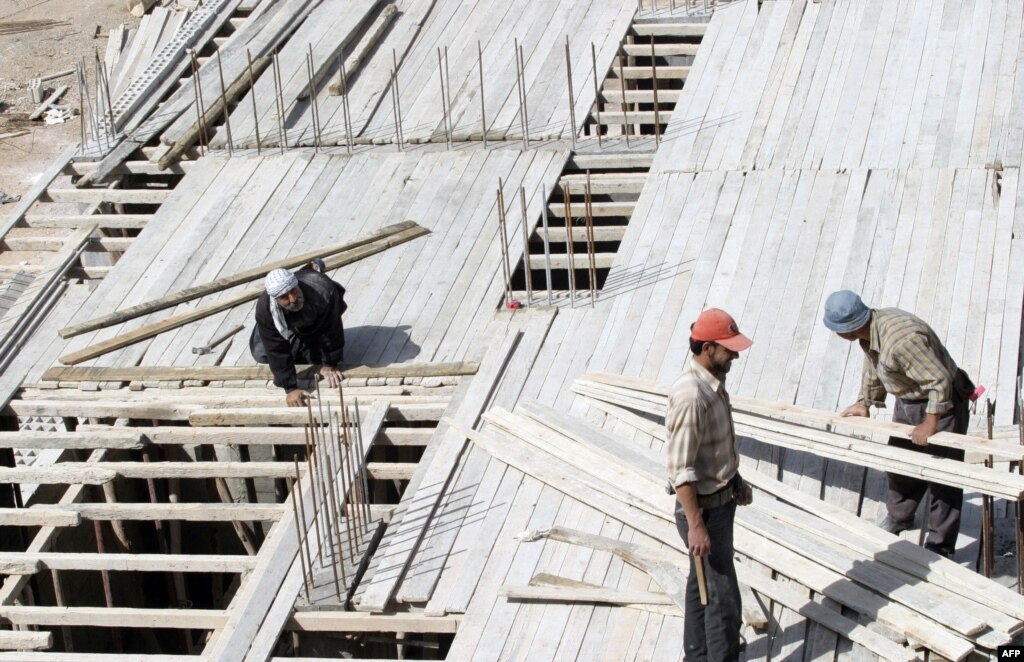
FILE - Members of a construction crew work at a site for new apartment buildings in Damascus, Syria.

FILE – Members of a construction crew work at a site for new apartment buildings in Damascus, Syria.

Go to Syria, workers told

Iran’s government is urging Iranian construction workers to go to Syria.

“A few months ago I was invited to a work-related gathering, and a fellow veteran contractor with strong ties with [Iranian] authorities informed us that there are very lucrative opportunities for builders in Damascus,” Amir Maghsoudloo, an Iranian construction contractor in Tehran, told VOA.

“When we asked about the security of the site, he said that the zone is even more secure than Tehran,” he said. “I turned the offer down due to family and security reasons, but, two other fellow contractors, as far as I know, got some projects in Damascus.”

Bricklayer Tahir Esmaili, an Afghan national who worked in Iran before moving to Syria in 2015, told VOA some Afghan workers in Iran had been offered construction jobs in Damascus.

Roughly 3 million Afghans live in Iran. Most settled there after fleeing war and conflict in their homeland. Many Afghans in Iran lack basic rights and live without a formal status. Most earn low wages in Iran, making Syria a lucrative alternative.

“There are quite a few projects running near [the holy Shi’ite site of] Sayyida Rouqqaya and the Iranian Embassy,” Esmaili said. “These projects are being dominantly run by Afghan nationals from Iran.”

Wider area of control

By buying properties throughout Syria, Iran is seeking to safeguard its presence in the war-torn country, even after a potential collapse of Assad’s government, experts said.

“Iran’s goal of owning property in Syria goes beyond business interest,” said Iranian analyst Fariborz Saremi told VOA from Germany. “Controlling Syria politically, militarily and economically, through real estate, would only make Tehran in a better position to stay in control of other parts of the Middle East.”

Damascus isn’t the only area in Syria where Iranians have been buying properties, analysts said.

In the central city of Homs, local activists said more Iranian business people and companies are looking for new opportunities after the Syrian military and its Lebanese Hezbollah alllies took control of the city in late 2015.

“The [Syrian] regime wants Iranians to invest in Homs, because it connects Damascus to the Alawite heartland in the coastal region,” Nawaf said.

And with more Iranian-owned properties, Iran would have more incentives to maintain a stronger military presence in Homs and beyond, analysts said.

****

VoA: Iran’s government wants its builders to buy up property in Shi-ite majority neighborhoods of Syria’s capital, Damascus.

It is also asking construction workers to go to Syria.

This information comes from construction industry officials in Tehran and Iranian experts.

Iranian analyst Fariborz Saremi said owning real estate gives Iran more control over Syria and other parts of the Middle East.

Rich and conservative Iranian business people with ties to the government are buying expensive homes in Damascus, according to news reports. This is influencing price increases in Syria’s real estate markets.

Five million houses have been destroyed in the civil war,” said Syrian economist Khorshid Alika told Voice of America. “The increased Iranian demand to buy land and properties has naturally led to more inflation in the market.”

Iran’s interest in Syrian real estate is not new. But it increased after the rebel uprising began in 2011.

Government-run media have been reporting recently about how Iran joined Russia to support Syrian President Bashar al-Assad. Assad’s government has been fighting against rebels and the Islamic State terror group.

Iran is not only asking people to buy homes and property in Syria. The country is also asking construction workers and contractors to take jobs there.
 

Get Out of Turkey, Next Target?

U.S. tells diplomatic and military families to leave south Turkey

WASHINGTON — The State Department and Pentagon ordered the families of U.S. diplomats and military personnel Tuesday to leave posts in southern Turkey due to “increased threats from terrorist groups” in the country.

The two agencies said dependents of American staffers at the U.S. consulate in Adana, the Incirlik air base and two other locations must leave. The so-called “ordered departure” notice means the relocation costs will be covered by the government.

Pentagon press secretary Peter Cook said no specific threat triggered the order, but said it was done “out of an abundance of caution” for the safety of the families in that region. He said he was not aware of a deadline for the families to leave, but said “this will move very quickly.”

In a statement, the military’s European Command said the step “allows for the deliberate, safe return of family members from these areas due to continued security concerns in the region.”

The orders cover the Adana consulate, U.S. military dependents in Incirlik, Ismir and Mugla as well as family of U.S. government civilians at Ismir and Mugla. The State Department also restricted official travel to that which it considers “mission critical.” Cook said that the order does not affect about 100 family members who are based in Istanbul and Ankara.

The move comes amid heightened security concerns throughout Turkey due to the ongoing fight against Islamic State militants in neighbouring Syria and Iraq and was accompanied by an updated travel warning advising U.S. citizens of an increased threat of attacks. It also comes as Turkey’s president is set to arrive in Washington to attend President Barack Obama’s nuclear security summit.

“We understand this is disruptive to our military families, but we must keep them safe and ensure the combat effectiveness of our forces to support our strong ally Turkey in the fight against terrorism,” the European Command statement said.

Incirlik is a critical base in the fight by the U.S.-led coalition against the Islamic State group, and includes strike aircraft, drones and refuelling planes.

Turkey’s decision last year to allow the coalition to conduct airstrikes with aircraft based at Incirlik shortened the time and distance required to conduct airstrikes in Syria and Iraq, compared with strikes flown from bases in the Persian Gulf area. And it increased the number of U.S. personnel at the base.

NATO’s Allied Land Command is based at Ismir and there is a Turkish base at Mugla where some U.S. military personnel go for training and other missions.

It was not immediately clear how many family members would be affected in total. The Pentagon said the order would affect about 680 military family members and roughly 270 pets. The State Department and Pentagon had begun a voluntary drawdown of staff at the two posts last September after Turkey announced it would take a greater role in the fight against Islamic State militants.

At the time, military officials said they had recommended the voluntary departure from Incirlik because of specific calls by militants for lone wolf attacks against the air base.

On Monday, Secretary of State John Kerry met with Turkish Foreign Mevlut Cavusoglu. State Department spokesman John Kirby said the two discussed measures to secure the Turkey-Syria border and disrupt extremist networks.

According to a U.S. official, the decision to order families to leave stemmed from the ongoing assessment of security threats in Turkey. The official was not authorized to discuss the matter publicly, so spoke on condition of anonymity.

The decision comes a day after Israel issued a new travel advisory for Turkey, warning its citizens to leave the country as soon as possible and to avoid any travelling there.

Israel tells citizens to get out of Turkey as soon as possible

Israel has issued a new travel warning asking its citizens to leave Turkey as soon as they can. The Counter-Terrorism Bureau at the Prime Minister’s Office has also advised the public to avoid visiting Turkey.

The travel warning came after the country raised the terror risk alert in Turkey from level 3 which is a basic concrete threat to level 2 which is a high concrete threat. The revision in the alert took effect following the terror attack in central Istanbul on 19 March in which three Israelis were killed and several others wounded.

Stripes: ANKARA, Turkey — Turkey’s president says the Turkish security forces have killed or captured more than 5,300 Kurdish rebels since hostilities resumed in July.

President Recep Tayyip Erdogan also said Monday a total of 355 security force members have been killed in the conflict during that period – 215 soldiers, 133 police officers and seven government-paid village guards.

The conflict flared in the summer after a fragile peace process that began in 2012 broke down. Since then, government forces have launched large-scale offensives against Kurdish militants in several urban districts in the mainly-Kurdish southeast region while Turkish jets have carried out cross-border airstrikes on suspected PKK Kurdish rebel hideouts in northern Iraq. 

The PKK, which is fighting for Kurdish autonomy, is considered a terrorist organization by Turkey and its allies.

ISIS: Our Soldiers are Everywhere

And a major recruiting center in Europe and Belgium are prisons.

How Belgian prisons became a breeding ground for Islamic extremism

Stephane Medot knows a thing or two about Belgian prisons. He spent 10 years in them. Arrested for carrying out more than a dozen armed bank robberies, the stocky, bald-headed Medot moved from prison to prison, from one cell of his own to another, until he served out his time.

Along the way, he got a front-row seat in a prison system that has become a breeding ground for violent Muslim extremists. Many of those involved in the Paris and Brussels attacks first did short stints behind bars for relatively petty crimes. And there these wayward young people met proselytizers and appear to have acquired a new, lethal sense of purpose.

A Belgian prison is where Abdelhamid Abaaoud, who helped plan the Paris attacks and who was killed in a police raid in November, met Salah Abdeslam, an alleged Paris attacker who was captured in Brussels this month. Salah’s brother Brahim, who blew himself up in Paris, also served time.

Two of the suicide bombers in the Brussels attacks last week, brothers Ibrahim and Khalid el-Bakraoui, had spent time in Belgian prisons for violent offenses that included armed robbery and carjacking.

Medot, now 37, said that from prison to prison, the routine he witnessed was similar. Proselytizing prisoners used exercise hours and small windows in their cells to swap news, copies of the Koran and small favors such as illicit cellphones. Gradually, they won over impressionable youths and taught them to stop drinking and start thinking about perceived injustices such as the invasion of Iraq, the plight of Palestinians or the treatment of their own immigrant families.

The prison guards, who could not understand Arabic, had a “laissez-faire attitude,” he said, and did nothing to stop the pulsating music or political discussions.

“If you’re not a Muslim, you feel the need to adapt to the rules,” said Medot, who is not Muslim. When the hour for prayer arrived, everyone was asked to turn off televisions so as not to disturb the faithful.

For the past year, Belgium’s Ministry of Justice has been planning to change a prison system widely seen as a school for radicals. It is creating two isolated areas, each with room for 20 people, at Hasselt and Ittre prisons for the most radical inmates. At the moment, said ministry spokeswoman Sieghild Lacoere, only five inmates clearly qualify. The segregation is set to begin April 11.

“The best solution for fighting the process of radicalization,” the ministry said in its action plan last year before the Paris and Brussels attacks, is “one part isolation by concentration, completely isolating the radical individuals from the other detainees to avoid a great contamination” and prevent them from “feeding other detainees more of their ideology.”

The ministry also said it would improve living conditions in the overcrowded prisons. Belgium has about 11,000 prisoners, ­Lacoere said, of whom 20 to 30 percent are Muslims, even though Muslims make up only about 6 percent of the population.

France, with Europe’s largest Muslim population, is facing similar problems. It, too, has opened special units, manned by psychologists, historians and sociologists, for potentially violent extremists at five prisons. A year ago it vowed to hire 60 more Muslim chaplains.

Medot said that changing the culture of prison is difficult. He said that youths “arrive alone, feel alone” and that the older Muslim inmates “attract guys who want to become fuller members of the group.”

Medot was in prison when terrorists attacked London, Madrid and a Jewish school in Toulouse, France. He said many prisoners celebrated what their “brothers” did. Medot said that when discussing the Sept. 11, 2001, attacks on the United States, many would say that “Americans stole the [Middle East’s] oil and that this is revenge and this is just.”

For several months, Medot said, he overlapped with Nizar Trabelsi, a professional soccer player turned al-Qaeda follower who confessed in 2003 to an aborted plot to drive a car packed with explosives into Kleine Brogel, a NATO air base in Belgium where U.S. nuclear missiles are thought to be stored. Trabelsi served 10 years in Belgium and then was extradited to the United States, despite condemnation from the European Court of Human Rights.

“He was one of the guys who was seen as a hero,” Medot said. In prison in Belgium, Trabelsi, a Tunisian, taught Arabic by passing books through the cells’ small windows. Though Medot, considered a flight risk, had his own cell, others stayed in cells with two to five people. Trabelsi also played loud Koranic music and prayers from his cell, as well as recordings of bullets and shooting. The guards did nothing except occasionally ask that he turn down the volume.

“The parents will come and visit, and the detainee will say he wants books, wants to find religion and change his ways,” Medot said, “and parents see that as positive, to take a path away from petty crime, away from drugs, away from alcohol. And they don’t know what is happening on the inside.”

But Medot said that the government’s plan to isolate radicals won’t work. Who will decide which prisoners are too radical to stay with other detainees? Won’t they become even more radical in isolation? And what will happen to them when their sentences run out?

Lacoere said the Justice Ministry’s plan includes hiring more experts to “de-radicalize” inmates. She said guards will get special training. She said isolating the radicals isn’t the same as abandoning them; they will get more intensive attention, she said.

Still, she acknowledged, there will be difficult issues. “There is not a lot of knowledge in the academic world on this de-
radicalization. It’s a very hard topic to talk about,” she said. “It’s about influencing people’s ideas, and there’s freedom of speech and thought in our country.”

Salmi Hedi, a Tunisian-born imam, has worked in the Belgian prison system for nearly 20 years trying to de-radicalize inmates. He said Belgium’s 18 penitentiaries share just eight imams and one woman religious counselor. The Justice Ministry has promised 11 more.

He disagrees with the government’s diagnosis and concern about “contamination” by radicals.

“Are they viruses? It is not a constructive view,” Hedi said. “It is very dangerous. If you put these people together, you cannot control them anymore. They will feel stronger.”

State Dept Omits ‘Easter’ in Lahore Terror Attack by JuA


Hat to Oliver:

 Oliver DarcyVerified account @oliverdarcy 15h15 hours ago

. statement on Pakistan bombing makes no mention Easter-celebrating Christians were deliberately targeted

*****

Related article: Who is Jamaat ul Ahrar

Taliban’s Pakistan faction claims deadly Easter park bombing

Jamaat-ul-Ahrar says suicide bomber deliberately targeted Christian community in Lahore attack that killed 65 people


Ahsanullah Ahsan, spokesman for Jamaat-ul-Ahrar, told the Associated Press that a suicide bomber with the faction deliberately targeted the Christian community

The explosion took place near the children’s rides in Gulshan-e-Iqbal park, local police chief Haider Ashraf said. He said the explosion appeared to have been a suicide bombing, but investigations were ongoing.

The attack killed 65 people and wounded over 300, said Deeba Shahnaz, a spokesman for Lahore rescue administration.

Punjab’s chief minister Shahbaz Sharif announced three days of mourning and pledged to bring the perpetrators to justice, said Zaeem Qadri, a spokesman for the provincial government.

The park was manned by police and private security guards, police chief Haider Ashraf said. “We are in a warlike situation and there is always a general threat but no specific threat alert was received for this place,” he added.

Schools and businesses in the city will remain closed on Monday, the city’s schools association and the Union of Lahore Traders said.

Prime Minister Nawaz Sharif held a meeting to assess the security situation in Lahore, according to a government statement. Pakistan’s army chief, Gen. Raheel Sharif, also convened an emergency meeting of the country’s intelligence agencies to begin to track down those responsible for the attacks, said army spokesman Gen. Asim Saleem Bajwa.

Salman Rafiq, a health adviser to the Punjab government, called on people to donate blood, saying that many of those wounded were in a critical condition.

One witness, who wished to be identified only by his first name, Afzal, said he had taken 20 children to hospital and carried three dead bodies to a police car. “I can’t explain to you the tragic situation,” he said.

Another witness, Tariq Mustapha, said that he had just left the park when he heard an explosion. He said his friend was still missing.

Footage broadcast on local television stations showed chaotic scenes in the park, with people running while carrying children and cradling the wounded in their laps.

A witness, not identified by name on Pakistan’s Geo TV station, said he was heading toward a fairground ride with his wife and two children when he heard a huge bang and all four of them were thrown to the floor. A woman was shown crying while looking desperately for her missing 5-year-old son.

A spokesman for the US National Security Council said that the United States “condemns the attack in the strongest terms,” describing it as a “cowardly act in what has long been a scenic and placid park.” Ned Price said the US would continue to work with Pakistan and its partners to “root out the scourge of terrorism.”


In 2007, Belgium Was Warned

CNN: in January 2015: A Western Intelligence source tells CNN that the ongoing terror threat appears to involve up to 20 sleeper cells of between 120 to 180 people ready to strike in France, Germany, Belgium and the Netherlands. The source said that European Union and Middle East intelligence agencies identified an “imminent threat” to Belgium, possibly also to the Netherlands.

The Belgian counterterrorism official said indications of ISIS ordering attacks in Europe mark an apparent significant shift by the terrorist group. Before the air campaign against it, the official said, there was little indication ISIS leaders were directly plotting attacks in the West. Instead, the group prioritized its project to create an Islamic caliphate.
The official named France, the UK and Belgium as countries facing a particular threat. Counterterrorism agencies in Germany also are on high alert because of the number of fighters who have traveled. Several European countries, including Britain, France, Belgium and the Netherlands are participating in the air campaign against ISIS in Iraq.
Why would ISIS change tack? Partly because of increased competition between ISIS and al Qaeda affiliates, including the Khorasan group in Syria, to be seen as the standard bearers of global jihad, according to the official.
The official said there is also significant concern about Khorasan attack plotting against Europe. U.S. officials previously told CNN that French al Qaeda operative and bomb-maker David Drugeon was suspected to be talent-spotting European jihadis in Syria for operations in Europe. Drugeon was injured in a drone strike in November but is believed to be still alive.
Last week, Andrew Parker, the head of Britain’s security service MI5, warned, “A group of core al Qaeda terrorists in Syria is planning mass casualty attacks against the West,” an apparent reference to the Khorasan group.

Belgium warned about emerging homegrown terrorist threat in 2007

The Belgian government was warned that the country’s intelligence agencies were ill-equipped to deal with the emerging threat from homegrown jihadists, nine years before the attacks on Brussels’ airport and subway system.

Some of the city’s suburbs were becoming an “operational base” for homegrown terrorists, according to a 2007 report by an independent committee tasked with reviewing the work of Belgium’s security services.

Faced with short-term constraints as well as evolving threats, these services have difficulty developing a vision – an in-depth and long term (strategy) on the development of radical Islam in Belgium.

Time, priorities and lack of permanent staff do not allow services to ensure that role.

– 2007 report on Belgium security

Although the report concluded that confronting extremism should not be the responsibility of intelligence agencies, it said they “(seemed) reluctant to investigate deeper causes of violent radicalisation… political, cultural, socialogical”

The report, unearthed by ITV News, warned Belgium’s parliament that “our country can at any time become the target of Jihadist terrorism.”

Tributes to the Brussels victims
Belgian has been accused of not doing enough to stop the attack in Brussels. Credit: Reuters/Francois Lenoir

This week, Belgian authorities have been accused of not doing enough to act on warnings from Turkey and the United States about the Brussels attackers.

And one police chief admitted that his department had failed to share a dossier of evidence about associates of Salah Abdeslam, four months before he was arrested.

The 2007 report concluded that the Belgian government should “encourage the intensification of cooperation between law enforcement and security services of (EU) member states.”

It recommended that the spy agencies consider “the possibility of hiring… agents with specific profiles for the knowledge of cultures and foreign languages.”

Turkey says it tried to warn Belgium that one of the two brothers who blew themselves up in suicide attacks in Brussels was a foreign fighter sent back to Europe after being arrested on the Turkey-Syria border.

“One of the attackers in Brussels is an individual we detained in Gaziantep in June 2015 and deported. We reported the deportation to the Belgian Embassy in Ankara on July 14, 2015, but he was later set free,” Mr Erdogan said.

“Belgium ignored our warning that this person is a foreign fighter.”

Mr Erdogan’s office confirmed Ibrahim El Bakraoui was deported to the Netherlands.

It said he was later released by Belgian authorities as “no links with terrorism” were found.

In previous cases, officials have said without evidence of crime, such as having fought in Syria, they cannot jail people deported from Turkey.