China versus Taiwan and the United States, Just the Facts

A hacking group has compromised at least nine global organizations in the fields of technology, defense, energy and other key sectors as part of an apparent espionage campaign. Attribution is still ongoing, specific tools and methods used in the apparent hacking efforts are in line with those used by Chinese cyber-espionage group Emissary Panda, also known as TG-3390, APT 27 and Bronze Union.

While China has indeed surpassed the United States in the size of their Navy, the other concern is the build up of Chinese nuclear weapons.  Meanwhile, the United States has deployed at least 30 U.S.military forces to Taiwan for training.For years, U.S.-Taiwan military exchanges have been thought of as an open secret—also known by the People’s Republic of China (PRC) leadership in Beijing. However, Tsai became the first Taiwanese leader in decades to publicly acknowledge the existence of a training program.

The United States has deployed the Iron Dome missile-defense system for testing in Guam by U.S. military planners concerned about possible Chinese attacks.Chinese President Jinping awarded additional 'War Powers ...

WAR GAMES:

The Chinese military – the People’s Liberation Army – is waging so-called gray-zone warfare against Taiwan. This consists of an almost daily campaign of intimidating military exercises, patrols and surveillance that falls just short of armed conflict. Since that report, the campaign has intensified, with Beijing stepping up the number of warplanes it is sending into the airspace around Taiwan. China has also used sand dredgers to swarm Taiwan’s outlying islands.

Military strategists tell Reuters that the gray-zone strategy has the potential to grind down Taipei’s resistance – but also that it may fall short, or even backfire by strengthening the island’s resolve. They are also envisioning starker futures. While they can’t predict the future, military planners in China, Taiwan, the United States, Japan and Australia are nonetheless actively gaming out scenarios for how Beijing might try to seize the prized island, and how Taiwan and America, along with its allies, might move to stop it.Xi’s options include seizing Taiwan’s outlying islands, blockades or all-out invasion. Some Taiwanese military experts say Beijing’s next step might be to seize the lightly defended and remote Pratas Islands in the north of the South China Sea.  Any of these moves could spin out of control into war between China and America over Taiwan.

Reuters has published a comprehensive report and possible scenarios.

The Chinese military has built targets in the shape of an American aircraft carrier and other U.S. warships in the Taklamakan desert as part of a new target range complex, according to photos provided to USNI News by satellite imagery company Maxar.

The full-scale outline of a U.S. carrier and at least two Arleigh Burke-class destroyers are part of the target range that has been built in the Ruoqiang region in central China. The site is near a former target range China used to test early versions of its so-called carrier killer DF-21D anti-ship ballistic missiles, according to press reports in 2013.

This new range shows that China continues to focus on anti-carrier capabilities, with an emphasis on U.S. Navy warships. Unlike the Iranian Navy’s aircraft carrier-shaped target in the Persian Gulf, the new facility shows signs of a sophisticated instrumented target range.
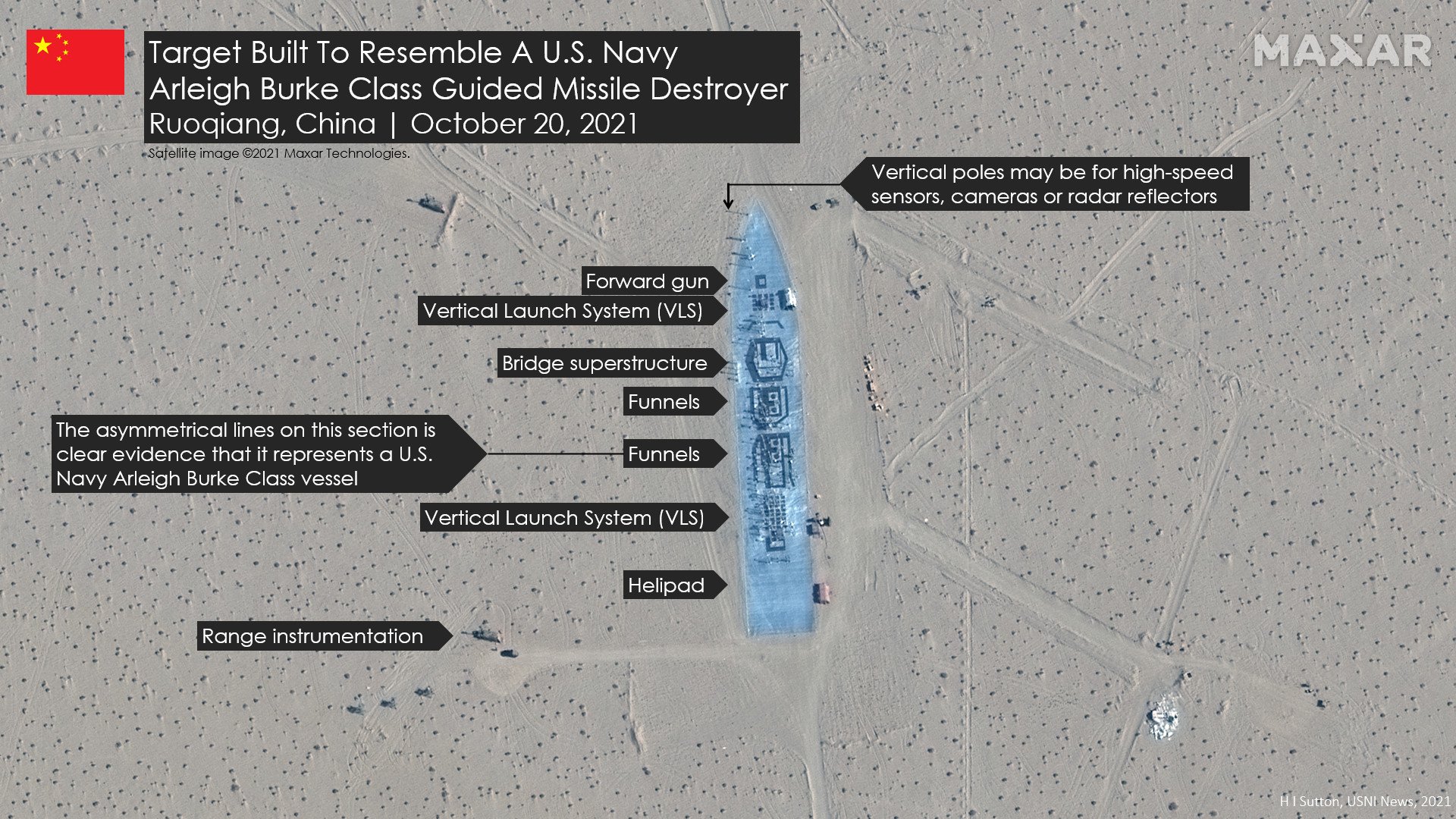
A target in the shape of a U.S. Destroyer in the Taklamakan Desert in Central China. H I Sutton Illustration for USNI News Satellite image ©2021 Maxar Technologies Used with Permission

The carrier target itself appears to be a flat surface without the carrier’s island, aircraft lifts, weapons sponsons or other details, the imagery from Maxar shows. On radar, the outline of the carrier stands out from the surrounding desert – not unlike a target picture, according to imagery provided to USNI News by Capella Space.

There are two more target areas representing an aircraft carrier that do not have the metaling, but are distinguishable as carriers due to their outline. But other warship targets appear to be more elaborate. There are numerous upright poles positioned on them, possibly for instrumentation, according to the imagery. Alternatively these may be used for radar reflectors to simulate the superstructure of the vessel.

The facility also has an extensive rail system. An Oct. 9 image from Maxar showed a 75 meter-long target with extensive instrumentation on a 6 meter-wide rail.
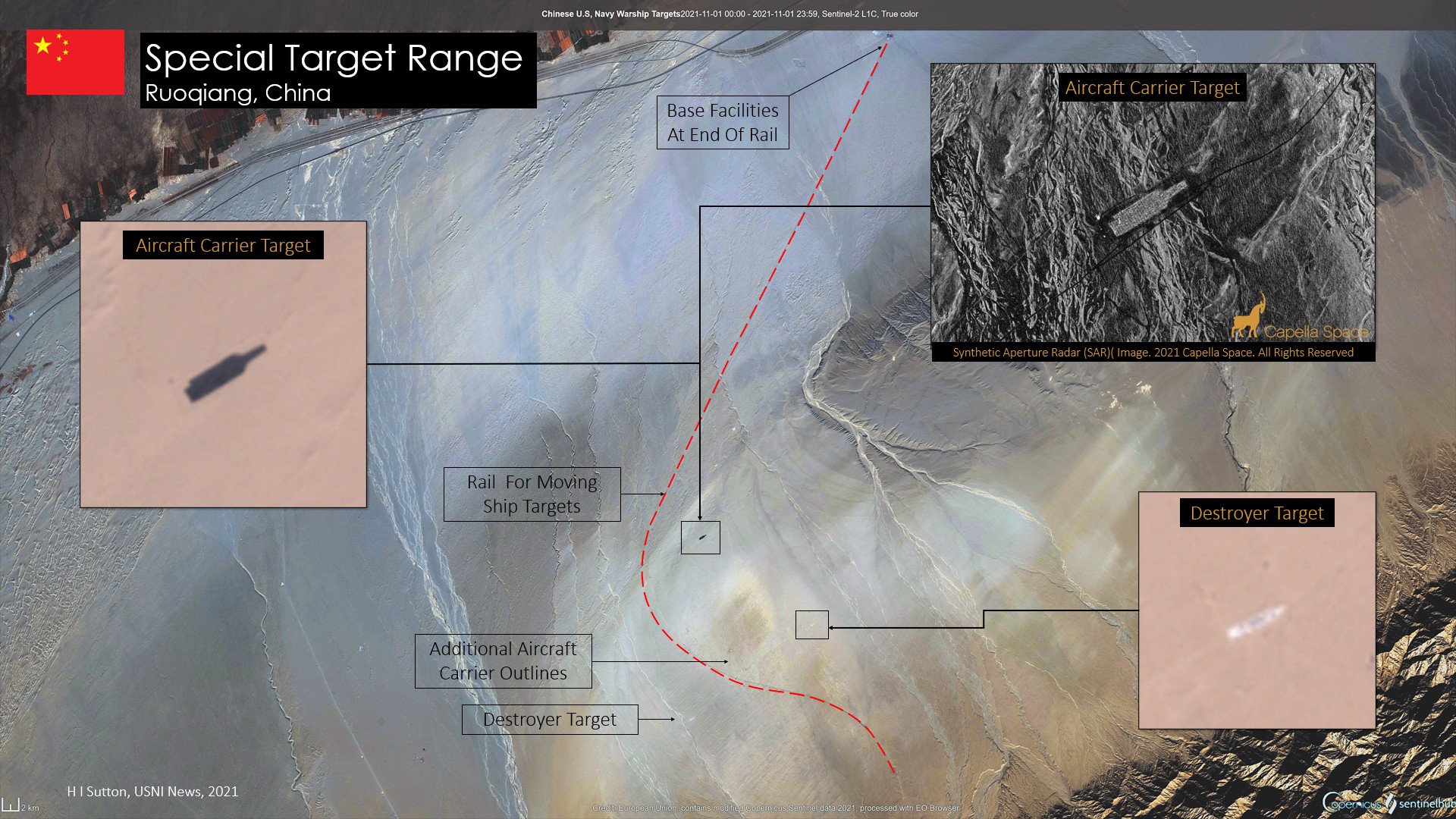
Target range in the Taklamakan desert in Central China. H I Sutton illustration for USNI News

The area has been traditionally used for ballistic missile testing, according to a summary of the Maxar images by geospatial intelligence company AllSource Analysis that identified the site from satellite imagery.

“The mockups of several probable U.S. warships, along with other warships (mounted on rails and mobile), could simulate targets related to seeking/target acquisition testing,” according to the AllSource Analysis summary, which said there are no indications of weapon impact areas in the immediate vicinity of the mockups. “This, and the extensive detail of the mockups, including the placement of multiple sensors on and around the vessel targets, it is probable that this area is intended for multiple uses over time.“

Analysis of historical satellite images shows that the carrier target structure was first built between March and April of 2019. It underwent several rebuilds and was then substantially dismantled in December 2019. The site came back to life in late September of this year and the structure was substantially complete by early October.
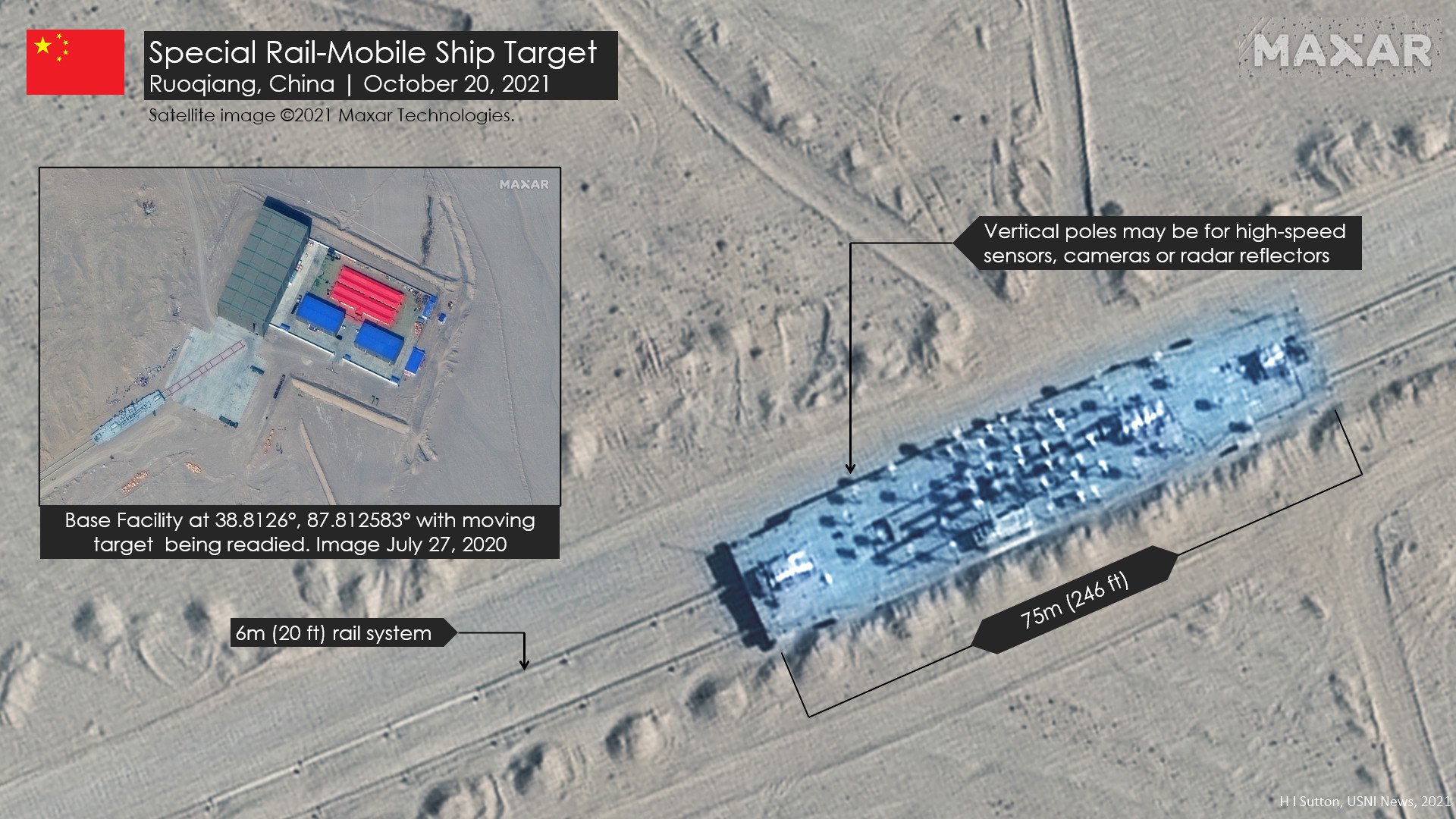
Detailed Photos of the mobile target at the Ruoqiang facility. H I Sutton Illustration for USNI News Satellite image ©2021 Maxar Technologies Used with Permission

China has several anti-ship ballistic missile programs overseen by the People’s Liberation Army Rocket Force. The land-based CSS-5 Mod 5 (DF-21D) missile has a range of over 800 nautical miles. It has a maneuverable reentry vehicle (MaRV) to target ships. The larger CSS-18 (DF-26) has a range of around 2,000 nautical miles.

“In July 2019, the PLARF conducted its first-ever confirmed live-fire launch into the South China Sea, firing six DF-21D anti-ship ballistic missiles into the waters north of the Spratly Islands,” according to the Pentagon’s latest annual report on China’s military. The Chinese are also fielding a longer range anti-ship ballistic missile that initially emerged in 2016.

“The multi-role DF-26 is designed to rapidly swap conventional and nuclear warheads and is capable of conducting precision land-attack and anti-ship strikes in the Western Pacific, the Indian Ocean, and the South China Sea from mainland China. In 2020, the PRC fired anti-ship ballistic missiles against a moving target in the South China Sea, but has not acknowledged doing so,” reads the report.
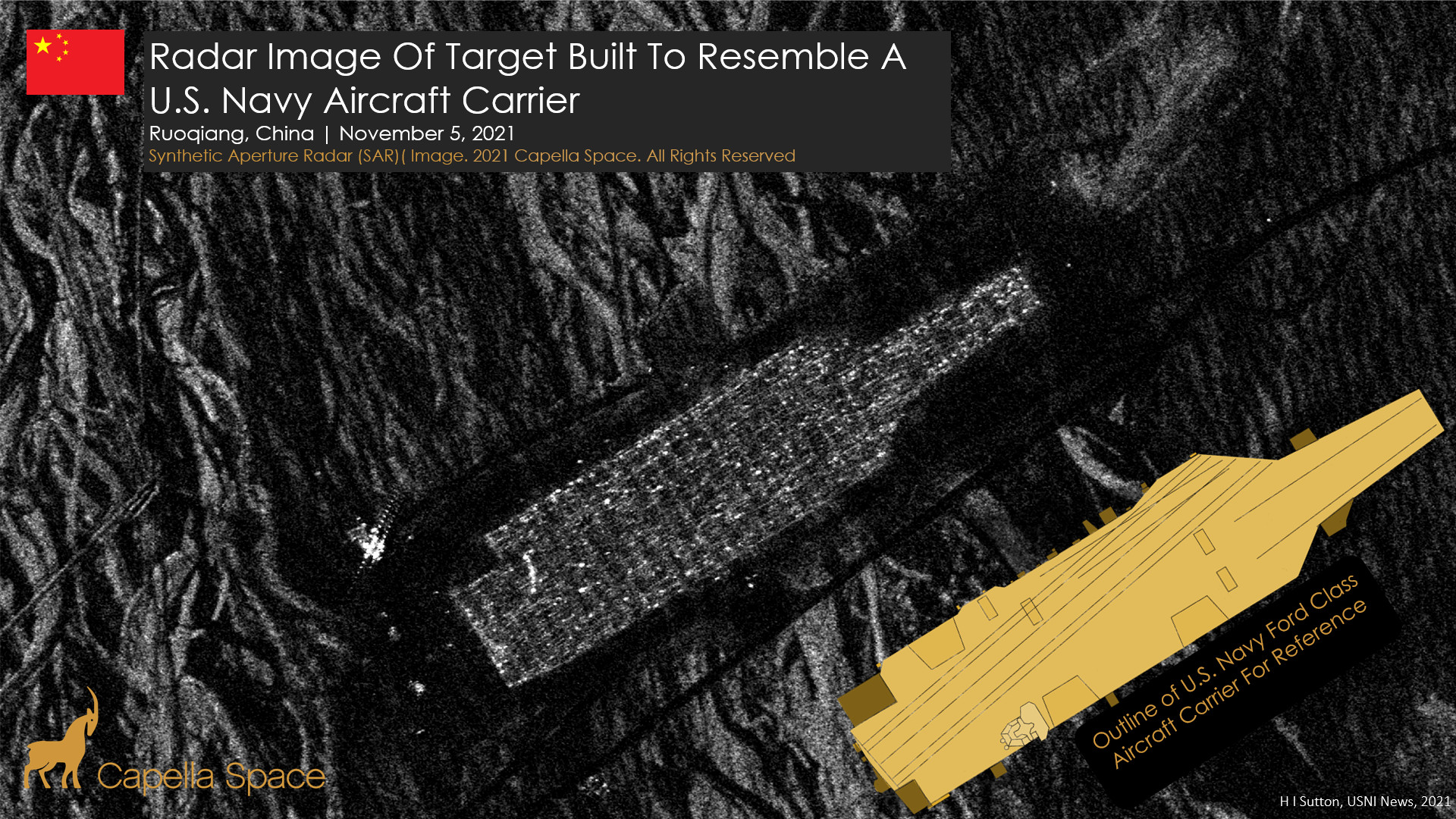
A Nov. 5, 2021 Capella Space synthetic aperture radar image of the target in the shape of a U.S. aircraft carrier in the Taklamakan Desert H I Sutton Illustration for USNI News

In addition to the land-based anti-ship ballistic missiles, China has a program to equip the People’s Liberation Army Navy H-6 bombers with a massive anti-ship ballistic missile. First revealed in 2018, the CH-AS-X-13 will likely be the largest air-launched missile in existence, and would be large enough to accommodate a hypersonic warhead.

Another possible launch platform for anti-ship ballistic missiles is the new Type-055 Renhai Class large destroyer. Described as a guided-missile cruiser, it will be capable of carrying anti-ship ballistic missiles, according to the Pentagon report.

It’s not the first time China has built an aircraft carrier target in the desert. Since 2003, a large concrete pad, roughly the size of a carrier, has been used as a target. The slab, which is part of the Shuangchengzi missile test range, has been hit many times and is frequently repaired. The new site in the Taklamakan desert is 600 miles away and is much more evolved. The newer ship targets are closer approximations of the vessels that they are supposed to represent.
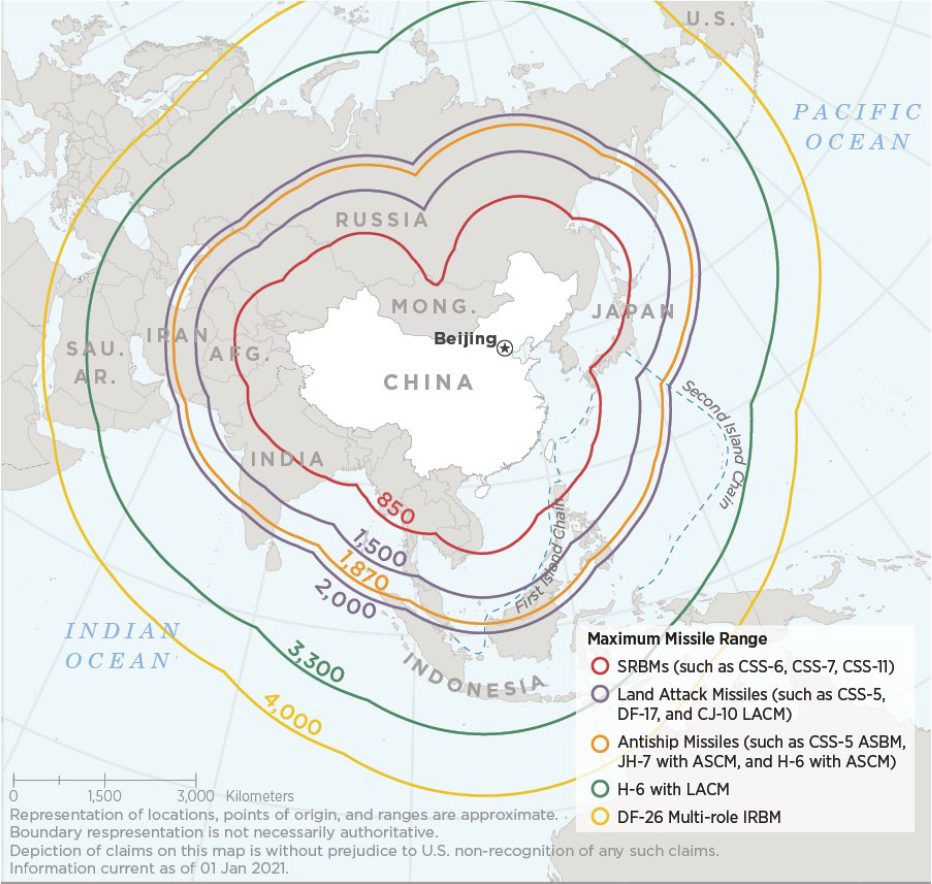
DoD Graphic

While questions remain on the extent of weapons that will be tested at the new facility, the level of sophistication of what can now be seen at the site show the PLA is continuing to invest in deterrents to limit the efficacy of U.S. naval forces close to China – in particular targeting the U.S. carrier fleet.

According to the Pentagon report released last week, a primary objective of the PLARF will be to keep U.S. carriers at risk from anti-ship ballistic missiles throughout the Western Pacific.

Introducing Air-scrubbing Machines of Carbon Dioxide

NEW YORK (AP) — On a field ringed by rolling green hills in Iceland, fans attached to metal structures that look like an industrial-sized Lego project are spinning. Their mission is to scrub the atmosphere by sucking carbon dioxide from the air and storing it safely underground.

Just a few years ago, this technology, known as “direct air capture,” was seen by many as an unrealistic fantasy. But the technology has evolved to where people consider it a serious tool in fighting climate change.

Orca - World's Biggest Carbon Capturing Machine Has Been ...

The Iceland plant, called Orca, is the largest such facility in the world, capturing about 4,000 metric tons of carbon dioxide per year. But compared to what the planet needs, the amount is tiny. Experts say 10 billion tons of carbon dioxide must be removed annually by mid-century.

“Effectively, in 30 years’ time, we need a worldwide enterprise that is twice as big as the oil and gas industry, and that works in reverse,” said Julio Friedmann, senior research scholar at the Center on Global Energy Policy at Columbia University.

RELATED READING: THE BENEFITS OF CARBON DIOXIDE

Leading scientific agencies including the United Nations Intergovernmental Panel on Climate Change say that even if the world manages to stop producing harmful emissions, that still won’t be enough to avert a climate catastrophe. They say we need to suck massive amounts of carbon dioxide out of the air and put it back underground — yielding what some call “negative emissions.”

“We have already failed on climate to the extent to which direct air capture is one of the many things we must do,” Friedmann said. “We have already emitted so many greenhouse gases at such an incredible volume and rate that CO2 removal at enormous scales is required, as well as reduction of emissions.”

As dire warnings have accelerated, technology to vacuum carbon dioxide from the air has advanced. Currently, a handful of companies operate such plants on a commercial scale, including Climeworks, which built the Orca plant in Iceland, and Carbon Engineering, which built a different type of direct air capture plant in British Columbia. And now that the technology has been proven, both companies have ambitions for major expansion. source


DIRECT AIR CAPTURE AT WORK

At Climeworks’ Orca plant near Reykjavik, fans suck air into big, black collection boxes where the carbon dioxide accumulates on a filter. Then it’s heated with geothermal energy and is combined with water and pumped deep underground into basalt rock formations. Within a few years, Climeworks says, the carbon dioxide turns into stone.

It takes energy to build and run Climeworks’ plants. Throughout the life cycle of the Orca plant, including construction, 10 tons of carbon dioxide are emitted for every 100 tons of carbon dioxide removed from the air. Carbon Engineering’s plants can run on renewable energy or natural gas, and when natural gas is used, the carbon dioxide generated during combustion is captured.

Carbon dioxide can also be injected into geological reservoirs such as depleted oil and gas fields. Carbon Engineering is taking that approach in partnership with Occidental Petroleum to build what’s expected to be the world’s largest direct air capture facility in the Southwest’s Permian Basin — the most productive U.S. oil field.

Direct air capture plants globally are removing about 9,000 tons of carbon dioxide from the air annually, according to the International Energy Agency.

Climeworks built its first direct air capture plant in 2017 in Hinwil, Switzerland, which captured 900 metric tons of carbon dioxide annually that was sold to companies for use in fizzy beverages and fertilizer. The company built another plant, called Artic Fox, in Iceland that same year; it captured up to 50 metric tons of carbon dioxide annually that was injected underground.

“Today we are on a level that we can say it’s on an industrial scale, but it’s not on a level where we need to be to make a difference in stopping climate change,” said Daniel Egger, chief commercial officer at Climeworks.

BIG PLANS, CHALLENGES

Their plans call for scaling up to remove several million metric tons of carbon dioxide annually by 2030. And Eggers said that would mean increasing capacity by a factor of 10 almost every three years.

It’s a lofty, and expensive, goal.

Estimates vary, but it currently costs about $500 to $600 per ton to remove carbon dioxide using direct air capture, said Colin McCormick, chief innovation officer at Carbon Direct, which invests in carbon removal projects and advises businesses on buying such services.

As with any new technology, costs can decrease over time. Within the next decade, experts say, the cost of direct air capture could fall to about $200 per ton or lower.

For years, companies bought carbon offsets by doing things like investing in reforestation projects. But recent studies have shown many offsets don’t deliver the promised environmental benefits. So McCormick said companies are looking for more verifiable carbon removal services and are investing in direct air capture, considered the “gold standard.”

“This is really exploding. We really didn’t see hardly any of this until a couple of years ago,” he said, referring to companies investing in the technology. “Two years ago Microsoft, Stripe and Shopify were really the leaders on this who first went out and said, ‘We want to procure carbon dioxide removal from the atmosphere.’”

Companies are setting targets of net zero carbon emissions for their operations but can only reduce emissions so far. That’s where purchasing carbon removal services such as direct air capture comes in.

Individuals can buy atmosphere-scrubbing services too: Climeworks offers subscriptions starting at $8 a month to people who want to offset emissions.

In the U.S., direct air capture facilities can get a tax credit of $50 a ton, but there are efforts in Congress to increase that to up to $180 a ton, which if passed, could stimulate development.

The Department of Energy announced Friday a goal to reduce the cost of carbon removal and storage to $100 per metric ton, saying it would collaborate with communities, industry and academia to spur technological innovation.

Oil companies such as Occidental and Exxon have been practicing a different form of carbon capture for decades. For the most part, they are taking carbon dioxide emissions from production facilities and injecting it underground to shake loose more oil and gas from between rocks.

Some question the environmental benefits of using captured CO2 to produce more fossil fuels that are eventually burned, producing greenhouse gases. But Occidental says part of the goal is to make products such as aviation fuel with a smaller carbon footprint — since while producing the fuel, they’re also removing carbon dioxide from the air and storing it underground.

Capturing carbon dioxide from oil and gas operations or industrial facilities such as steel plants or coal-burning power plants is technically easier and less costly than drawing it from the air, because plant emissions have much more highly concentrated CO2.

Still, most companies are not capturing carbon dioxide that leaves their facilities.

Worldwide, industrial facilities capturing carbon dioxide from their operations had a combined capacity to capture 40 million tons annually, triple the amount in 2010, according to the International Energy Agency.

But that’s less than 1% of the total emissions that could be captured from industrial facilities globally, said Sean McCoy, assistant professor in the department of chemical and petroleum engineering at the University of Calgary.

If governments created policies to penalize carbon dioxide emissions, that would drive more carbon removal projects and push companies to switch to lower-carbon fuels, McCoy said.

“Direct air capture is something you get people to pay for because they want it,” he said. “Nobody who operates a power plant wants (carbon capture and storage). You’re going to have to hit them with sticks.”

___

Associated Press reporter Jamey Keaten contributed from Geneva.

Democrat Legislation is Remaking American using MMT

Government Jobs for Everyone….consider this –>

Modern Monetary Theory (MMT) is a heterodox macroeconomic framework that says monetarily sovereign countries like the U.S., U.K., Japan, and Canada, which spend, tax, and borrow in a fiat currency that they fully control, are not operationally constrained by revenues when it comes to federal government spending. MMT was pioneered by American economist and theorist Warren Mosler in 1992, along with Bill Mitchell, a university professor based in Australia and a key developer of the theory.

Modern Monetary Theory & Why Central Banks are lost in the ...

AIER: Modern Monetary Theory (MMT) offers some unconventional policy recommendations based on the United States’ monetary sovereignty. MMT proponents also advocate government guaranteed jobs paying a living wage for all Americans. What would be the consequences of such a guarantee?

The Public Service Employment program detailed in a 2018 paper from the Levy Economics Institute would be funded by Washington and administered by states. It would offer full and part-time jobs paying $15 per hour plus benefits. The program’s spending would be mandatory, like other entitlement programs. The jobs would “provide public services in nonprofit community organizations, public schools, and state and local governments.”

The program could accomplish three distinct ends. The first is stabilizing aggregate demand during economic downturns. The second is instituting work-relief in place of cash assistance. The third is implementing a “living wage” for all Americans.

When the economy slips into recession, businesses lay off some workers and cut others’ wages. Reductions in these workers’ spending produce second-round (and third-round) effects: landlords, for example, cut back their spending after not receiving rent. Many economists support macroeconomic stabilization.

Stabilization works much better when automatic. Discretionary stabilization spending, like 2009’s American Recovery and Reinvestment Act, can take months to enact. Laid off workers can start a guaranteed government job immediately.

Today unemployed workers receive cash assistance. While I do not advocate government make-work jobs, work-relief has two advantages over cash assistance. First, work requirements effectively control fraud, as revealed by the 1990s welfare reforms. People working while on the welfare rolls never showed up for mandatory job training.

Work-relief also denies recipients the leisure of staying home. People will compare the full value of their options. Suppose a person values the freedom of not working at $30,000 a year. If they also receive $10,000, only a $20 per hour job matches the full value of the cash assistance.

The MMT jobs program also implements a living wage providing a “just” level of compensation. Economics shows how workers in a competitive labor market get paid the value they create for businesses. The “problem” of low wages is then inadequate job skills.

The living wage is redistribution disguised as work. Market wages and salaries are not charity; the prices customers willingly pay for goods and services cover workers’ pay. Market-based salaries come entirely from voluntary payment and workers earn their pay by helping produce goods and services.

Guaranteed jobs effectively set a minimum wage because few Americans will work for businesses offering worse compensation packages (wages and benefits). Government jobs would be far more effective in assisting low-wage workers because a minimum wage ends up pricing many out of the labor market altogether.

Government jobs paying $15 an hour plus benefits would likely cost $40,000 per job annually. MMT proponents project 15 million government jobs would be needed even when the economy is strong. MMT can advocate such a budget-busting program because in its view monetary sovereignty renders Federal spending costless under most circumstances.

The biggest potential problem with the jobs guarantee, even at a lower wage, is whether people will have to work. What exactly is a government “guaranteed job?” The term job suggests a person must work satisfactorily or be fired. The guarantee suggests anyone fired must then be given another position.

Government guaranteed no-show jobs would blow up the labor market. If you had a “job” paying $30,000 plus benefits not requiring work, how much would you need to be paid to take a real job? Guaranteed $15 per hour no-show jobs would effectively be a $30 or $40 per hour minimum wage.

The United States is prosperous because we produce goods and services people want in large quantities. Yet production requires real work, not government make-work jobs. By diverting millions out of productive private sector jobs, the MMT jobs guarantee seems guaranteed to impoverish America.

About that Drone Attack on the Pennsylvania Power Grid

The Drive: U.S. officials believe that a DJI Mavic 2, a small quadcopter-type drone, with a thick copper wire attached underneath it via nylon cords was likely at the center of an attempted attack on a power substation in Pennsylvania last year. An internal U.S. government report that was issued last month says that this is the first time such an incident has been officially assessed as a possible drone attack on energy infrastructure in the United States, but that this is likely to become more commonplace as time goes on. This is a reality The War Zone has sounded the alarm about in the past, including when we were first to report on a still unexplained series of drone flights near the Palo Verde nuclear powerplant in Arizona in 2019.

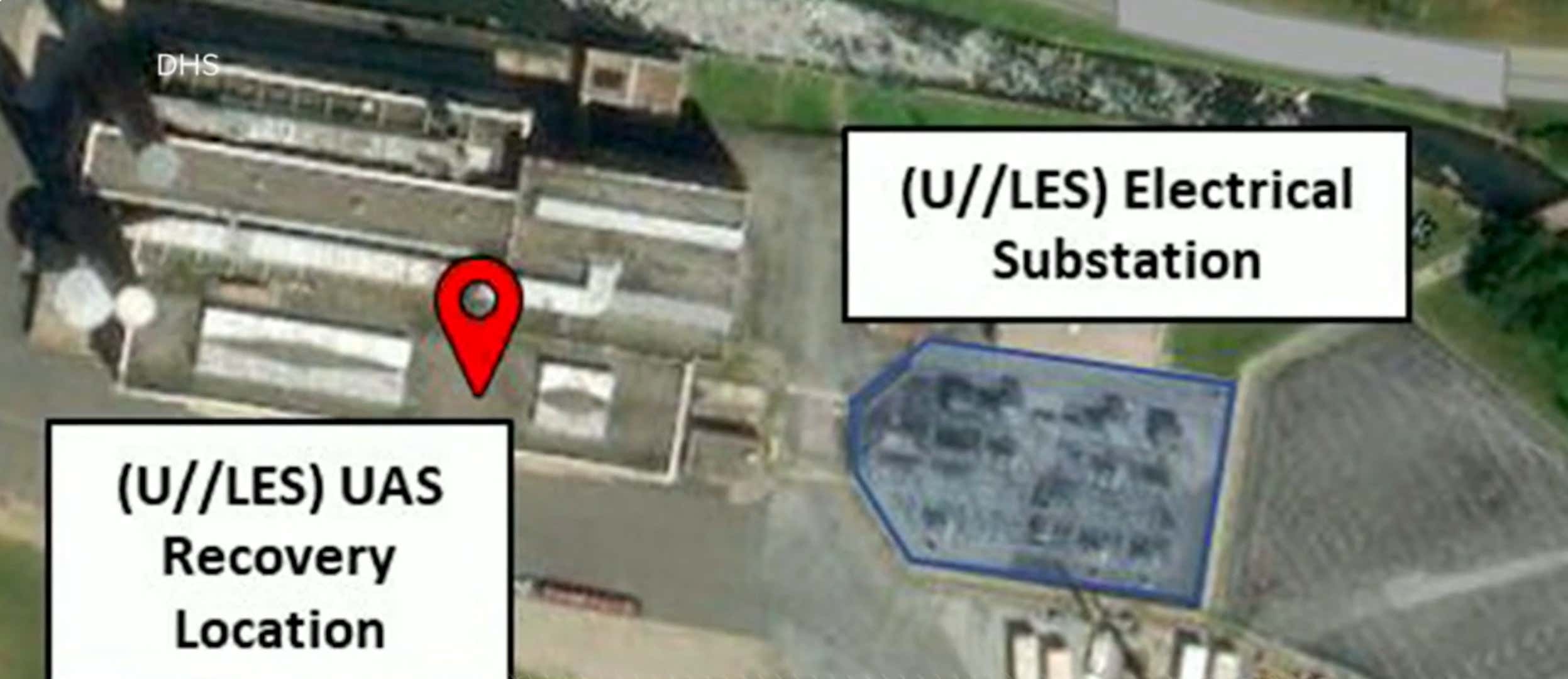
ABC News was first to report on the Joint Intelligence Bulletin (JIB) covering the incident in Pennsylvania last year, which the Department of Homeland Security (DHS), Federal Bureau of Investigation (FBI), and the National Counterterrorism Center (NCTC) published on Oct. 28, 2021. The document, which ABC obtained a copy of, but only released a small portion of, is marked unclassified, but parts also labeled Law Enforcement Sensitive (LES) and For Official Use Only (FOUO). Other outlets have since obtained copies of this document, which reportedly says that this likely attack took place on July 16, 2020, but does not identify where the substation in question was located.


DHS via ABC News

RELATED READING: FBI Strategic Intelligence/Assessment on Domestic Terrorism

A portion of an annotated satellite image from a US Joint Intelligence Bulletin regarding a likely attempted drone attack on a power substation in Pennsylvania in 2020.

“This is the first known instance of a modified UAS [unmanned aerial system] likely being used in the United States to specifically target energy infrastructure,” the JIB states. “We assess that a UAS recovered near an electrical substation was likely intended to disrupt operations by creating a short circuit to cause damage to transformers or distribution lines, based on the design and recovery location.”

ABC and other outlets have reported that the JIB says that this assessment is based in part on other unspecified incidents involving drones dating back to 2017. As already noted, The War Zone previously reported on another worrisome set of incidents around Arizona’s Palo Verde Generating Station, the largest nuclear power plant in the United States in terms of its output of electricity, in 2019. In the process of reporting that story, we uncovered other reported drone flights that prompted security concerns near the Limerick Generating Station nuclear power plant in Pennsylvania earlier that year.

The Night A Mysterious Drone Swarm Descended On Palo Verde Nuclear Power Plant By Tyler Rogoway and Joseph Trevithick Posted in The War Zone
Here’s What’s In New Guidelines For Defending Infrastructure Against Drone Attacks By Brett Tingley Posted in The War Zone
The Y-12 Nuclear Development Site Has Deployed Its First Anti-Drone System By Brett Tingley Posted in The War Zone
Some Chinese-Made Drones Cleared By Pentagon For U.S. Government Use By Brett Tingley Posted in The War Zone
Is The United States Firing Off “Electricity Bombs” in Syria? By Joseph Trevithick Posted in The War Zone

“To date, no operator has been identified and we are producing this assessment now to expand awareness of this event to federal, state, local, tribal, and territorial law enforcement and security partners who may encounter similarly modified UAS,” the JIB adds.

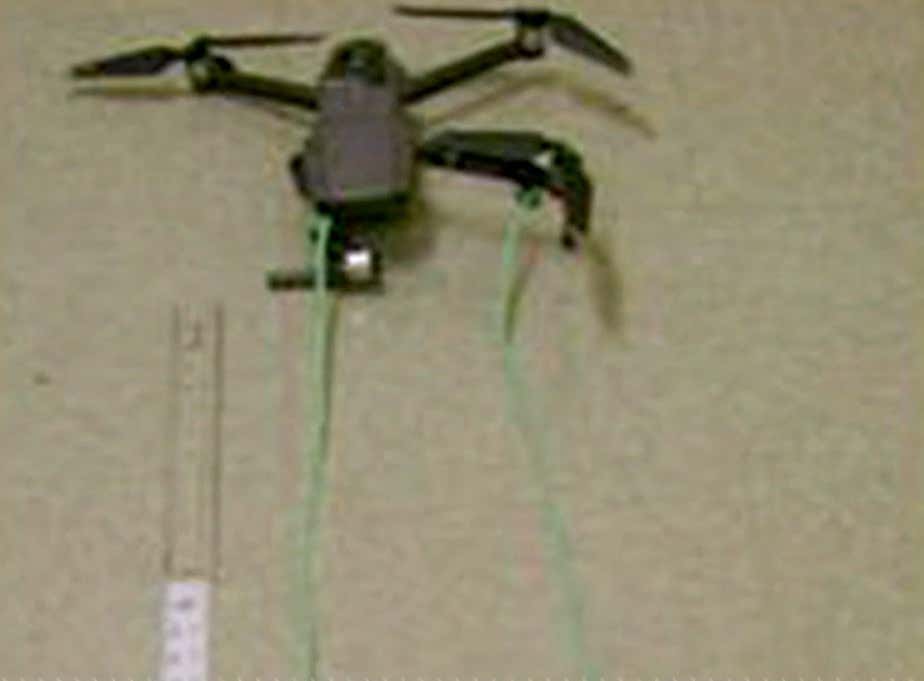
Beyond the copper wire strung up underneath it, the drone reportedly had its camera and internal memory card removed. Efforts were taken to remove any identifying markings, indicating efforts by the operator or operators to conceal the identifies and otherwise make it difficult to trace the drone’s origins.


DHS via ABC News

A low-quality image showing the drone recovered after the likely attempted attack in Pennsylvania. The green lines are the nylon cables. A copper wire was attached to the bottom ends of both lines.

It’s unclear how much of a threat this particular drone posed in its modified configuration. The apparent intended method of attack would appear to be grounded, at least to some degree, in actual science. The U.S. military employed Tomahawk cruise missiles loaded with spools of highly-conductive carbon fiber wire against power infrastructure to create blackouts in Iraq during the first Gulf War in 1991. F-117 Nighthawk stealth combat jets dropped cluster bombs loaded with BLU-114/B submunitions packed with graphite filament over Serbia to the same effect in 1999.

Regardless, the incident only underscores the ever-growing risks that small drones pose to critical infrastructure, as well as other civilian and military targets, in the United States. If this modified drone did pose a real risk, it would also highlight the low barrier to entry to at least attempt to carry out such attacks. New DJI Mavic 2s can be purchased online right now for between $2,000 and $4,000.

The technology is so readily available that non-state actors around the world, from terrorists in the Middle East to drug cartels in Mexico, are already employing commercial quad and hexacopter-type drones armed with improvised explosive payloads on a variety of targets on and off more traditional battlefields. This includes attempted assassinations of high-profile individuals.

The U.S. government is finally coming to terms with these threats and there are certainly some steps being taken, at least at the federal level, to protect civilian and domestic military facilities against small drones. At the same time, it is equally clear that there is still much work to be done.

This particular incident in Pennsylvania last year highlights separate security concerns relating to Chinese-made small drones that are now widely available in the United States and are even in use within the U.S. government. DJI, or Da Jiang Innovations, is by far the largest Chinese drone maker selling products commercially in the United States today and has been at the center of these debates in recent years.

Whether or not the modified Mavic 2 posed a real danger in this instance or if this was truly the first-ever attempted drone attack on energy infrastructure in the United States, it definitely reflects threats are real now and will only become more dangerous as time goes on.